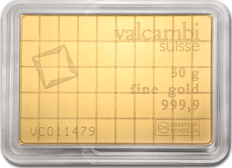
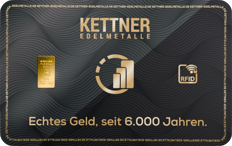
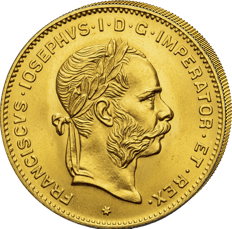
25 x 1g Gold Bar Heimerle und Meule UnityBar
£2,945.31£2,986.96
VAT-free and excl. shipping
Ships from 20/11/2026
 +49 7930-2699

 More than 300,000
 Over 30 years
 Secure shipping
 Google: 4.9/5
Numerous investors buy gold to protect themselves against crises. We have selected special offers for you that you should own in order to protect yourself from the next major crisis and to benefit from the gold price. Here you will find investor packages, gold coins, gold bars, silver coins or silver bars.


In 1923, paper money in Germany lost its value. Week by week, the Statistisches Reichsamt, the statistical office of the Reich, recorded the prices in Berlin, in marks and converted into gold.
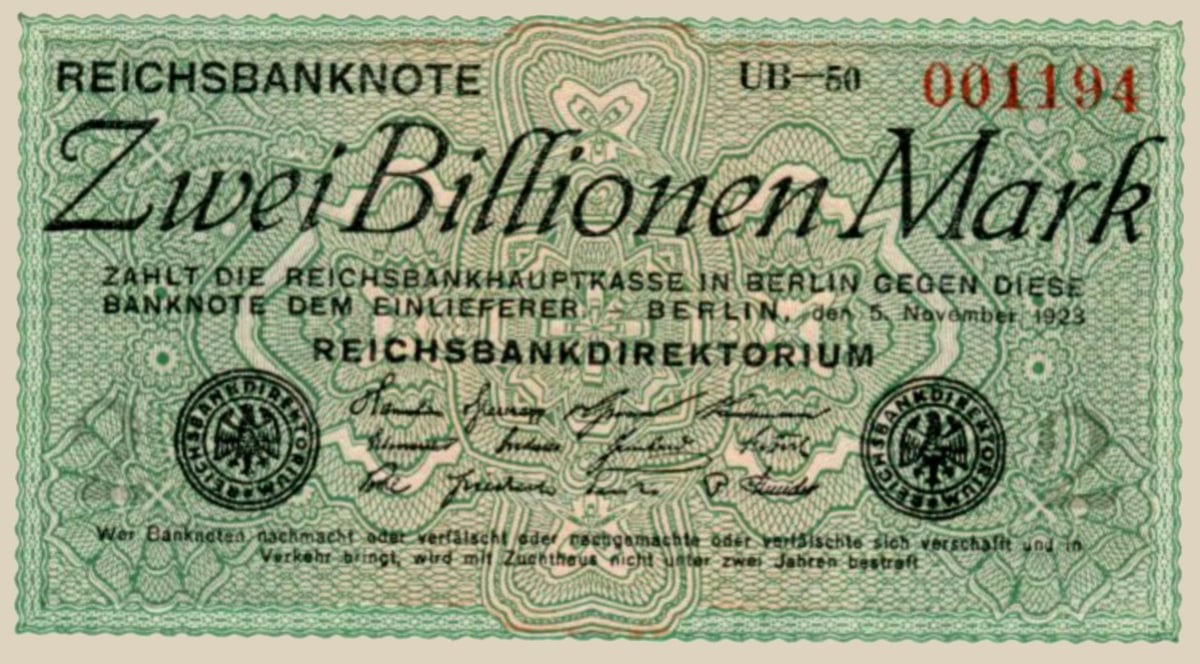
Counted in gold, the price of bread stayed a matter of pfennigs all year, between 2 and 78 pfennigs.
On paper: 233 billion marks. Counted in gold: 39 pfennigs; before the war it was 28.
In marks, the price of bread rose more than a billionfold from 3 January to 19 November.
Statistisches Reichsamt, Zahlen zur Geldentwertung in Deutschland 1914 bis 1923, Berlin 1925. The office converted the prices into gold at the dollar rate in Berlin.
Postage for an inland letter of up to 20 grams. Sources: Statistisches Reichsamt 1925 and Bund Deutscher Philatelisten, the German philatelists’ association.
In the autumn of 1923, more and more prices were stated in gold marks and paid in paper marks. The decree of 15 October 1923 establishing the Deutsche Rentenbank gave the gold value of the gold mark.
“A gold mark … is the value of 1/2790 kilogram of fine gold.”
Verordnung über die Errichtung der Deutschen Rentenbank, § 6 (2), Reichsgesetzblatt 1923, Part I, p. 963 f.
That works out at about 0.36 grams of fine gold per gold mark. From November 1923, one dollar officially equalled 4.20 gold marks, almost exactly as before the war.
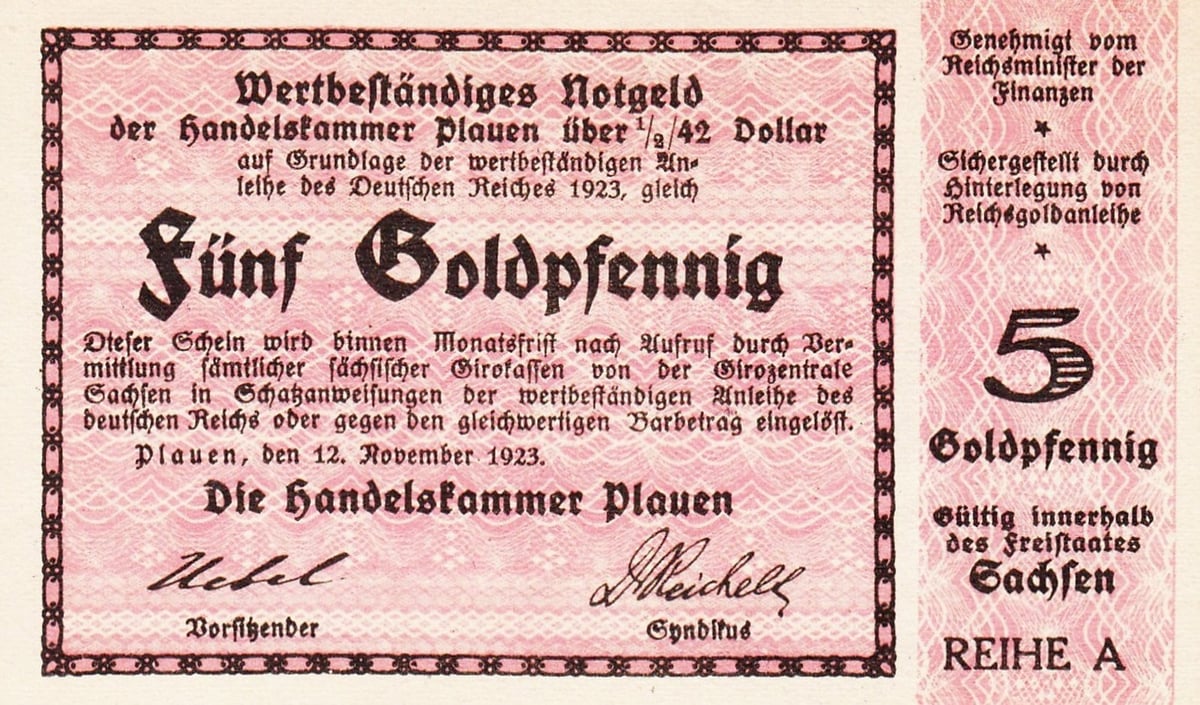
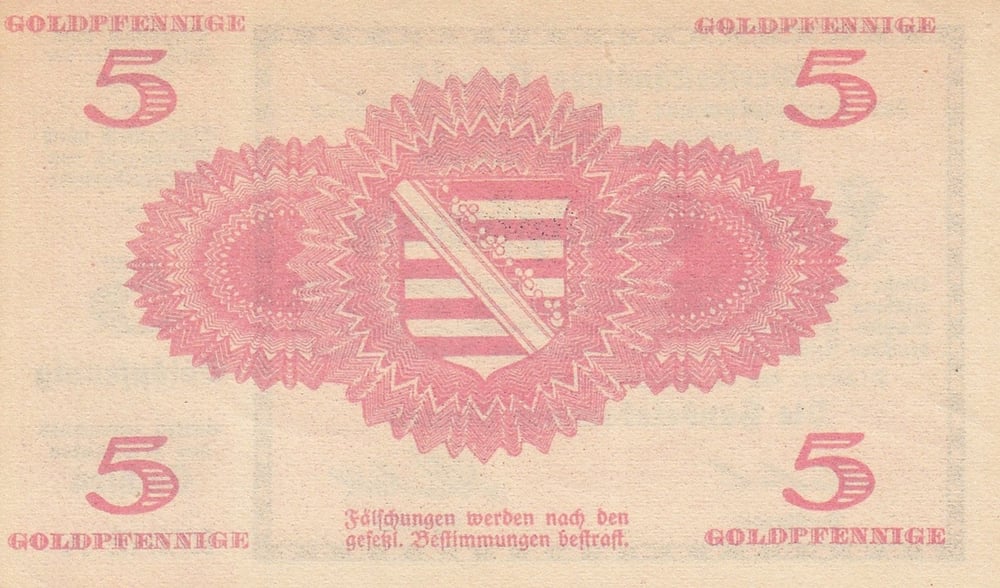
At the end of October 1923, the Reich government permitted value-stable emergency money. It was denominated in gold marks, often with its value in dollars, and backed by bonds of the Reich’s gold loan held on deposit. In the end, more than 2,800 kinds of value-stable notes were in circulation.
The steps are parts of a dollar at 4.20 gold marks. As a rule, an emergency note could not be issued for more than 4.20 gold marks, that is one dollar. Fine gold calculated at 1/2790 kilogram per gold mark.
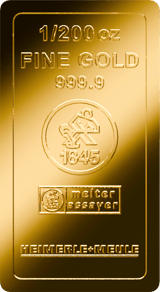 1/200 ounce gold bar1/200 ounce gold barHeimerle + MeuleEdition KettnerFine gold 999.9/1,000
By calculation, a note for 0.42 gold marks corresponded to about 0.15 grams of fine gold. A bar of 1/200 ounce, at about 0.16 grams, contains only a little more.
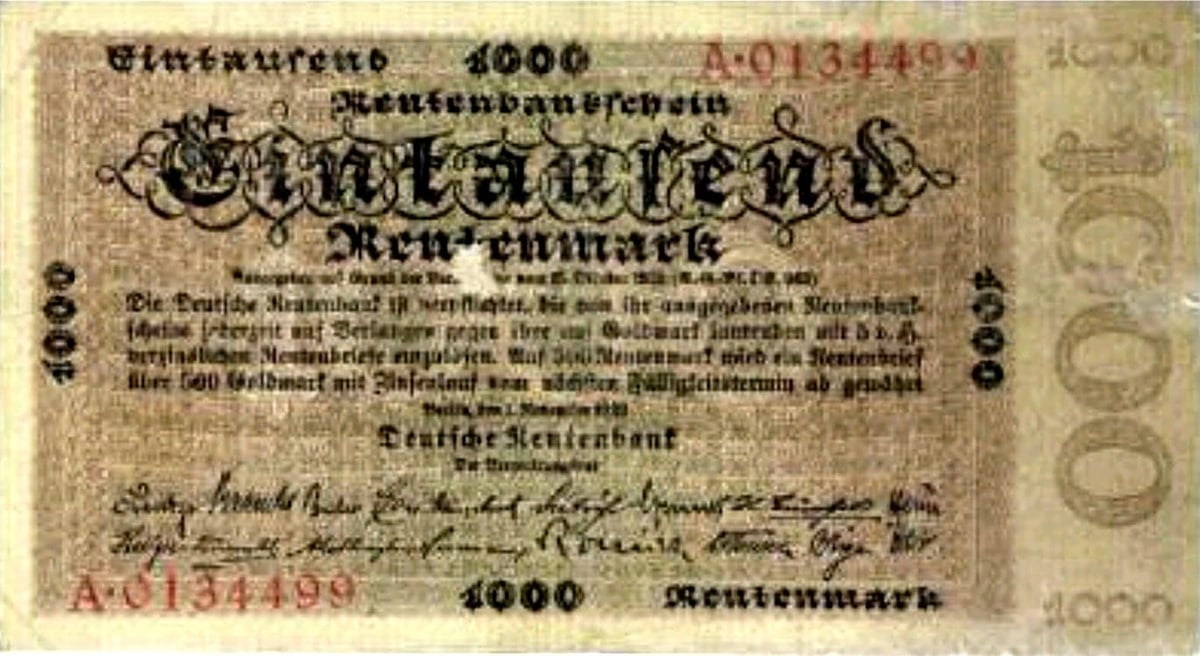
From 15 November 1923, the Deutsche Rentenbank issued a new currency, the Rentenmark. From 20 November, one Rentenmark equalled one trillion paper marks.
The Rentenmark was divided into 100 Rentenpfennig. It was backed by Rentenbriefe, bonds denominated in gold marks and secured on land.
One dollar was worth 4.20 Rentenmarks. On the Berlin exchange it cost 4.2 trillion marks from 20 November.
The Crisis Protection Packages XS to XL by Heimerle + Meule hold gold in five sizes under two grams: 0.1 gram, 1/100 ounce, 0.5 gram, 1 gram and 1/20 ounce.
A troy ounce has 31.1034768 grams. So 1/100 ounce works out at about 0.31 grams and 1/200 ounce at about 0.16 grams.
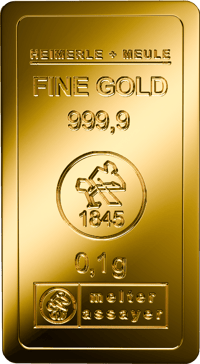 0.1 g gold bar0.1 g gold barHeimerle + MeuleEdition KettnerFine gold 999.9/1,000
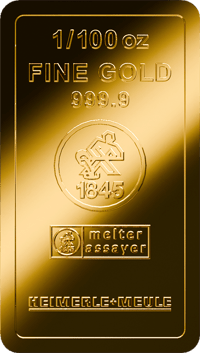 1/100 ounce gold bar1/100 ounce gold barHeimerle + MeuleEdition KettnerFine gold 999.9/1,000
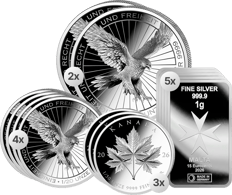
The Kettner Crisis Protection Box holds 12 gold bars and 48 silver bars by Heimerle + Meule. One part gold to four parts silver. The Box XS keeps the same ratio with 4 and 16 bars.
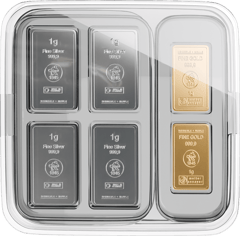 Crisis Protection BoxProtection Box12 × 1 g gold48 × 1 g silverHeimerle + Meule
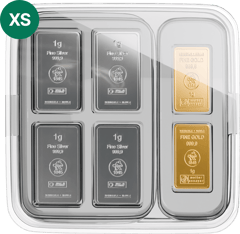 Crisis Protection Box XSProtection Box XS4 × 1 g gold16 × 1 g silverHeimerle + Meule
Under EU law, gold bars with a gold content of at least 99.5 per cent and gold coins with a gold content of at least 90 per cent count as cash, as “commodities used as highly-liquid stores of value”. Regulation (EU) 2018/1672, Article 2 and Annex I
Stay informed with product launches, financial news and exclusive offers. Sign up for our free newsletter today.
By entering your email address and clicking the "Submit" button, you give the following consent: "I agree to be informed by email about new products, financial news and exclusive offers, and therefore consent to the processing of my email address for the purpose of sending the newsletter. I can revoke this consent at any time without giving reasons, with effect for the future. The lawfulness of processing carried out prior to revocation remains unaffected."