Only 1 left to order
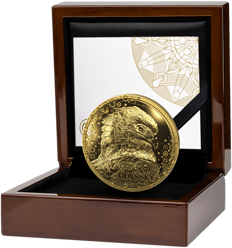
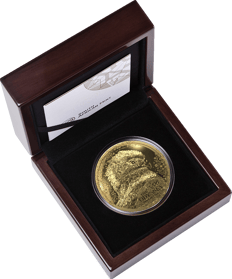
1 oz Gold Odyssey of the Sky Bateleur Eagle 2025 (Mintage: 500 | Proof)
£4,989.33
VAT-free and excl. shipping
Available in 2–3 business days

 More than 300,000
 Over 30 years
 Secure shipping
 Google: 4.9/5


Paris, 1799
The naturalist François Levaillant was at the Cape from 1781 to 1784 and brought back more than 2,000 specimens, mostly birds. His work on the birds of Africa appeared in instalments from 1796, with copperplate engravings printed in colour. In it, he explains the Bateleur’s name himself.
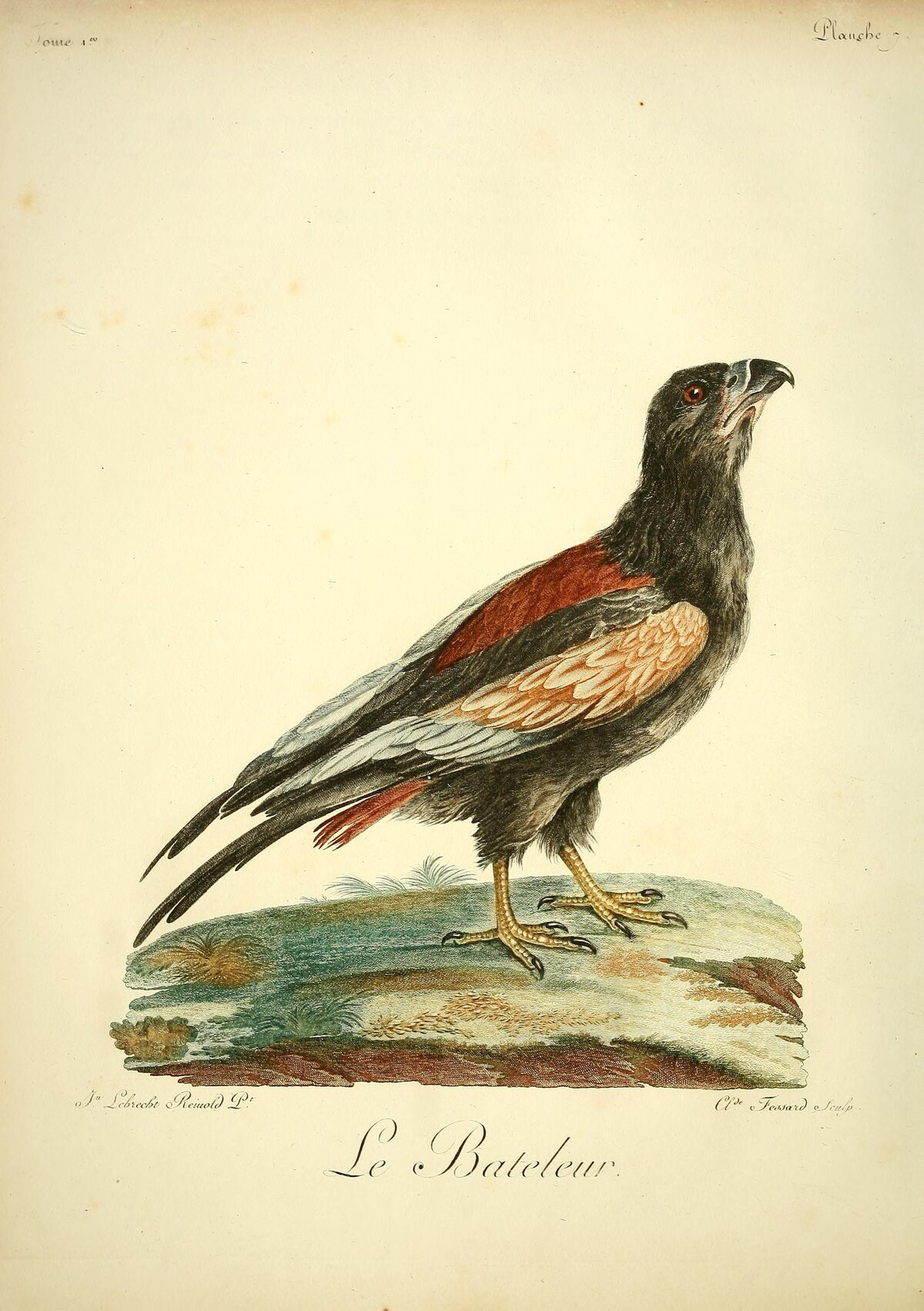
François Levaillant, Histoire naturelle des oiseaux d’Afrique, Volume 1, Paris 1799“I took the name of this bird from its way of playing in the air. One would indeed take it for an acrobat performing feats of strength to amuse the spectators.”
“J’ai tiré le nom de cet oiseau de sa manière de se jouer dans les airs: on diroit, en effet, un bateleur qui fait des tours de force pour amuser les spectateurs.”
He also saw the bird suddenly drop, as if it had broken a wing. Today BirdLife International describes its gliding flight like this: it tilts its wings from side to side, as if trying to find its balance.
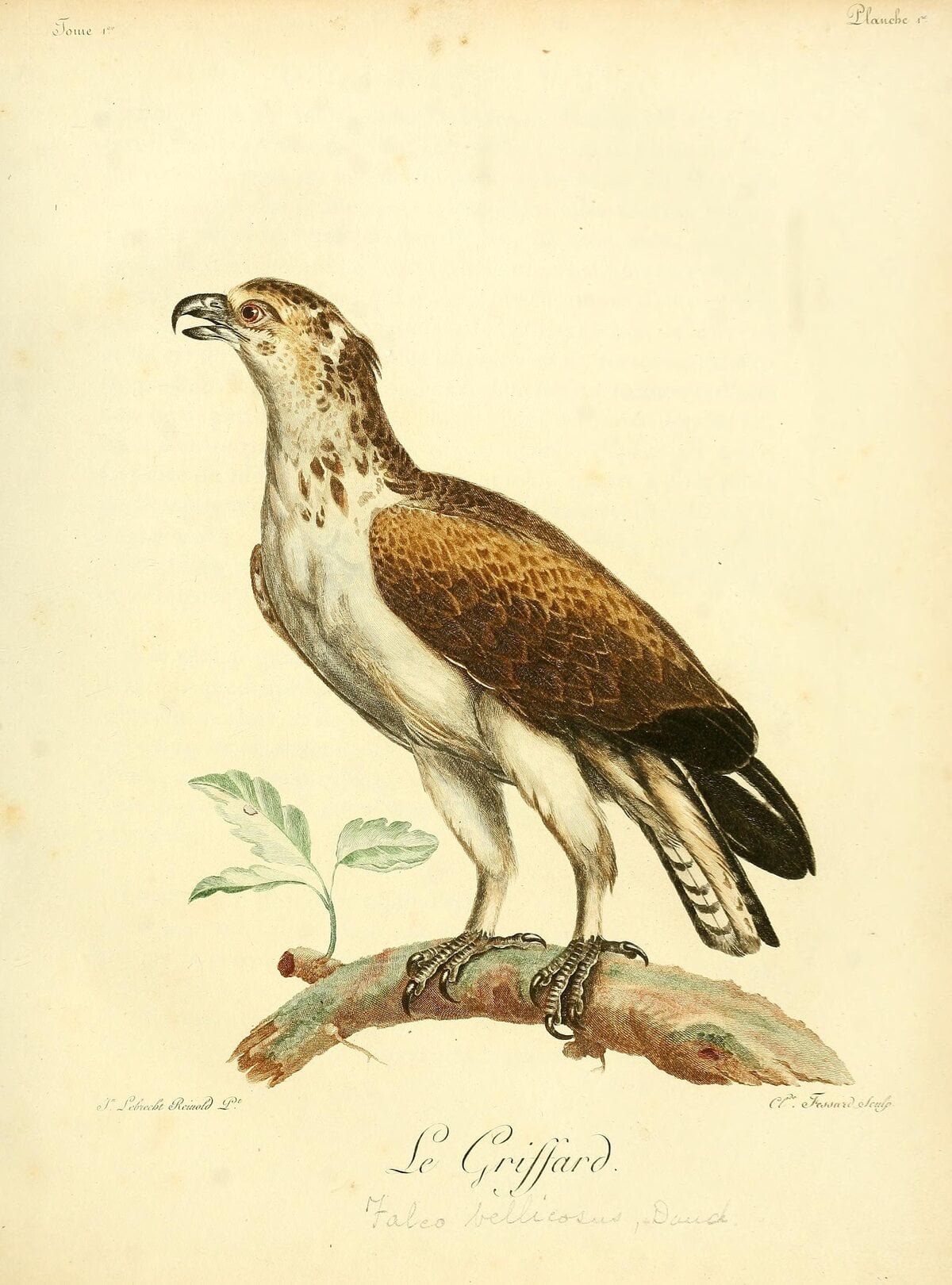
Levaillant writes that it is about the size of the Golden Eagle but has longer legs and stronger talons. The zoologist François Marie Daudin described the species in 1800 based on Levaillant’s work and gave it the name bellicosus, Latin for warlike.
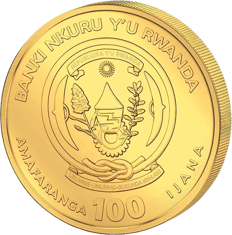
The coat of arms side
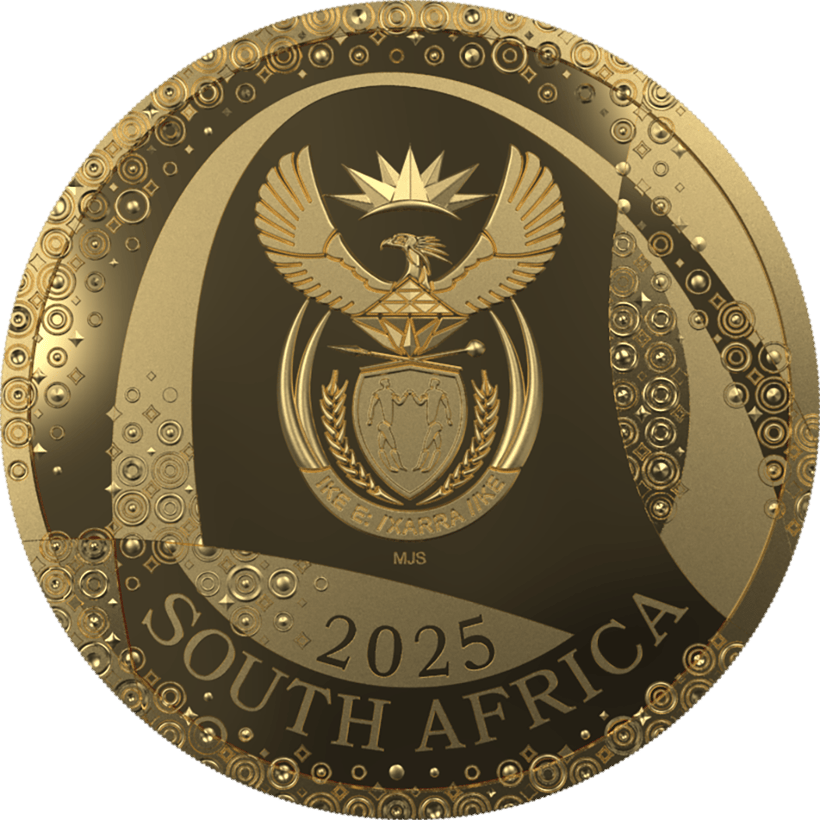
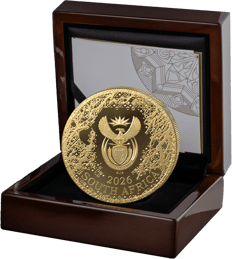
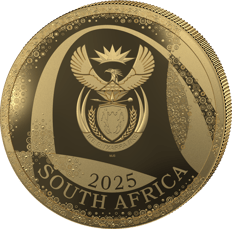
On the other side is the national coat of arms of South Africa, official since 27 April 2000. Above the shield, a secretary bird, itself a bird of prey, spreads its wings. According to the government, its raised wings stand for the rise of the nation and at the same time offer it protection.
Both sides of the 2025 coins carry a pattern modelled on Isishweshwe, a cotton print, originally indigo blue, with small white motifs. With it, the mint wants to show the bond between people and nature.
According to the South African National Gallery in Cape Town, German missionaries and traders brought their blue-printed cloth to the Eastern Cape in the middle of the 19th century.
The gold coins
In gold, the series shows the birds’ heads, as close up as in a portrait.
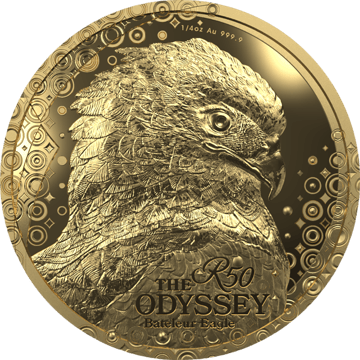
Terathopius ecaudatus
The scientific name means “marvellous face, tailless”.
Black plumage, a chestnut back, face and legs bright red. The mint chose it for its shape and its colourful plumage.
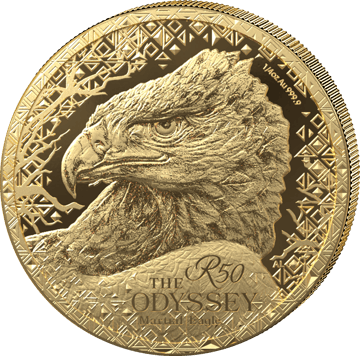
Polemaetus bellicosus
The scientific name means “war eagle, warlike”.
One of Africa’s largest eagles: dark brown above, pale below with brown spots, the eyes yellow. The females are considerably larger than the males.
Since 2020, both species have been considered endangered worldwide. Fewer than 1,000 mature Bateleurs live in South Africa, and BirdLife South Africa named it Bird of the Year 2024.
Sources: The Peregrine Fund, BirdLife International, BirdLife South Africa, San Diego Zoo Wildlife Alliance, South African MintSeven coins per year
The 2025 and 2026 issues came out in the same seven sizes, all in proof quality. The heaviest coins are the scarcest: 50 coins of 5 ounces of gold, 100 of one kilogram of silver.
| Available from us | |||
|---|---|---|---|
| Coin | Mintage | Bateleur2025 | Martial Eagle2026 |
| 1/4 ounce goldR50, 22 mm, 1,000 coins | 1,000 coins |  | 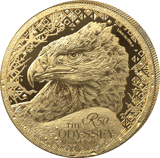 |
| 1 ounce goldR100, 32.69 mm, 500 coins | 500 coins | 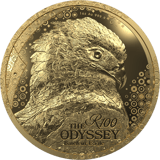 | 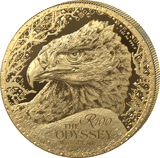 |
| 5 ounces goldR200, 50 mm, 50 coins | 50 coins | 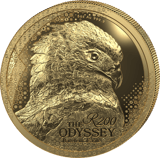 | not available |
| 1 ounce silverR5, 38.725 mm, 5,000 coins | 5,000 coins | not available | not available |
| 2 ounces silverR10, 50 mm, 5,000 coins | 5,000 coins | not available | not available |
| 5 ounces silverR20, 64 mm, 500 coins | 500 coins | not available | not available |
| 1 kilogram silverR50, 100 mm, 100 coins | 100 coins | not available | not available |
Face value in rand, figures from the South African Mint for 2025 and 2026
For 2026 the mint is issuing two sets, each pairing an Odyssey coin with a Krugerrand: 1,000 in silver, 500 in gold. The Krugerrand in each set bears a small Martial Eagle as a Privy Mark, and this Krugerrand is only available in the sets. A Privy Mark is an additional mark on an otherwise unchanged coin design.
The first Krugerrand was made jointly by the South African Mint and the Rand Refinery on 3 July 1967.
The South African Mint has announced seven annual issues, each with a bird of Africa. It has not yet made public which birds will follow the Martial Eagle.
There are gold coins that you buy, and there are those that you admire. The Odyssey of the Sky series from the renowned South African Mint belongs to the latter category: it literally rises into the skies and, after decades devoted to African land fauna, turns for the first time to the continent's majestic birds of prey. Struck in Proof, with a mirrored field and deep relief, these gold coins combine the sober value of fine gold with the emotional power of a small work of art. This guide sheds light on the origin, designs, denominations, authenticity, tax treatment and storage of the series.
The Odyssey of the Sky is a comparatively young collector series, whose first chapter appeared in 2025 with the Bateleur Eagle (known in German as Gaukler). For decades, South African minting programmes had placed the animals of the savannah at the centre: the elephant, the lion or the rhinoceros. With this new series, the mint consistently turns its gaze skyward for the first time, paying tribute to Africa's birdlife. Each issue puts a different bird of prey centre stage, telling a continuing story piece by piece: a true odyssey through the skies of the continent.
The gold issues are struck from 999.9 fine gold in Proof, the highest collector quality. This places the series within the sophisticated spectrum of modern collector's items, which also includes classic bullion favourites such as the Krugerrand or internationally sought-after themed coins such as the Somalia Elephant. Anyone wishing to explore the full range of South African and African minting artistry will find an overview of related series in the gold coins section.
Behind the series stands the South African Mint, founded in 1890 and thus one of the oldest and most respected mints in the world. It became famous above all for the Krugerrand, the most widely traded investment gold coin of all. Kettner Edelmetalle is the official German partner of the South African Mint, meaning the Odyssey issues come directly from the source. This provenance is not only a matter of prestige but also of reliability: the coins are delivered with a numbered certificate of authenticity.
The heart of every issue is the eagle design. The reverse shows the respective bird of prey in finely chiselled engraving, set within traditional South African Isishweshwe ornamentation, those characteristic fabric print patterns deeply rooted in the country's cultural heritage. In this way, animal portrait and culture merge into an unmistakable work of art. The obverse bears the national coat of arms of the Republic of South Africa, the year of issue and the face value in South African rand, an official legal tender of the Republic of South Africa.
The first chapter was dedicated to the Bateleur Eagle, known in German as Gaukler. This spectacular bird of prey from sub-Saharan Africa reaches a wingspan of up to 190 cm and impresses with acrobatic, almost dance-like flight manoeuvres, which is also the origin of its French-derived name, meaning something like juggler or tightrope walker. The debut issue appeared in several denominations, ranging from small fractional ounces to rare large formats with a particularly low mintage.
The second chapter puts the Martial Eagle (Kampfadler) in the spotlight, the largest and most powerful bird of prey in Africa. It has long been regarded as a symbol of strength, vision and freedom. In Proof condition, every detail of the plumage comes into its own: deeply mirrored fields meet velvety frosted relief areas. Related in theme are series that likewise celebrate African wildlife, such as the Big Five Gold series or the African Safari issues.
After decades on the ground, the South African Mint takes off for the first time with Odyssey of the Sky, turning the African sky into a stage of pure gold.
The series is available in several weight classes, so that both newcomers and ambitious collectors can find a suitable variant. Besides the format, the decisive factor for desirability is above all the mintage: the smaller it is, the greater the collector appeal tends to be.
All issues are struck in Proof (PP) quality. For this, the mint uses hand-selected blanks, polished dies and multiple strikes, an elaborate process that creates the characteristic contrast between mirror-like gloss and frosted design. Anyone who prefers smaller denominations will also find thematically suitable fractional-ounce formats among classic bullion series such as the Krugerrand or the Australian Kangaroo gold coins.
With high-quality collector coins, authenticity is a key topic. The Odyssey issues offer several points of reference at once:
Kettner Edelmetalle relies on ISO-compliant authenticity verification and supplies exclusively original goods direct from the mint. For safe storage at home, suitable coin capsule accessories are recommended, protecting the sensitive surface from scratches and fingerprints.
A significant advantage of gold coins is their tax status. Investment gold is exempt from VAT in Germany, unlike many silver coins, which are subject to the margin scheme. Gold coins such as those in the Odyssey series are therefore traded VAT free.
Tax notice
Profits from the sale of physical gold are generally tax free after a minimum holding period of one year. This information does not replace individual tax advice.
An Odyssey gold coin thus combines numismatic appeal with the classic advantages of the precious metal. Anyone who views gold specifically as a building block of wealth protection will find further information in the inflation hedge and retirement provision sections.
Especially with Proof-quality coins, proper storage determines the long-term grade of preservation. Even the slightest touch can affect the mirrored surfaces. The following is therefore recommended:
Special coin pouches are also suitable for transport and keeping the collection organised. Anyone continuously growing their collection can invest regularly in precious metals via savings plan products.
Odyssey of the Sky is primarily a collector series, not a pure investment product. Its appeal stems from the interplay of low mintage, high-quality striking and an ongoing design concept, characteristics that can favour growing collector demand in the long term. Low mintages in Proof quality have traditionally been regarded as the centrepiece of serious collections.
Nevertheless, every issue carries the intrinsic value of its fine gold within it. Gold has been a proven store of value for over 6,000 years, retaining its lustre across generations, and has never become worthless. Anyone wishing to compare the collector aspect with the classic character of collector's coins will find further themed series there. In addition to the gold issues, there are also silver coins in the Odyssey series, with higher mintages and a lower entry price.
The series is dedicated to Africa's birds of prey. The first chapter in 2025 featured the Bateleur Eagle (Gaukler), the second chapter in 2026 the Martial Eagle (Kampfadler). Each issue puts a different eagle centre stage, set within traditional Isishweshwe patterns.
The gold issues are struck from 999.9 fine gold, the purest investment gold. They are delivered in Proof quality with a numbered certificate of authenticity.
The issuer is the South African Mint, founded in 1890 and one of the oldest mints in the world. It is also responsible for the world-famous Krugerrand.
Yes. Investment gold is exempt from VAT in Germany, which means the gold issues in the series are traded VAT free. Silver coins, on the other hand, are usually subject to the margin scheme.
The series ranges from small fractional ounces to several ounces. Larger formats generally have lower mintages and are considered particularly sought after, while smaller denominations allow for a more affordable entry.
Ideally, the coins remain in their original case and are additionally protected by capsules. Touching the design surface should be avoided, as Proof coins are highly sensitive to fingerprints and scratches.
 Odyssey of the Sky
Stay informed with product launches, financial news and exclusive offers. Sign up for our free newsletter today.
By entering your email address and clicking the "Submit" button, you give the following consent: "I agree to be informed by email about new products, financial news and exclusive offers, and therefore consent to the processing of my email address for the purpose of sending the newsletter. I can revoke this consent at any time without giving reasons, with effect for the future. The lawfulness of processing carried out prior to revocation remains unaffected."