Only 1 left to order
1 Ounce Gold Chess Pieces Rook 2026 (Mintage 99 | Proof | Platinum-Plated)
£6,247.10
VAT-free and excl. shipping
Available in 2–3 business days

 More than 300,000
 Over 30 years
 Secure shipping
 Google: 4.9/5

Sport strengthens body and soul. Even in ancient times, athletic competitions were an important event for people, and this fascination has not diminished to this day — quite the contrary. Billions of people still follow sporting events on TV or live. This fascination has not left the precious metals market untouched, and an increasing number of coins are dedicated to the theme of sport or sporting events. These are mostly limited edition coins that quickly rise in value.


The chessboard has 64 squares of equal size, the football goal measures 7.32 m between the posts, and a baseball is covered with two strips of leather, tightly stitched. Rule books fix some things to the centimetre, give a range for others and leave some open.
The world chess federation, FIDE, lays down the board in its rules: 8 × 8, that is 64 squares of equal size, light and dark in turn. Its standard for chess equipment recommends 5 to 6 cm per side. The board was not always chequered. What are probably the earliest European rules, summarised by Murray in 1913, have a board without alternating colours. The Einsiedeln Poem, written before 1100 according to Murray, already names the use of the alternating colours: they simplify the calculation of moves and guard against false moves.

Diagram: a board of 8 × 8 squares, the queen on d4. The squares she reaches on an empty board are shaded: on file d the squares d1 to d3 and d5 to d8, on rank 4 the squares a4 to c4 and e4 to h4, on one diagonal a1, b2, c3, e5, f6, g7 and h8, on the other g1, f2, e3, c5, b6 and a7, 27 squares in all. The four squares she reached in the past, one square diagonally each, carry a dark mark in the centre: c3, e3, c5 and e5.
Diagram
According to the rules of FIDE, the queen moves any distance along a file, rank or diagonal, as long as no piece stands in the way. On an empty board she reaches 27 squares from d4: 14 on file and rank, 13 on the two diagonals. In the early rules that Murray summarises, she moved only one square diagonally. It was in the last years of the 15th century, according to Murray, that a new kind of chess arose in which the queen has her present move; before that she was far weaker than the rook or the knight, afterwards practically twice as strong as the rook.
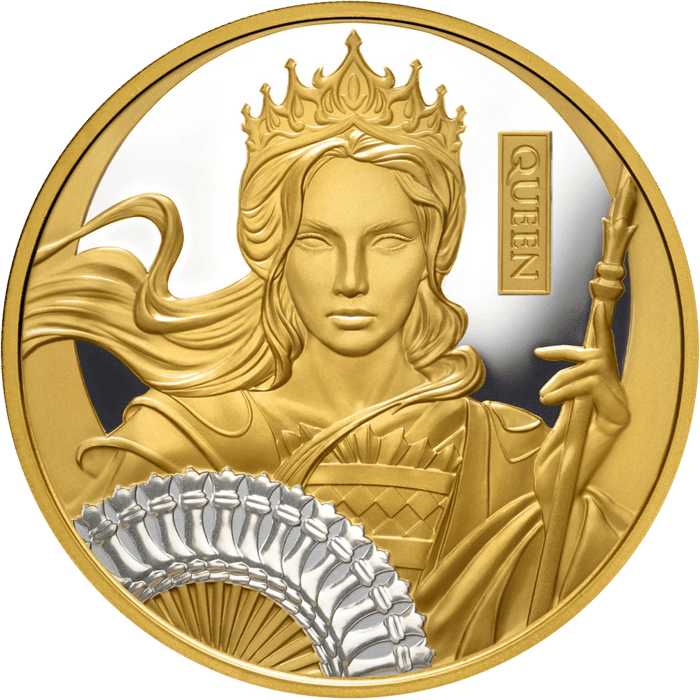
Shown in gold: the queen as a woman with a crown, a long staff in her hand and a large fan.
According to Murray, Rowbothum, who put a chess book into English in 1562, added a note on the English pieces of his day. Of the pawns he writes:
… the Paunes be made smalest & least of all, & thereby they may best be knowen.
Today FIDE gives numbers for it. Its standard gives a standard height of 50 mm for the pawn and 95 mm for the king, with up to 10% deviation, as long as the order of the sizes is kept. Four pawns must fit comfortably on one square.
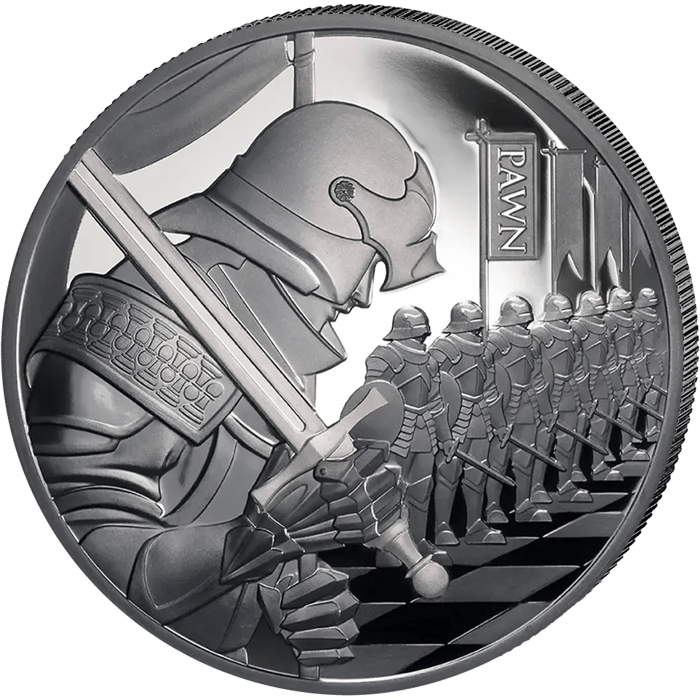
In silver, the pawn as a figure with a helmet, in front of a row of identical figures on chequered ground.
The rule-making body of football, the IFAB, fixes the goal in Law 1 with two numbers: 7.32 m between the inner edges of the goalposts, 2.44 m from the ground to the lower edge of the crossbar. Next to them, in brackets, stand 8 yards and 8 feet. For the distance between the goalposts and the height of the crossbar off the ground, the Law gives no range.
Diagram according to Law 1 of the IFAB: a pitch seen from above as a line drawing. A thin line shows the largest pitch allowed, 120 m long and 90 m wide, with its two goals, a bold one the smallest, 90 m long and 45 m wide. The goals, the penalty areas as marked areas in front of the goals and the centre circle around the centre of the pitch are as large in the largest pitch as in the smallest: the goal 7.32 m wide, the penalty area 16.5 m deep and, by our own calculation, 40.32 m wide, the centre circle with a radius of 9.15 m. Only the outer lines of the pitch and the halfway line, which joins the midpoints of the two touchlines, grow longer with it.
Diagram
For the pitch, on the other hand, Law 1 allows ranges: 90 to 120 m in length and 45 to 90 m in width, for international matches 100 to 110 m and 64 to 75 m. What stays fixed is the penalty area, the marked area in front of each goal, 16.5 m from the inside of each goalpost to the side and 16.5 m into the pitch, and the centre circle around the centre of the pitch with a radius of 9.15 m. The lines are part of the areas they bound. At a width of 45 m, 2.34 m remain on each side of the penalty area, because it is 7.32 + 2 × 16.5 = 40.32 m wide (own calculation).
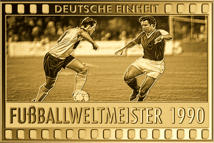
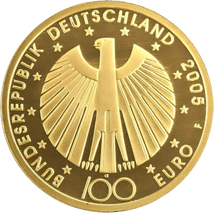
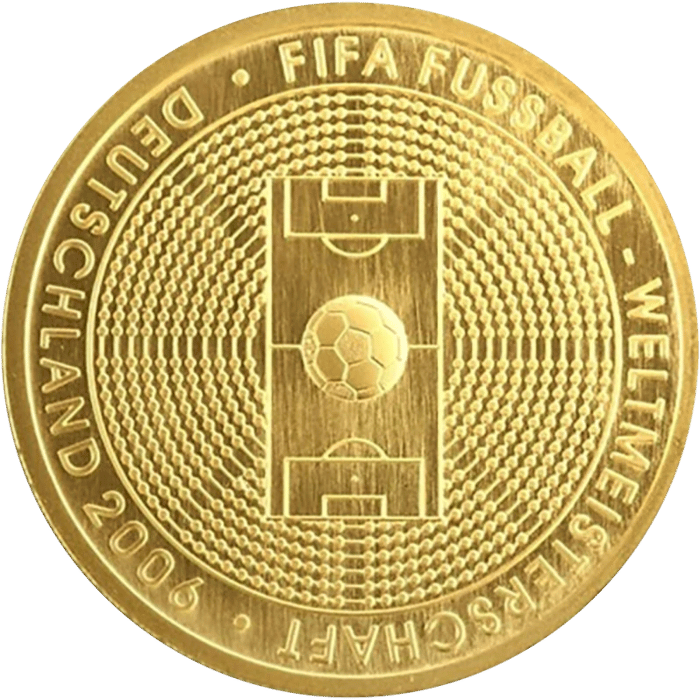
According to the Deutsche Bundesbank, the 100 euro gold coin for the 2006 Football World Cup was issued on 4 October 2005; it is 28 mm in diameter and weighs 15.55 g. According to the Deutsches Münzen Magazin, it was the first German gold coin on the theme of football; the design side is by Heinz Hoyer.
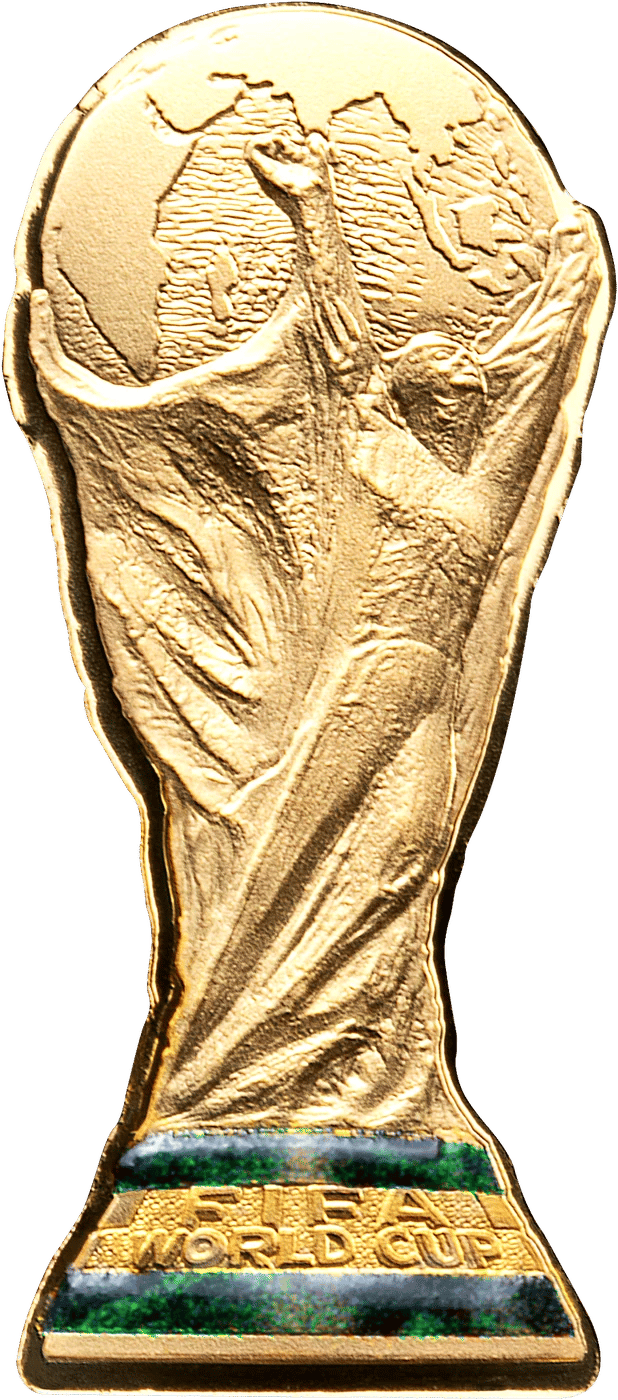
For the 1974 World Cup, FIFA, the world governing body of football, commissioned a new trophy; from 53 designs by experts from seven countries, the one by Silvio Gazzaniga was chosen. It is 36 cm high, made of 18 carat gold, with two layers of malachite in the base, and under the rules FIFA keeps possession of it. The trophy before it, the Jules Rimet Cup of 1930, is by the sculptor Abel Lafleur: 35 cm high, made of gilded sterling silver, on a base of lapis lazuli.
A gold piece of 1 g in the shape of a trophy: at the top a sphere with raised continents, carried by two twisting figures, below a base with two green bands.
For the football, the rule-making body of football, the IFAB, lays down in Law 2: spherical, made of suitable material, 68 to 70 cm in circumference, 410 to 450 g in weight at the start of the match, with a pressure of 0.6 to 1.1 atmospheres at sea level. The Law does not name a seam or a pattern.
Diagram for Rule 3.01 of MLB, the North American baseball league, which prescribes a cover of two strips of leather, tightly stitched. The drawing shows a ball as a circle, inside it the two strips in two flat tones: a light band in the middle and two darker round areas on the left and right, which together form the second strip. Between them the seam runs as a continuous line. A baseball weighs 141.7 to 148.8 g and measures 22.9 to 23.5 cm in circumference.
Diagram
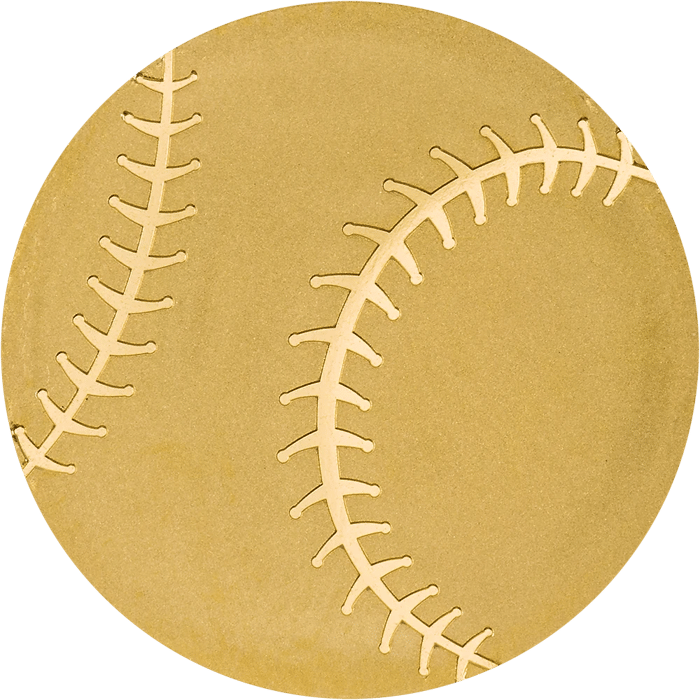
The rules of MLB, the North American baseball league, on the other hand, describe how the ball is built. A baseball is a sphere of yarn wound round a small core of cork, rubber or similar material, covered with two strips of white horsehide or cowhide, tightly stitched together. It weighs 141.7 to 148.8 g and measures 22.9 to 23.5 cm in circumference; grams and centimetres are calculated from the measures in the rule.
The surface of a baseball in gold, very close: two light seam arcs, both cut off at the edge.
In basketball, the rule lays down the basket. Under Rule 1 of the NBA, the North American basketball league, the ring measures 18 inches, 45.72 cm, on the inside, and its upper edge is 10 feet off the floor, 3.048 m. The ring is painted orange, and a white net 18 inches long hangs from it. Behind it stands a backboard of 6 × 3½ feet, flat and transparent. Centimetres and metres are calculated.
In the rules for board, pitch and ball, many measures are a range: the recommended 5 to 6 cm of a chess square, the height of the pieces with up to 10% deviation, the length and width of the football pitch, the circumference and weight of football and baseball. What is fixed is what can be counted or what decisions rest on: 64 squares in 8 × 8, a goal of 8 yards × 8 feet, a ring of 18 inches.
 Sports
Stay informed with product launches, financial news and exclusive offers. Sign up for our free newsletter today.
By entering your email address and clicking the "Submit" button, you give the following consent: "I agree to be informed by email about new products, financial news and exclusive offers, and therefore consent to the processing of my email address for the purpose of sending the newsletter. I can revoke this consent at any time without giving reasons, with effect for the future. The lawfulness of processing carried out prior to revocation remains unaffected."