


1 Ounce Gold Krugerrand 2026
£3,131.27
VAT-free and excl. shipping
Available in 2–3 business days
 More than 300,000
 Over 30 years
 Secure shipping
 Google: 4.9/5
Bullion coins are very popular with investors of all types. They are a simple way to invest in gold & silver. Bullion coins offer you a purchase price close to the current gold price & silver price. There are well-known coin series, such as the Maple Leaf, which are issued annually. Please note: Bullion coins are taxed differently depending on the material. For more details, please refer to the product description.


Holding a gold or silver coin in your hand evokes a feeling that no savings account and no securities portfolio can convey: tangible, genuine value. This is precisely where the enduring fascination of bullion coins, also known as investment coins, lies. They combine the pure material value of precious metal with a purchase price close to the current daily price and are regarded worldwide as one of the simplest ways to invest in physical gold and silver. The following sections cover the definition, denominations, taxes, the best-known coin series, storage and the typical questions surrounding the purchase.
Bullion coins are minted precious-metal coins whose value is derived almost entirely from their fine weight. Unlike collector's coins, only a small premium is added on top of the material value, the so-called agio. This premium covers minting, distribution and trading margin, and is significantly lower than for numismatically minted issues. Bullion coins are produced in large mintages and struck anew year after year, which is why global demand remains stable and resale is straightforward.
The term investment coin is used synonymously with bullion coin; the word bullion refers to precious metal in bar or coin form. Gold and silver coins are the most common, while platinum and palladium coins remain a niche. Compared with bars, coins are more popular among many investors because they are visually more appealing, can be divided into small units, and are instantly recognised internationally. Those looking to get started will find a good overview of gold bullion coins and the matching selection of silver coins.
The Key Facts at a Glance
Gold coins have been minted for centuries and long served as official currency. Today they are considered a classic investment and a tangible asset that holds its own in times of crisis. Investors value the high value density of gold coins: even a single troy ounce concentrates a considerable sum into a very small space. Most investment gold coins have a fineness of 999.9/1,000; a few classics, such as the Krugerrand, deliberately rely on a more robust alloy.
A decisive advantage concerns taxation: in Germany, investment gold is exempt from VAT under § 25c UStG. Buying and selling classic investment gold coins therefore incurs no VAT, which is one reason why demand has remained high for years and why many investors use the gold price as a benchmark. Those wishing to hedge larger sums often combine coins with gold bars, which offer an even lower premium for the same fine weight.
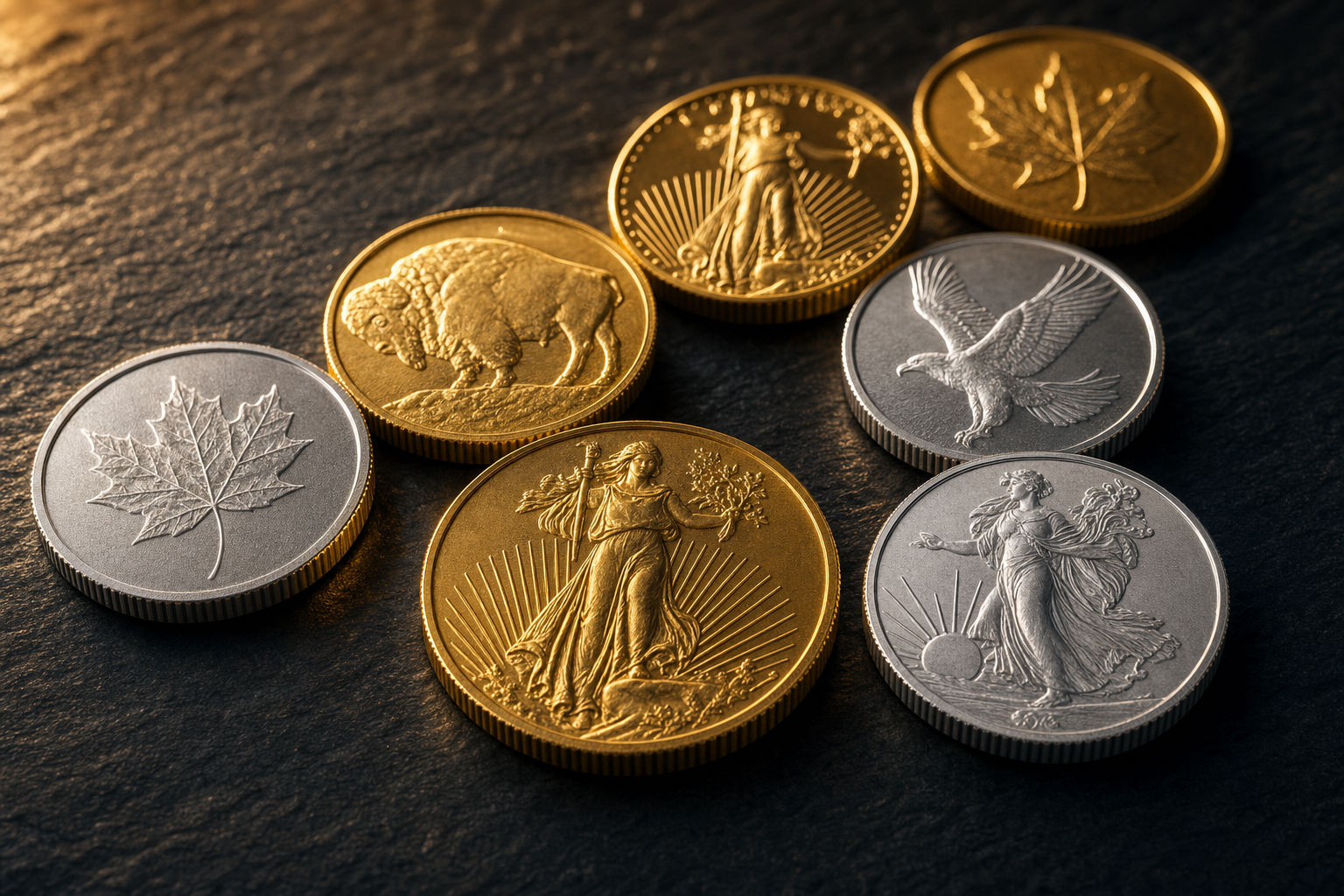
Silver coins form the second major pillar of the market. They are considerably cheaper than gold coins and are therefore excellent for getting started or for gradually building wealth. Many investors build their precious-metals portfolio on a solid foundation of silver and later add gold. Popular issues can be resold easily at any time, which makes silver coins a flexible addition.
Different tax rules apply to silver than to gold. Since 2014, imported silver coins have generally been subject to standard taxation at the full VAT rate. Many dealers, however, apply the margin scheme: under this scheme, only the difference between the purchase and selling price is taxed, not the full amount, which makes the effective premium noticeably lower. A comprehensive overview of silver bullion coins shows the common series; for larger quantities, it is also worth looking at silver bars.
Bullion coins are minted in standardised weight units, with gold usually based on the troy ounce (around 31.1 grams). Choosing the denomination is one of the most important decisions when buying, since smaller units are more flexible but carry a higher premium per gram.
Small denominations have a practical advantage: they can later be sold individually without having to sell an entire troy ounce at once. Those who buy regularly can also benefit from the cost-average effect, more on that further below. Fractional sets, such as those available for the Krugerrand, bundle several sizes into a single issue and are sought after by collectors and investors alike.
Over the decades, a number of coin series have established themselves as the global benchmark. They are minted anew every year, are readily available from dealers and banks, and can be sold internationally, a strong argument especially for newcomers.
The Krugerrand from South Africa, minted since 1967, is still considered the best-selling gold bullion coin in the world. Its high copper content makes it resistant to scratches and gives it a characteristic reddish tone. Kettner Edelmetalle is the official German partner of the South African Mint. The Vienna Philharmonic from Austria impresses with pure fine gold and a changing musical design, while the Canadian Maple Leaf, with its maple leaf design, has been one of the best-known issues since 1979.
Among silver coins, the Maple Leaf tops the popularity scale, hardly any other issue can be resold as quickly. The American Eagle, featuring the heraldic animal of the USA and Lady Liberty, is just as much of a perennial favourite as the Australian Kangaroo from the Perth Mint and the British Britannia. These series form the backbone of many silver portfolios.
The range of bullion coins made of platinum and palladium is limited, but is attracting growing interest. Both metals play an important role in industry, which partly decouples their price development from that of gold. Adding a small allocation can therefore make sense for diversifying a precious-metals portfolio. Well-known issues include the Platinum Maple Leaf with a fineness of 999.5/1,000, as well as individual palladium coins. Both metal groups are subject to standard taxation and therefore to the full VAT rate.
Tax treatment is one of the most important differences between the metals and noticeably affects the overall cost.
Tax Note
Anyone who makes a profit selling bullion coins does not need to pay tax on it, provided at least twelve months have passed between purchase and sale. This information does not replace tax advice; the individual situation is always decisive.
For retirement provision geared to the long term, or as an inflation hedge, the holding period thus plays into investors' hands: physical precious metal reveals its strength above all over longer periods.
When buying, it is worth considering several factors: the fine weight, the premium over the daily price, the condition and the popularity of the series. Widely circulated issues are easier to resell than exotic mintages. For larger investments, the timing of the purchase can play a role; those who do not want to time it deliberately spread their purchases over time.
Those who buy the same denomination at regular intervals smooth out price fluctuations over the years and achieve a stable average price.
This cost-average effect takes the nervousness out of the market and can be conveniently implemented through a savings plan. Secure storage is just as important as the purchase itself. For individual pieces, coin capsules are a good choice, protecting against scratches and oxidation; larger holdings can be kept in coin cases or a bank safe deposit box. Shipping from Kettner Edelmetalle is 100% insured.
Like any asset class, bullion coins also have two sides. The most important points at a glance:
Compared with collector's coins, whose value exceeds the material value and depends more heavily on rarity and condition, bullion coins are the more predictable choice. Those wishing to combine both worlds will find an appealing bridge between investment and passion in elaborately enhanced special editions.
Bullion coins derive their value almost entirely from the precious metal and are minted in large mintages. Collector's coins, on the other hand, command a premium above the material value, resulting from rarity, design and condition.
Globally known series such as the Krugerrand, Maple Leaf or Vienna Philharmonic are ideal for getting started. They are easy to trade, available in small denominations and can be resold without complications at any time.
Investment gold is VAT-exempt, so no VAT is charged here. Silver coins are subject to standard taxation, although the margin scheme can often be applied. Platinum and palladium are taxed at the full rate.
If at least twelve months have passed between purchase and sale, profits from the sale of physical precious metals are tax-free. Within this period, a profit may be subject to tax. The individual situation should be clarified with a tax advisor.
The percentage premium is lowest for the 1-ounce denomination. Smaller units such as 1/10 oz or 1 g are more flexible but carry a higher premium per gram. The choice depends on the budget and the desired balance between flexibility and price.
Individual coins are protected from scratches and environmental influences in coin capsules. Larger holdings can be stored in coin cases, a safe or a bank safe deposit box. A dry, clean environment and a well thought-out security concept are important.
Stay informed with product launches, financial news and exclusive offers. Sign up for our free newsletter today.
By entering your email address and clicking the "Submit" button, you give the following consent: "I agree to be informed by email about new products, financial news and exclusive offers, and therefore consent to the processing of my email address for the purpose of sending the newsletter. I can revoke this consent at any time without giving reasons, with effect for the future. The lawfulness of processing carried out prior to revocation remains unaffected."
