


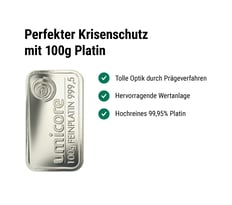
100g Platinum Bar Umicore, Heraeus, Degussa
£5,079.93
excl. UK import VAT and shipping
Available in 2–3 business days

 More than 310,000
 Over 30 years
 Secure shipping
 Google: 4.9/5
The 100 g platinum bar is among the weightier investment forms in the platinum segment and combines substantial material value with a more favourable premium per gram compared to small bars. Platinum, alongside gold, silver and palladium, is one of the most important investment metals and occupies a special position due to its rarity and its industrial significance. This guide looks at the properties of platinum as a precious metal, the advantages of the 100-gram denomination, the leading manufacturers such as Umicore, Heraeus and Degussa, authenticity features, tax particularities, as well as questions of storage and the market environment.

Platinum is a silvery-white, extremely corrosion-resistant precious metal that occurs in nature considerably more rarely than gold. Worldwide annual mining output amounts to only a fraction of gold production, with the majority coming from South Africa and Russia. This scarcity is one of the reasons why platinum bars are regarded as a worthwhile addition to a broadly diversified precious metals portfolio. A bar in a format of 100 grams represents a middle path between handy small bars and capital-intensive large formats.
Unlike gold, which primarily serves as a store of value, platinum is to a considerable extent an industrial metal. It is used in vehicle catalytic converters, in the chemical and glass industries, in medical technology and, increasingly, in hydrogen technologies. This dual demand from investment and industry shapes price formation. Anyone who chooses the 100-gram denomination acquires a compact unit of high counter-value, well suited to longer-term wealth diversification. A look at the overarching category of platinum bars shows the entire available range of weight classes.
Choosing the right denomination is one of the key decisions when buying platinum. As a general rule: the larger the bar, the lower the percentage premium over the pure material value. In this respect, a 100 g platinum bar offers a favourable ratio of minting costs to metal value, without requiring the high capital outlay of a 500-gram or kilogram bar.
For investors who wish to commit a larger sum to platinum but value flexibility for a later sale, the 100-gram unit is often a sensible size. Smaller formats offer greater divisibility but come with a higher premium. The following overview classifies the common weight classes:
Anyone who prefers a troy-ounce-based denomination will find an internationally widespread alternative in the 1 oz platinum bar. The decision between the formats ultimately depends on the investment horizon and the desired degree of flexibility.
A key quality feature is the origin of the bar from a recognised refinery. The category of 100-gram platinum bars includes products from renowned European manufacturers, whose bars have a fineness of 999.5/1,000 (platinum .9995) and are delivered in Brilliant Uncirculated (BU) condition.
Among the established mints are the Belgian Umicore, regarded as one of the world's leading names in precious metals recycling and processing, as well as Heraeus from Hanau, a technology group with a long tradition in precious metals processing. Degussa also stands for high-quality bar minting. Bars from these manufacturers are generally marked with fine weight, fineness, manufacturer's logo and an individual serial number, and are supplied with a certificate of authenticity. These features considerably ease any later resale, as they are immediately recognised on the market.
Bars from current production are often offered as various manufacturers, meaning that, depending on availability, a bar from Umicore, Heraeus or Degussa will be delivered. For pure investment purposes this is immaterial, since all three minting houses are internationally tradeable and of equal value. An overview of further renowned mints can be found in the manufacturer section.
Security when acquiring platinum depends significantly on the authenticity and traceability of the bar. Recognised refineries incorporate several features that make counterfeiting more difficult and simplify verification.
Physically, platinum can be identified by its high density of around 21.45 g/cm³, which is considerably higher than that of gold. Specialist dealers use non-destructive methods such as ultrasound or X-ray fluorescence analysis for verification. Kettner Edelmetalle employs an ISO-compliant authenticity verification process, so that only tested goods reach sale. Anyone wishing to keep a bar permanently in its original condition should not open the sealed packaging; suitable storage solutions can be found in the coin capsules section.

An important difference from investment gold concerns VAT. While investment gold is VAT-exempt in Germany, platinum as an investment metal is subject to standard VAT. When buying a 100-gram platinum bar, the price is therefore quoted including VAT (Value Added Tax). This applies equally to palladium bars and should be taken into account when considering returns.
Tax note
On a private sale of platinum, a capital gain may be tax-free once the one-year speculation period under § 23 EStG has elapsed. This information does not replace tax advice; a tax advisor should be consulted for the individual situation.
By comparison, a look at the 100 g gold bar is instructive: gold is VAT-free on purchase, which makes entry easier for many investors. Platinum, on the other hand, scores with its industrial demand base and a historically independent price trend, enabling diversification within the precious metals portfolio.
A bar with a counter-value in the range of several thousand euros requires well-considered storage. In principle, both home storage in a private safe and safekeeping in a bank safe deposit box are available. Both options have advantages and disadvantages regarding access, costs and insurance cover.
Besides a safe, special storage systems are also suitable for protected safekeeping. Additional accessories such as coin cases help to store several bars in an organised and damage-free manner. For shipping, Kettner Edelmetalle relies on 100% insured transport, so that the goods are covered right up to handover.
The platinum price is quoted on the international commodity markets in US dollars per troy ounce and converted into euros. Historically, platinum traded above the gold price for long periods, before the ratio reversed in recent years. This shift is closely linked to demand from the automotive industry as well as to supply from the few producing countries.
For the price formation of a 100 g platinum bar, besides the current spot price, the manufacturer's premium is relevant. Since platinum is a comparatively thin market, prices can fluctuate more strongly than for gold or silver. This volatility opens up opportunities but also carries risks; no concrete return promises can be derived from it. Anyone viewing platinum as a long-term addition can place the category in the context of the entire platinum range and compare it with other asset classes such as gold bars or silver bars.
Platinum unites two worlds: the character of a precious metal and the demand dynamics of an industrial commodity.
Besides bars, platinum is also available in the form of platinum coins. Both investment forms have their merits: bars generally offer a lower premium per gram and are suited to pure value investment, while coins such as the Vienna Philharmonic in platinum or the platinum Maple Leaf additionally carry collector value and a state minting guarantee.
For investors seeking the maximum material value per euro invested, the 100-gram bar is generally the more efficient choice. Anyone who, on the other hand, values internationally recognised mintings with a face value will find a suitable complement in the coin series. Both forms can easily be combined within a portfolio.
Investment platinum bars from renowned manufacturers usually have a fineness of 999.5/1,000, corresponding to platinum .9995. This means the bar contains 100 grams of pure platinum.
Yes. Unlike investment gold, platinum is subject to standard VAT in Germany. The price shown includes VAT (Value Added Tax). On a private sale, a profit can remain tax-free once the one-year speculation period has elapsed.
Among the leading mints are Umicore, Heraeus and Degussa. Bars from these refineries are internationally tradeable and are supplied with a serial number as well as a certificate of authenticity.
Platinum is rarer than gold and is, to a large extent, in demand industrially, for example in catalytic converters and hydrogen technologies. The price can therefore develop independently of the gold price, enabling diversification. Gold is tax-free on purchase, platinum is not.
The 100-gram bar offers a favourable premium per gram with a manageable capital outlay. It sits between the more flexible small bars and the capital-intensive large formats, and is therefore well suited to longer-term wealth diversification.
Storage in a home safe or bank safe deposit box is recommended. The sealed original packaging should be preserved, as it protects the Brilliant Uncirculated (BU) condition and makes resale easier.
 100 g Platinum Bars
Stay informed with product launches, financial news and exclusive offers. Sign up for our free newsletter today.
By entering your email address and clicking the "Submit" button, you give the following consent: "I agree to be informed by email about new products, financial news and exclusive offers, and therefore consent to the processing of my email address for the purpose of sending the newsletter. I can revoke this consent at any time without giving reasons, with effect for the future. The lawfulness of processing carried out prior to revocation remains unaffected."