


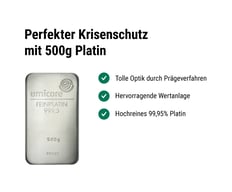
500g Platinum Bar Umicore, Heraeus, Degussa
£28,100.25
excl. UK import VAT and shipping
Available in 2–3 business days

 More than 300,000
 Over 30 years
 Secure shipping
 Google: 4.9/5
The 500 g platinum bar is one of the most substantial investment forms in the segment of white precious metals: a tangible piece of concentrated value that many investors see as a deliberate statement against the vicissitudes of the capital markets. Platinum is rarer than gold, in high industrial demand, and in this size represents an investment for anyone who values substance over unit count. The following sections cover production, fineness, manufacturers, tax particulars, storage and the role of platinum in a broadly diversified portfolio.

A 500 g platinum bar combines half a kilogram of pure fine platinum in a single, compact object. This denomination therefore appeals to investors with a larger investment volume who want to keep the premium per gram as low as possible. As with all precious metals, the rule applies: the larger the bar, the lower the percentage manufacturing premium over the pure material value. A 500-gram format is thus considerably more cost-efficient than many small units of the same total weight.
Platinum is a white-grey, extremely dense yet malleable metal. Its industrial significance, for example in catalytic converters, medical technology and hydrogen technology, sets it fundamentally apart from gold, whose demand is driven predominantly by investment and jewellery demand. Anyone wishing to diversify their wealth more broadly will find in the range of platinum bars a complement that behaves differently from classic investment gold. The broader offering around physical platinum also shows how diversely this precious metal is traded.
Up to a weight of around 250 grams, platinum bars are usually minted: the metal is shaped under high pressure, which produces sharp edges and a shiny appearance. The 500 g platinum bar exceeds this threshold and is therefore generally cast. Liquid platinum is poured into a casting mould, where it solidifies into the finished bar.
Cast bars have a characteristically matter, sometimes slightly irregular surface: a feature that connoisseurs value because it makes the artisanal origin visible. Each bar is also individually numbered and marked with a fineness stamp, manufacturer's logo and weight stamp. This marking is an essential feature for authenticity and identification.
Anyone wishing to compare the differences between the weight classes in detail will find the 1 kg platinum bar as the next-larger cast format, and the 100 g platinum bar as a smaller, equally common unit.
All market-standard 500 g platinum bars have a fineness of 999.5/1,000. This value, often stated as 99.95 percent or simply "fine platinum", is consistent across manufacturers and corresponds to the international standard for investment platinum. This means a bar of this quality can be traded worldwide, regardless of which of the renowned producers it comes from.
An important quality seal is certification by the LPPM (London Platinum and Palladium Market). LPPM-certified bars with "Good Delivery" status meet strict requirements for purity, weight tolerance and proof of origin, and enjoy the highest level of international acceptance. For investors, a certified bar means easier resale and a reliable buy-back market: an advantage that gold and silver investors also appreciate.
The 500-gram bar is produced by some of the most respected refineries in the world. The best-known names include Umicore, Heraeus and Degussa: all brands with a long tradition in precious metals processing.
The technology group Heraeus, headquartered in Hanau, was founded as early as 1851 and today ranks among the world's leading family businesses in the industry. Bars from Heraeus stand for consistently high manufacturing quality.
Umicore is an internationally active materials technology and recycling group with Belgian roots, whose precious metal bars are recognised worldwide. Degussa, in turn, carries on the legacy of one of the most traditional German refineries. Which specific manufacturer is supplied depends on availability; the quality is identical across all three. An overview of the individual mints is provided on the Heraeus manufacturer page as well as the overview of Umicore.
A crucial difference compared with gold: while investment gold is exempt from VAT in Germany, platinum bars are subject to the full VAT rate of 19 percent. For tax purposes, platinum is not considered investment gold under the Value Added Tax Act and is therefore treated like a regular industrial metal.
Tax notice
Platinum bars are traded with 19 percent VAT. After the one-year holding period has elapsed, a private capital gain is, under current law, exempt from income tax. This information does not replace tax advice; in individual cases, consulting a tax advisor is recommended.
For comparison, it is worth looking at the tax-privileged alternatives in the gold bar range, which, as investment gold, is exempt from VAT. Silver bars also have their own tax particulars and are frequently offered under the margin scheme.
Platinum occupies a special position in portfolio theory. Anyone who adds a third precious metal alongside gold and silver spreads the risk across several independent sources of demand. If an individual metal falls in price due to technical or economic developments, the remaining positions can act as a support within the portfolio.
Precisely because platinum demand is strongly industrially driven, its price development often differs from that of investment gold. This independence makes platinum an interesting building block for anyone who values genuine diversification. In addition to bars, platinum coins also offer a way to invest in this precious metal, for example in smaller, easily divisible units. For an even broader positioning, palladium in bar form can also be considered as a fourth precious metal.
Platinum is not only a capital investment but a piece of applied industrial history: a metal without which modern catalytic converters and hydrogen technology would scarcely be conceivable.
A 500 g platinum bar represents considerable material value and should be stored with corresponding care. Suitable options include a private safe with adequate resistance class or a bank safe deposit box. In both cases, appropriate insurance is important, as is the safekeeping of purchase documents and the manufacturer's number.
For gentle storage, suitable accessories are recommended: the bar should remain in its original foil or in a suitable protective sleeve to avoid scratches and fingerprints. At Kettner Edelmetalle, shipping is generally 100% insured and discreet, by value courier: an essential aspect, especially for high-value bars in this price category.
Large bar formats are usually kept in stock in manageable quantities. For larger order volumes, it can be worthwhile to clarify availability in advance, as individual bars may need to be ordered from the manufacturer first. Delivery time therefore varies between a few business days and, in the case of direct sourcing from the factory, longer periods.
As a German family business with more than 280,000 customers and ISO-compliant authenticity verification, Kettner Edelmetalle places particular emphasis on verified goods and transparent processing. Anyone wishing to diversify their investment more broadly will find, alongside the 500-gram format, smaller entry-level sizes such as the 50 g platinum bar or the 1 oz platinum bar.
Market-standard 500 g platinum bars have a fineness of 999.5/1,000, which corresponds to 99.95 percent pure fine platinum. This value is consistent across manufacturers and corresponds to the international standard for investment platinum.
Up to about 250 grams, platinum bars are minted. For larger weights such as 500 grams, casting is the standard process: liquid platinum is poured into a mould and solidifies into a bar. Cast bars can be recognised by their matter surface and individual serial number.
Yes. Unlike investment gold, platinum bars are not exempt from VAT and are traded at the full rate of 19 percent. However, after the one-year holding period has elapsed, a private capital gain is, under current law, exempt from income tax. For details, consulting a tax advisor is recommended.
Established manufacturers include Umicore, Heraeus and Degussa. All three are renowned refineries with a long tradition. Which manufacturer is supplied depends on availability; the fineness of 999.5/1,000 is identical across all of them.
The larger the bar, the lower the percentage manufacturing premium relative to the pure metal value. A 500 g platinum bar is therefore cheaper per gram than many small units of the same total weight: ideal for investors aiming for a larger volume.
It is advisable to store it in a suitable safe or bank safe deposit box with appropriate insurance. The bar should remain in its original foil or a protective sleeve to avoid scratches and fingerprints. Suitable accessories can be found in the corresponding range.
 500 g Platinum Bars
Stay informed with product launches, financial news and exclusive offers. Sign up for our free newsletter today.
By entering your email address and clicking the "Submit" button, you give the following consent: "I agree to be informed by email about new products, financial news and exclusive offers, and therefore consent to the processing of my email address for the purpose of sending the newsletter. I can revoke this consent at any time without giving reasons, with effect for the future. The lawfulness of processing carried out prior to revocation remains unaffected."