Sold out

1 Ounce Silver Vienna Philharmonic 2026
£50.15
excl. UK import VAT and shipping
Available again from 23/11/2026

 More than 310,000
 Over 30 years
 Secure shipping
 Google: 4.9/5
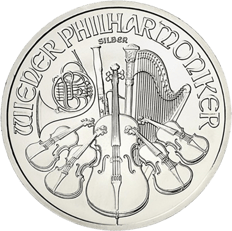
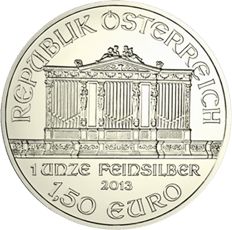
Since its introduction in 2008, the Münze Österreich has managed to create one of the most well-known silver bullion coins in Europe in a short period of time. The Vienna Philharmonic silver coin features several orchestral instruments such as the harp on the obverse and an image of the Vienna Opera House with the organ in the Golden Hall of the Vienna Musikverein on the reverse.


An orchestra cast in silver: the Vienna Philharmonic is the only bullion coin in the world dedicated to Austria's most famous orchestra, and at the same time one of Europe's best-selling silver coins. Since 2008, the Austrian Mint has struck the coin in pure fine silver, in the classic denomination of 1 ounce. The following sections cover the history behind the design, the design itself, fineness and quality, tax treatment, proper storage and the key purchasing criteria, so that choosing the right coin becomes easier.
The Silver Vienna Philharmonic is one of the classics among European silver coins. As a bullion coin, its price closely tracks the current silver price, plus a modest premium for minting and distribution. This makes it a popular building block for anyone looking to diversify their wealth more broadly into physical precious metal, from beginners buying their first ounce to experienced investors who prefer whole tubes or master boxes.
Unlike many overseas coins, the Philharmonic is minted within the EU, which means short transport routes and high availability. Anyone wanting to combine minted designs with a bar holding often adds a silver bar to the coin; as a counterweight to silver, many investors also value the value-dense gold. Many also consider the Silver Philharmonic a solid building block for crisis protection.
The success story began in 1989, initially in gold. The then chief engraver of the Austrian Mint, Thomas Pesendorfer, drew his inspiration directly from the Golden Hall of the Vienna Musikverein, where the New Year's Concert takes place every year. The result was a design that puts the instruments of the world-famous orchestra centre stage. The gold edition alone was named the world's best-selling gold coin several times during the 1990s.
On 1 February 2008, the premiere in fine silver followed, with an adapted diameter and a smooth coin edge. In silver, the Philharmonic has to this day been issued exclusively in the denomination of one ounce. Anyone looking for the related edition in yellow precious metal will find it in the Vienna Philharmonic in gold, the same signature design, a different metal.
An orchestra you cannot hear, but can hold: the Philharmonic makes a piece of Viennese musical culture tangible.
The design is considered one of the coin's success factors. It is calm, clear and unmistakable, and has needed no stylistic update since the first edition.
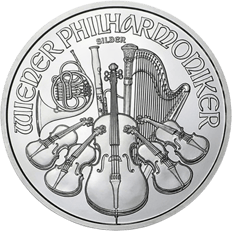
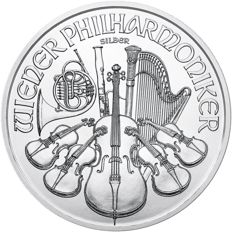
The obverse brings together the orchestra's most important instruments: five string instruments, plus a horn, a bassoon and the characteristic Vienna harp. This side also carries the details of fine silver, fineness and fine weight. The composition looks like an ensemble forming up for a shared overture.
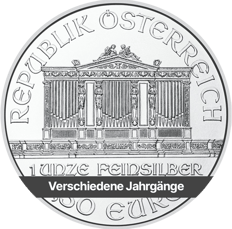
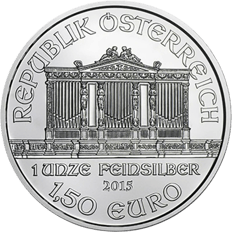
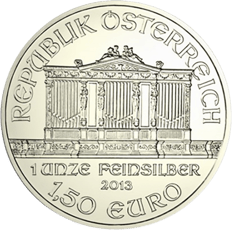
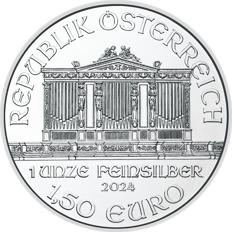
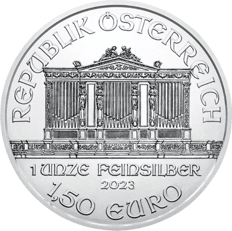
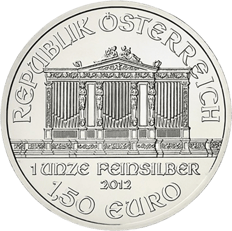
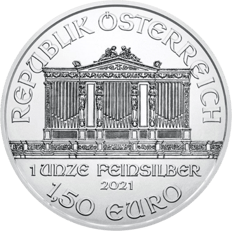
The reverse shows the organ in the Golden Hall of the Vienna Musikverein, the concert hall where the New Year's Concert is performed. It also bears the face value of 1.50 euros. This makes the Philharmonic legal tender in the Republic of Austria. Because the silver coin was not issued until 2008, it has carried a face value in euros from the very start.
The Silver Vienna Philharmonic consists of 999/1,000 fine silver and is issued exclusively in Mint State (MS) minting quality. The coin edge is smooth and carries no inscription. These clear, consistent features make authenticity verification and later resale easier.
These points are worth a closer look when buying:
Like many fine silver coins, the Philharmonic can develop so-called milk spots or slight tarnishing over time. Neither affects the pure material value, but both can be avoided with good storage. Individual coins can be reliably protected in suitable coin capsules.
In silver, the Philharmonic is issued consistently as a 1-ounce coin, which keeps the range easy to navigate and the individual coins easy to trade. For building larger positions, standardised packages are available.
| Unit | Content | Typical Use |
|---|---|---|
| Single coin | 1 oz | Getting started, gifting, targeted additions |
| Tube | 20 x 1 oz | Gradual wealth building |
| Master box | 500 x 1 oz | Large-volume investment close to the silver price |
Investors appreciate the favourable tradability of whole tubes or master boxes, which usually mean a lower premium per coin. Anyone looking to compare with other classics will find them in the Canadian Maple Leaf or the Silver Krugerrand. The design also appears in other precious metals, for example as the Vienna Philharmonic in platinum. A complete overview of all series is available in the silver coins overview.
Since the abolition of the margin scheme for silver coins, investment silver coins are treated uniformly in Germany: the purchase price is subject to the standard VAT (Value Added Tax). As an EU-minted coin, the Philharmonic benefits here from short transport routes compared with imported goods.
Tax Note
Silver coins are subject to VAT in Germany. After the one-year holding period has elapsed, a later private capital gain may be tax-free. This is general information and does not replace tax advice.
Anyone who puts the tax aspect at the forefront should take a look at the broader selection of silver bullion coins and compare the conditions there with those of the Philharmonic.
Silver reacts more sensitively to environmental influences than gold and can tarnish on contact with air. This is why, especially for the Philharmonic with its fine Mint State surface, thoughtful storage pays off, so that the minted design stays attractive for years.
For the orderly storage of several coins, suitable containers from the coin cases range are ideal, while for overall needs it is worth taking a look at the accessories range. This way, both shine and resale value are preserved in the long term.
The price of a Silver Vienna Philharmonic is made up of the current silver price plus a premium for minting, distribution and VAT. The material value is based on the world market price, which is quoted in troy ounces and fluctuates during the course of the day. Silver is in demand both as an industrial and an investment metal, which is why its price tends to move more dynamically than that of gold.
Thanks to its high recognition and worldwide mintage, the Philharmonic can generally be resold without complications. Anyone planning long-term, staged wealth building can take a look at the savings plan products. For long-term oriented investors, silver is also considered a possible building block for inflation protection.
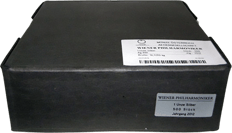
The Silver Philharmonic is minted by the Austrian Mint in Vienna; with its face value of 1.50 euros, it is legal tender in Austria. With us, you can get the ounce of the 2026 year of issue individually and, depending on availability, also in tubes of 20 coins as well as in the Austrian Mint's master box of 500 coins in 25 tubes.
You can order your Silver Philharmonics directly here in the shop or by phone from our customer advisors at +49 7930 2699, Monday to Friday from 8 a.m. to 8 p.m. If you would like to invest a larger amount, our customer advisors will be happy to prepare an individual offer for you and discuss selection, payment and delivery with you. You can also put together your personal offer online.
Before shipping, two specialists check every order according to the dual-control principle. We then seal the goods in a safety bag that can only be opened once, and ship them in a neutral box that gives no indication of precious metals. Every shipment is insured for its full value. We deliver to Austria by UPS, either directly to your address or to a UPS parcel shop near you, and on request by secure value courier. Individual items over 10,000 € are delivered only by secure value courier. You will find shipping costs and all details under Shipping and Payment; the payment methods for your order are shown at checkout.
If you sell silver coins as a private individual that you have owned for more than one year, the profit remains tax-free under the Austrian Income Tax Act (§ 31 EStG). For a sale within one year, speculative gains remain tax-free as long as they total no more than 440 € in the calendar year. This information is general in nature and does not replace tax advice.
We will buy back Silver Philharmonics you have purchased from us, if you wish. After logging in to our buy-back portal, you select the coins directly from your orders; you do not need an invoice for this. Coins from another purchase can be offered to us there together with the purchase invoice. Whether we make an offer depends on the item, the quantity and our current needs. The buy-back portal is also open to you in Austria.
You will usually receive a written offer within 24 hours. If you accept it, you will receive an insured DHL shipping label for shipping from Germany, free of charge from an offer amount of 500 €. Send in the coins in full, ideally in their original tube if they were delivered in one. Our experts check authenticity, completeness and condition, after which we transfer the amount to your account. The silver price on the day your coins arrive with us applies. A buy-back from Switzerland and Liechtenstein is currently not possible due to customs regulations.
The coin consists of 999/1,000 fine silver and contains exactly one ounce of pure silver. It is issued exclusively in Mint State (MS) minting quality.
The gold edition was already issued in 1989; the first silver edition followed on 1 February 2008. In silver, the Philharmonic has to this day been minted exclusively in the one-ounce denomination.
The obverse shows instruments of the Vienna Philharmonic orchestra, including five string instruments, a horn, a bassoon and the Vienna harp. The reverse depicts the organ in the Golden Hall of the Vienna Musikverein and bears the face value of 1.50 euros.
Yes. Since the abolition of the margin scheme, investment silver coins in Germany are subject to standard VAT, which is included in the purchase price. Investment gold, by contrast, is exempt from VAT.
Milk spots are light discolourations that can occur on fine silver coins. They do not affect the pure material value, but can be well avoided through dry storage in a tube or capsule.
For larger positions, tubes of 20 coins and master boxes of 500 coins are common. They are usually closer to the pure silver price, because the premium per coin decreases. Anyone who prefers master boxes should ideally choose a quantity divisible by 500.
 Vienna Philharmonic
Stay informed with product launches, financial news and exclusive offers. Sign up for our free newsletter today.
By entering your email address and clicking the "Submit" button, you give the following consent: "I agree to be informed by email about new products, financial news and exclusive offers, and therefore consent to the processing of my email address for the purpose of sending the newsletter. I can revoke this consent at any time without giving reasons, with effect for the future. The lawfulness of processing carried out prior to revocation remains unaffected."