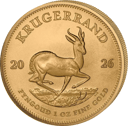
1 Ounce Gold Krugerrand 2026
£2,896.09
VAT-free and excl. shipping
Available in 2–3 business days

 More than 310,000
 Over 30 years
 Secure shipping
 Google: 4.9/5
Gold coins are equally interesting for investors and collectors alike. Those who invest in gold benefit from coins, compared to bars, with the added chance of appreciation in value. Particularly popular gold coins include Britannia, Maple Leaf, Krugerrand and Vreneli.


In 1865, Switzerland, France, Italy and Belgium founded the Latin Monetary Union. They shared one monetary system, and the public treasuries of every member state accepted the gold coins of the others. That is why the gold pieces of 20 francs and 20 lire look different and yet match in weight, fineness and size. The union ended in 1926.
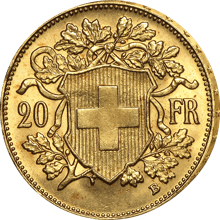 SwitzerlandVreneli 20 francs
The same for all four
Weight, fineness and diameter: 6.45 g · 900/1,000 · 21 mm
Values according to Swissmint for the Vreneli, with the weight rounded. All four gold pieces followed the French monetary system.
Of 24 parts, 22 are gold. This is how British coinage law specifies the Sovereign, and the Coinage Act 1870 already set it out the same way. Even the first modern Sovereign of 1817 was made of 22 carat gold.
Same fineness: 916.7/1,000
The Krugerrand from South Africa and the American Eagle from the USA are struck to the same fineness. The one-ounce pieces each contain one ounce of fine gold; the alloy metal is added on top.
Gold coins wear down in circulation. That is why coinage laws set a minimum weight. In the United Kingdom this still applies today: a Sovereign is legal tender there only as long as it weighs at least 7.93787 grams.

In the German Empire this limit was called the Passiergewicht from 1871. Imperial gold coins that had worn below it were still accepted at full face value by the state treasuries. The Empire withdrew them at its own expense to be melted down.
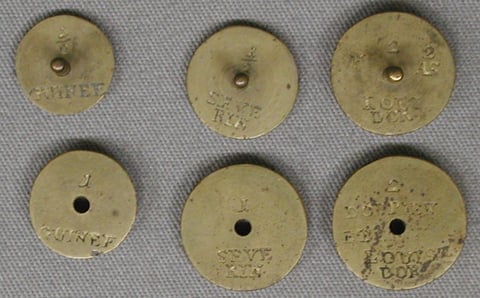
To check the weight, people used coin balances with their own weights for each type of coin.
Gold coins bring together two worlds that otherwise rarely meet: the cool rationality of a crisis-proof investment and the quiet fascination of a work of art that fits in the palm of your hand. Gold has been minted into coins since antiquity: as a means of payment, as a status symbol, as a store of wealth across generations. Anyone wishing to buy gold coins today will find a remarkably diverse field of world-renowned bullion classics and sought-after collector's editions. The following sections cover history, denominations, authenticity features, special tax aspects, storage and the question of what really matters when buying.
Gold coins are among the oldest and most common forms of physical investment. They combine the timeless appeal of the precious metal with trading recognised worldwide: a 1 oz investment gold coin can be resold around the globe with little effort. It is precisely this liquidity that makes gold coins a calm anchor point within many people's wealth, especially in times when confidence in paper currencies wavers.
Compared to gold bars, coins offer a decisive appeal: the minted design. Beyond the pure material value, this can create a collector's value that, for rare strikes or anniversary editions, lies well above the gold price. The classic bullion coins such as the Krugerrand, the Canadian Maple Leaf or the Vienna Philharmonic have gained enormous acceptance over decades and are available in various denominations.
A gold coin is wealth you can hold in your hand, independent of banks, servers and systems.
Broadly speaking, the market is divided into two groups. Bullion coins, also known as investment coins, are minted in large quantities, usually carry an unchanging design and track closely with the current gold value in price. Their premium above the pure material value is low. Collector's coins, on the other hand, are issued in limited mintages, often with a design that changes annually and in an elaborate minting quality such as Proof. Those who prefer security and low premiums opt for bullion classics; those who enjoy designs and rarity will find a wide field within collector's coins.
The history of the gold coin dates back to antiquity, when the first gold coins were minted as a means of payment. For centuries, gold accompanied trade, temporarily losing importance to silver in the Middle Ages and regaining it with the Crusades and the discovery of new gold deposits. With the introduction of the gold mark as the imperial currency in the 19th century, gold became the fixed anchor of the German monetary system, before modern paper currencies took over this role.
The year 1967 marked a turning point: with the first minting of the Krugerrand, the world's first modern investment gold coin was created, deliberately designed for private wealth building. Its success became a model: in the following decades, mints from Canada to Austria to the USA issued their own bullion coins. Historic circulation gold coins such as the Swiss Vreneli or strikes from the German Empire still remind us today that gold was once an everyday means of payment.
The most common unit for gold coins is the troy ounce (oz), which corresponds exactly to 31.1035 grams of fine gold. Bullion classics are traditionally available in four standard sizes, complemented by increasingly popular small gold in the gram range. The choice of denomination is a trade-off between premium and flexibility.
Smaller denominations cost proportionally more, because minting and handling per coin require roughly the same effort regardless of size. In return, they offer flexibility: anyone wishing to sell partial amounts later is more flexible with several small units than with a single large coin. For pure wealth building, the 1 oz coin is usually the most economical, while savings plan products and smaller units are better suited for regular saving. Anyone wishing to grade the size even more finely will also find an inexpensive alternative in 1 gram gold bars.
Precisely because gold coins concentrate high value in a small space, they become a target for counterfeiters. Reputable mintings therefore carry a range of security features that facilitate authenticity verification. Two scams are historically well known: minimally scraping gold from the coin's edge, and gold-plated coins made from other metals with a similar weight.
The Canadian mint responded to counterfeits with the Maplegram, a microscopically engraved security feature on the Maple Leaf. Other mints rely on fine edge reeding, micro-engravings or serial numbers. A few simple criteria can help with your own checks:
Kettner Edelmetalle sources gold coins and gold bars exclusively directly from the manufacturers and checks every item for authenticity in compliance with ISO standards. As the official German partner of the South African Mint, the Krugerrand comes from a secure source. Anyone wishing to delve deeper into the subject will find comparable testing standards in the gold bars category.
A key advantage of gold coins is their tax treatment. In Germany, investment gold is exempt from VAT under § 25c UStG, unlike many silver coins, for example, which are subject to the margin scheme. If physical gold coins are held for longer than one year, any subsequent profit from a sale is also exempt from income tax after the speculation period. This combination makes investment gold coins a sought-after component for long-term wealth building.
Tax Notice
Investment gold is exempt from VAT in Germany, and profits from the sale of physical gold coins are exempt from income tax after a holding period of more than one year. This information does not replace individual tax advice.
The price of a gold coin is made up of several components: the current gold price, the mint's production and logistics costs, a possible collector's premium and the dealer's margin. For bullion coins, the pure material value dominates, while for limited collector's editions, rarity plays a greater role. Anyone wishing to base purchasing decisions on key figures should check these points:
Instead of speculating on the current daily gold price, many investors focus on the long-term perspective. Investment gold coins can be bought and sold worldwide, making them a particularly liquid component: common classics are tradable at any time across different years of issue. Anyone wishing to diversify broadly combines bullion classics with German gold coins or supplements their portfolio with ready-made gold investor packages.
Physical gold needs to be stored safely and in a way that preserves its value. Scratches, fingerprints or moisture can reduce the condition and thus the collector's value. Essentially, three options are available: home storage in your own safe, a bank safe deposit box, or a specialised storage service. Each option has its own balance of availability, cost and security.
Suitable accessories are recommended for value preservation: coin capsules protect the surface from touch and environmental influences, while coin cassettes keep several pieces organised and within reach. Coins should generally not be polished or touched with bare fingers: for bullion coins, the material value counts, while for collector's pieces even a small flaw can affect the price.
The international range of gold coins is vast, but a few designs have established themselves as bullion classics. The South African Krugerrand is considered the oldest modern bullion coin and contains a copper alloy that makes it particularly robust. The Maple Leaf from Canada stands out with a fineness of 999.9 and elaborate security features. The Austrian Vienna Philharmonic is Europe's best-selling gold coin.
The British Britannia, the American American Eagle with the bald eagle, and the Australian Kangaroo are also among the globally traded bullion coins. Anyone seeking historic strikes will find what they're looking for in the British Sovereign or the Mexican Centenario. For lovers of changing designs, series such as the Lunar series or the China Panda offer a new design every year.

A particular appeal of historic gold coins lies in their possible special status: circulation gold coins from past eras, such as from the German Empire, combine material value with a piece of history. Anyone looking for gold coins as a gift will find festively presented editions under gifts made of gold.
You can order your gold coins directly here in the shop or by phone from our customer advisors at 07930-2699, Monday to Friday from 8 a.m. to 8 p.m. If you wish to invest a larger amount, our customer advisors will be happy to put together an individual offer for you and discuss selection, payment and delivery with you. You can also put together your personal offer online.
Every shipment is insured for its full value. We pack your order at our own logistics centre in Germany and send it in neutral boxes that give no indication of precious metals. For a goods value of €20,000 or more, we recommend delivery by secure value courier. If your order is sent as a parcel, you will receive the tracking number by e-mail. You can pay by bank transfer or directly online, for example with PayPal or credit card. The checkout will show you which payment methods are available for your order. You can read more about this under Shipping and Payment.
Bullion coins such as the Krugerrand, the Maple Leaf or the Vienna Philharmonic are issued anew each year. If you want coins with the current year, for example as a gift or for a collection, choose the current year of issue. If you are primarily interested in the gold itself, older or mixed years of issue are equally suitable: for the same denomination, they contain the same amount of fine gold.
We are happy to buy back gold coins you have purchased from us. After logging in to our buy-back portal, you select the items directly from your orders; you don't need an invoice for this. You can offer us coins from another purchase there along with the purchase invoice. Whether we make an offer for these depends on the item, quantity and our current demand.
You will usually receive a written offer within 24 hours. If you accept it, you will receive an insured DHL shipping label for sending from Germany, free of charge for offers of €500 or more. Please send the coins complete, including capsule, case and certificate if they were delivered with these. Otherwise, we may only reimburse the metal value. Our experts check authenticity, completeness and condition, after which we transfer the amount to your account. For bullion coins, the gold price on the day your coins reach us applies; for collector's coins, market demand applies. Due to customs regulations, a buy-back from Switzerland and Liechtenstein is currently not possible.
Bullion coins are minted in large quantities with an unchanging design and track closely with the gold value in price. Collector's coins are issued in limited mintages, often with a design that changes annually and a higher premium, but in return offer greater potential for collector's premiums.
Investment gold is exempt from VAT in Germany. This means investment gold coins are in a more favourable tax position than many silver coins. For specific individual cases, we recommend seeking tax advice.
For planned wealth building, the 1 oz coin is the most economical due to its favourable premium. Anyone wishing to start with a small budget or remain flexible should opt for fractional denominations such as 1/10 oz or small gold in the gram range.
Important indicators include the exact weight and dimensions, clean minting quality, the absence of magnetism, and manufacturer-specific security features such as the Maplegram on the Maple Leaf. The safest protection is to buy from established dealers who source directly from the mints.
Home safes, bank safe deposit boxes or specialised storage services have all proven effective. Coin capsules and coin cassettes are suitable for protecting the surface. Coins should not be polished or touched with bare fingers in order to preserve their condition.
The most sought-after bullion classics include the Krugerrand, Maple Leaf, Vienna Philharmonic, Britannia, American Eagle and the Kangaroo. Among collectors, changing series such as the China Panda or the Lunar series are particularly coveted.
Stay informed with product launches, financial news and exclusive offers. Sign up for our free newsletter today.
By entering your email address and clicking the "Submit" button, you give the following consent: "I agree to be informed by email about new products, financial news and exclusive offers, and therefore consent to the processing of my email address for the purpose of sending the newsletter. I can revoke this consent at any time without giving reasons, with effect for the future. The lawfulness of processing carried out prior to revocation remains unaffected."