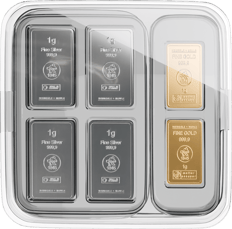
Security Deposit S
£2,583.50£2,708.90
excl. UK import VAT and shipping
Available in 2–3 business days

 More than 300,000
 Over 30 years
 Secure shipping
 Google: 4.9/5


Ten troy ounces of gold weigh 311.03 grams and disappear into a single coin tube: unassuming, compact, yet an asset that has managed for millennia without an issuer, without default risk and without an expiry date. This very principle lies behind Gold Investor Packages: several bullion coins or gold bars bought together as a bundle instead of piece by piece. The following guide explains how investment packages are priced, which denominations suit which goal, what applies for tax purposes, and what matters for verification, storage and insurance.
A Gold Investor Package is not a separate product in the metallurgical sense, but a bundle: instead of a single coin, ten, twenty, fifty or a hundred identical pieces move into storage in one go. The content remains classic investment gold: common gold bullion coins or fine gold bars with a fineness of at least 995/1,000. What changes is the pricing.
Every gold coin and every bar costs more than the fine gold it contains: minting, packaging, transport, insurance and the trading margin make up the so-called premium (agio). This premium is almost always degressive in percentage terms: the larger the unit purchased, the smaller the surcharge per gram of fine gold. Anyone buying a complete original tube instead of ten individual coins saves on handling and packaging steps, and this effect is reflected in the package price.
The basis of every calculation is the gold price, quoted as the spot price per troy ounce on the world market and fixed twice daily via the London reference price. The package price is made up of this: the current material value of the fine gold contained plus the premium. Because the rate fluctuates by the second, the price of an investment package is only ever valid at the moment of order, which is why comparing dealers only makes sense if both offers refer to the same point in time for the price.
Bullion coins rarely leave the mints individually. Common forms are sealed coin tubes of ten pieces as well as larger collective containers, referred to depending on the mint as a master box or monster box. This packaging is more than logistics: it protects the minted edges from scratches, keeps the pieces in identical orientation and, while unopened, documents the unbroken chain of provenance from the mint. For larger holdings, it is also worth looking at master boxes, which keep the transport of entire series organised.
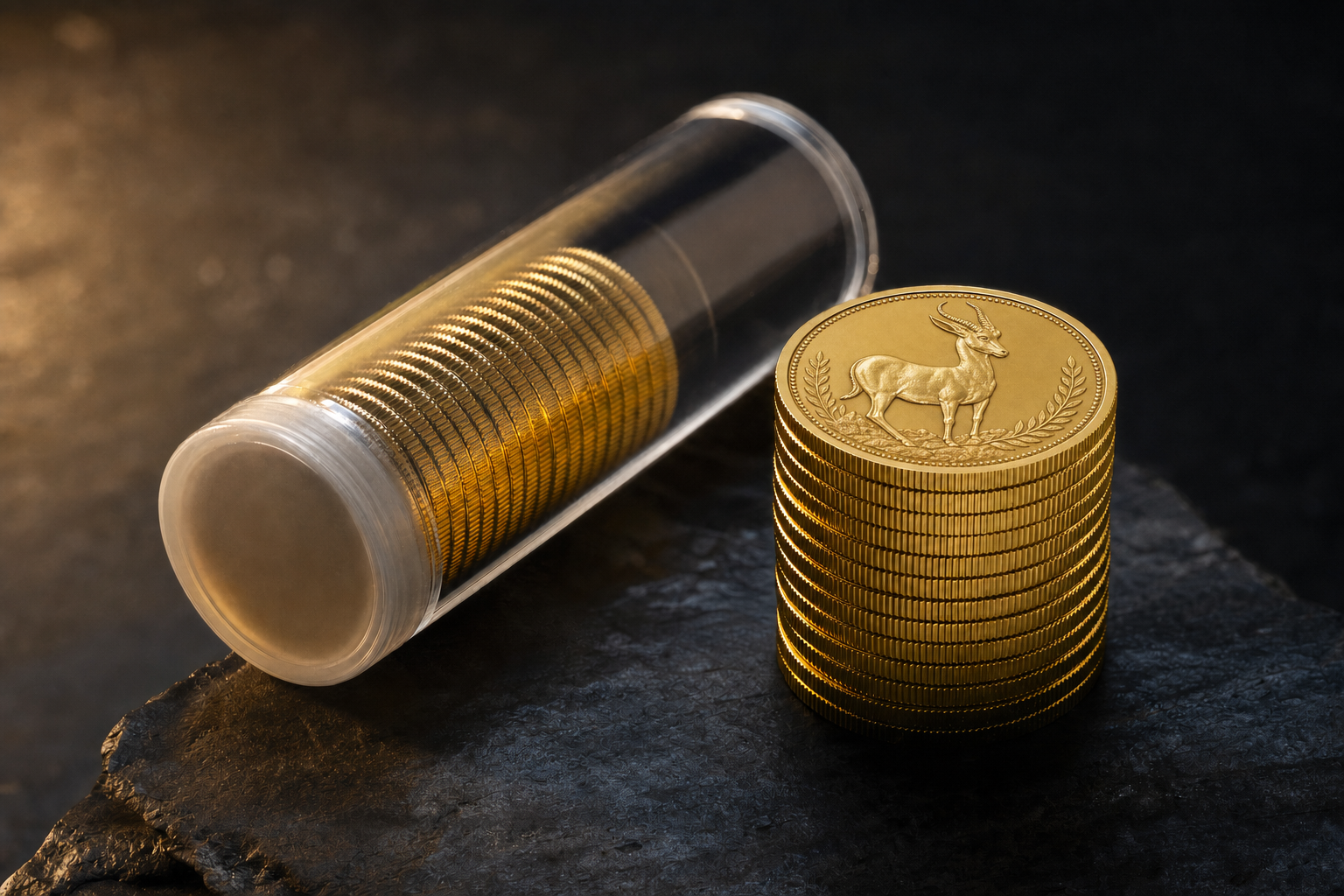
Almost exclusively the coins considered for investor packages are those that are known worldwide, minted in their millions and can be valued at any trading venue without lengthy explanation. This liquidity is the real reason why the range of gold coins in the investment sector is concentrated on a handful of names.
| Coin | Fineness | First minted | Origin |
|---|---|---|---|
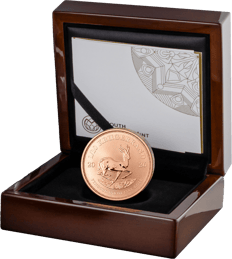
| Krugerrand | 916.7/1,000 (22 carat) | 1967 | South Africa |
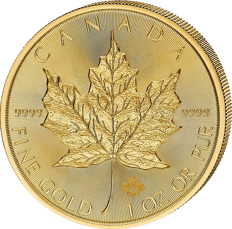
| Maple Leaf | 999.9/1,000 | 1979 | Canada |
| Vienna Philharmonic | 999.9/1,000 | 1989 | Austria |
| Britannia | 999.9/1,000 (since 2013) | 1987 | United Kingdom |
| American Eagle | 916.7/1,000 (22 carat) | 1986 | USA |
| Kangaroo | 999.9/1,000 | 1986 | Australia |
A common misunderstanding concerns fineness: a Krugerrand at 22 carat still contains exactly one troy ounce of fine gold. The copper admixture simply increases the gross weight to 33.93 grams and makes the surface noticeably more scratch-resistant, a practical advantage for coins that are handled frequently. Coins minted from 999.9 fine gold, such as the Vienna Philharmonic from the Austrian Mint, are softer by comparison and consistently belong in a capsule or tube.
Gold bars form the second pillar of investment packages alongside coins. They carry no national emblem and no face value, but their premium is generally lower, making them the most direct route from purchase price to fine weight. A distinction is drawn between minted bars (up to around 100 grams, with a clean surface and serial number in a blister pack) and cast bars of larger units with a more rustic appearance.
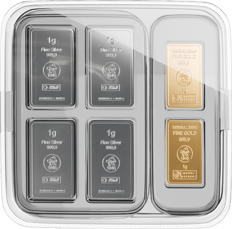
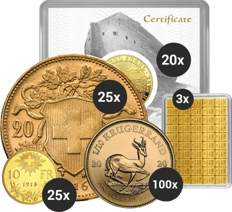
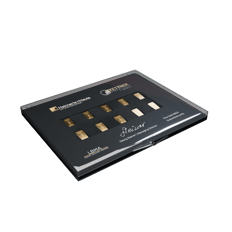
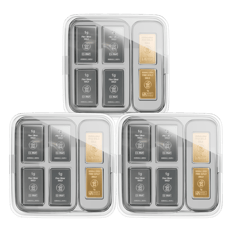
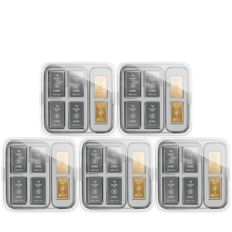
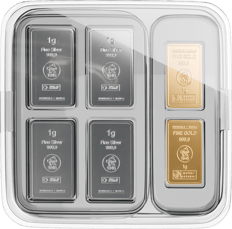
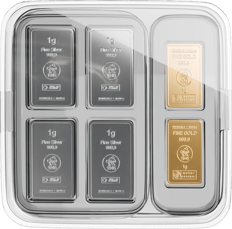
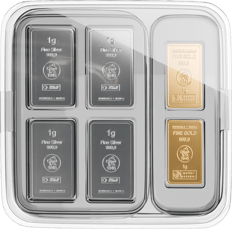
Small weights are especially widespread in the package business, because individually they would hardly be economical to trade: 1-gram bars in a bundle, CombiBars for breaking off individual gram units, or collector's boxes with half-gram pieces. The gold CombiBar solves an old problem here: it provides the divisibility of small gold without every gram having to be individually packaged and checked.
Provenance is decisive: bars from recognised refineries, such as Heraeus, Umicore, Valcambi or C.Hafner, carry a mint mark, fineness statement and serial number, making them undisputed upon resale. An intact blister pack with a legible certificate is as good as cash and should never be opened.

An investor package is not a trading position for next month, but a decision made with decades in mind.
The most important question before buying is not which coin, but which size. One troy ounce of fine gold in a single piece is the cheapest way to acquire gold, but also the least flexible, because the value cannot be split up. Ten tenth-ounce coins of the same fine weight cost noticeably more premium, but can be sold or given away individually.
Packages with 1/10-ounce coins or gram bars aim less at cost efficiency than at the ability to act. Anyone who views gold as a reserve for situations in which payment channels are disrupted needs small, widely recognised units: nobody exchanges a whole ounce for a minor purchase. The same logic also shapes the composition of many precious metal sets.
For long-term wealth building, one-ounce coins and bars from 100 grams upward form the foundation, because here the smallest share of the purchase price flows into ancillary costs. In practice, a pyramid structure proves itself: a solid base of large units, topped by a narrower layer of small gold for flexibility. Anyone building up gradually rather than in one lump sum will find suitable structures among the savings plan products.
The tax framework is one of the main reasons why physical gold is so widespread in Germany. Investment gold is exempt from VAT on purchase, unlike silver coins, for which margin scheme taxation applies depending on origin. This exemption is tied to clear criteria and applies to bars from 995/1,000 fineness as well as to coins from 900/1,000 fineness that were minted after 1800, are or were legal tender in their country of origin, and whose price does not exceed the material value by more than 80 percent.
Tax notice
Investment gold is exempt from VAT under § 25c UStG. Profits from the sale of physical precious metals remain tax-free under § 23 EStG if more than one year lies between acquisition and sale; within this period, an allowance applies to all private sales transactions within a given year. This information does not replace tax advice; the individual situation is decisive.
In practice, this leads to a simple rule: keep purchase receipts. Only those who can prove the date and price of acquisition can later demonstrate that the one-year holding period has elapsed. For larger packages, a simple inventory list with quantity, coin type, year of issue, fine weight and purchase date is recommended; it helps both with sale and in the event of inheritance. For anonymous over-the-counter cash purchases, there is a statutory threshold of 2,000 euros in Germany; in mail-order business, the buyer is identified in any case through the payment and delivery data.
The larger the holding, the more important two topics become that are easily overlooked when buying individual pieces: verification and storage. Reputable dealers subject incoming goods to standardised procedures: weighing to the hundredth of a gram, dimensional checks of diameter and thickness, ultrasonic time-of-flight measurement and X-ray fluorescence analysis. Kettner Edelmetalle uses an ISO-compliant authenticity verification process in a fully automated high-security logistics centre for this purpose; goods leave the premises 100 percent insured.
For storage, the rule is: dry, dark, mechanically protected and out of sight. Smaller holdings are well kept in coin capsules and a sturdy coin case, larger ones belong in a certified safe or a bank safe deposit box. It is important to check your home contents insurance: narrow compensation limits apply for cash and valuables, which can usually only be raised with a certified security cabinet. A discreet can safe does not replace a proper safe, but serves as an additional hiding place for small units. And wherever the gold is kept, at least one trusted person should know the storage location.
Gold pays no interest, no dividend and no rent. Its contribution to wealth lies elsewhere: it is a tangible asset without counterparty risk, unlike certificates or fund shares on gold, its existence does not depend on any issuer, custodian bank or delivery promise. Historically, the price trajectory of gold has often developed differently from that of equities and bonds; viewed over the long term, physical precious metal therefore serves diversification, as a building block for inflation hedging and as a quiet reserve, not as a substitute for a liquid account. The actual performance is determined by the market alone; reliable forecasts are not possible.
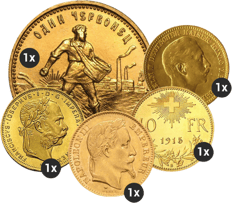
Investor packages in particular are often bought with a time horizon that extends beyond one's own lifetime. A tube of one-ounce coins is divisible, transferable and understood in every currency in the world, qualities that make it interesting for succession planning and retirement provision. Anyone wishing to diversify further can combine gold with white metals from the silver range, or add historical coins such as the gold coins from the German Empire, which carry a collector's value alongside their material value. An overview of all bundle sizes and metals is provided in the overview of Investor Packages.
The price difference does not arise from the metal, but from the premium. Purchasing whole original packaging units, a single picking and packaging process, and shared insured shipping lower the ancillary costs per gram of fine gold. The larger the unit, the smaller the percentage surcharge on the material value.
Bars offer the lower premium and therefore more fine gold per euro invested. Bullion coins, on the other hand, are known worldwide, carry a state face value and can be easily identified even without a testing device. Many holdings contain both: bars as the foundation, coins for flexibility and tradability.
No. Investment gold is exempt from VAT under § 25c UStG, provided the statutory criteria regarding fineness, year of minting and price margin above the material value are met. The situation is different for silver: there, VAT is charged, often in the form of margin scheme taxation for imported silver coins.
Common bullion coins and bars from recognised refineries are bought back worldwide; the price is based on the current gold price. A package does not have to be sold as a whole, partial sales are the norm. Original packaging, certificate and purchase receipt speed up the process and have a positive effect on the price achievable.
For getting started, packages with 1/10-ounce coins or small bars have proven their worth, because they limit the capital outlay and keep the holding divisible. As the portfolio grows, the focus usually shifts towards one-ounce coins and bars from 100 grams, where the cost share of the purchase price is considerably smaller.
Precious metals travel in neutral packaging with no indication of the contents and are fully insured. Packages marked as in stock come from the company's own warehouse and are generally shipped within a few business days; Kettner Edelmetalle delivers 100 percent insured from a fully automated high-security logistics centre. Upon receipt, the rule applies: open the shipment in the presence of a witness and check the contents against the delivery note, that is quantity, coin type, year of issue and fine weight.
Stay informed with product launches, financial news and exclusive offers. Sign up for our free newsletter today.
By entering your email address and clicking the "Submit" button, you give the following consent: "I agree to be informed by email about new products, financial news and exclusive offers, and therefore consent to the processing of my email address for the purpose of sending the newsletter. I can revoke this consent at any time without giving reasons, with effect for the future. The lawfulness of processing carried out prior to revocation remains unaffected."