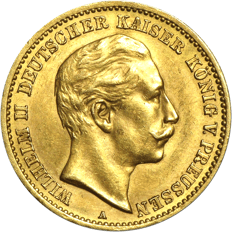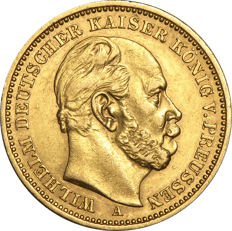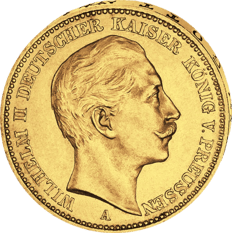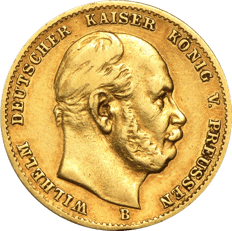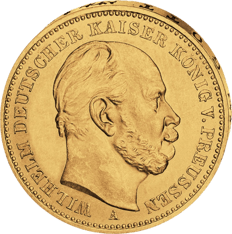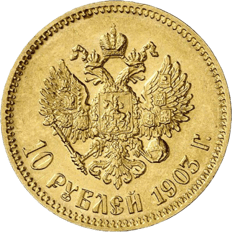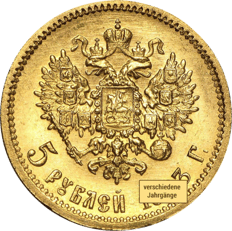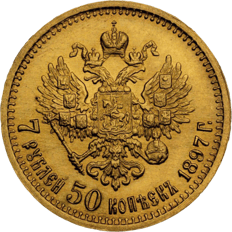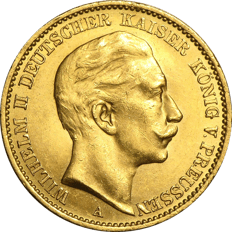
20 Mark Prussia Wilhelm II Gold Coin
£918.44
VAT-free and excl. shipping
Available in 2–3 business days

 More than 300,000
 Over 30 years
 Secure shipping
 Google: 4.9/5
Between 1871 and 1915, the Imperial gold coins were produced in denominations of 5, 10 and 20 Reichsmark. Unlike many other gold coins, the Imperial gold coins were actually legal tender. Today, they are highly sought after, especially among collectors.


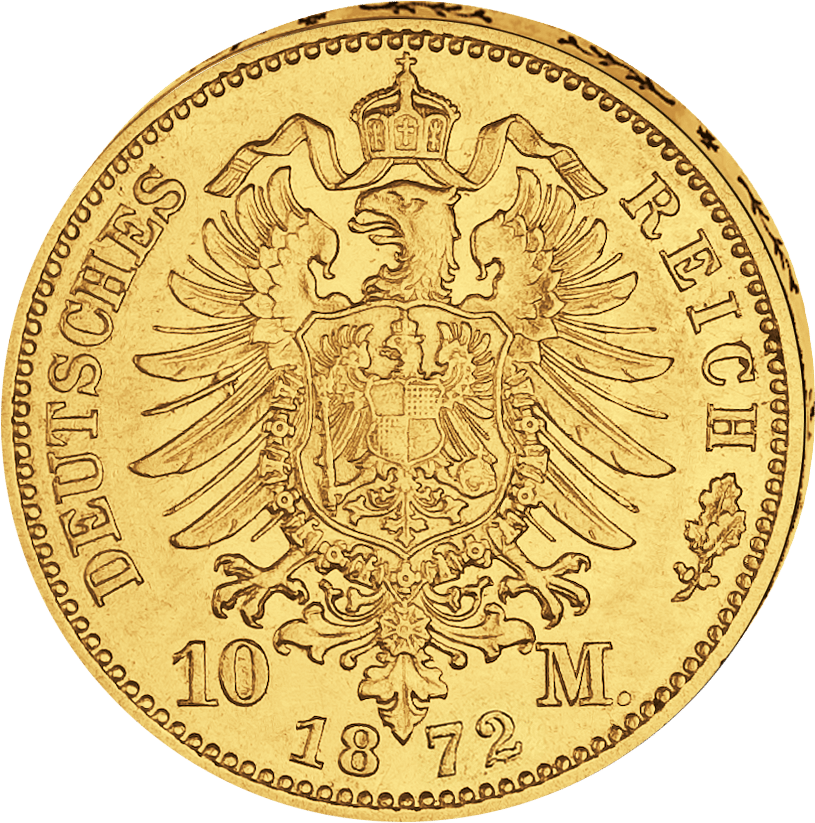
On 4 December 1871, the young Empire enacted the law on the new gold coins. The first 20‑mark pieces were struck in Berlin that same month.
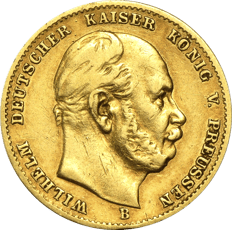
Each gold coin bears the image of its own state on the front, usually its ruler, and the imperial eagle on the back. The 10- and 20‑mark pieces here come from Prussia.
The Coinage Act of 1873 replaced the thaler, the gulden and the other state currencies. From one pound of fine gold, 1,395 marks were struck.
1871
The first imperial gold coin
The law of 4 December introduces the mark as the new unit of account, divided into 100 pfennigs.
1873
The mark becomes the Empire’s currency
The Coinage Act of 9 July makes the mark the currency of the entire Empire. It takes two and a half years to become legal tender everywhere.
1876
The Reichsbank opens
On 1 January, the mark is legal tender throughout the Empire, and the Reichsbank begins its work.
1913
The last imperial portrait
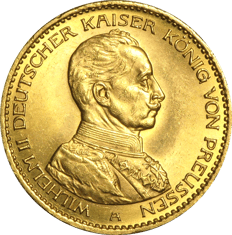
The last Prussian issue shows Wilhelm II in uniform. It is now struck only in Berlin.
1914
Paper instead of gold
On 31 July, one day before Germany’s declaration of war on Russia, the Reichsbank stops redeeming its notes for gold. After almost 43 years, gold coins disappear from everyday life.
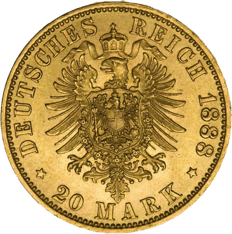
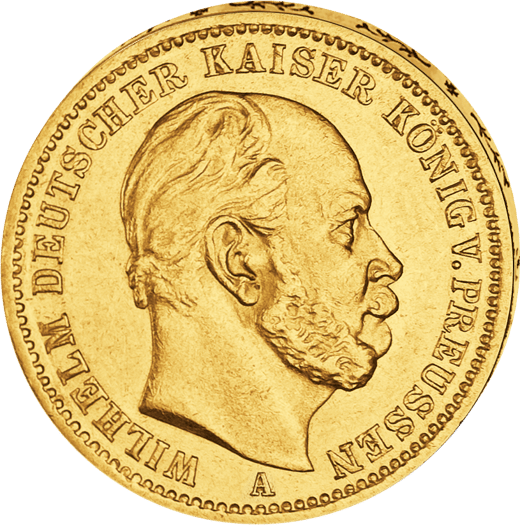
In 1888, the Berlin Mint struck 20‑mark pieces with three different emperors. Wilhelm I died on 9 March, his son Frederick III on 15 June. On the same day, Wilhelm II succeeded him.
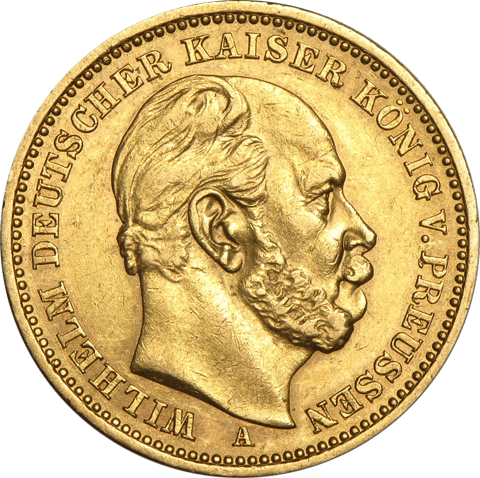
Wilhelm I
1871 to 1888
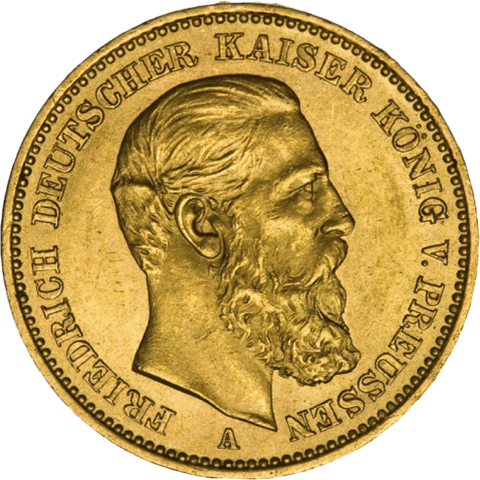
Frederick III
99 days
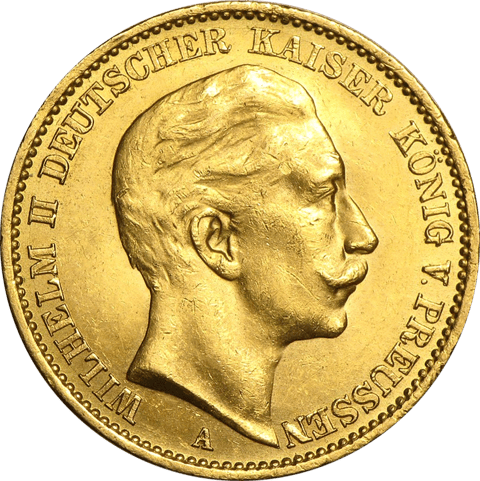
Wilhelm II
1888 to 1918
Gold coins with Frederick III therefore exist only from 1888 and only with the mint mark A for Berlin.
As a gift
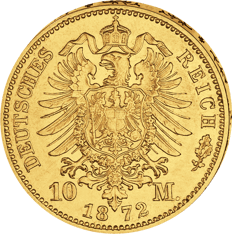
The 10‑mark piece of 1872, the first year of issue, in a coin card, containing half as much gold as a 20‑mark piece.
View the 1872 10‑mark piece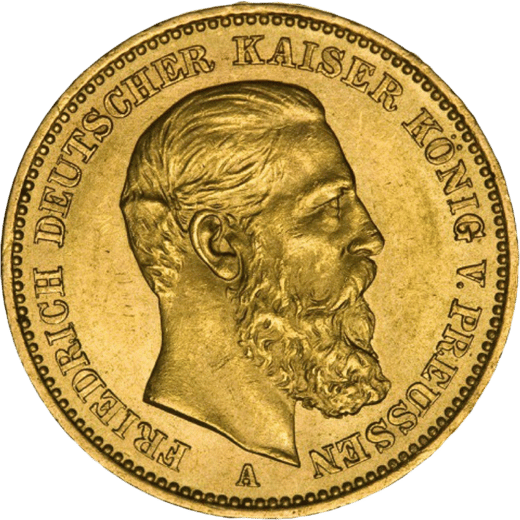
For collectors
Frederick III, the 99‑day emperor. Every one of his 20‑mark pieces bears the date 1888.
View the Frederick III piece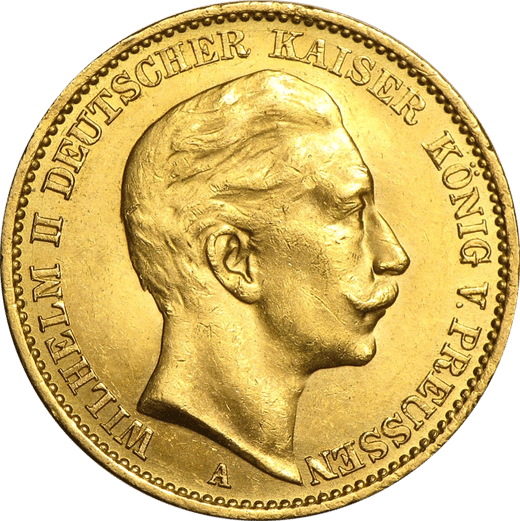
As a reserve
The 20‑mark piece with Wilhelm II, in .900 gold with 7.168 g of fine gold per coin.
View the 20‑mark pieceOver a hundred years old. And still gold.
Historical details based on the Reichsgesetzblatt, the Deutsche Bundesbank, the German Bundestag, the German Historical Museum, the Federal Agency for Civic Education, economic history studies of the Goldmark and numismatic catalogues.
Anyone who picks up an Imperial gold coin holds a piece of German history: minted between 1871 and 1915, gold from the German Empire was once genuine legal tender and passed through countless hands. Today, the 5, 10 and 20 Mark coins made of fine gold combine two worlds in a single piece: the tangible material value of the precious metal and the aura of a bygone era. This guide covers the history, denominations, the designs of the federal states, authenticity features, the notorious forgeries and the tax treatment, and shows why the Double Crown remains one of Germany's most popular historical bullion coins to this day.
With the founding of the German Empire in 1871, a patchwork of currencies came to an end: in the northern German territories, people reckoned in Thalers, in the south in Guilders, and regional Crowns also circulated alongside them. The new imperial currency, the Mark, created for the first time a means of payment valid in all federal states. The Mark was backed by gold: banknotes could be exchanged for gold coins at the Reichsbank at any time, which gave the currency great stability.
The gold for the first mintings came largely from the French reparation payments after the Franco-Prussian War of 1870/71: melted-down gold francs were re-struck into German Mark coins. Because the purchasing power of a gold Mark was enormous, the coins rarely stayed in circulation for long and were mainly used for larger purchases. As part of the broad family of German gold coins, Imperial gold coins mark the beginning of a national minting tradition that continues to this day with the Goldmark and the Goldeuro.
The First World War ended this era: from 1914, gold disappeared from payment transactions, replaced by paper money without real backing. Anyone who owns an Imperial gold coin today holds a testament to the last German gold currency.
Our German trade gold, and with our emperors on it, too: a special feeling to hold this history in your hands and sense through how many hands this coin must already have passed.
Imperial gold coins were issued in three face values. All of them consist of a 900 gold alloy with 10% copper added, which made the coins scratch-resistant and suitable for everyday use. Incidentally, from 1875 the coins were officially called "Crowns": the 10 Mark piece counted as a Crown, the 20 Mark as a Double Crown, and the 5 Mark as a half Crown. Because of its reddish copper tint, the 20 Mark coin was also popularly nicknamed Goldfuchs (gold fox).
| Face value | Fineness | Gross weight | Fine gold | Diameter |
|---|---|---|---|---|
| 5 Mark | 900/1,000 | 1.99 g | 1.79 g | 17.0 mm |
| 10 Mark | 900/1,000 | 3.98 g | 3.58 g | 19.5 mm |
| 20 Mark | 900/1,000 | 7.96 g | 7.17 g | 22.5 mm |
The 20 Mark Double Crown is by far the best-known and most frequently traded Imperial gold coin. With around 7.17 grams of fine gold, a diameter of 22.5 mm and the edge inscription "GOTT MIT UNS" (God with us), it is roughly the size of a one-euro coin. Because more than 190 million examples of the 20 Mark coin alone were minted over the decades, common years, such as the Prussian issues featuring William II, remain available in good quantities to this day and trade close to the pure gold price.
The 10 Mark Crown contains 3.58 grams of fine gold and is the smaller sibling of the Double Crown, ideal for anyone seeking a historical gold coin with a lower capital outlay. The 5 Mark coin, on the other hand, was only minted in 1877 and 1878: with a diameter of just 17 mm, it was considered too small and impractical, kept returning to the Reichsbank, and was withdrawn from circulation in 1900. This is precisely why it is today the rarest denomination and, at the same time, the most frequently forged.
Unlike modern bullion coins, Imperial gold coins do not have a single design but an entire panorama of them. The reason: the Empire was a union of kingdoms, grand duchies, duchies, principalities and free cities, and each territory had its own design side struck. The value side, by contrast, remained uniform and showed the Imperial Eagle, the year of minting, the face value and a letter for the mint.
The most widespread are the Prussian issues featuring the three German Emperors:
In addition, there are issues from numerous federal states, such as the Kingdom of Bavaria (Ludwig II, Otto, Ludwig III), the Kingdom of Saxony with Kings Johann, Albert and Georg, the Grand Duchies of Baden, Württemberg and Hesse, as well as many smaller houses such as Saxe-Coburg and Gotha, Mecklenburg-Schwerin, Mecklenburg-Strelitz, Reuss or Schaumburg-Lippe, the latter ruled by a prince. The Free Cities of Hamburg, Bremen and Lübeck displayed their city coat of arms instead of a ruler. For collectors, this diversity opens up a vast field that can be assembled into an impressive collection, yet one that is almost never complete, a charm similar to the design worlds of the Vreneli or the Sovereign from elsewhere in Europe.
For unambiguous cataloguing, all German coins since 1871 carry a Jäger number, named after the numismatist Kurt Jäger. It simplifies identification and serves as the central reference in any reputable trade. For example, behind the 20 Mark Prussia coin lie numbers such as J.243, J.246, J.250, J.252 and J.253, depending on the emperor and year of issue.
The mint letters reveal the origin: A stands for Berlin, B for Hanover, C for Frankfurt, J for Hamburg; there were also other mints, such as Munich (D) or Stuttgart (F). Important for valuation:
Because of this range, a comparison with classic investment gold is worthwhile: anyone focused primarily on material value will find more predictable premiums in gold bars or modern bullion coins such as the Krugerrand, whereas Imperial gold coins bring the added appeal of history.
Hardly any other collecting area is as heavily affected by forgeries. Notorious are the restrikes made by ophthalmologist Dr. Karl-Heinz Schmidt and his sister Ilona Hausmann, who professionally restruck hundreds of thousands of Imperial gold coins between 1959 and 1962. At the time this was still legal; only later was the unmarked restriking of former German circulating gold coins made a criminal offence, and the two were convicted in 1963. By then, however, so many restrikes had entered circulation that for years they were even sold as investment gold at bank counters.
What to look out for
Especially for the 5 Mark Imperial gold coin, a large proportion of the pieces in circulation are considered restrikes or forgeries. Verification criteria include weight, diameter, edge inscription, material, and whether the design and year match the Jäger catalogue. Schmidt-Hausmann restrikes still turn up on online auction platforms to this day.
The safest protection is to buy from an established dealer with trained authenticity verification. Kettner Edelmetalle uses an ISO-compliant inspection for this purpose, so that every coin offered is checked before shipping. Anyone who wants to store their pieces safely afterwards will find suitable protection against scratches and environmental influences in coin capsules and coin cassettes.
As gold coins with a high fineness, Imperial gold coins generally count as VAT-exempt investment gold: in Germany, the purchase of investment gold is exempt from VAT pursuant to § 25c UStG. If a gold coin is sold privately after a holding period of more than one year, any capital gain is tax-free under current law. This is general information and does not replace tax advice; the specific circumstances decide each individual case.
The same principles apply to storage as for other investment gold: a safe place at home, a safe or a bank safe deposit box, ideally insured. Because of their potential collector's value, historical coins should also be additionally protected against mechanical damage; it is worth taking a look at the accessories range here. For building up a broader position, Imperial gold coins are suitable as a historical building block alongside regular purchases via savings plan products.
When it comes to buying and selling, the following applies: common 20 Mark issues are highly fungible, meaning they can be traded easily at any time, as they are known throughout Germany. For the pure material value, a comparison with the classic gold range is worthwhile; anyone who appreciates historical pieces from other countries will find related options among the ducats or the crowns.
Imperial gold coins appeal equally to two groups of buyers. Investors value the common 20 Mark Double Crowns for their high gold content and good availability; they trade close to the gold price and can be sold on again without any problems. Collectors, on the other hand, are drawn by the enormous diversity of designs from the federal states, the hunt for rare years, and the idea of owning an original piece of the last German gold currency.
Beginners in particular, who want to combine historical pieces with an investment character, will find an ideal starting point here, and can later expand their collection with international classics such as the Vienna Philharmonic or the Maple Leaf. Anyone who is more interested in purely German issues will discover further facets in the broader category of German gold coins.
Imperial gold coins are the gold coins of the German Empire that were minted between 1871 and 1915 in face values of 5, 10 and 20 Mark. They consist of a 900 gold alloy and were originally genuine legal tender of the gold-backed Mark currency.
The 20 Mark coin weighs 7.96 grams at a fineness of 900/1,000 and thus contains around 7.17 grams of pure gold. The diameter is 22.5 mm, and the edge inscription reads "GOTT MIT UNS" (God with us).
The Jäger number is a cataloguing system for German coins since 1871, named after the numismatist Kurt Jäger. Each issue is assigned a unique number that identifies the design, face value and issuing territory, making identification and valuation easier.
Clues are given by deviations in weight, diameter, edge inscription and material, as well as a combination of design and year that does not exist according to the Jäger catalogue. Particular caution is advised with the 5 Mark issue. The safest protection is to buy from a dealer with professional authenticity verification.
Gold coins with a high fineness generally count as investment gold and are exempt from VAT pursuant to § 25c UStG. Under current law, a private capital gain is tax-free after a holding period of more than one year. This is general information and not tax advice.
The Empire consisted of many constituent states with their own rulers. That is why the design sides showed different emperors, kings, dukes, or, in the case of the Free Cities of Hamburg, Bremen and Lübeck, the city coat of arms, depending on the issuing territory. The value side with the Imperial Eagle, by contrast, remained uniform.
 German Empire
Stay informed with product launches, financial news and exclusive offers. Sign up for our free newsletter today.
By entering your email address and clicking the "Submit" button, you give the following consent: "I agree to be informed by email about new products, financial news and exclusive offers, and therefore consent to the processing of my email address for the purpose of sending the newsletter. I can revoke this consent at any time without giving reasons, with effect for the future. The lawfulness of processing carried out prior to revocation remains unaffected."