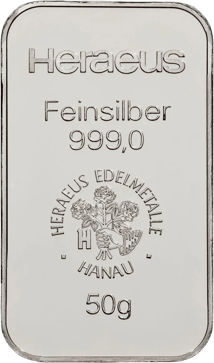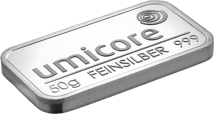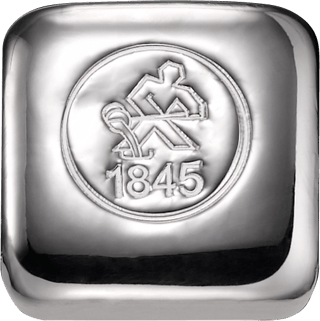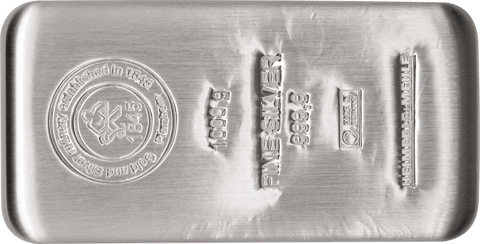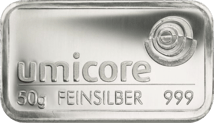
50g Silver Bar (various manufacturers)
£141.48
incl. VAT and excl. shipping
Available in 2–3 business days

 More than 280,000
 Over 30 years
 Secure shipping
 Google: 4.9/5


Silver bars range from a few grams to about 31 kilograms. Between 10 grams and 15 kilograms, the small ones are usually minted and the large ones cast. Where one stops and the other begins, each house decides for itself.
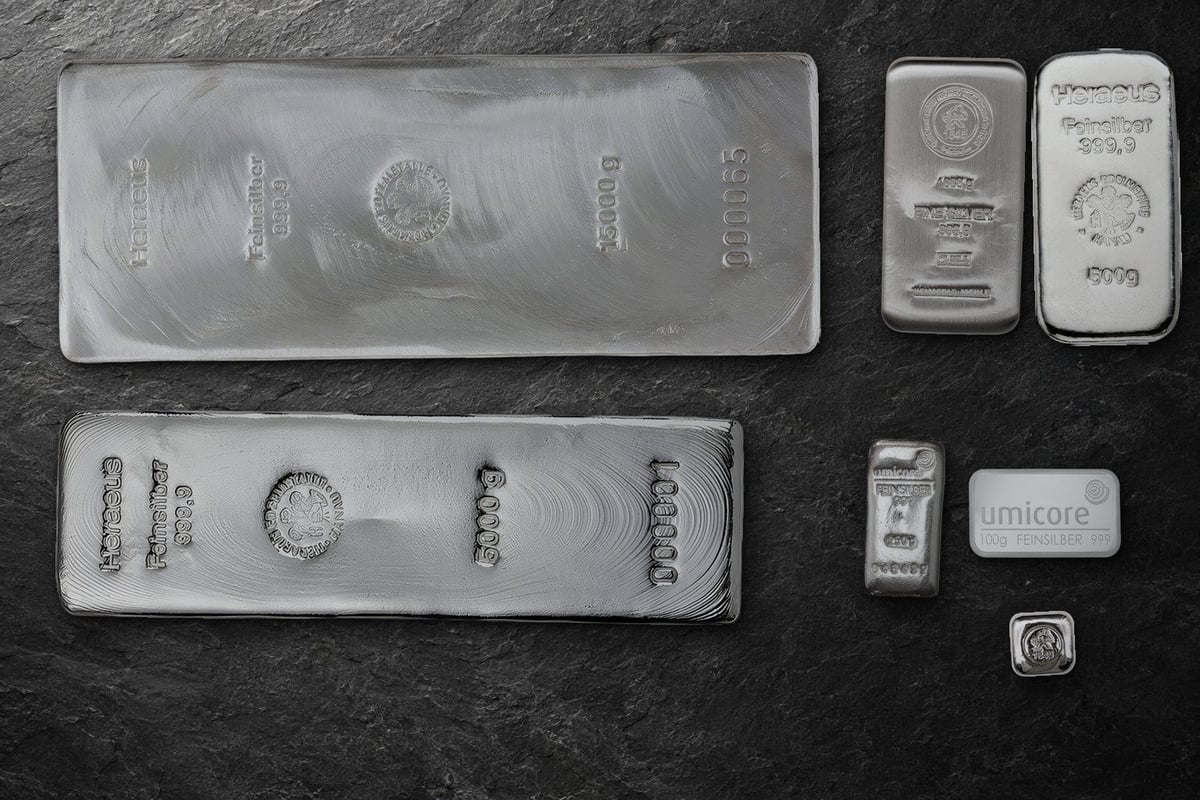
Umicore mints its silver bars from 10 to 100 grams. From 250 grams on, the house casts them, right up to 15 kilograms.
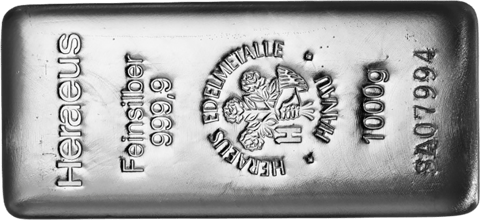
At Heraeus, the line falls in the same place. There, the ounce and 100 grams are minted, while 250 and 500 grams and 1, 5 and 15 kilograms are cast.
Other houses draw the line somewhere else entirely. Heimerle + Meule already casts the ounce, a small square with sides of 23.5 millimetres. Valcambi still mints the kilo, 130 millimetres long and 11.2 millimetres thick.
The larger the bar, the more likely it is cast.
Sizes according to the makers, for Heraeus only the sizes the house itself lists; the minted ounce from Heimerle + Meule according to its bar in the shop. On the axis, it is as far from 10 to 100 grams as from 100 grams to 1 kilogram.
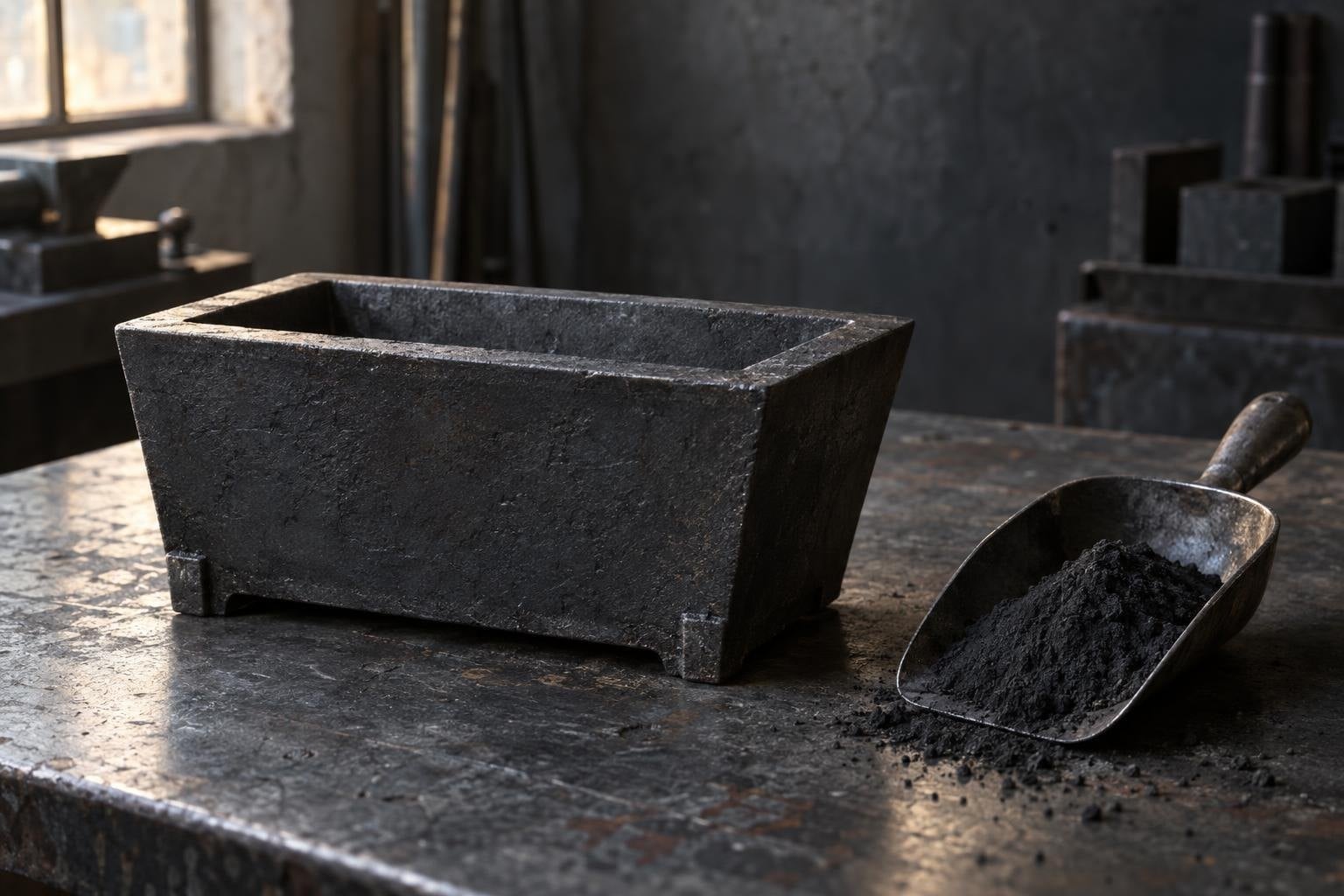
When pure silver melts, it takes up oxygen from the air. As it solidifies, the oxygen escapes again, and that can happen violently. Old encyclopaedias call it spitting.
“When melted in contact with air, pure silver absorbs a great deal of oxygen, which, however, escapes at the moment of solidification …”
Pierer’s Universal‑Lexikon, volume 16, 1863, entry “Spratzen”, translated
In doing so, the oxygen breaks through the crust that has already set and drives out the silver that is still liquid, into a spongy mass from which beads of silver leap. That is how Pierer’s encyclopaedia describes it.
The chemist Gay‑Lussac caught the oxygen under a bell jar filled with water. He obtained twenty to thirty times the volume of the silver, Pierer reports. In 1911, the Encyclopaedia Britannica gives twenty times. These are figures from encyclopaedias of 1863 and 1911, not present-day measurements.
The remedy is given in the same article: stir while the silver solidifies, “but best of all” sprinkle charcoal powder on it before it sets. According to Pierer, silver with 1 to 2 percent copper does not spit, but pure silver does.
The oxygen is not entirely out of the picture. When a refinery on the London list assays its silver with a spectrograph today, oxygen and nitrogen expressly count as silver.
Diagram after the description in Pierer’s Universal‑Lexikon of 1863, not to scale.
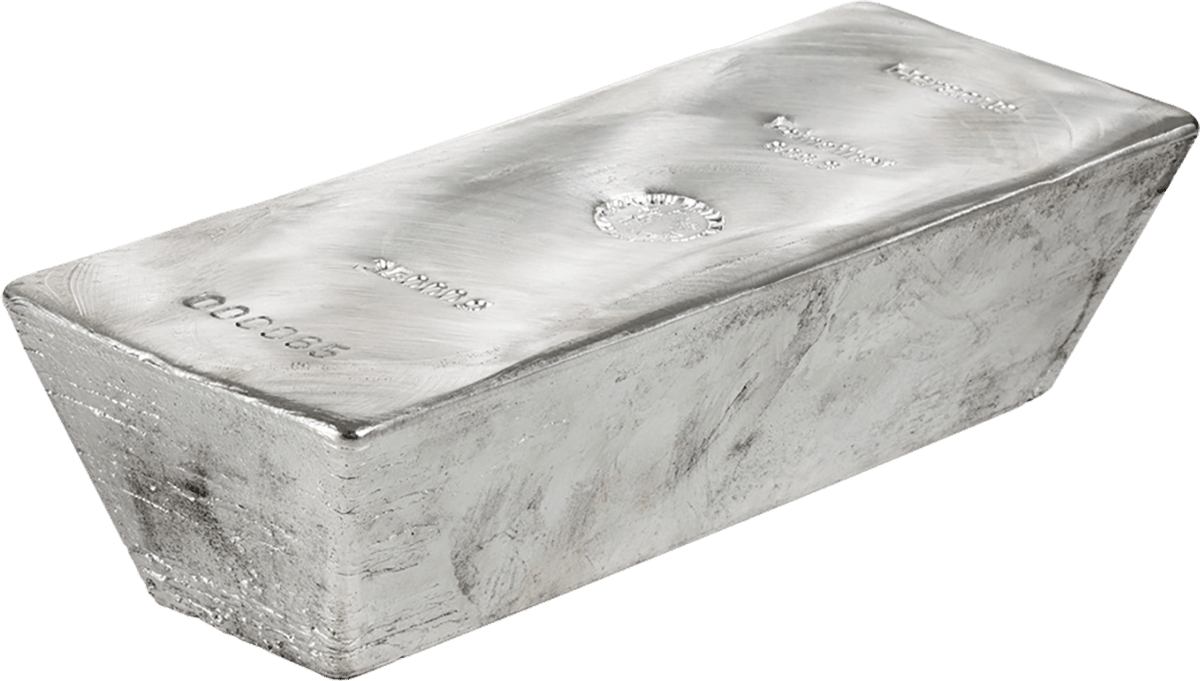
Silver contracts strongly as it solidifies, the Meyers encyclopaedia of 1909 writes. On a cast bar, this shows on top: the top face can sink slightly in the middle, and rings from cooling can appear as well.
“Excessive shrinkage (i.e. the concavity of the top face of the Bar and any concentric cooling rings) must not significantly affect the clarity of the Bar marks or the safe stacking of the Bars.”
LBMA, Good Delivery Rules, Technical Specifications, section 2.1.4
The LBMA is the association of the London precious metals market. Its rules are written for the large bars of this market. They show what happens when silver is cast.
Silver has rules of its own there. A little hammering of the surface is allowed; for gold, at most the smoothing of a sharp burr. And closed moulds have been banned for silver since 2008, mainly because hidden cavities can form in them.
Cast bars are wider at the top than at the bottom. On the 15‑kilogram bar from Umicore, the top face measures about 235 by 100 millimetres and the bottom 210 by 80, with a height of 75 millimetres. For its silver bars, the LBMA requires a slope of 5 to 15 degrees, so that they are easy to grip.
Calculated from Umicore’s dimensions, the sides of its cast bars slope at about 6 to 10 degrees.
A cast bar shows on its top face how it solidified.
Dimensions from Umicore. In gold, the top face, the dip in it only suggested: its depth has not been measured. The slope is calculated from the top and bottom widths and the height.
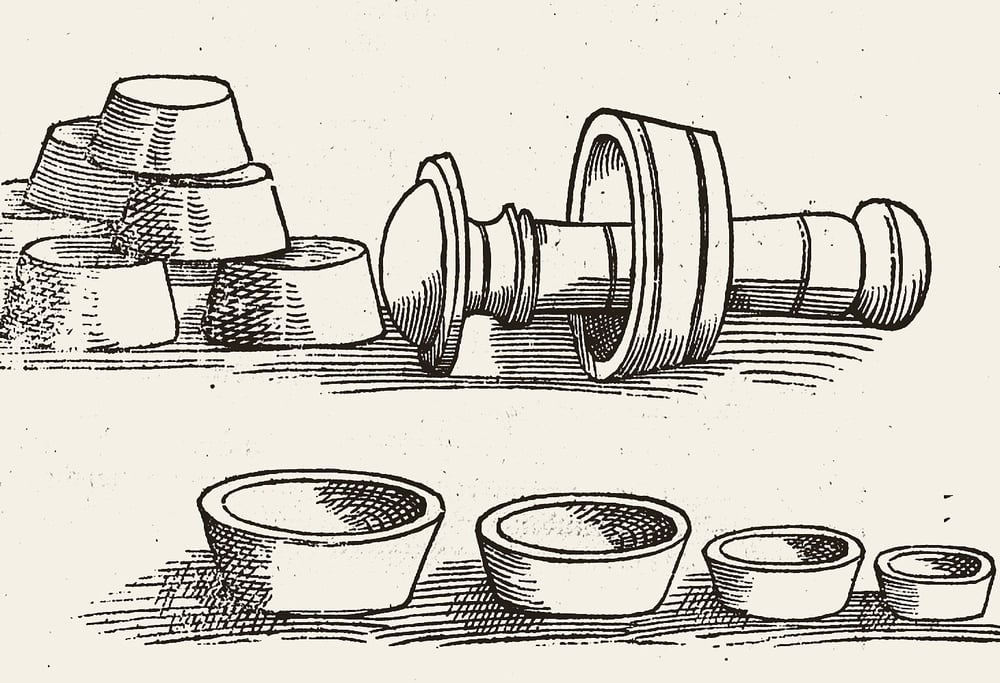
For gold, the LBMA requires its referee laboratory to carry out the fire assay, at least six times. For silver, the laboratory measures what is not silver and subtracts it from 1,000 parts.
“In the case of silver, the Referee will normally use one or other spectrographic analysis method and determine the silver assay by difference (with dissolved gases such as oxygen counting as silver).”
LBMA, Good Delivery List Rules, January 2026, Annex D, section 2.3
These are the rules for the refineries on the London list. They show how differently the two metals are assayed.
For a long time, silver was assayed in fire, in small dishes called cupels. In 1832, the French mint commission published instructions by Gay‑Lussac, the same man who had caught the oxygen in silver. After that, it could also be done “by the wet way”: the silver is precipitated with a solution of common salt instead of being assayed in fire in the cupel.
In 1874, Jacob Volhard described another wet method, with thiocyanate instead of common salt.
The common salt assay lives on in the standards. ISO 13756 determines silver in jewellery and precious metals with sodium or potassium chloride, ISO 11427 with potassium bromide, both today in the edition of 2024 and for silver contents of 100 to 999 parts per thousand. For higher contents, both name spectroscopy by difference.
With silver, the rest is what counts: 1,000 parts minus everything foreign.
According to the LBMA rules of January 2026. The foreign share is drawn greatly enlarged.
Stamping the weight onto the bar is an old practice. The silver treasure of Kaiseraugst in Switzerland includes a bar from shortly after AD 350. Punched into it is P III, three Roman pounds.
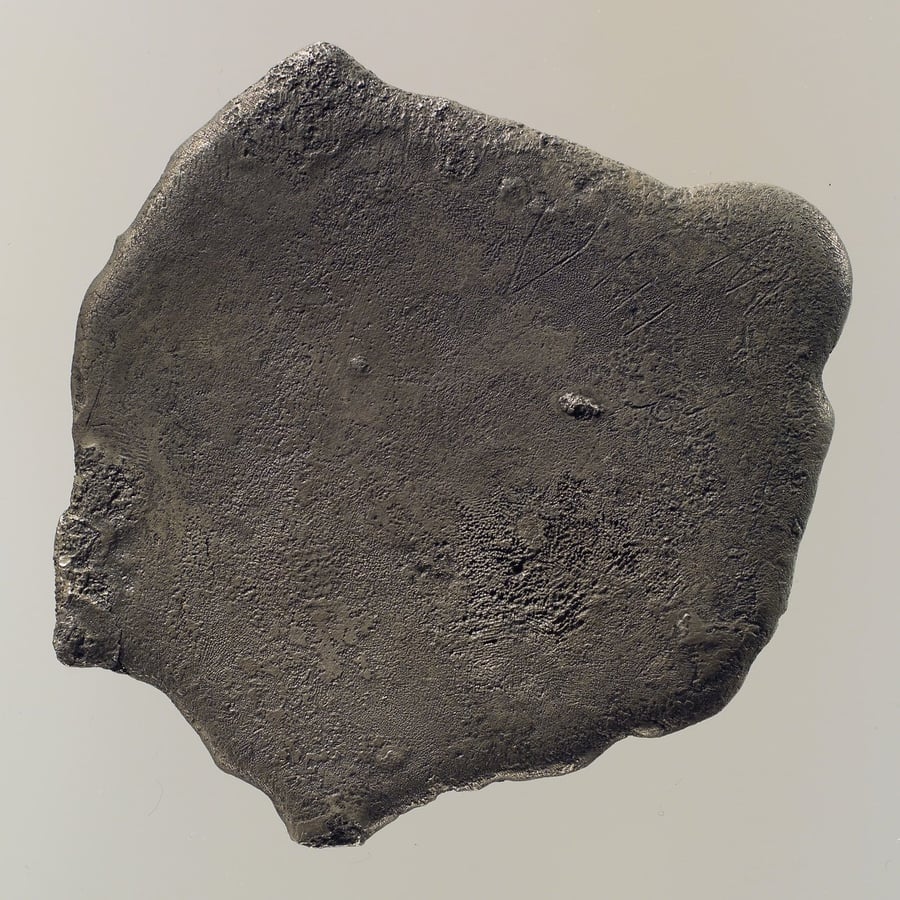
The bar measures 12.3 by 7.8 centimetres and is 1 centimetre thick. It weighs 947.8 grams, which corresponds to three Roman pounds.
Beside it are two small stamps reading GRONOPI, probably the name of the official in charge, and a round stamp with the bust and name of the Emperor Magnentius.
A kilo bar of today weighs almost the same, yet has a different shape. The cast kilo bar from Heraeus measures 111 by 51 millimetres and is 21 millimetres thick, more than twice as thick as the Roman bar.
Much older still is a silver bar with Hittite hieroglyphs in the Metropolitan Museum in New York, from the 14th to 13th century BC.
More than 1,650 years ago, the weight was already on the bar.
Dimensions: Augusta Raurica, Augster Blätter zur Römerzeit 10, and the makers. All three from above at the same scale, the kilo bars as product photos from the shop, the Roman bar drawn as an outline to its dimensions.
Receive a free and individual precious metals offer matching your financial goals within just a few minutes.
 Request offer now
Der 50 g Silberbarren zählt zu den beliebtesten Stückelungen im Silberbereich -- groß genug, um den Spread gegenüber kleineren Einheiten spürbar zu drücken, und gleichzeitig handlich genug für flexible Teilverkäufe. Mit einem Feingehalt von 999,9 aus den Prägestätten von Heraeus, Argor-Heraeus, Umicore, Heimerle & Meule oder Valcambi richtet sich diese Größe an Einsteiger ebenso wie an erfahrene Stapler. Dieser Ratgeber beleuchtet Herstellung, Prüfverfahren, steuerliche Besonderheiten, Aufbewahrung und die wichtigsten Kaufkriterien rund um den 50-Gramm-Silberbarren.
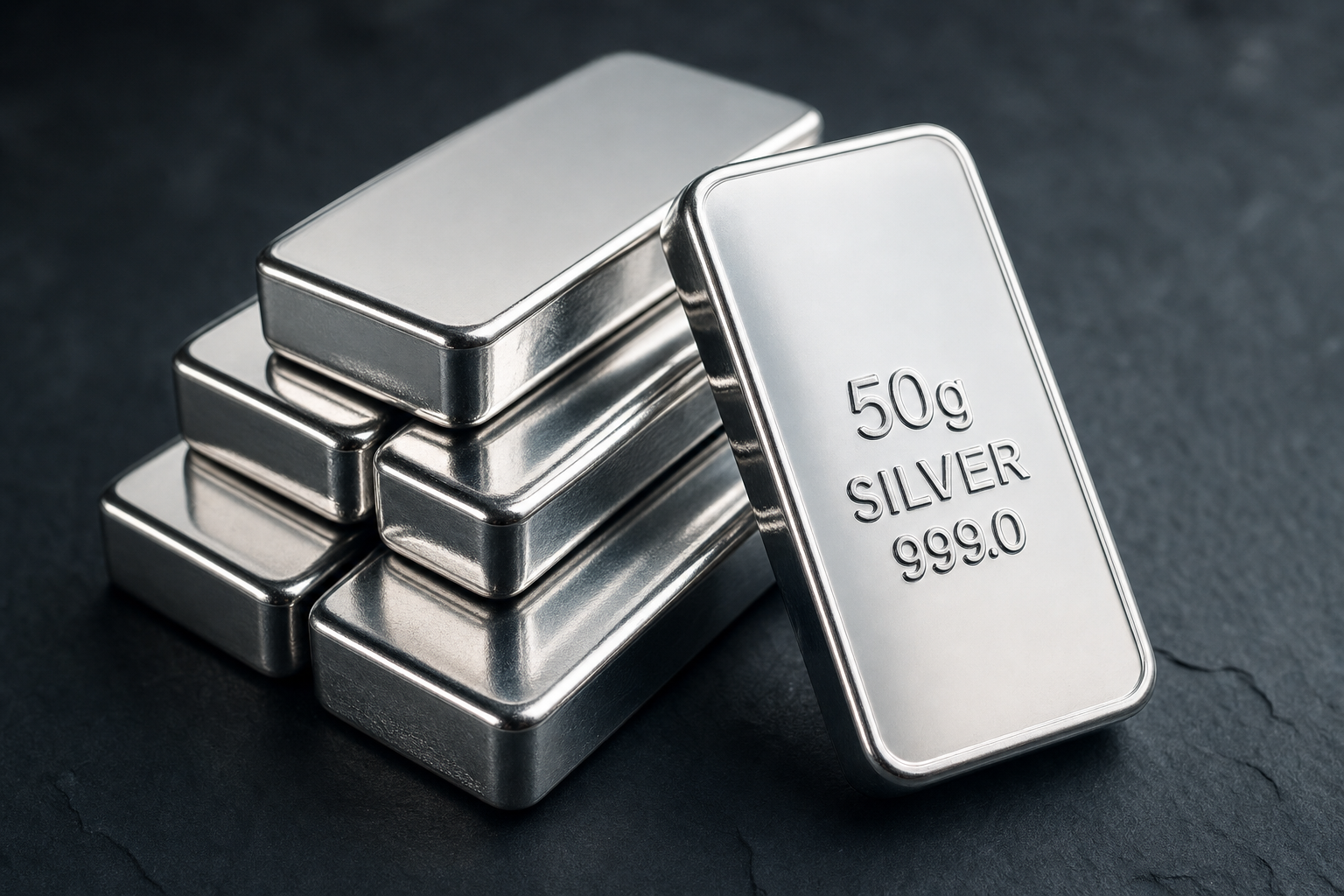
Mit einem Feingewicht von 50 Gramm bei einem Feingehalt von 999,9/1000 belegt der 50 g Silberbarren eine Mittelposition zwischen den kleinen Einsteigergrößen und den schweren Anlagebarren. Geprüft werden sämtliche LBMA-zertifizierten Hersteller anhand standardisierter Verfahren, sodass das Material weltweit als Good Delivery gilt. Die Form ist je nach Herstellungsverfahren entweder geprägt mit scharfen Kanten und glänzender Oberfläche oder gegossen mit der charakteristisch rustikalen Anmutung.
Im Sortiment der Silberbarren-Kategorie bildet die 50-Gramm-Stückelung einen Brückenwert: Sie ist günstiger im Aufgeld als 10 g Silberbarren oder 20 g Silberbarren, bietet aber mehr Teilbarkeit als ein 100 g Silberbarren.
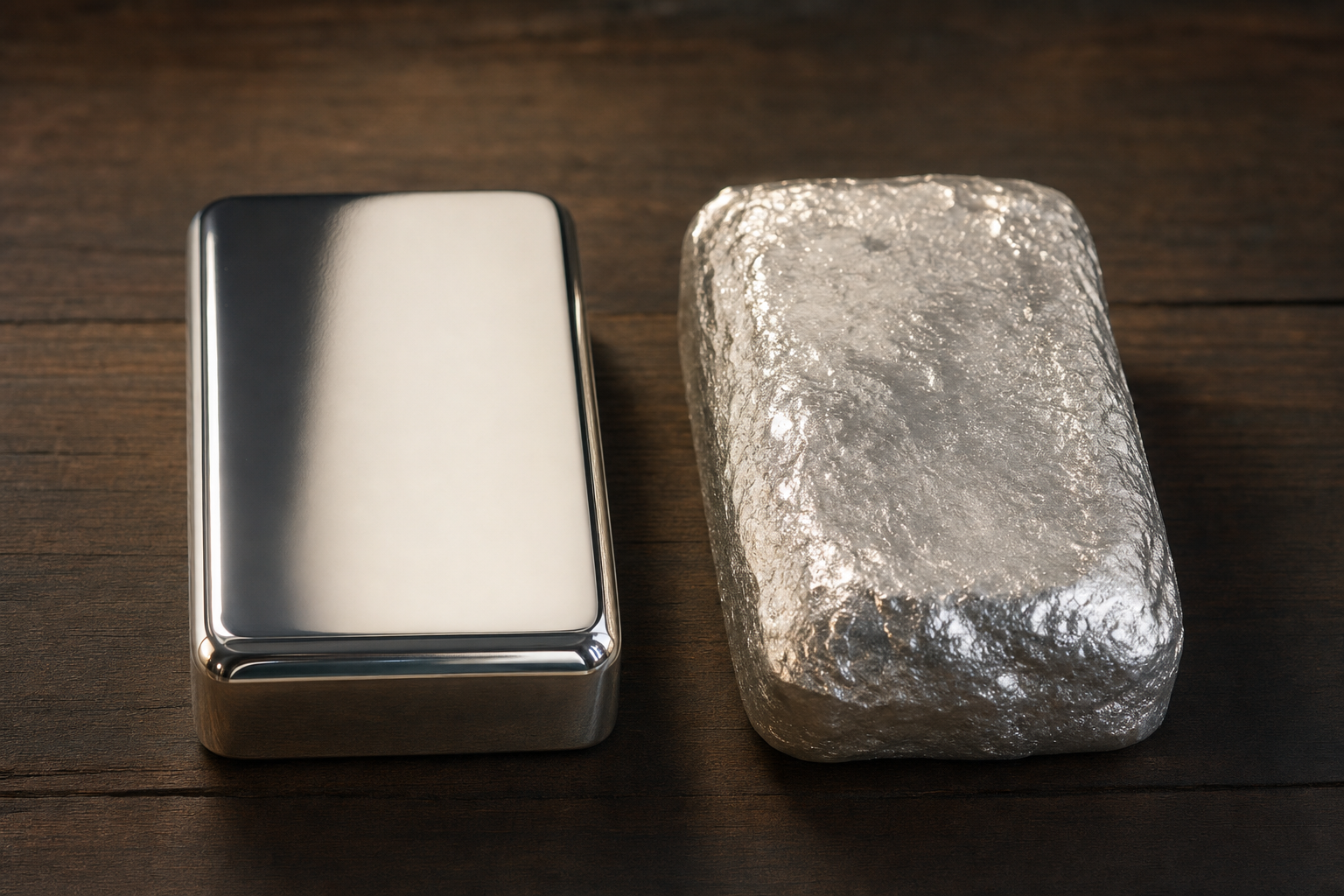
Der 50 g Silberbarren wird von allen relevanten europäischen Scheideanstalten gefertigt. Jeder Hersteller setzt eigene Akzente in Design, Verpackung und Prägeverfahren. Die Wahl des Prägers hat geringen Einfluss auf den reinen Materialwert, kann aber beim Wiederverkauf relevant werden -- bekannte Marken sind in der Regel leichter handelbar.
Geprägte Barren entstehen durch Stempelprägung kalter oder leicht erwärmter Silberronden. Sie zeichnen sich durch scharfkantige Konturen, hochglänzende Flächen und detaillierte Reliefs aus. Hersteller wie Heraeus, Argor-Heraeus und Umicore liefern geprägte 50-Gramm-Barren in zertifizierter Blisterverpackung.
Gegossen wird flüssiges Silber direkt in Formen abgefüllt. Das Ergebnis ist eine raue, leicht unebene Oberfläche mit individuellem Charakter -- jeder Barren ist ein Unikat. Die Manufaktur Heimerle & Meule ist für ihre traditionell gegossenen Silberbarren bekannt. Gegossene Stücke werden von Sammlern wegen ihres handwerklichen Charmes geschätzt.
Eine eigene Kategorie bilden Münzbarren und Münzstangen -- sie kombinieren Prägestempel mit Barrenformat und gelten als gesetzliches Zahlungsmittel im Ausgabeland. Wer Vielfalt im Depot mag, mischt unterschiedliche Formen.
Anders als Goldbarren sind Silberbarren in Deutschland nicht umsatzsteuerbefreit. Auf den Materialwert wird beim Kauf der volle Mehrwertsteuersatz von 19 % erhoben. Diese Mehrwertsteuer-Belastung ist der wichtigste Grund für das höhere Aufgeld bei Silber gegenüber Gold.
Steuerlicher Hinweis zu Silberbarren
Silberbarren mit Sitz des Verkäufers in Deutschland werden seit 2014 mit dem regulären Mehrwertsteuersatz von 19 % besteuert. Die Differenzbesteuerung nach §25a UStG, die früher für Importsilber genutzt wurde, ist seit 2023 für importierte Silberbarren weitgehend entfallen. Nach einer Haltedauer von einem Jahr sind Veräußerungsgewinne aus Silberbarren als privates Veräußerungsgeschäft jedoch steuerfrei (§23 EStG).
Wer Silber primär aus steuerlichen Gründen meidet, sollte im Gegenzug einen Blick auf Anlagemünzen aus Gold oder 50 g Goldbarren werfen.
Fälschungen sind im Silberbereich seltener als bei Gold, kommen aber vor. Wer über Privatkanäle oder Auktionsplattformen kauft, sollte Prüfverfahren kennen. Bei einem Bezug über etablierte Händler wie Kettner Edelmetalle entfällt das Prüfthema in der Praxis -- die ISO-konforme Echtheitsprüfung erfolgt bereits im Wareneingang.
Silber reagiert empfindlicher auf Umwelteinflüsse als Gold. Schwefelhaltige Luft, hohe Luftfeuchtigkeit oder direkter Hautkontakt können die Oberfläche dunkel anlaufen lassen -- der reine Materialwert bleibt davon unberührt, optische Sammlerwerte können jedoch leiden. Die Originalverpackung sollte daher möglichst nicht geöffnet werden.
Bei mehreren 50-Gramm-Stücken bietet sich ein zertifizierter Wertschutzschrank ab Widerstandsgrad 0 oder höher an. Wichtig: Die Hausratversicherung deckt Edelmetalle nur bis zu festgelegten Höchstsummen -- ein Blick in die Police lohnt. Für den ordentlichen Aufbewahrungs-Workflow eignen sich Münzkassetten und Dosensafes.
Schließfächer in Banken bieten physische Sicherheit, sind aber an Öffnungszeiten gebunden und nicht automatisch versichert. Externe Edelmetall-Lager mit Zollfreilager-Status (z. B. in der Schweiz) sind eine Alternative für größere Bestände.
Die Wahl der richtigen Stückelung hängt vom Anlagebudget, der gewünschten Teilbarkeit und der Aufgeld-Toleranz ab. Grundregel: Je größer der Barren, desto niedriger das prozentuale Aufgeld -- desto unflexibler aber auch der Teilverkauf.
Wer Wert auf staatliche Prägung und Sammlerpotenzial legt, kombiniert Barren mit Klassikern wie dem Maple Leaf, dem Wiener Philharmoniker oder dem Silber-Krügerrand. Barren bieten dafür den niedrigsten Materialaufpreis pro Gramm.
Bei der Auswahl spielen mehrere Faktoren zusammen. Wer rein nach Materialwert kauft, achtet vor allem auf das Aufgeld zum Spotpreis. Wer Sammleraspekte einbeziehen möchte, nimmt Hersteller, Verpackung und Erhaltungsgrad mit ins Kalkül.
Wer das 50-g-Format als Einstieg nutzt und langfristig größer werden möchte, findet im gesamten Silberbarren-Sortiment sowie in den Silber-Investorenpaketen abgestimmte Anschlussgrößen.
Aus Aufgeld-Sicht ist ein 50 g Silberbarren günstiger als fünf 10-g-Stücke -- der Pro-Gramm-Aufschlag sinkt mit steigender Stückelung. Der Vorteil mehrerer kleiner Barren liegt in der besseren Teilbarkeit beim Wiederverkauf. Wer beides verbinden möchte, mischt 50-g-Barren mit kleineren Einheiten.
Für den 50-Gramm-Bereich sind Heraeus, Argor-Heraeus, Umicore, Heimerle & Meule und Valcambi etablierte Adressen. Alle fünf Prägestätten sind LBMA-anerkannt. Die Wahl ist meist Geschmackssache zwischen geprägt (glänzend, scharfkantig) und gegossen (matt, individuell). Markenbarren laufen beim Wiederverkauf in der Regel ohne Aufschlag-Verlust.
Auf Silberbarren fallen in Deutschland 19 % Umsatzsteuer auf den Materialwert an. Anders als bei Anlagegold gibt es keine Mehrwertsteuer-Befreiung. Nach einer Haltedauer von einem Jahr sind Veräußerungsgewinne als privates Veräußerungsgeschäft gemäß §23 EStG steuerfrei.
Die Abmessungen variieren je nach Hersteller und Prägeart. Ein typischer geprägter 50 g Silberbarren misst ca. 47 mm × 27 mm × 3 mm. Gegossene Stücke sind etwas dicker und kompakter. Das Feingewicht von exakt 50,00 Gramm bei einem Feingehalt von 999,9/1000 ist hingegen einheitlich.
Aus reiner Materialsicht ändert sich nichts am Wert. Aus Sammler- und Wiederverkaufssicht ist die ungeöffnete Blisterverpackung jedoch deutlich vorteilhafter -- sie schützt vor Anlauffarben und bestätigt zusammen mit der Seriennummer die Echtheit. Empfehlung: Verpackung geschlossen lassen.
Geprägte Barren entstehen durch Stempelprägung kalter Silberronden -- sie haben scharfe Kanten, glänzende Oberflächen und detaillierte Reliefs. Gegossene Barren werden aus flüssigem Silber in Formen gegossen und zeigen eine raue, individuelle Oberfläche. Materialwert und Feingehalt sind identisch; der Unterschied liegt in Optik und Haptik.
 50 g Silberbarren
Stay informed with product launches, financial news and exclusive offers. Sign up for our free newsletter today.
By entering your email address and clicking the "Submit" button, you give the following consent: "I agree to be informed by email about new products, financial news and exclusive offers, and therefore consent to the processing of my email address for the purpose of sending the newsletter. I can revoke this consent at any time without giving reasons, with effect for the future. The lawfulness of processing carried out prior to revocation remains unaffected."