Only 4 left to order
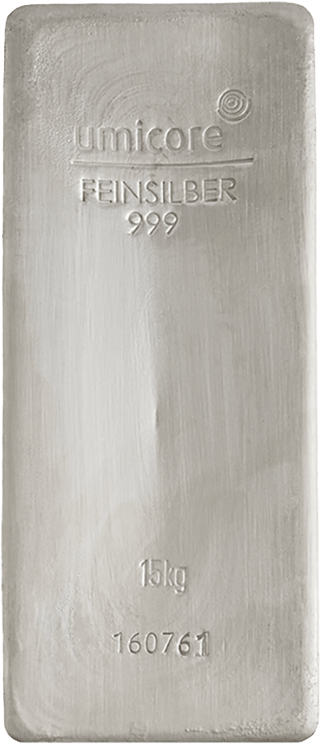
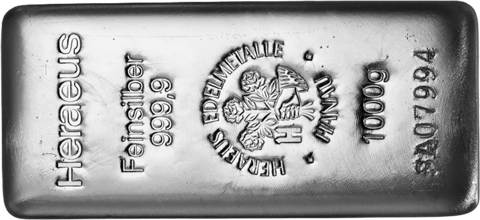
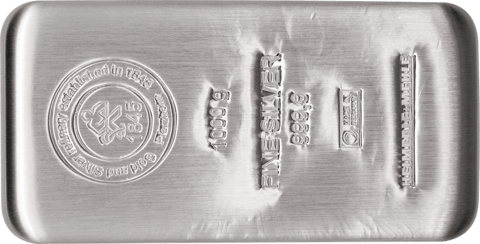
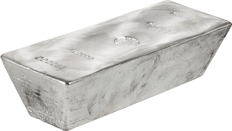
15kg Silver Bar Heraeus
£28,238.79
excl. UK import VAT and shipping
Available in 3–4 business days

 More than 300,000
 Over 30 years
 Secure shipping
 Google: 4.9/5
Buying larger quantities of precious metals – including 1 kg, 5 kg and 15 kg silver bars – can lower the unit cost per gram or ounce, as the manufacturing and distribution costs are spread over a larger quantity. The larger the coins and bars, the lower the premium on the silver price. Compared to gold, silver has a higher potential for appreciation, as it is a highly sought-after industrial metal.
Investing in 15 kilogram silver bars is suitable for
Refineries that produce 15 kilogram silver bars:


Silver bars range from a few grams to about 31 kilograms. Between 10 grams and 15 kilograms, the small ones are usually minted and the large ones cast. Where one stops and the other begins, each house decides for itself.
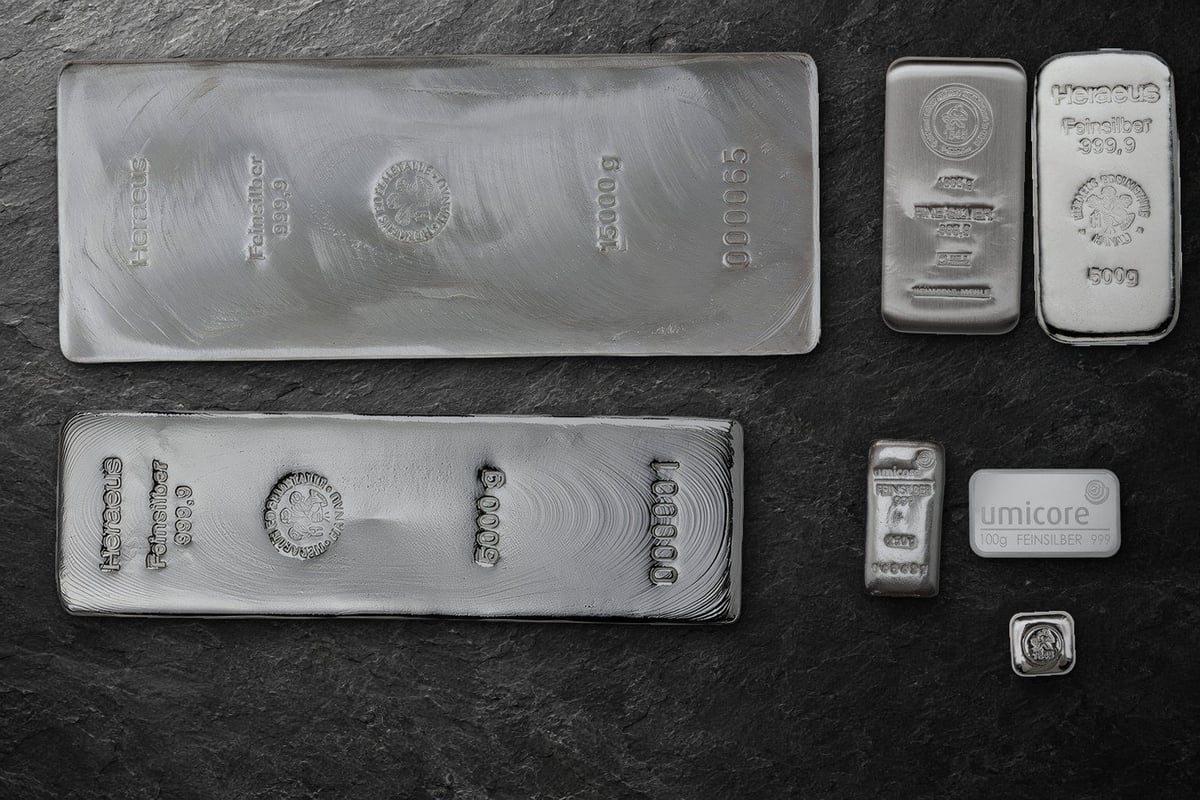
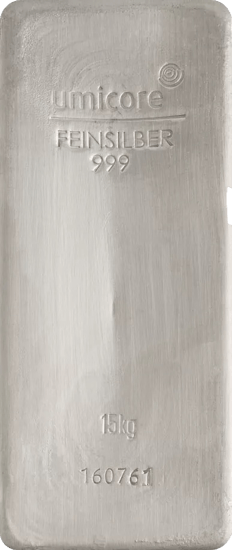
Umicore mints its silver bars from 10 to 100 grams. From 250 grams on, the house casts them, right up to 15 kilograms.
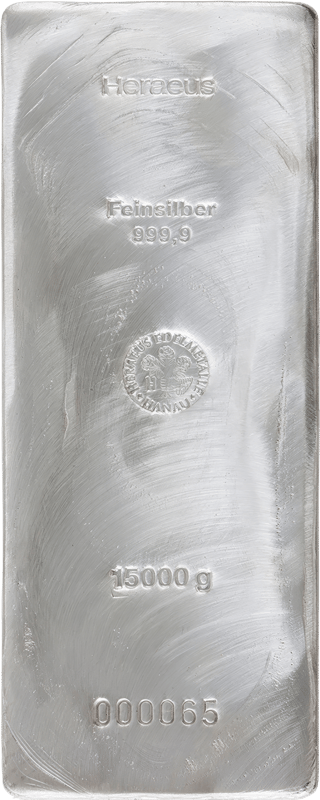
At Heraeus, the line falls in the same place. There, the ounce and 100 grams are minted, while 250 and 500 grams and 1, 5 and 15 kilograms are cast.
Other houses draw the line somewhere else entirely. Heimerle + Meule already casts the ounce, a small square with sides of 23.5 millimetres. Valcambi still mints the kilo, 130 millimetres long and 11.2 millimetres thick.
The larger the bar, the more likely it is cast.
Sizes according to the makers, for Heraeus only the sizes the house itself lists; the minted ounce from Heimerle + Meule according to its bar in the shop. On the axis, it is as far from 10 to 100 grams as from 100 grams to 1 kilogram.
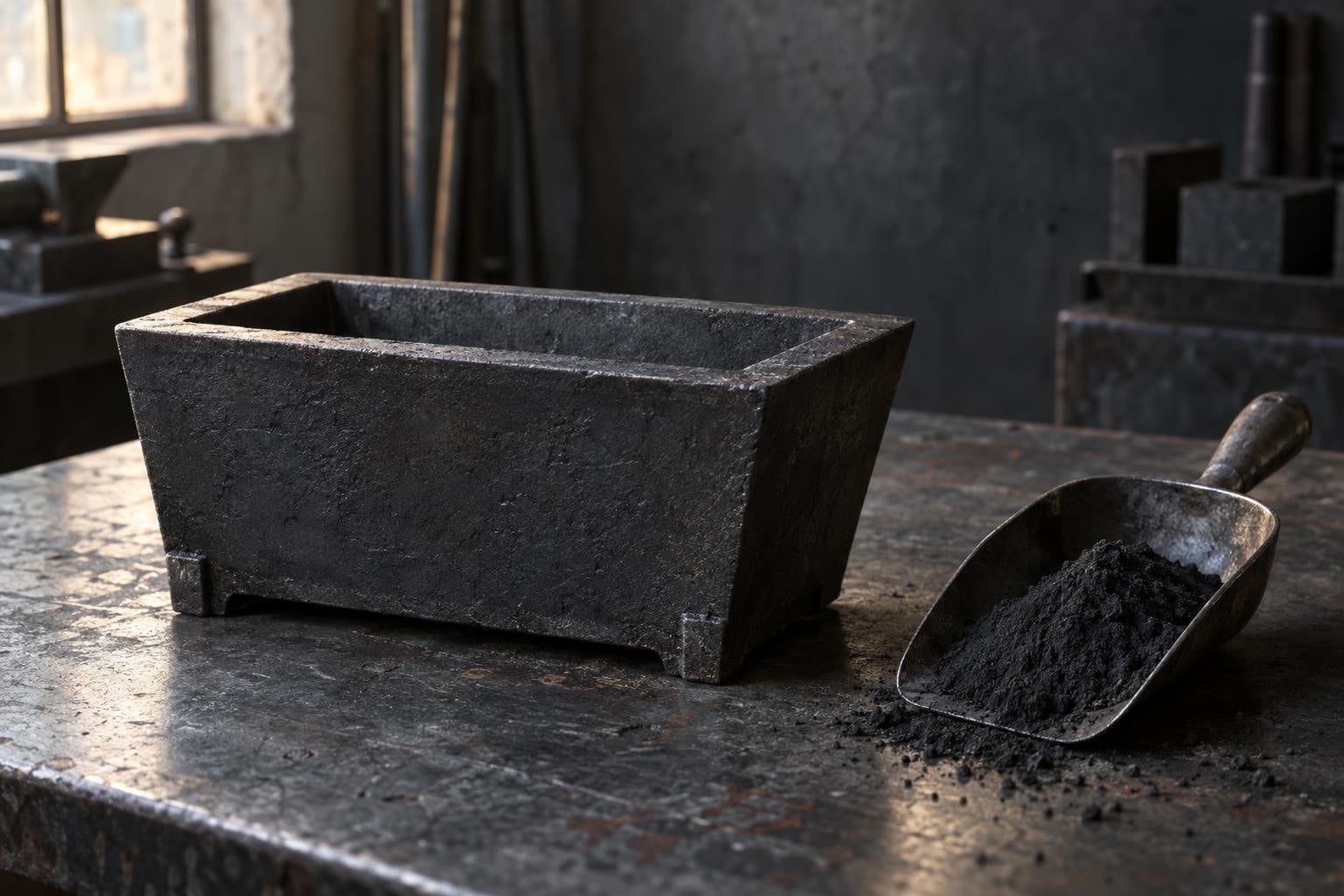
When pure silver melts, it takes up oxygen from the air. As it solidifies, the oxygen escapes again, and that can happen violently. Old encyclopaedias call it spitting.
“When melted in contact with air, pure silver absorbs a great deal of oxygen, which, however, escapes at the moment of solidification …”
Pierer’s Universal‑Lexikon, volume 16, 1863, entry “Spratzen”, translated
In doing so, the oxygen breaks through the crust that has already set and drives out the silver that is still liquid, into a spongy mass from which beads of silver leap. That is how Pierer’s encyclopaedia describes it.
The chemist Gay‑Lussac caught the oxygen under a bell jar filled with water. He obtained twenty to thirty times the volume of the silver, Pierer reports. In 1911, the Encyclopaedia Britannica gives twenty times. These are figures from encyclopaedias of 1863 and 1911, not present-day measurements.
The remedy is given in the same article: stir while the silver solidifies, “but best of all” sprinkle charcoal powder on it before it sets. According to Pierer, silver with 1 to 2 per cent copper does not spit, but pure silver does.
The oxygen is not entirely out of the picture. When a refinery on the London list assays its silver with a spectrograph today, oxygen and nitrogen expressly count as silver.
Diagram after the description in Pierer’s Universal‑Lexikon of 1863, not to scale.
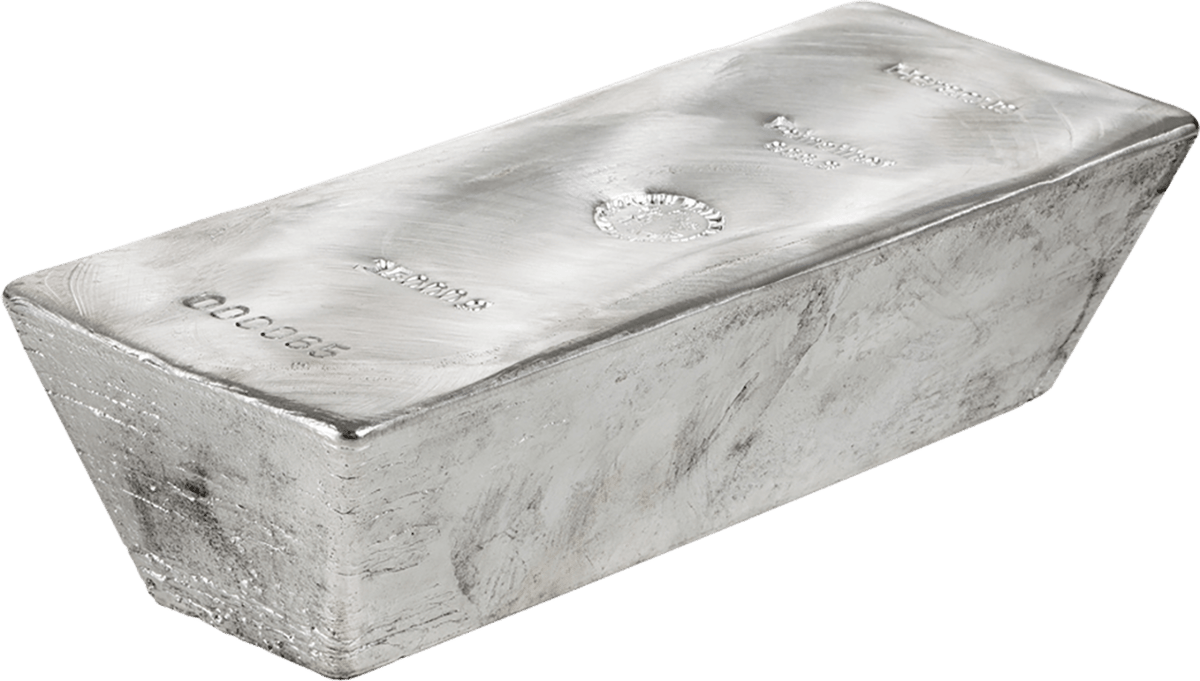
Silver contracts strongly as it solidifies, the Meyers encyclopaedia of 1909 writes. On a cast bar, this shows on top: the top face can sink slightly in the middle, and rings from cooling can appear as well.
“Excessive shrinkage (i.e. the concavity of the top face of the Bar and any concentric cooling rings) must not significantly affect the clarity of the Bar marks or the safe stacking of the Bars.”
LBMA, Good Delivery Rules, Technical Specifications, section 2.1.4
The LBMA is the association of the London precious metals market. Its rules are written for the large bars of this market. They show what happens when silver is cast.
Silver has rules of its own there. A little hammering of the surface is allowed; for gold, at most the smoothing of a sharp burr. And closed moulds have been banned for silver since 2008, mainly because hidden cavities can form in them.
Cast bars are wider at the top than at the bottom. On the 15‑kilogram bar from Umicore, the top face measures about 235 by 100 millimetres and the bottom 210 by 80, with a height of 75 millimetres. For its silver bars, the LBMA requires a slope of 5 to 15 degrees, so that they are easy to grip.
Calculated from Umicore’s dimensions, the sides of its cast bars slope at about 6 to 10 degrees.
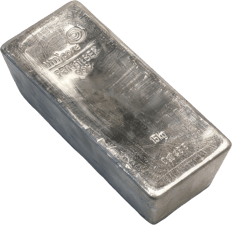
A cast bar shows on its top face how it solidified.
Dimensions from Umicore. In gold, the top face, the dip in it only suggested: its depth has not been measured. The slope is calculated from the top and bottom widths and the height.
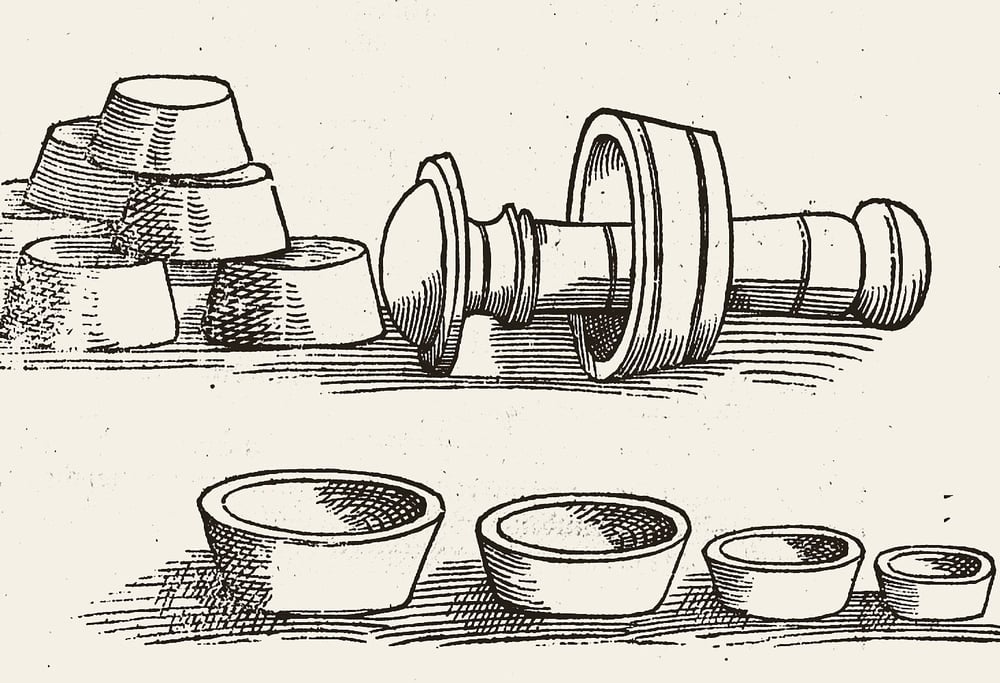
For gold, the LBMA requires its referee laboratory to carry out the fire assay, at least six times. For silver, the laboratory measures what is not silver and subtracts it from 1,000 parts.
“In the case of silver, the Referee will normally use one or other spectrographic analysis method and determine the silver assay by difference (with dissolved gases such as oxygen counting as silver).”
LBMA, Good Delivery List Rules, January 2026, Annex D, section 2.3
These are the rules for the refineries on the London list. They show how differently the two metals are assayed.
For a long time, silver was assayed in fire, in small dishes called cupels. In 1832, the French mint commission published instructions by Gay‑Lussac, the same man who had caught the oxygen in silver. After that, it could also be done “by the wet way”: the silver is precipitated with a solution of common salt instead of being assayed in fire in the cupel.
In 1874, Jacob Volhard described another wet method, with thiocyanate instead of common salt.
The common salt assay lives on in the standards. ISO 13756 determines silver in jewellery and precious metals with sodium or potassium chloride, ISO 11427 with potassium bromide, both today in the edition of 2024 and for silver contents of 100 to 999 parts per thousand. For higher contents, both name spectroscopy by difference.
With silver, the rest is what counts: 1,000 parts minus everything foreign.
According to the LBMA rules of January 2026. The foreign share is drawn greatly enlarged.
Stamping the weight onto the bar is an old practice. The silver treasure of Kaiseraugst in Switzerland includes a bar from shortly after AD 350. Punched into it is P III, three Roman pounds.
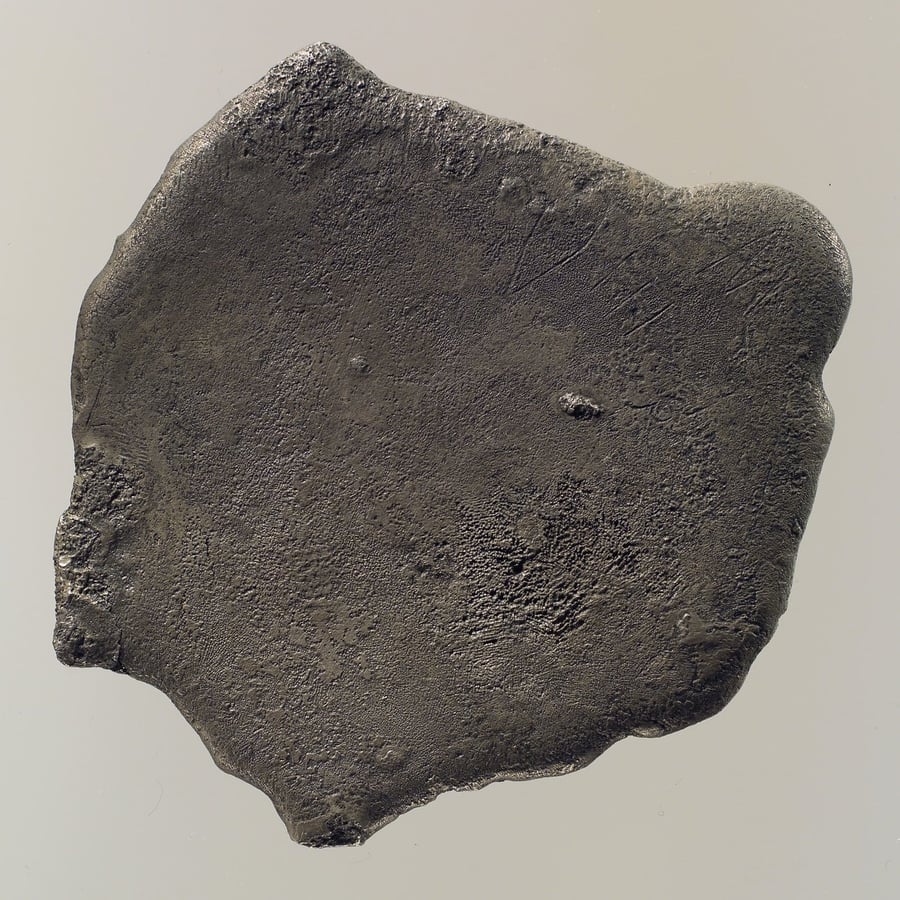
The bar measures 12.3 by 7.8 centimetres and is 1 centimetre thick. It weighs 947.8 grams, which corresponds to three Roman pounds.
Beside it are two small stamps reading GRONOPI, probably the name of the official in charge, and a round stamp with the bust and name of the Emperor Magnentius.
A kilo bar of today weighs almost the same, yet has a different shape. The cast kilo bar from Heraeus measures 111 by 51 millimetres and is 21 millimetres thick, more than twice as thick as the Roman bar.
Much older still is a silver bar with Hittite hieroglyphs in the Metropolitan Museum in New York, from the 14th to 13th century BC.
More than 1,650 years ago, the weight was already on the bar.
Dimensions: Augusta Raurica, Augster Blätter zur Römerzeit 10, and the makers. All three from above at the same scale, the kilo bars as product photos from the shop, the Roman bar drawn as an outline to its dimensions.
A 15 kg silver bar is the premier class among physical silver investments: a single piece of fine silver that combines more than three million milligrams of pure precious metal in your hand, while offering a price per gram close to the pure material value. Anyone investing on this scale is thinking long-term, strategically and in real assets. This guide explains which manufacturers cast 15-kilogram bars, how classic cast bars differ from enhanced Fiji minted bars, how they are taxed and what matters for storage, authenticity and resale.
Silver bars weighing 15 kilograms are produced by only a handful of renowned mints. The decisive advantage of this weight class lies in the premium: the larger the bar, the lower the percentage mark-up on the pure silver price, because production and distribution costs are spread over a very large quantity of material. With 15,000 grams of fine silver, production costs have barely any effect in relation to the high material value: the purchase price comes closer to the current daily silver price than with almost any other form of silver investment.
Silver is regarded not only as a monetary precious metal but also as an industrial metal in strong demand. Its continued use in electronics, photovoltaics and medical technology gives the metal a special role that sets it apart from pure investment gold. Anyone wishing to build up a larger position will find the 15-kilogram format an efficient solution. Smaller denominations such as the 1 kg silver bar or the 5 kg silver bar remain more flexible for resale, while the large bar scores on price per gram. A look at the entire range of silver bars helps you find the right combination of price and divisibility.
15 kg silver bars are offered exclusively in cast form. The liquid silver is poured into a mould, after which the manufacturer's logo, fineness, weight and an individual serial number are stamped into the surface once it has cooled. This production method is common and economical for very large bars, since minting would be technically demanding and expensive at this mass. The result is a characterful bar with a slightly irregular, naturally formed surface: no two bars are alike.
Established names of the industry number among the leading refineries for 15-kilogram bars. Anyone looking specifically for a particular mint can refer to the respective manufacturer pages:
Many of these bars meet the LBMA Good Delivery standard and are therefore tradeable internationally: an important criterion for later resale.
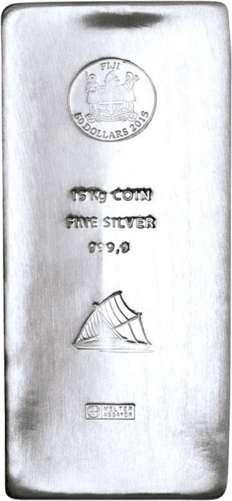
A special variant within the 15-kilogram class is the enhanced Fiji minted bar. It is cast on behalf of the Republic of Fiji by the Swiss mint Argor-Heraeus from 999.9 fine silver and combines the advantages of a bar with the status of a coin. This is because the Fiji minted bar bears a coin stamp with a face value and is therefore recognised as legal tender on the Fiji Islands: for the 15 kg bar, this is a face value of 50 dollars.
Visually, the minted bar stands out clearly from the plain cast bar. On its surface it displays the coat of arms of the Fiji Islands, the year of issue, weight and fineness, as well as a sailing ship and the AH-Melter Assay stamp of Argor-Heraeus. With dimensions of around 231 x 98.8 x 78.4 mm, it is an impressive collector's and investment piece delivered with a certificate of authenticity. This double certification, by the renowned mint and by the issuing island state, creates additional security for investors and collectors alike.
A minted bar combines the material efficiency of a large bar with the face-value status of a genuine coin: investment and collector's appeal in a single piece.
A key difference from the classic cast bar lies in the tax treatment: since they are formally coins, Fiji minted bars can be traded under the margin scheme pursuant to §25a UStG, which can ultimately mean a price advantage for private investors compared to bars taxed at the regular rate of 19%. Anyone interested in this enhanced variant will find further sizes in the range of silver minted bars as well as among the enhanced silver bars.
Unlike investment gold, which is exempt from VAT under §25c UStG, classic silver bars in Germany are generally subject to the standard VAT rate of 19%. This factor should be taken into account when entering the silver market, though it has less of an impact on the high-volume 15-kilogram bar, thanks to its minimal premium, than on many smaller units. An alternative is offered by margin-scheme-taxed products such as the Fiji minted bars mentioned above or selected silver coins.
Tax notice
Profits from the sale of physical silver bars are tax-free after a holding period of more than one year (private disposals, §23 EStG). If sold within the one-year speculation period, an annual tax-free allowance applies; profits exceeding this amount are subject to tax. This is general information and does not replace tax advice.
The price of a 15 kg silver bar always tracks the current silver price and fluctuates accordingly throughout the day. Because of the very low mark-up, this format is particularly suitable for investors focused on pure material value. For continuous wealth building in smaller steps, however, savings plan products are the more suitable choice.
Investing in 15 kilograms of silver is not a spontaneous decision but part of a well-thought-out strategy. This format is aimed primarily at the following types of investors:
Anyone using silver specifically for retirement provision or as an inflation hedge will find the large bar a cost-efficient base. For balanced portfolios, it is additionally advisable to add a share of gold, for example in the form of gold bars, to benefit from the well-known interaction between the two precious metals.
A 15 kg silver bar places special demands on storage, simply because of its weight and volume alone. With several bars, the mass quickly adds up to a considerable load, which requires an appropriately sized storage facility. Essentially, three options are available:
Silver can tarnish over time and develop a dark patina. This is completely normal and does not reduce the material value: when resold, the bar is assessed on its pure silver content. Nonetheless, careful storage is advisable to protect against scratches and dirt; suitable accessories such as cases and storage solutions help preserve its condition. Kettner Edelmetalle always ships 100% insured and discreetly.
Authenticity is of central importance for an investment of this scale. Reputable 15-kilogram bars bear the manufacturer's logo, fineness information and an individual serial number that allows unambiguous identification. For minted bars such as the Fiji bar, a certificate of authenticity is also included. Kettner Edelmetalle subjects incoming goods to an ISO-compliant authenticity verification, so that only flawless bars are dispatched.
When reselling later, a recognised bar pays off: products meeting the LBMA Good Delivery standard, as well as certified minted bars, can be sold straightforwardly at the current daily rate. For the best possible buy-back price, a like-new, original-packaging condition together with the certificate is important. Anyone wishing to stay flexible can combine the large bar with divisible units such as the 500 g silver bar, or supplement it with popular Maple Leaf silver coins, which are easy to sell individually.
Because production and distribution costs are spread over a very large quantity of material. The premium, the mark-up on the pure silver price, is significantly lower in percentage terms than for small denominations. As a result, the purchase price comes especially close to the current daily silver price.
Bars in this weight class are produced exclusively by casting. After casting, the manufacturer's logo, fineness, weight and serial number are stamped into the surface. Minting would be technically demanding and uneconomical at 15 kilograms.
The Fiji minted bar from Argor-Heraeus bears a coin stamp with a face value and is legal tender on the Fiji Islands. It has a more elaborate design, is delivered with a certificate, and can be traded under the margin scheme, whereas normal bars are subject to the full VAT rate of 19%.
Classic silver bars are subject to the standard VAT rate of 19% in Germany. Profits from the sale are tax-free after a holding period of more than one year. Margin-scheme-taxed minted bars can be more advantageous in price for private investors. This does not replace individual tax advice.
No. Silver develops a natural patina over time that does not affect its material value. When resold, the bar is assessed based on its pure silver content. Nevertheless, for the best possible buy-back price, bars should ideally be kept in as-new, original packaging.
Options include an adequately sized, anchored home safe, a bank safe deposit box, or professional storage in a high-security facility. Due to the high weight, the load-bearing capacity of the storage location should be taken into account. Suitable insurance is recommended.
 15 kg Silver Bars
Stay informed with product launches, financial news and exclusive offers. Sign up for our free newsletter today.
By entering your email address and clicking the "Submit" button, you give the following consent: "I agree to be informed by email about new products, financial news and exclusive offers, and therefore consent to the processing of my email address for the purpose of sending the newsletter. I can revoke this consent at any time without giving reasons, with effect for the future. The lawfulness of processing carried out prior to revocation remains unaffected."