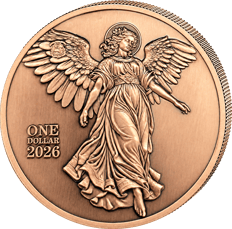
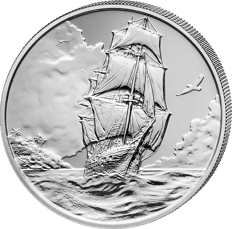
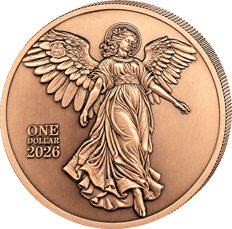
1 oz Copper Ascension Island
£7.53
excl. UK import VAT and shipping
Available in 2–3 business days

 More than 310,000
 Over 30 years
 Secure shipping
 Google: 4.9/5
Copper is also known as "red gold" for good reason. The material impresses with many properties that generate particularly high demand from industry. But even in the form of coins, this semi-precious metal is winning over more and more investors. They are convinced that investing in copper coins is the right path. Find popular coins and medals made of copper in our range.


Most of us hold copper in our hands every day. The 1, 2 and 5‑cent coins have a skin of copper, with steel underneath. The Deutsche Bundesbank describes them as strongly magnetic.
The 10, 20 and 50‑cent coins are made of “Nordic gold”. It is not gold: the alloy is 89 per cent copper, with aluminium, zinc and tin added. It is not magnetic.
A magnet lifts the 1‑cent coin. The 10‑cent coin stays where it is.
The idea is older than the euro. The 1 pfennig coin of the D‑Mark had a steel core covered with copper on both sides. It measured 16.50 millimetres across, weighed 2.00 grams and was introduced in 1948. At 16.25 millimetres, the 1‑cent coin is almost the same size.
All three at the same scale. The diameters are given by the Deutsche Bundesbank, the ECB and our product data.
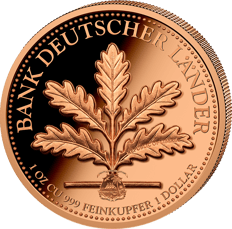
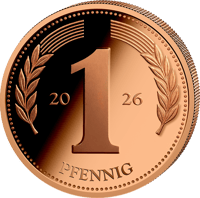 1 ounce copper Pfennig 2026Copper Pfennig 2026Liberia, 1 dollar1 ounce, 40 mmCopper 999/1,000
The design of the old pfennig, the numeral 1 between two ears of grain, now exists in copper for collectors. The coin was issued by Liberia, with a face value of 1 dollar.
Pure gold and pure silver are too soft for coins that pass through many hands. That is why copper was added to them. For the gold coins of the German Empire, the ratio was laid down in law.
“The mixing ratio of the Imperial gold coins is fixed at 900 thousandths gold and 100 thousandths copper.”
Gesetz, betreffend die Ausprägung von Reichsgoldmünzen, of 4 December 1871, § 4, Reichsgesetzblatt 1871, p. 404
Two years later, the silver coins were given the same formula. The Münzgesetz, the coinage act of 9 July 1873, lays down in Article 3: “900 parts silver and 100 parts copper” (Reichsgesetzblatt 1873, p. 234).
Sterling silver has a fineness of 925/1,000. According to The Royal Mint, the rest is usually copper, because copper makes the soft silver stronger.
Swiss gold coins, the Vreneli among them, are 90 per cent gold and 10 per cent copper. Of this alloy, Swissmint writes: “The colour of this material is quite red.”
The coins became yellow because the blanks were treated in a pickling bath before striking. In the process, copper is removed from the surface. The alloy itself makes the coin hard and resistant to wear and tear.
Goldmark, 1871Goldmark
Sterling silverSterling
Each grid has 1,000 squares, and each square is one thousandth. In sterling silver, the rest is usually copper.
The Statue of Liberty in New York is made of copper. Its skin is only 3/32 inch thick, about 2.4 millimetres, according to the National Park Service.
The copper was shaped in Paris, in the workshop of Gaget, Gauthier & Co. There the sheets were hammered over wooden forms, and the statue was assembled from 1881 to 1884.
The skin does not carry its own weight. Flat metal straps connect it to Gustave Eiffel’s framework. They hold the statue together and flex like springs.
Taken apart into 350 pieces, the statue arrived in New York on 17 June 1885 aboard the ship “Isère”. It was dedicated on 28 October 1886.

Both at the same scale, enlarged. The thickness of the skin is given by the National Park Service, that of the coin by the ECB.
There is a lot of copper in American small change, too. The 5‑cent coin is called the “nickel” there, but it is three quarters copper.
“The 5‑cent coin is an alloy of 75 percent copper and 25 percent nickel.”
United States Code, 2024 edition, Title 31, § 5112 (b)
For collectors, there is the Libertas Americana 2026 in copper, issued by Liberia with a face value of 1 dollar.
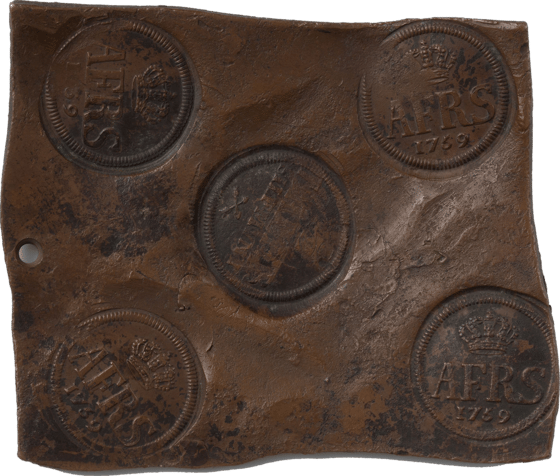
In Sweden in the 17th and 18th centuries, copper itself was money. The coins were worth as much as their metal. Because copper was worth less than silver, a copper coin of 10 daler had to be large and heavy.
The 10‑daler plate made at Avesta in 1644 weighs 19.7 kilograms. The Royal Coin Cabinet in Stockholm calls it the largest coin in the world.
The plates were moved on sledges. Europe’s first banknotes were issued in 1661 by Stockholms Banco. They quickly became popular because they were more convenient than the heavy copper coins, according to Sweden’s Riksbank.
Both at the same scale, seen from above. The measurements of the plate are given by the Rijksmuseum in Amsterdam, those of the coin by the ECB. A ½‑daler plate of 1759 with five stamps. Rijksmuseum Amsterdam, public domain (CC0).
By calculation: 19.7 kilograms is just under four bars of 5 kilograms each.
In the 17th century, at times around two thirds of the world’s copper came from Sweden, above all from the mine at Falun.
At Midsummer 1687, the mine collapsed. It left behind the “Stora Stöten”, a crater 95 metres deep. No miner was killed, because they all had time off to celebrate Midsummer.

In the Mansfeld region of Saxony‑Anhalt, the copper lies in a thin, dark layer of rock, the copper shale. It is only 20 to 40 centimetres thick and was laid down as sediment in a sea about 255 million years ago.
According to tradition, the miners Nappian and Neucke found this layer near Hettstedt in the year 1199. This is reported in the Mansfeldische Chronik by Cyriacus Spangenberg, dating from 1572.
Copper was mined here and near Sangerhausen for almost 800 years. Mining in the Mansfeld basin ended in 1969, near Sangerhausen in 1990.
Diagram of a section two metres high. The thickness of the layer is to scale, based on the Landesamt für Geologie und Bergwesen Sachsen‑Anhalt, the state office for geology and mining.
Copper rightly bears the nickname red gold: hardly any other metal combines a warm shine, deep cultural-historical roots and such a central role in modern industry. As an investment form, this semi-precious metal moves outside the limelight of gold and silver, and that is precisely where its appeal lies. Copper coins and copper medallions are perhaps the most accessible entry point into the world of physical precious metals: affordable, rich in design and with a character all of its own that captivates collectors and newcomers alike. The following overview explains origin, denominations, minting, authenticity, tax, storage and the most frequently asked questions on the subject.
The desire to buy copper coins rarely stems from the pure material value. Compared to gold coins or silver coins, copper costs only a fraction per ounce. Yet anyone who holds a single coin quickly senses why the metal fascinates so many people: the reddish shimmering surface, the delicate reliefs and the enormous variety of designs turn every strike into a small work of art. Copper is thus far more than mere small change: it is a collector's item with soul.
As a standalone asset class, copper traditionally stands in the shadow of the classic precious metals. However, the copper price is largely determined by industrial demand, ranging from electric mobility to renewable energy and digitalisation. This structural demand makes the metal interesting for the long term, although no short-term performance can be promised. For beginners and small-scale investors, copper coins are an uncomplicated way to develop a feel for physical precious metals before taking the step towards bullion coins made of gold or silver. Copper bars also fit the picture as a complement when larger quantities of material are involved.
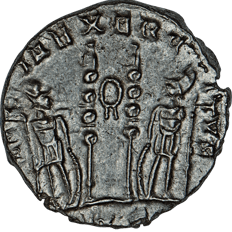
Copper is one of the oldest metals ever used by humankind. Several millennia ago, an entire era, the Copper Age, took its name from the metal, before the Bronze Age followed with the alloy of copper and tin. As a coinage metal, copper has accompanied humanity for just as long: from Roman As coins through Prussian strikes bearing rulers' portraits to the small pfennig coins of the D-Mark era, copper was for centuries the metal of everyday small change.
This historical depth resonates in modern strikes. Many present-day designs deliberately draw on classic models, bringing the fascination of old coin imagery back to life in a new metal. Anyone keen on the cultural-historical side will find the copper commemorative coins to be a particularly narrative-rich category, while the Native American designs revive the American minting tradition.
A key point when buying is the distinction between genuine coins and medallions. A coin with a face value is considered an official means of payment of a state, is issued by a state mint and struck in troy ounces. Such copper coins are comparatively rare: a well-known example is the Andorra Eagle, issued with official status as a 1-cent denomination.
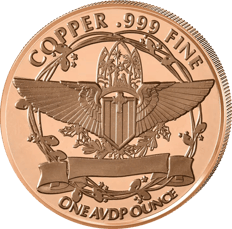
By far the larger number of copper strikes are medallions. They carry no face value, are not considered legal tender and are usually issued in the AVDP ounce. They are issued by a growing number of private mints, which explains the enormous creative range of designs.
In practice, this means: anyone deliberately looking for a classic bullion coin should check for a struck face value. Anyone who, by contrast, enjoys designs and collector themes will be perfectly suited to the medallions. Related series can also be discovered among the silver Pandas or as a copper variant in the China Panda category.
Copper strikes are deliberately generous in size, because the low material value would make small formats uneconomical. An overview of the most common sizes:
| Format | Weight (approx.) | Typical use |
|---|---|---|
| 1 oz | approx. 28.35 g | Standard format, widest range of designs |
| 2 oz | approx. 56.7 g | larger reliefs, more depth of detail |
| 5 oz | approx. 141.7 g | collector's highlights, Proof |
| Sets | variable | themed series, gift editions |
The 1 oz format is the undisputed classic and covers the widest range of designs. Larger 5 oz strikes are often issued in Proof quality and in limited mintage, making them intended more as a collector's item than a pure material investment. Anyone wanting to complete series will find a broad spectrum of unusual themes in the other series, ranging from prehistoric animals to pop-culture-style designs and seasonal editions.
The real strength of copper strikes lies in their creative freedom. Because private mints are not bound by state design requirements, the spectrum ranges from historical classics to distinctly modern themes. Popular designs inspired by well-known coin imagery include:
Alongside this exists a colourful world of independent designs, ranging from prehistoric animals to zodiac signs and fantasy themes to current events. Zodiac series in particular are popular as a small, personal collection or as a gift linked to a birth month. This variety makes copper coins an affordable entry point for collectors. Classic animal series can be followed further, for example, via the Buffalo category or inspired by the Canadian Maple Leaf. Anyone wishing to collect the design across different metals will also find the maple leaf among the gold editions of the Maple Leaf.
Copper coins with a face value display the classic minting features of a circulation coin. For medallions, face value and currency details are omitted, while weight and fineness are often struck directly onto the piece. Typical features of a struck coin are:
Because the material value of copper is low, counterfeiting in the strict sense is barely an issue, unlike with high-value investment gold. All the more important, then, is the quality of the strike itself: a clean, sharp relief, an even surface and an effective protective film against natural tarnishing are the decisive quality features. Kettner Edelmetalle inspects incoming goods as part of an ISO-compliant authenticity verification, so that every strike leaves the logistics centre in verified quality.
The tax classification follows the distinction between coin and medallion. Unlike investment gold, which is exempt from VAT in Germany, copper products are generally subject to VAT.
Tax note
Copper coins with a face value may fall under the margin scheme. Copper medallions and copper granulate, on the other hand, are usually treated at the standard VAT rate of 19% on both purchase and sale. For a binding tax classification in individual cases, consulting a tax advisor is recommended.
This rule is one reason why copper is regarded more as a collector's and entry-level item and less as a tax-optimised large-scale investment. Anyone wishing to make full use of the tax advantage of physical precious metals sensibly combines their copper collection with VAT-exempt holdings from the gold bars range.
Copper is a reactive metal and naturally tarnishes in air over time: the surface loses its shine and can darken in colour. For preserving value, especially with strikes in Proof quality, correct storage is therefore crucial. The following basic rules have proven effective:
For the orderly presentation of entire series, coin cases and collector's accessories are suitable, while can safes allow for discreet storage. Suitable accessories, from capsules to gloves, can be found bundled together in the accessories category.
As a collecting and entry-level metal, copper has a firm place alongside the classic precious metals, but it also comes with clear limitations. An honest comparison helps to put it into perspective.
What speaks in favour of copper coins
What to bear in mind
A piece of copper does not sell on its material value, but on its story and its design: therein lies the particular appeal of this collecting class.
Copper is encountered almost daily without being noticed: the euro's 1, 2 and 5 cent pieces shimmer in a coppery red. In fact, though, only the outer shell consists of copper, while the core is made of steel. This copper cladding protects the core from corrosion while also ensuring that the pure material value does not exceed the face value. A glance at the coin in one's pocket thus shows, on a small scale, what collectors appreciate about copper strikes: the characteristic, warm colour. Anyone wishing to delve deeper into the material science will find the basics in the copper category.
Copper coins are suitable above all as an affordable entry point into physical precious metals and as a collector's item. The material value is low, but many strikes offer potential collector's value instead. They are interesting as a complement to gold and silver holdings, but they do not replace classic investment gold. A specific performance cannot be promised.
A coin carries a face value, is considered official legal tender and is issued by a state mint in troy ounces. A medallion has no face value, is not legal tender and is mostly produced by private mints in the AVDP ounce. The overwhelming majority of the copper strikes on offer are medallions.
AVDP stands for avoirdupois, an Anglo-American weight system. An AVDP ounce corresponds to roughly 28.35 grams and is used for medallions without a face value, while genuine bullion coins are struck in the slightly heavier troy ounce (around 31.1 grams).
Copper coins with a face value may fall under the margin scheme. Copper medallions and copper granulate are usually treated at the standard VAT rate of 19% on both purchase and sale. Investment gold, by contrast, is exempt from VAT. A tax advisor should be consulted for individual cases.
Copper reacts with oxygen and air humidity, forming a dark patina over time. An effective protective film applied at the factory, as well as storage in coin capsules, significantly slow this process. Cotton gloves should be worn when handling, as skin oils accelerate tarnishing.
For most copper strikes, the year of minting is secondary to the value. More decisive are the design, the mintage size and the grade. Limited editions with a small mintage and in Proof quality tend to have the greatest collector's potential.
Stay informed with product launches, financial news and exclusive offers. Sign up for our free newsletter today.
By entering your email address and clicking the "Submit" button, you give the following consent: "I agree to be informed by email about new products, financial news and exclusive offers, and therefore consent to the processing of my email address for the purpose of sending the newsletter. I can revoke this consent at any time without giving reasons, with effect for the future. The lawfulness of processing carried out prior to revocation remains unaffected."