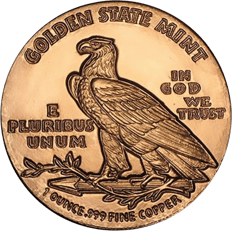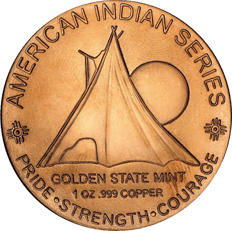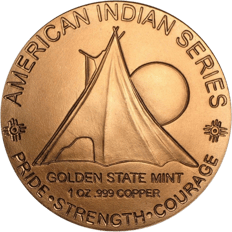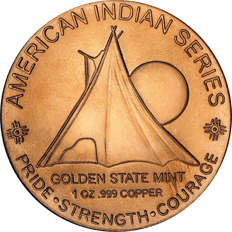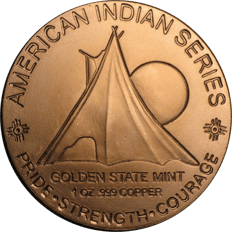
1 Ounce Copper Coin Indian Head
£8.03
excl. UK import VAT and shipping
Available in 2–3 business days

 More than 300,000
 Over 30 years
 Secure shipping
 Google: 4.9/5


A stoic gaze, wild feather headdresses, the collective memory of an entire continent cast in metal: Indian Head copper coins tell the story of North America's indigenous peoples in the smallest of spaces. They combine the iconic designs of early US coinage with the warm, reddish shimmer of the semi-precious metal copper. This guide sheds light on the origins and designs, the available denominations, the particularities of the incuse minting process, as well as the questions on value, storage and collecting that occupy beginners and experienced numismatists alike.
Nearly seven million members of indigenous peoples in around 550 tribes still live in the United States today. Nevertheless, thoughts on this subject usually drift into the past: to the Sioux, to the Battle of the Little Bighorn, to tipis and legendary chiefs. It is precisely this fascination that mints have translated into designs that remain among the most expressive in numismatics to this day. The characteristic head in profile, often framed by a magnificent feather headdress, turns every coin into a small work of art.
The reddish-brown, slightly antique tone of copper suits the historical aura of these portraits perfectly. It is no wonder that these collector's coins are prized by design enthusiasts and investors alike. Anyone building a coin collection with a historical focus will find in the Indian Head designs a thematically cohesive and emotionally charged collecting field that combines wonderfully with other copper coin series.
To understand the roots of these coins, it is worth looking back to the beginning of the last century. Until 1907, minting an Indian head on US coinage was considered unthinkable by many. Lady Liberty and the bald eagle as the heraldic animal dominated the designs issued by the United States Mint.
Yet the memory of the battles with the indigenous peoples, of their courage and wisdom, returned to the nation's collective memory. The stoic facial expression of many chiefs and their silhouette on the backs of wild horses were soon to adorn the then 2.5, five and ten dollar coins made of gold. These coins served as legal tender until the end of the Great Depression in 1933, after which numerous historic gold coins were melted down.
The specimens that escaped this fate remain, for many collectors, among the most beautiful designs ever to emerge from a US mint. For around five decades, these designs have been experiencing a renaissance, now not only in gold but also in silver, platinum and, indeed, in copper.
At the same time as the first Indian heads appeared, US President Theodore Roosevelt pushed through a novel minting process. The coins received an incuse, that is, a recessed design: the design and lettering lie below the coin's surface rather than raised above it. The advantage lay in reduced wear, which is why many historic specimens are still preserved in excellent condition today. Modern copper coinages also take up this principle and impress with finely worked reliefs.
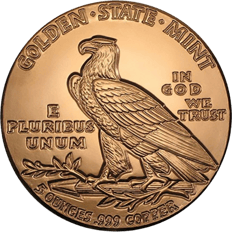
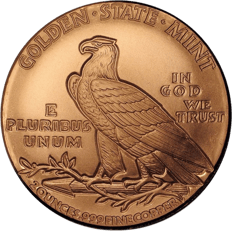
The best-known design bears the name Incuse Indian Head. Responsible for it is the American sculptor Bela Lyon Pratt. His design shows an Indian head in profile, whose face takes up only about a third of the field, with the striking feather headdress dominating the greater part. The border is formed by 13 stars along with the inscription "Liberty" and the year. The reverse is adorned with a bald eagle, complemented by details of weight and fineness and the mottoes e pluribus unum, meaning "out of many, one", as well as "In God We Trust".
A design that is not produced but remembered: therein lies the special appeal of the Indian Head coinages.
The range extends from the classic portrait to named chiefs. Alongside the Indian Head, there are designs dedicated to famous figures and historic trails. Each piece typically carries a fineness of 999/1,000 and a precautionary lacquer coating that protects the copper surface from tarnishing.
These coinages are typically offered in three weights, so that both compact entry-level pieces and heavier collector formats can be found:
| Denomination | Character | Suited for |
|---|---|---|
| 1 oz | the classic, handy and affordable | Beginners, thematic collecting |
| 2 oz | larger relief, more presence | Design enthusiasts |
| 5 oz | heavy format, impressive look | Collectors focused on tactile appeal |
Single coins are suitable for starting out, while a tube of 20 is of interest to anyone wishing to stock up on a design in larger quantities. For safe storage, suitable coin capsules or a coin box are recommended, protecting the copper from scratches and hand contact.
Why copper in particular? This semi-precious metal combines a low entry price with strong symbolic power. Pure bullion coins made of gold, silver, platinum or palladium trade on the world market at significantly higher prices. Copper coins therefore offer affordable access to coin collecting without any loss in design quality.
It is important to distinguish between the collector's aspect and the investment aspect: anyone wishing to invest primarily in precious metal will find a more suitable basis in copper bars or classic investment products made of gold. Indian Head copper coins are first and foremost collector's items with high sentimental and design value, not a promise of returns, but a tangible piece of history.
Good to know
Copper coins are numismatic medals and not legal tender. Their appeal lies in the design, the minting quality and the collecting theme, not in a fixed face value. The team at Kettner Edelmetalle, with many years of experience, is happy to answer any questions on storage or insurance.
When buying, it is worth looking at a few details that determine the long-term condition of a collection. Copper reacts more sensitively to environmental influences than gold, but with the right handling, the surface stays beautiful permanently.
Anyone wishing to add thematically related designs will find suitable connections in the Buffalo series or among the commemorative coins. A look at designs of indigenous peoples across precious metals also opens up exciting collecting fields.
Incuse means recessed: the design and lettering lie below the coin's surface rather than raised above it. This process, developed by sculptor Bela Lyon Pratt, was used from 1908 on the historic Indian Head gold coins and reduces wear because the highest points of the coin remain smooth.
The modern coinages are usually made of copper with a fineness of 999/1,000. They are often additionally given a thin protective lacquer coating that protects the surface from tarnishing.
The common weights are 1 oz, 2 oz and 5 oz. The 1 oz version is the affordable classic for getting started, while larger formats offer a more imposing relief and greater presence in the collection. There are also single coins and tubes of 20.
Indian Head copper coins are usually issued in limited mintages and are very popular with collectors. Coinages such as the Incuse Indian Head or chief designs are therefore quickly sold out and are regularly reissued.
Best stored dry, away from light and individually in coin capsules or tubes. The coin should only be touched at the edge and should not be polished, since a natural patina preserves its character and the lacquer coating already protects the metal.
First and foremost, these are collector's items with high design and sentimental value. For a classic precious metals investment, bars or bullion coins made of gold and silver are better suited. Copper coins win people over through their design and low entry price.
 Indian
Stay informed with product launches, financial news and exclusive offers. Sign up for our free newsletter today.
By entering your email address and clicking the "Submit" button, you give the following consent: "I agree to be informed by email about new products, financial news and exclusive offers, and therefore consent to the processing of my email address for the purpose of sending the newsletter. I can revoke this consent at any time without giving reasons, with effect for the future. The lawfulness of processing carried out prior to revocation remains unaffected."