Only 2 left to order
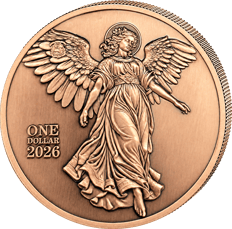
Zodiac Sign Copper Set (Mintage: 499)
£167.42£251.54
excl. UK import VAT and shipping
Available in 2–3 business days

 More than 300,000
 Over 30 years
 Secure shipping
 Google: 4.9/5

Copper is also known as "red gold" for good reason. The material impresses with many properties that generate particularly high demand from industry. But even in the form of coins, this semi-precious metal is winning over more and more investors. They are convinced that investing in copper coins is the right path. Find popular coins and medals made of copper in our range.


Most of us hold copper in our hands every day. The 1, 2 and 5‑cent coins have a skin of copper, with steel underneath. The Deutsche Bundesbank describes them as strongly magnetic.
The 10, 20 and 50‑cent coins are made of “Nordic gold”. It is not gold: the alloy is 89 per cent copper, with aluminium, zinc and tin added. It is not magnetic.
A magnet lifts the 1‑cent coin. The 10‑cent coin stays where it is.
The idea is older than the euro. The 1 pfennig coin of the D‑Mark had a steel core covered with copper on both sides. It measured 16.50 millimetres across, weighed 2.00 grams and was introduced in 1948. At 16.25 millimetres, the 1‑cent coin is almost the same size.
All three at the same scale. The diameters are given by the Deutsche Bundesbank, the ECB and our product data.
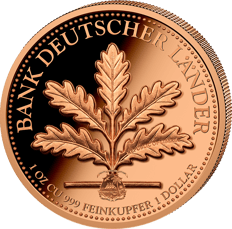
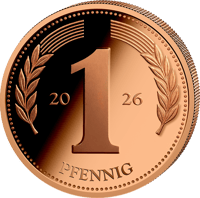 1 ounce copper Pfennig 2026Copper Pfennig 2026Liberia, 1 dollar1 ounce, 40 mmCopper 999/1,000
The design of the old pfennig, the numeral 1 between two ears of grain, now exists in copper for collectors. The coin was issued by Liberia, with a face value of 1 dollar.
Pure gold and pure silver are too soft for coins that pass through many hands. That is why copper was added to them. For the gold coins of the German Empire, the ratio was laid down in law.
“The mixing ratio of the Imperial gold coins is fixed at 900 thousandths gold and 100 thousandths copper.”
Gesetz, betreffend die Ausprägung von Reichsgoldmünzen, of 4 December 1871, § 4, Reichsgesetzblatt 1871, p. 404
Two years later, the silver coins were given the same formula. The Münzgesetz, the coinage act of 9 July 1873, lays down in Article 3: “900 parts silver and 100 parts copper” (Reichsgesetzblatt 1873, p. 234).
Sterling silver has a fineness of 925/1,000. According to The Royal Mint, the rest is usually copper, because copper makes the soft silver stronger.
Swiss gold coins, the Vreneli among them, are 90 per cent gold and 10 per cent copper. Of this alloy, Swissmint writes: “The colour of this material is quite red.”
The coins became yellow because the blanks were treated in a pickling bath before striking. In the process, copper is removed from the surface. The alloy itself makes the coin hard and resistant to wear and tear.
Goldmark, 1871Goldmark
Sterling silverSterling
Each grid has 1,000 squares, and each square is one thousandth. In sterling silver, the rest is usually copper.
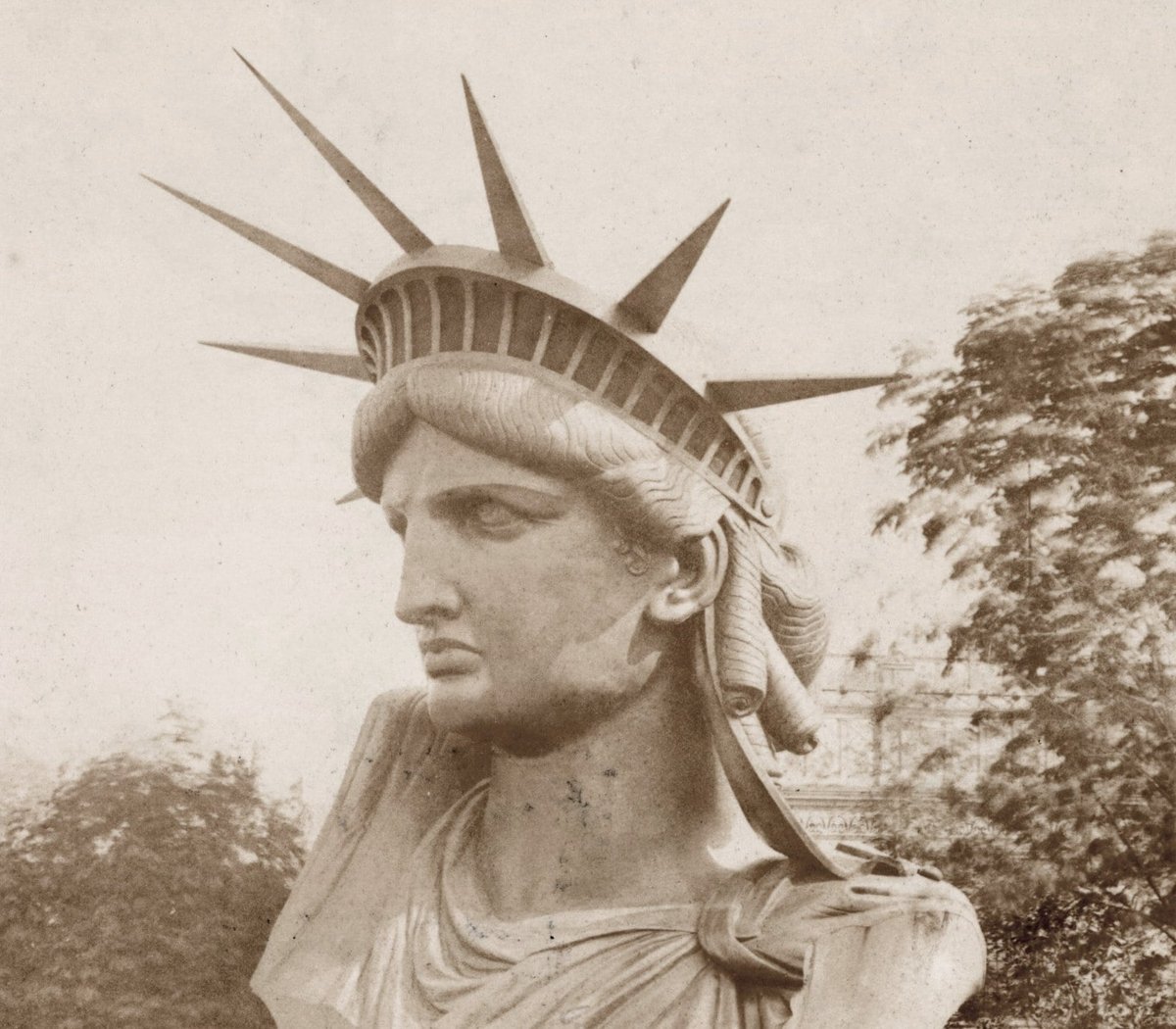
The Statue of Liberty in New York is made of copper. Its skin is only 3/32 inch thick, about 2.4 millimetres, according to the National Park Service.
The copper was shaped in Paris, in the workshop of Gaget, Gauthier & Co. There the sheets were hammered over wooden forms, and the statue was assembled from 1881 to 1884.
The skin does not carry its own weight. Flat metal straps connect it to Gustave Eiffel’s framework. They hold the statue together and flex like springs.
Taken apart into 350 pieces, the statue arrived in New York on 17 June 1885 aboard the ship “Isère”. It was dedicated on 28 October 1886.
Both at the same scale, enlarged. The thickness of the skin is given by the National Park Service, that of the coin by the ECB.
There is a lot of copper in American small change, too. The 5‑cent coin is called the “nickel” there, but it is three quarters copper.
“The 5‑cent coin is an alloy of 75 percent copper and 25 percent nickel.”
United States Code, 2024 edition, Title 31, § 5112 (b)
For collectors, there is the Libertas Americana 2026 in copper, issued by Liberia with a face value of 1 dollar.
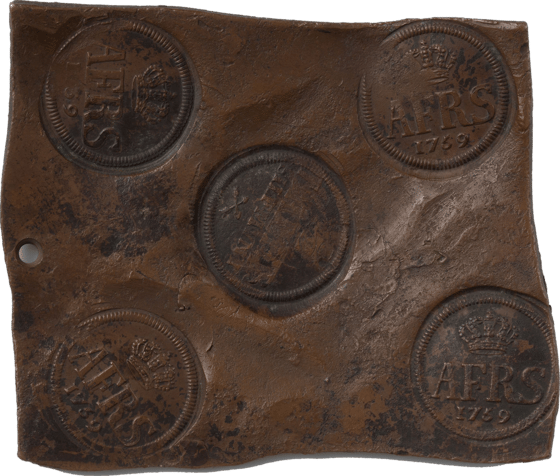
In Sweden in the 17th and 18th centuries, copper itself was money. The coins were worth as much as their metal. Because copper was worth less than silver, a copper coin of 10 daler had to be large and heavy.
The 10‑daler plate made at Avesta in 1644 weighs 19.7 kilograms. The Royal Coin Cabinet in Stockholm calls it the largest coin in the world.
The plates were moved on sledges. Europe’s first banknotes were issued in 1661 by Stockholms Banco. They quickly became popular because they were more convenient than the heavy copper coins, according to Sweden’s Riksbank.
Both at the same scale, seen from above. The measurements of the plate are given by the Rijksmuseum in Amsterdam, those of the coin by the ECB. A ½‑daler plate of 1759 with five stamps. Rijksmuseum Amsterdam, public domain (CC0).
By calculation: 19.7 kilograms is just under four bars of 5 kilograms each.
In the 17th century, at times around two thirds of the world’s copper came from Sweden, above all from the mine at Falun.
At Midsummer 1687, the mine collapsed. It left behind the “Stora Stöten”, a crater 95 metres deep. No miner was killed, because they all had time off to celebrate Midsummer.

In the Mansfeld region of Saxony‑Anhalt, the copper lies in a thin, dark layer of rock, the copper shale. It is only 20 to 40 centimetres thick and was laid down as sediment in a sea about 255 million years ago.
According to tradition, the miners Nappian and Neucke found this layer near Hettstedt in the year 1199. This is reported in the Mansfeldische Chronik by Cyriacus Spangenberg, dating from 1572.
Copper was mined here and near Sangerhausen for almost 800 years. Mining in the Mansfeld basin ended in 1969, near Sangerhausen in 1990.
Diagram of a section two metres high. The thickness of the layer is to scale, based on the Landesamt für Geologie und Bergwesen Sachsen‑Anhalt, the state office for geology and mining.
Stay informed with product launches, financial news and exclusive offers. Sign up for our free newsletter today.
By entering your email address and clicking the "Submit" button, you give the following consent: "I agree to be informed by email about new products, financial news and exclusive offers, and therefore consent to the processing of my email address for the purpose of sending the newsletter. I can revoke this consent at any time without giving reasons, with effect for the future. The lawfulness of processing carried out prior to revocation remains unaffected."