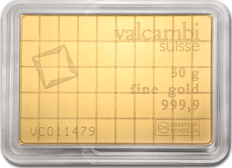
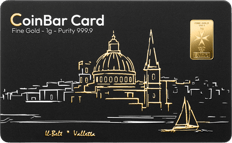
25 x 1g Gold Bar Heimerle und Meule UnityBar
£2,705.13£2,747.04
VAT-free and excl. shipping
Available in 3–4 business days

 More than 310,000
 Over 30 years
 Secure shipping
 Google: 4.9/5
Numerous investors buy gold to protect themselves against crises. We have selected special offers for you that you should own in order to protect yourself from the next major crisis and to benefit from the gold price. Here you will find investor packages, gold coins, gold bars, silver coins or silver bars.


In 1923, paper money in Germany lost its value. Week by week, the Statistisches Reichsamt, the statistical office of the Reich, recorded the prices in Berlin, in marks and converted into gold.
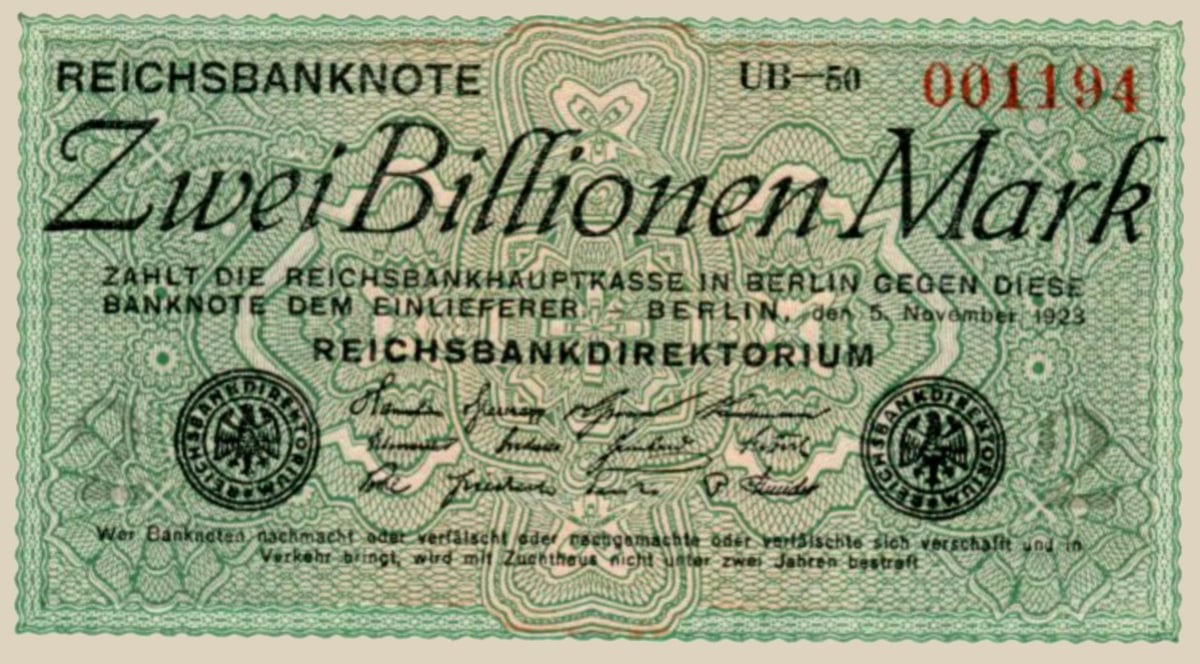
Counted in gold, the price of bread stayed a matter of pfennigs all year, between 2 and 78 pfennigs.
On paper: 233 billion marks. Counted in gold: 39 pfennigs; before the war it was 28.
In marks, the price of bread rose more than a billionfold from 3 January to 19 November.
Statistisches Reichsamt, Zahlen zur Geldentwertung in Deutschland 1914 bis 1923, Berlin 1925. The office converted the prices into gold at the dollar rate in Berlin.
Postage for an inland letter of up to 20 grams. Sources: Statistisches Reichsamt 1925 and Bund Deutscher Philatelisten, the German philatelists’ association.
In the autumn of 1923, more and more prices were stated in gold marks and paid in paper marks. The decree of 15 October 1923 establishing the Deutsche Rentenbank gave the gold value of the gold mark.
“A gold mark … is the value of 1/2790 kilogram of fine gold.”
Verordnung über die Errichtung der Deutschen Rentenbank, § 6 (2), Reichsgesetzblatt 1923, Part I, p. 963 f.
That works out at about 0.36 grams of fine gold per gold mark. From November 1923, one dollar officially equalled 4.20 gold marks, almost exactly as before the war.
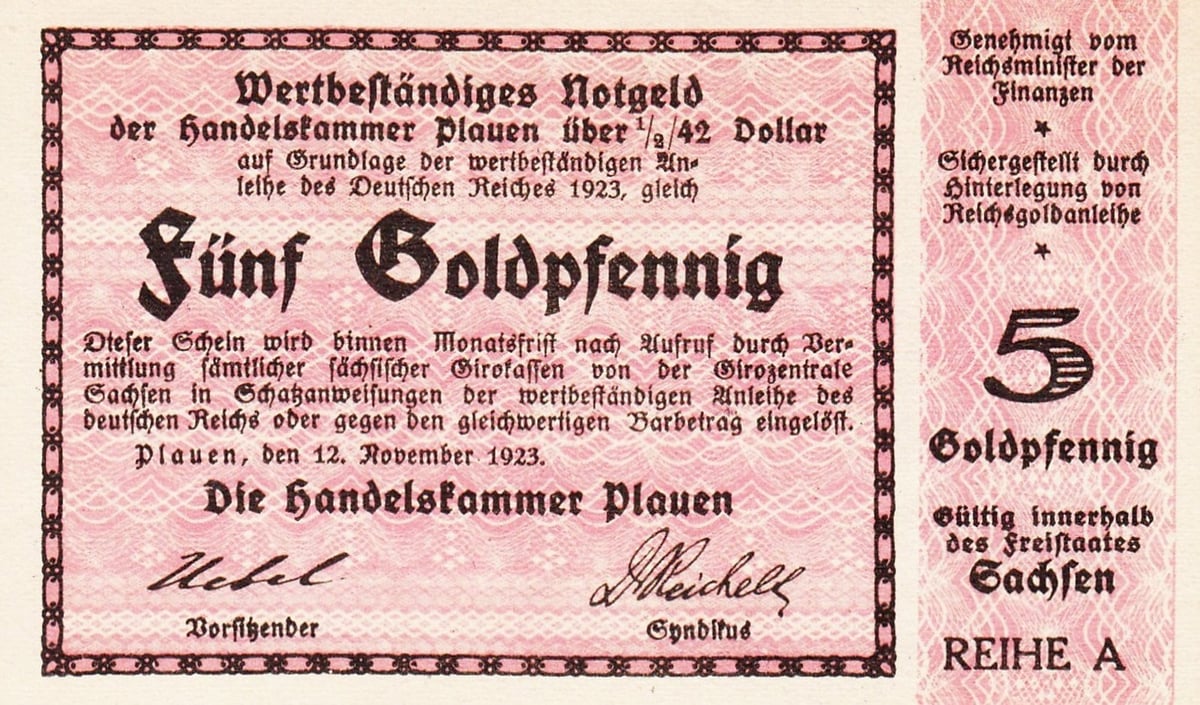
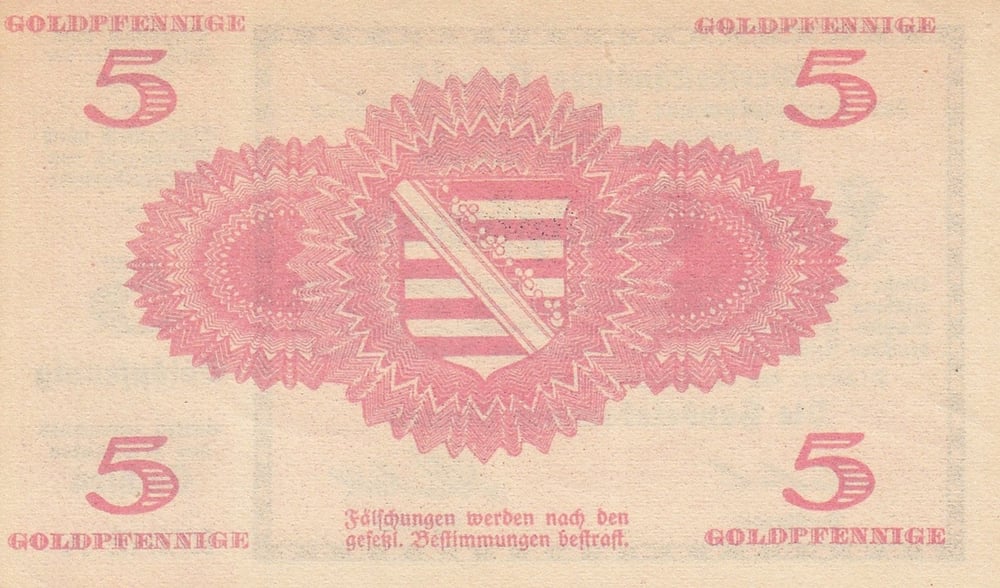
At the end of October 1923, the Reich government permitted value-stable emergency money. It was denominated in gold marks, often with its value in dollars, and backed by bonds of the Reich’s gold loan held on deposit. In the end, more than 2,800 kinds of value-stable notes were in circulation.
The steps are parts of a dollar at 4.20 gold marks. As a rule, an emergency note could not be issued for more than 4.20 gold marks, that is one dollar. Fine gold calculated at 1/2790 kilogram per gold mark.
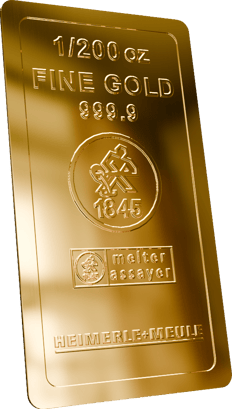
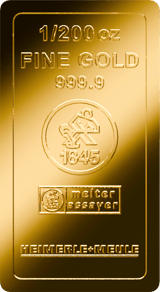 1/200 ounce gold bar1/200 ounce gold barHeimerle + MeuleEdition KettnerFine gold 999.9/1,000
By calculation, a note for 0.42 gold marks corresponded to about 0.15 grams of fine gold. A bar of 1/200 ounce, at about 0.16 grams, contains only a little more.
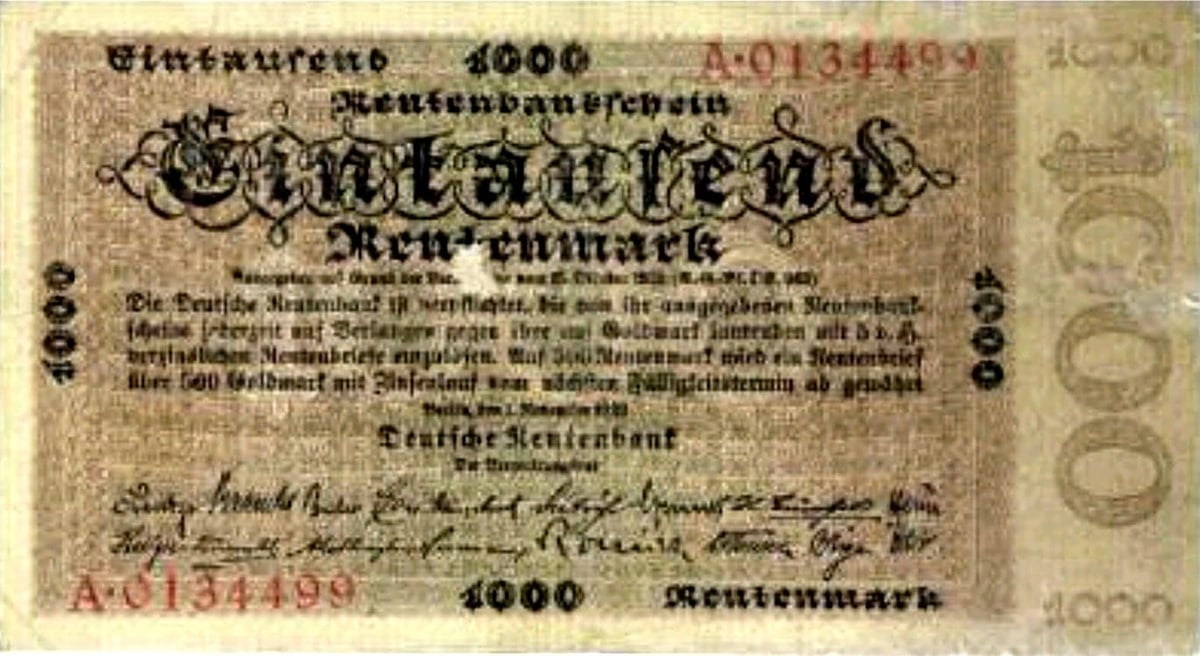
From 15 November 1923, the Deutsche Rentenbank issued a new currency, the Rentenmark. From 20 November, one Rentenmark equalled one trillion paper marks.
The Rentenmark was divided into 100 Rentenpfennig. It was backed by Rentenbriefe, bonds denominated in gold marks and secured on land.
One dollar was worth 4.20 Rentenmarks. On the Berlin exchange it cost 4.2 trillion marks from 20 November.
The Crisis Protection Packages XS to XL by Heimerle + Meule hold gold in five sizes under two grams: 0.1 gram, 1/100 ounce, 0.5 gram, 1 gram and 1/20 ounce.
A troy ounce has 31.1034768 grams. So 1/100 ounce works out at about 0.31 grams and 1/200 ounce at about 0.16 grams.
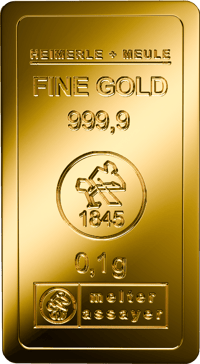 0.1 g gold bar0.1 g gold barHeimerle + MeuleEdition KettnerFine gold 999.9/1,000
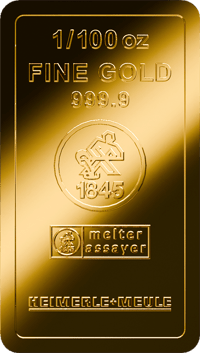 1/100 ounce gold bar1/100 ounce gold barHeimerle + MeuleEdition KettnerFine gold 999.9/1,000
The Kettner Crisis Protection Box holds 12 gold bars and 48 silver bars by Heimerle + Meule. One part gold to four parts silver. The Box XS keeps the same ratio with 4 and 16 bars.
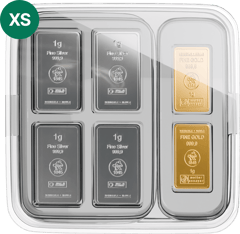 Crisis Protection Box XSProtection Box XS4 × 1 g gold16 × 1 g silverHeimerle + Meule
Under EU law, gold bars with a gold content of at least 99.5 per cent and gold coins with a gold content of at least 90 per cent count as cash, as “commodities used as highly-liquid stores of value”. Regulation (EU) 2018/1672, Article 2 and Annex I
When currencies falter and trust in paper money fades, people have always searched for a value that endures. Gold and silver have delivered exactly that for millennia, as a tangible asset that needs no bank, no network and no functioning payment system. Crisis protection packages bundle this idea into ready-made combinations of well-known bullion coins and bars. The following sections explain why precious metals belong in crisis preparedness, which denominations make sense, and what to look out for regarding authenticity, tax and storage.
The idea behind any crisis protection is simple: gold and silver have an intrinsic value that does not depend on a debtor's promise or the stability of a currency. While balances in a bank account can lose purchasing power during a crisis or become temporarily inaccessible, physical precious metal remains a tangible asset you can hold in your hand. In periods of high inflation, during currency reforms and in geopolitical crises, precious metals have historically proven to hold their value.
History speaks clearly: during the hyperinflation of the Weimar Republic in 1923, anyone who owned a gold coin could still buy groceries, while those who only had banknotes needed a wheelbarrow to get to the bakery. Similar scenes later played out in Argentina, Zimbabwe and Venezuela. For this reason, investors use precious metals not primarily as a return-generating asset, but as insurance for their own wealth. The idea of crisis protection thus complements a broader strategy for inflation hedging; those looking to get started will find a solid foundation in bullion coins.
Gold is the core metal of any crisis preparedness strategy. It is recognised worldwide, extremely value-dense and, in Germany, exempt from VAT when purchasing investment gold. For crisis protection, small denominations in particular have proven their worth, because they can be sold individually and tie up smaller amounts than large bars or full ounces. It is not without reason that gold has been regarded for generations as the ultimate safe haven when other values start to falter.
Tenth-ounce gold coins from well-known mints are particularly popular. The South African Krugerrand, the Britannia from the British Royal Mint, the American Eagle and the Swiss Vreneli are among the most widely traded investment gold coins in the world. Anyone comparing a broad selection of gold coins will find the right format for almost any budget.

A 1/10 oz gold coin contains around 3.11 grams of fine gold, making it affordable for many even at high gold prices. The advantage is obvious: instead of a single large coin, wealth is spread across many small units. In an emergency, the full equivalent of an ounce does not have to be sold all at once; a whole coin will always be more sought-after in barter than one that has been divided up. Anyone looking for even smaller units will find additional fine gradations with a 1 gram gold bar or a 5 gram gold bar.
Silver is considered the crisis metal for smaller budgets. Its lower price per ounce makes silver coins the ideal complement when it comes to small-denomination values for everyday life. In a crisis scenario where cash loses value, small silver units are closer to typical everyday amounts than high-value gold coins; ten 1 oz silver coins fit comfortably in a jacket pocket.
Classics among silver bullion coins include the Maple Leaf from Canada, the Vienna Philharmonic and the silver Britannia. Anyone looking to build up larger quantities turns to silver bars or space-saving coin bars. A broad overview is offered by the silver coins range as a whole.
Note on the taxation of silver
Unlike investment gold, silver is subject to VAT in Germany. For silver coins from outside the EU, the margin scheme is often applied, meaning only the trading margin is taxed. Investment gold, by contrast, is exempt from VAT under § 25c UStG.
This information is for general guidance only and does not constitute tax advice. For your personal tax situation, it is always advisable to consult a tax advisor.
The core of a well-thought-out crisis protection strategy is the right mix of large and small units. Large denominations are cheaper per gram, while small ones are more flexible. A balanced combination unites both advantages. The ounce serves as the globally recognised standard measure: the Krugerrand and other bullion coins carry a fine weight of 31.10 grams, matching the international investment standard.
Anyone who does not want to put together their own combination will find ready-curated mixes with the investor packages and a gold-silver mix. The mix has the advantage of combining both metals in a single package, balancing value density and divisibility. Many of these sets come with an elegant velvet pouch, making the package suitable for storage or as a gift.
Crisis protection is only as good as the authenticity of the metals it contains. Established bullion coins have clearly defined dimensions, weights and finenesses, which make verification easier. Well-known mintages such as the Krugerrand, Britannia or Maple Leaf are also so widespread worldwide that counterfeits are quickly noticed in the specialist trade.
Important verification criteria include:
Kettner Edelmetalle relies on ISO-compliant authenticity verification and a fully automated high-security logistics centre, so that every product leaves the premises verified. For the safe storage of verified coins, suitable accessories such as coin capsules are recommended, as they protect against scratches and environmental influences.
Tax treatment differs significantly depending on the metal. Investment gold is VAT-free on purchase, while silver, platinum and palladium are not. The speculation period is particularly relevant: a profit from the sale of physical precious metals is tax-free after a holding period of more than one year. This makes physical gold suitable as a long-term building block for retirement provision as well; anyone building up crisis protection over the years benefits especially from this rule.
Two options are available for storage: home storage within your own reach and a bank safe deposit box. Many arguments favour home storage for crisis protection, since only then is the metal available at all times, especially in a crisis where access to banks could be restricted. A certified safe as well as protective accessories such as coin cassettes and can safes help with this. Anyone holding larger quantities of silver should factor in the space required, as silver is considerably more voluminous than the equivalent value in gold.
Crisis protection only fulfils its purpose if the precious metal is actually within reach at the decisive moment.
Besides gold and silver, platinum and palladium complement a broadly diversified precious metals portfolio. Both metals are rarer than gold and are in strong industrial demand, which distinguishes their price formation from pure investment logic. As an addition, they increase diversification, but within crisis protection they should play a more supplementary role, since they are less established as a classic means of payment. Copper is also occasionally mentioned as an affordable tangible asset, but due to its low value per weight it is hardly suitable as a compact crisis reserve. Anyone proceeding strategically combines a solid gold core with silver as a divisible complement and uses platinum or palladium only for targeted diversification.
Physical gold usually forms the core, because it is recognised worldwide, value-dense and VAT-free on purchase. Silver complements it as a divisible, everyday-relevant metal. Small denominations such as 1/10 oz gold coins are considered particularly flexible, because they can be sold individually when needed.
Small units such as 1/10 oz coins or gram bars allow wealth to be spread across many parts. In an emergency, this means the value of a whole ounce does not need to be sold all at once. The disadvantage is a somewhat higher premium per gram compared with larger units.
Investment gold is exempt from VAT on purchase under § 25c UStG. Silver, platinum and palladium are subject to VAT, often in the form of the margin scheme. Profits from the sale of physical precious metals are tax-free after a holding period of more than one year. This information does not replace individual tax advice.
For crisis protection, home storage in a certified safe is often advantageous, because the metal is then available at all times. Coin capsules, coin cassettes and can safes additionally protect against damage. With a bank safe deposit box, it should be borne in mind that access could be restricted during a crisis.
Ready-made packages offer a balanced, pre-assembled mix of gold and silver and make getting started easier. Anyone who already has experience can individually put together a combination of gold coins, silver coins and bars tailored to their own budget. Both approaches can also be combined.
Platinum and palladium are rarer than gold and are in strong industrial demand. As an addition, they increase the diversification of a precious metals portfolio. For pure crisis protection, they play a supplementary role, as they are less established as a classic store of value and means of exchange than gold and silver.
Stay informed with product launches, financial news and exclusive offers. Sign up for our free newsletter today.
By entering your email address and clicking the "Submit" button, you give the following consent: "I agree to be informed by email about new products, financial news and exclusive offers, and therefore consent to the processing of my email address for the purpose of sending the newsletter. I can revoke this consent at any time without giving reasons, with effect for the future. The lawfulness of processing carried out prior to revocation remains unaffected."