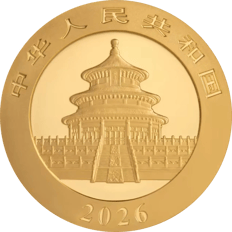
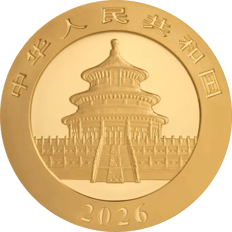
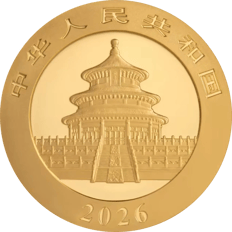
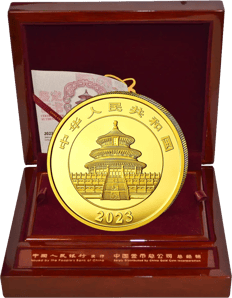
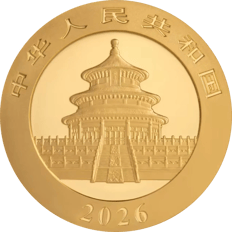
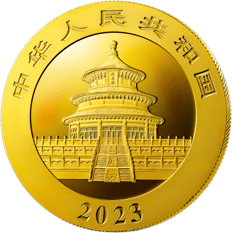
30g Gold China Panda 2027
£2,882.86
VAT-free and excl. shipping
Ships from 28/12/2026

 More than 310,000
 Over 30 years
 Secure shipping
 Google: 4.9/5
The China Mint is always good for surprises. Quite traditionally, it has been minting the successful Gold China Panda since 1987. The coin is available in a wide range of 1g, 3g, 8g, 15g and as 30g. This wide selection convinces many investors to add the coins to their portfolio when making a purchase.


Hardly any gold coin ignites as much collecting passion as the China Panda. Since 1982, the state-owned China Mint has struck the image of the black and white bear in pure gold, and unlike almost all other bullion coins in the world, the design changes every year. It is precisely this appeal that makes the China Panda gold coin a special blend of value-stable investment gold and sought-after collector's item. This guide examines the history, denominations, fineness, authenticity features, tax particulars and proper storage.
The first Panda gold coin left the mint of the People's Republic of China in 1982. What was conceived as a national bullion coin quickly developed into a worldwide collecting phenomenon. In China, the panda is regarded as a national symbol and bringer of good fortune, an animal that embodies calm, peace and constancy. This cultural significance transfers directly to the coin and explains part of its emotional appeal.
The issuer is the China Mint, one of the most respected mints in the world, whose quality is comparable to international top standards. Over the decades, the Panda has established itself alongside classics such as the Krugerrand and the Canadian Maple Leaf as one of the best-known gold coins of all. As part of the extensive gold coin range, the China Panda occupies a special position, as it unites the investment and collector themes in a single design.
A Panda is not simply struck, it tells a new story every year. Therein lies the special charm of this series.

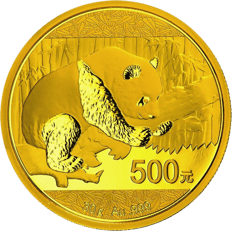
The defining feature of the series is the annual change of design. The obverse shows a new depiction of one or more pandas year after year, sometimes eating bamboo, sometimes with a cub, sometimes climbing or playing. Only in the years 2001 and 2002 was the same design exceptionally used twice, a practice that was abandoned again following protests from the collector community.
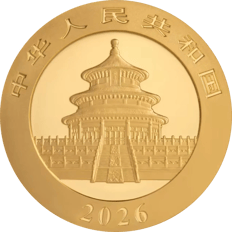
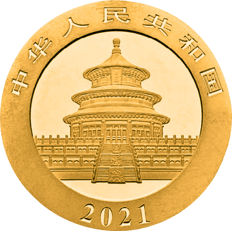
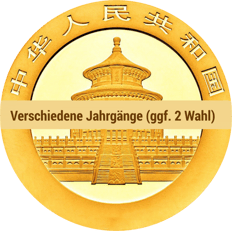
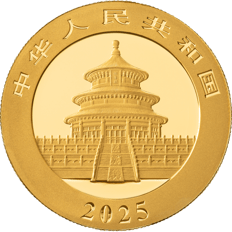
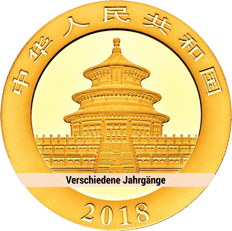
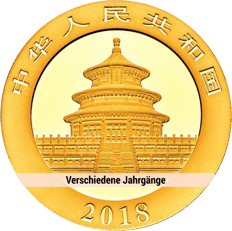
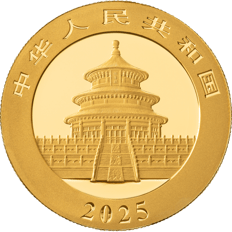
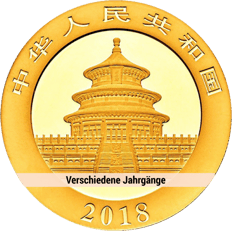
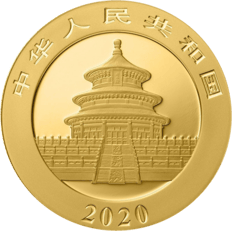
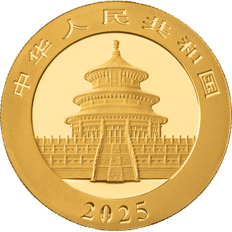
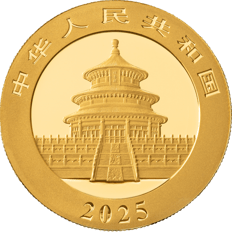
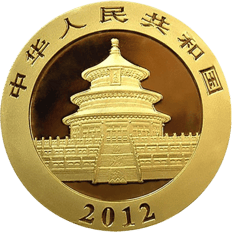
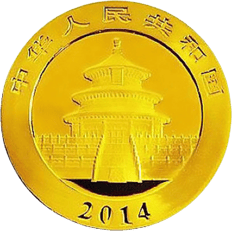
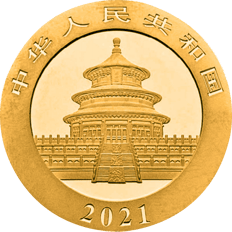
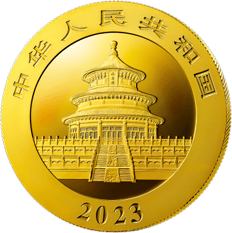
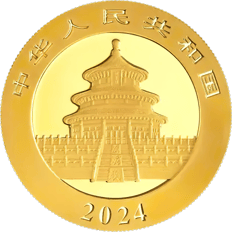
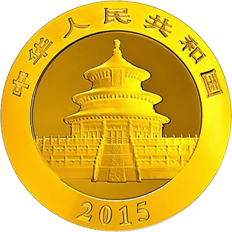
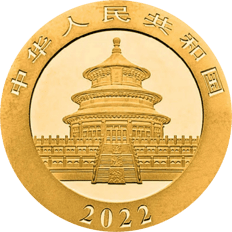
The reverse consistently shows the Temple of Heaven in Beijing (Temple of Prayer for Good Harvests), supplemented by the year of issue, fine weight and face value. It is this contrast between the recurring landmark and the ever-new Panda design that attracts collectors worldwide anew, year after year.
Because each year's issue is visually unique, individual editions develop their own distinctive character over time. Older and low-mintage years, such as 1995 and 1996, when only a small number of one-ounce coins were struck, achieve significantly higher premiums among collectors than the pure material value. Anyone who views the Panda as a complement to classic collector's coins will quickly understand the dual character of this series.
A major turning point in the series' history occurred in 2016: since then, the China Panda has no longer been struck in troy ounces but in the metric gram system. This sets it apart from almost all other international bullion coins. The denominations common today are:
Before 2016, sizes were commonly denoted in troy ounces: 1/20 oz, 1/10 oz, 1/4 oz, 1/2 oz and the classic 1 oz. These older Panda coins are often offered on the market in circulation quality across various years of issue and are in demand among collectors. For larger asset holdings, rare special editions also exist in 50 g, 100 g, 150 g and even 1 kg, often in Proof (PP) quality with a strictly limited mintage. Anyone who appreciates fine denominations will also find comparable small formats among the 1 gram gold bars or as 5 gram gold bars.
Smaller units are more flexible to sell and are suitable for gradually building up wealth, but carry a percentage-wise higher premium over the gold price. Larger denominations are cheaper per gram but tie up more capital in a single piece. For beginners, a mixture is advisable, similar to the logic behind fractional fractional sets.
Modern China Pandas are made of 999.9/1,000 fine gold (24 carat). This makes the Panda, unlike the Krugerrand or the American Eagle with their hardening copper alloy, a pure fine gold coin, comparable in this respect to the Vienna Philharmonic or the Maple Leaf.
The China Mint produces two basic versions: the Brilliant Uncirculated (BU) bullion variant for classic gold purchases, and the elaborately crafted Proof (PP) version with mirror-polished fields and frosted design elements. Proof editions are usually issued in limited mintages, often with a case and certificate of authenticity, and are primarily aimed at collectors.
Good to know: face value and fine weight
The face value stamped on the coin in yuan is purely symbolic and lies far below the actual material value. What determines the value is the fine gold content combined with the current gold price, plus, for rare years, a collector's premium.
Gold coins from official mints carry numerous security features. For the China Panda, these include the precise minting sharpness of the annual design, the precisely defined weight and the standardised diameter, as well as the characteristic relief structure of the China Mint. Since counterfeits circulate particularly in Asian markets, a clear rule applies: coins should only be purchased from established, reputable precious metals dealers.
Kettner Edelmetalle relies on an ISO-compliant authenticity verification process, ensuring that only verified original goods are shipped. For secure storage after purchase, suitable coin capsule accessories are recommended, protecting the sensitive surface.
A key advantage of gold coins lies in their tax treatment. In Germany, investment gold is exempt from VAT under § 25c UStG, meaning no VAT is charged on the purchase of China Panda gold coins. This clearly distinguishes gold from silver coins, which are subject to margin scheme taxation or regular VAT.
In addition, there is the speculation period: if physical gold is held for longer than one year, any capital gain is tax-free for private individuals. This combination makes investment gold attractive as a long-term building block for wealth, comparable to other classics in the American Eagle segment.
Note
This information is for general purposes only and does not replace individual tax or investment advice. For your personal situation, you should seek expert advice.
Pure 999.9 fine gold is relatively soft and sensitive to scratches and fingerprints. Especially with Proof coins, even a small touch can diminish the collector's value. Proper storage is therefore not a minor issue, but essential to preserving value.
Coin boxes are suitable for the organised collection of entire year sets, while individual pieces can be transported safely in coin cases. As a general rule, always hold coins by the edge and never touch the design surface with bare fingers.

The China Panda unites two worlds: as a pure fine gold coin, it is a tradeable building block of wealth whose value is closely tied to the gold price. As an annually changing collector's design, it also carries the potential for a numismatic premium, which, for rare years, can exceed the material value.
This dual nature makes the Panda a popular building block for wealth accumulation and for retirement provision. Anyone who regularly purchases small denominations can gradually build up a collection with a savings plan. Anyone wishing to place the Panda in a thematic context will find related collecting themes with an East Asian connection in Chinese design series such as the Lunar series.
It remains important to note: buying gold coins is a long-term decision without guaranteed performance. Historical mintage figures and collector demand provide guidance, but no certainty about future prices.
The China Mint has struck the Gold Panda since 1982. Since then, a new Panda design has appeared every year, which distinguishes the series from most other bullion coins.
Modern editions are made of 999.9/1,000 fine gold (24 carat). The Panda is therefore a pure fine gold coin without hardening alloy additives, comparable to the Maple Leaf or the Vienna Philharmonic.
Since 2016, the coin has been struck in grams: 1 g, 3 g, 8 g, 15 g and 30 g are the standard denominations, along with rare special sizes of up to 1 kg. Older years before 2016 were issued in troy ounces (1/20 oz to 1 oz).
No. As investment gold, the China Panda is exempt from VAT under § 25c UStG. Furthermore, after a holding period of more than one year, any capital gain is tax-free for private individuals.
Two special features stand out: the annually changing design and minting in metric gram units since 2016. Both give the Panda a pronounced collector character that classic bullion coins with an unchanging design cannot offer.
Low-mintage years such as 1995 and 1996 often achieve premiums over the pure gold value among collectors. However, there is no guarantee of value appreciation, rarity and demand determine the collector's price.
 China Panda
Stay informed with product launches, financial news and exclusive offers. Sign up for our free newsletter today.
By entering your email address and clicking the "Submit" button, you give the following consent: "I agree to be informed by email about new products, financial news and exclusive offers, and therefore consent to the processing of my email address for the purpose of sending the newsletter. I can revoke this consent at any time without giving reasons, with effect for the future. The lawfulness of processing carried out prior to revocation remains unaffected."