Coin Case Cargo (S6) for 144 Coins
£37.72
excl. UK import VAT and shipping
Available in 2–3 business days

 More than 300,000
 Over 30 years
 Secure shipping
 Google: 4.9/5


A growing coin collection deserves more than a drawer. Anyone who has spent years gathering gold coins, silver issues and collector's pieces knows the feeling when a gleaming coin gets scratched against its neighbour or its value suffers from improper storage. A coin case creates order, protection and dignified presentation all at once. This guide explains the construction, materials and capacity of coin cases, shows the difference from trays, cassettes and tubes, and answers the most common questions about safe storage.
A coin case is a sturdy storage container that holds several coin trays, keeping entire collections compact, organised and protected. Unlike a single coin cassette for just a few pieces, the case is designed for larger holdings: it stacks removable inserts on top of one another, so that every coin gets its own fixed place in an individual recess. The terms coin case, collector's case and coin cassette are often used interchangeably in the trade; they always refer to the same principle of organised storage.
The benefit works on two levels. On one hand, the case serves for safe transport, for instance to a coin fair, to the dealer or to the bank safe deposit box, without the pieces knocking against each other. On the other hand, it offers permanent, decorative home storage, keeping the collection within reach and attractively presented at all times. For collectors, the case is therefore far more than mere accessory from the accessories category: it gives numismatic passion a stylish form.
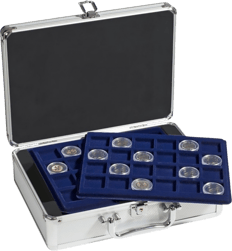
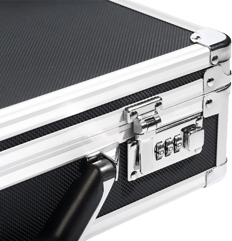
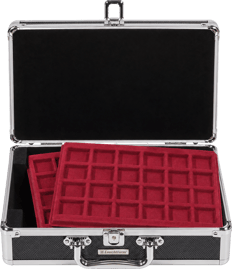
The classic coin case consists of a robust body and several insertable trays. The inside of the lid is usually lined with velour or a velvet-like fabric, which additionally cushions the coins and enhances their appearance. High-quality cases feature two combination locks, which secure the contents against unauthorised access and prevent accidental opening during transport.
The trays, also referred to as inserts in connection with cases, are the actual organising element. Each tray offers a certain number of round recesses with a defined diameter. A field marked "30 mm" accordingly accommodates coins up to this outer diameter. The trays are individually removable, so that particular series can be viewed or transported separately. Suitable collector's accessories such as cotton gloves complement careful handling.
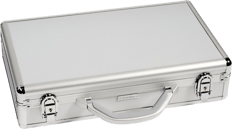
The most common cases are made of anodised aluminium: lightweight, sturdy, resilient and with clean edges. They are excellently suited for mobile use. Models made of wood look more refined and often serve as representative storage in the home environment. Both variants reliably protect the coins from dust, impact and light.
Coin cases come in many sizes, from the compact model in A4 format to the large collector's case that holds many times more. Requirements vary greatly: one person transports large volumes, another is looking for a handy, lightweight companion. A small case measures roughly the width and length of an A4 sheet at around ten centimetres in height, while larger versions offer almost double the volume.
Besides the case class, the fit of the trays to the denomination is especially decisive. Many inserts are designed for the widely used 1 oz denomination. Anyone collecting different units such as 1/2 oz, 2 oz or larger issues must pay attention to the matching recess diameter, so that the coins neither wobble nor get stuck. The following questions help with the choice:
Anyone who first protects their coins in coin capsules should choose the trays somewhat more generously, since the capsule increases the outer diameter.
There are several ways to store precious metal, differing in purpose and target group. The coin case scores with organised, decorative storage of medium to large collections. Other solutions set different priorities:
For pure investors who are simply looking for practical storage of large quantities, tubes and master boxes are often more practical. Collectors who value order and presentation make the right choice with the coin case.
Tip before buying
Before purchasing, it is worth taking a careful look at the tray specification: the stated recess diameter should match the actual diameter of the coin, including any capsule. This way, every piece sits firmly without jamming.
The most important reason for a coin case is value preservation. Precious metal coins, besides their pure material value, often carry a collector's value that reacts sensitively to mechanical damage. A single scratch can diminish a coin's condition and thus its collector's value. The soft lining and the precisely fitted recesses prevent exactly that.
For permanent storage, a few proven principles apply:
Anyone who systematically builds up their holdings, for instance through the classic investment staples from the silver coins range or popular bullion issues such as the Krugerrand, benefits from the uniform order that a case provides across many years of issue.
In principle, any coin can be kept in a suitable tray, from the euro coin set to the heavy bullion ounce. Particularly popular are cases for the large, serially issued pieces, for which entire year series accumulate over the years. These include, for example, the Maple Leaf, the Vienna Philharmonic or animal series such as the Koala.
Cases are also a common solution for euro commemorative coins and coin sets, since many identically sized pieces often come together here. Collectors of gold coins, in turn, appreciate the representative effect of a well-organised case, in which the golden strikes stand out particularly elegantly against dark velour.
A coin only finds its proper place in the tray, organised, protected and visible at all times.
As one of the largest German precious metals houses, Kettner Edelmetalle offers suitable accessories for the organised storage of entire collections. The cases on offer are lined inside with velour, contain individually removable trays and are secured with two combination locks. This way, a collection can be protected, transported and presented all at once. Anyone wishing to systematically expand their range will also find matching coin cassettes and coin tubes for different storage needs.
The terms are largely used interchangeably in the trade and both describe a container for holding coin trays. The term case usually refers to the larger models, often fitted with a carrying handle and combination lock, while the term cassette is more often used for smaller units. The underlying principle of organised storage is identical.
The decisive factor is the outer diameter of the coin in millimetres. The tray must offer recesses that match this diameter or slightly exceed it. If the coin is stored in a capsule, the required diameter increases accordingly. Common values are 30, 33, 38 or 47 mm.
Yes, many trays are suitable for both capsuled and uncapsuled coins. It is important that the recess diameter accommodates the capsule, since it increases the outer diameter. For capsuled bullion ounces, a tray with a larger field is therefore recommended.
Most common are cases made of anodised aluminium, which is lightweight, sturdy and easy to care for. There are also representative models made of wood. The inside is usually lined with velour or a velvet-like fabric, which cushions the coins and enhances their appearance.
For pure investors storing large quantities of identical coins, coin tubes or master boxes are often more practical and space-saving. The coin case plays to its strengths where order, gentle storage and attractive presentation of varied pieces are called for, that is, mainly for collectors.
Coins should only be touched by the edge or with gloves and stored in a matching recess without play. A dry, temperature-stable storage location prevents tarnishing and corrosion. Anyone transporting the collection frequently should additionally use coin capsules as direct protection.
 Coin Case
Stay informed with product launches, financial news and exclusive offers. Sign up for our free newsletter today.
By entering your email address and clicking the "Submit" button, you give the following consent: "I agree to be informed by email about new products, financial news and exclusive offers, and therefore consent to the processing of my email address for the purpose of sending the newsletter. I can revoke this consent at any time without giving reasons, with effect for the future. The lawfulness of processing carried out prior to revocation remains unaffected."