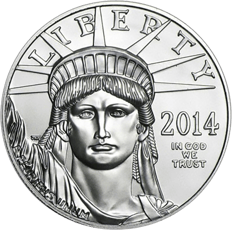
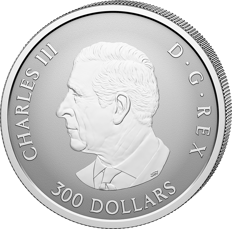
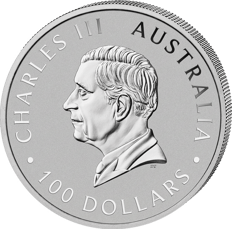
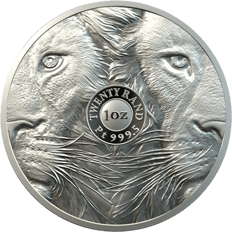
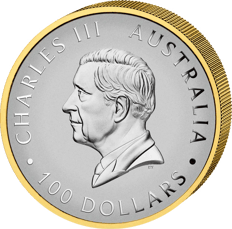
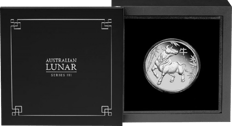
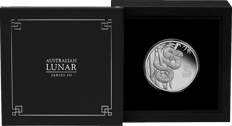
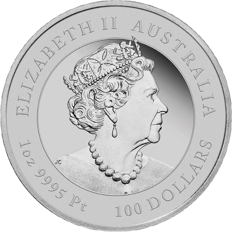
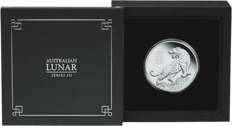
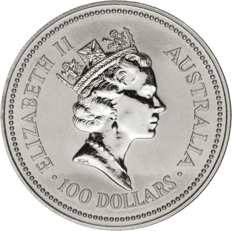
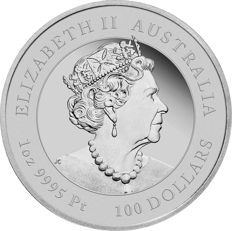
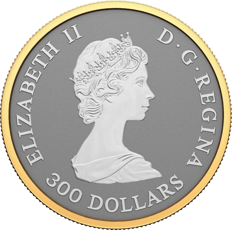
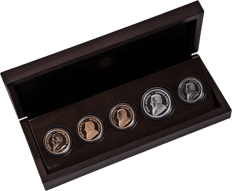
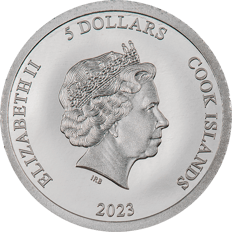
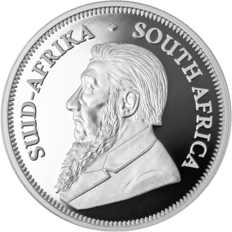
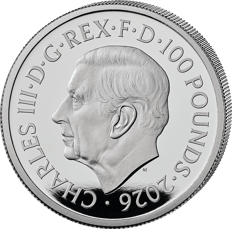
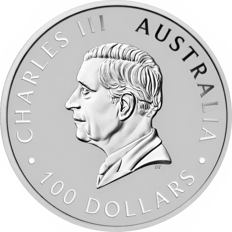
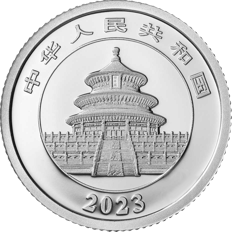
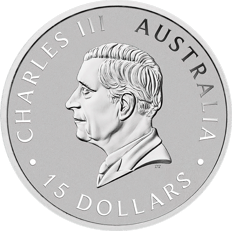
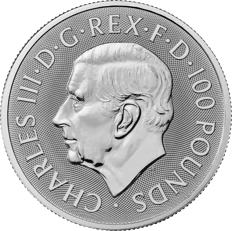
1 oz Platinum Lunar III Goat 2027 (Mintage: 5,000)
£1,399.70
excl. UK import VAT and shipping
Available in 2–3 business days

 More than 310,000
 Over 30 years
 Secure shipping
 Google: 4.9/5
Platinum is a popular investment metal. If you are looking for an investment opportunity in platinum and have a preference for beautiful bullion coins, platinum coins are an excellent choice. We are here to help you select the right platinum coins for your investment portfolio. Our range includes current coin issues and popular collector's coins made of platinum.


Platinum and palladium are two of the six platinum-group metals. All six have “similar physical and chemical properties and tend to occur together in nature”, writes the U.S. Geological Survey.
Atomic number, symbol and name. The metal of this page is highlighted.
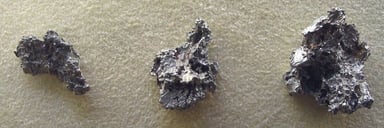
They come together in magma. When it becomes saturated with sulphur, a sulphide melt separates out, and the platinum-group metals preferentially concentrate in it. Deposits of this kind provide almost everything that is mined.
The upper crust contains, on average, half a milligram of platinum per tonne. Ores mined for platinum-group metals contain 5 to 15 grams of all six combined per tonne. Our own calculation: around 10,000 to 30,000 times as much.
Platinum ends up mainly in minerals of its own. In most rocks they are tiny: from less than a thousandth to a few tenths of a millimetre.
“Most geologists can spend a lifetime working on rocks enriched in PGEs and never see a platinum-group mineral in a hand specimen.”
U.S. Geological Survey, 2017
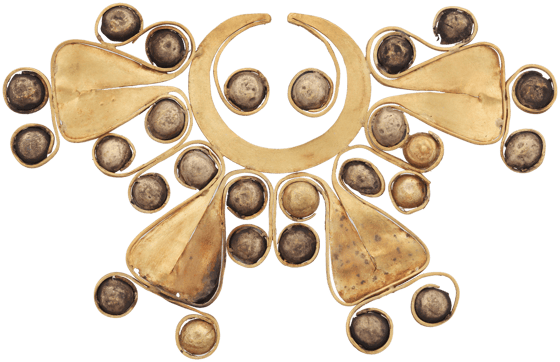
On the coast along what is now the border between Colombia and Ecuador, the La‑Tolita‑Tumaco culture knew platinum some centuries before Christ. Its goldsmiths combined it with gold: they sintered both into alloys, coated gold with platinum and plated objects with foil made of both metals. The sophistication of their metalworking was “in some cases, unique in the world”, writes David A. Scott.
Many centuries later, in 1786, Pierre François Chabaneau succeeded in producing malleable platinum in Madrid, aided by Fausto de Elhuyar. A royal decree of 1787 kept the process secret. The laboratory in Calle Hortaleza was called “Casa de la Platina”. There and in a second laboratory, 435 to 560 kilograms of platinum were produced.
The steps after the study in Mineralogical Magazine, 2020.
“the ingots, all too often cracked and sometimes even crumbled away under the hammer, all for no apparent reason”
Chaston, 1980, quoted in Mineralogical Magazine, 2020
A study from 2020 sees the cause here: the platinum still contained the other platinum-group metals.

William Willis invented platinum printing in 1873. The image first forms from light-sensitive iron salts. During development, these are dissolved out and replaced by platinum, as the Victoria and Albert Museum describes it. In the end, the image consists of platinum.
The prints were prized for their wealth of subtle tonal gradations, mostly silvery greys, and for their permanence. Today, platinum printing is enjoying a return in fine-art photography.
In 1886, Peter Henry Emerson shows cargo sailing boats near Cantley in Norfolk, waiting for the turn of the tide. The print is Plate XXIV of the book “Life and Landscape on the Norfolk Broads”.
In June 1924, A. F. Lombaard panned gravel from a dry river bed on the farm Maandagshoek in South Africa. He found “a few specks of heavy white metal” and immediately suspected platinum. His concentrate was sent to Hans Merensky on 7 June; on 12 August, Merensky joined him in the field.
The most important discovery followed in the first half of September: the rock layer now known as the Merensky Reef. The reports of 1925 do not say who took the first sample, and no one recorded the exact day.
A reef like this is usually a rock layer centimetres to metres thick, extending over tens to hundreds of kilometres. The Merensky Reef can be traced throughout the eastern and western parts of the Bushveld Complex.
The complex is around 2.05 billion years old and underlies an area of around 69,000 km². According to the U.S. Geological Survey (as of 2017), 7,200 tonnes of platinum-group metals have been mined there since the 1920s.
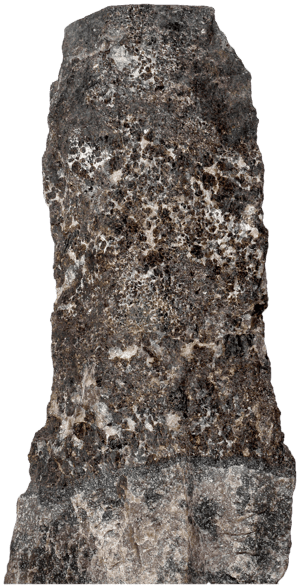
Diagram, not to scale: the band is drawn much thicker than it would be in proportion.
In the ore, platinum usually occurs alongside palladium and the other four platinum-group metals; only the refinery separates them. The palladium page tells how the palladium coin of 2017 came into being.
Platinum is the rarest of the classic investment precious metals, roughly thirty times rarer than gold and, for long stretches of history, more expensive. Anyone who buys platinum coins therefore acquires not just a tangible asset, but a piece of precious metal with an idiosyncratic, fascinating history and a dual role between investment and industrial raw material. The following sections cover its origins and mints, the various denominations, well-known designs such as the Maple Leaf or the Vienna Philharmonic, the tax particulars, and the question of what actually drives the platinum price.
Compared directly with gold coins and silver coins, the market for platinum coins is still relatively small. This is precisely what appeals to many investors: while gold and silver have long circulated in mintages of millions, high-quality platinum coins are comparatively rare. Demand for this white precious metal has risen noticeably in recent years, and supply has grown with it: new issues are added year after year.
Like gold and silver, platinum is traded in troy ounces, and standard bullion coins carry a fineness of 999.5/1,000. This means they consist of almost entirely pure platinum. Classics such as the Krugerrand or the Vienna Philharmonic are now also available in platinum, making it easy to get started, as the designs are already familiar from the gold and silver versions.
Regardless of material, a distinction is made between bullion coins and collector's coins. Bullion coins, also called investment coins, are minted in high numbers, and their price is primarily based on the current daily material value. They are suitable for beginners as well as experienced investors. Collector's coins made of platinum, on the other hand, carry an additional collector's value alongside their precious metal value, derived from low mintage, special minting quality, or the age of the issue.
Anyone who invests regularly in tangible assets will find the broader range across all precious metals in the bullion coins category: platinum adds a rare, distinctive facet to this field.

Hardly any precious metal has had such an unusual journey as platinum. For a long time it was considered worthless, even a nuisance. After the arrival of the Europeans in South America, gold prospectors came across a heavy, silvery-white metal that was difficult to melt; they disparagingly christened it platina, little silver.
The first platinum coins of the 18th century were not investments but forgeries: because the platinum price was far below the gold price at the time, platinum cores were gold-plated and issued as gold coins. The forgeries were so widespread that the Spanish king temporarily banned the platinum trade entirely in 1758.
Platinum was seriously minted as a genuine circulating currency only once: in the Russian Empire, Tsar Nicholas I had coins worth 3, 6 and 12 roubles struck from platinum between 1828 and 1845. Around 14 million platinum roubles were produced, mockingly nicknamed Serinkie (little donkeys) because of their plain appearance.
A metal that once could not be melted is now considered one of the most valuable in the world: platinum has come further than any other precious metal.
The modern era began in 1983 when the Isle of Man introduced the Platinum Noble, minted until 1997, which set the fineness standard of 999.5/1,000 still in use today. Canada followed in 1988 with the platinum Maple Leaf from the Royal Canadian Mint, and the United States followed suit with the American Eagle. Today, mints around the globe issue bullion and collector's coins in platinum.
The Australian Koala was first minted in 1988 and changed its design every year; due to platinum's high volatility, the series was discontinued in 2000. It was followed in 2011 by the Platypus, the Perth Mint's platypus coin, a 1 oz bullion coin depicting a platypus gliding underwater. Further designs and years of issue can be found under further platinum coins.
The standard bullion coin is the 1 oz (31.1 g) coin. There are also smaller denominations such as 1/2, 1/4, 1/10, 1/20 or 1/25 oz, as well as, for some series, gram issues and larger formats. Because the minting effort per coin remains roughly the same, a simple rule of thumb applies:
The larger the denomination, the lower the price per ounce.
Small units are more flexible for later resale and have a lower entry price, but carry a higher percentage premium. Larger units are more material-efficient but less divisible. Anyone wishing to combine platinum with bars will find platinum bars the lower-premium alternative for pure weight-based investment.
The most important difference from investment gold: platinum coins are not exempt from VAT. In Germany, the full 19% VAT applies on purchase. This means the purchase price is noticeably higher than the pure material value, an effect that works in the opposite direction when selling.
Tax notice
Unlike investment gold, platinum coins and platinum bars are subject to the full 19% VAT. If a profit is made on a later sale, it remains tax-free provided at least twelve months have passed between purchase and sale (private disposal transactions). This information is general in nature and does not replace professional tax advice.
Anyone wishing to make full use of the tax advantages of precious metals often combines platinum with VAT-exempt investment gold, such as gold bars or classic gold coins.
Since the value of bullion coins is primarily determined by the material, it is worth taking a closer look at price formation. Platinum futures have been traded in US dollars on the New York Mercantile Exchange since 1964, while the physical reference price has been set by the London Platinum and Palladium Market since 1987. The current price can be tracked at any time in the platinum section.
Platinum is extremely volatile because it is, to a large extent, an industrial metal. These factors have a particularly strong influence on the price:
In addition to its use in catalytic converters, platinum is also used in jewellery manufacturing, medical and laboratory technology, and aerospace. This broad industrial base makes the metal a distinctive building block alongside silver and palladium.
Platinum coins are an interesting addition to a broadly diversified precious metals portfolio. They combine appealing designs with the rarity of a metal whose price largely moves independently of gold. Like any form of investment, they have two sides.
For storage, the rule is: platinum coins should be kept dry, secure, and, wherever possible, in their original packaging. Coin capsules protect the sensitive surface from scratches, while coin cassettes or a safe deposit box are recommended for larger holdings. Collector's coins in Proof quality in particular quickly lose value from fingerprints or scratches.
The full 19% VAT applies on purchase, since platinum, unlike investment gold, is not exempt from VAT. A later profit on resale remains tax-free if at least twelve months have passed between purchase and sale. This information does not replace individual tax advice.
Standard platinum bullion coins carry a fineness of 999.5/1,000 and thus consist of almost entirely pure platinum. This standard was already set by the Isle of Man's Platinum Noble and still applies to most issues today.
This cannot be answered in general terms, because the prices of both metals largely move independently of each other. Historically, platinum was often more expensive than gold, but in recent years the relationship has shifted several times. The decisive factor is which metal is currently in stronger industrial demand.
The 1 oz coin is the most widespread and liquid size, with the lowest price per ounce. Smaller denominations such as 1/10 oz are more flexible and cheaper to start with, but carry a higher percentage premium. For pure weight-based investment, platinum bars are the lower-premium alternative.
Platinum is, to a large extent, an industrial metal whose demand depends heavily on the automotive and manufacturing industries. Combined with the concentration of production in a few countries and its pricing in US dollars, this leads to pronounced volatility, significantly more than is typical for gold.
It is advisable to look at the historical price trend, choose an experienced precious metals dealer, and, in the case of collector's coins, pay attention to mintage and condition. Platinum is better suited to long-term investment horizons; hasty purchases or sales in response to short-term price swings should be avoided.
Stay informed with product launches, financial news and exclusive offers. Sign up for our free newsletter today.
By entering your email address and clicking the "Submit" button, you give the following consent: "I agree to be informed by email about new products, financial news and exclusive offers, and therefore consent to the processing of my email address for the purpose of sending the newsletter. I can revoke this consent at any time without giving reasons, with effect for the future. The lawfulness of processing carried out prior to revocation remains unaffected."