Sold out

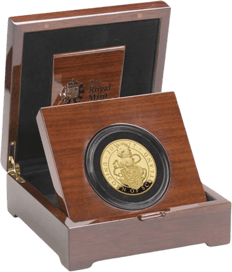
1 oz Platinum The Queen's Beasts The White Greyhound of Richmond 2022
£1,765.99
excl. UK import VAT and shipping
currently not available

 More than 300,000
 Over 30 years
 Secure shipping
 Google: 4.9/5
Since 2016, the British Royal Mint has been producing the Queen's Beasts bullion coin as gold and silver coins. In 2017, the manufacturer also launched the platinum coin as a world first. The coins form a 10-part coin series, celebrating "The Queen's Beasts" with each design. The coin is traded as a classic bullion coin.


Hardly any modern series brings as much royal splendour to the otherwise rather sober platinum market as The Queen's Beasts. Ten heraldic beasts, each with its own history and a distinctive coat of arms, transform pure investment platinum into small works of art. This guide explains the origins and designs, technical data and fineness, the tax treatment of platinum, and proper storage, so that the decision between collecting and investing can be made on a clear basis.
The Queen's Beasts platinum coin is one of the most expressive modern bullion coins from the United Kingdom. It is minted by the historic British Royal Mint, whose roots go back more than a thousand years. While the series initially launched in gold and silver in 2016, the platinum edition followed in 2017, something of a small revolution in detail for a platinum market that had long lacked variety in design.
The name of the series goes back to ten stone statues that were erected outside Westminster Abbey for the coronation of Queen Elizabeth II in 1953. Each of these heraldic beasts embodies a branch of the royal lineage, from the Tudors through the Plantagenets to the House of Hanover. Anyone who is enthusiastic about the royal symbolism of British coinage will find the same design programme on the Queen's Beasts silver coins and the Queen's Beasts gold coins.
The historical models go back even further: as early as the 16th century, the so-called King's Beasts adorned the bridge to Henry VIII's Hampton Court Palace. For the coronation of Elizabeth II, the sculptor James Woodford created ten new statues in an upright, guardian-like pose. For the coin design, the engraver Jody Clark translated these figures into a modern, dynamic style, the same hallmark that also shaped the Queen's long-standing portrait on countless British coins.
Two new designs were issued each year, so that the series built up into a complete cycle over several years of issue. This creates an appealing challenge for collectors to gather all the heraldic beasts. The individual issues are:
The crowning conclusion is the Completer Coin from 2022: it unites all ten heraldic beasts on a single coin, rounding off the series fittingly. Anyone looking for further royally inspired coins from the Royal Mint will find what they are looking for in the Tudor Beasts series or the classic Britannia in platinum.
Ten heraldic beasts, a decade of minting history: the Queen's Beasts tell the lineage of the British royal house in precious metal.
Among the ten designs, one creature stands out in particular, one that is unfamiliar to many: the Yale of Beaufort. This mythical animal has a goat-like body with golden spots and two horns that it can move independently of each other. Such mythical creatures are very popular among design collectors; thematically related coins can be found, for example, in the Lunar Series III in platinum with its yearly changing zodiac signs.
Like every bullion coin, the Queen's Beasts also has two sides with a clear division of roles. The design side shows one of the heraldic beasts in each case, half upright and partially concealed by a shield. The background is covered with a fine, honeycomb-like structure, a design element that is not only visually appealing but also makes counterfeiting considerably more difficult.
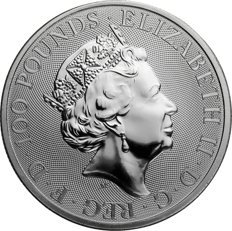
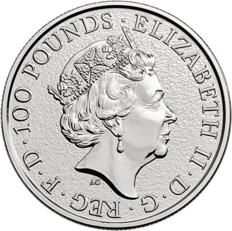
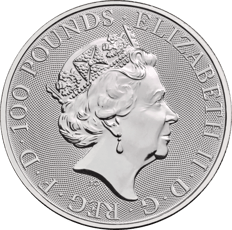
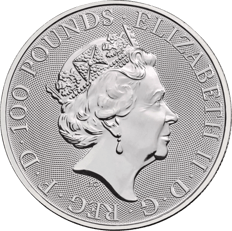
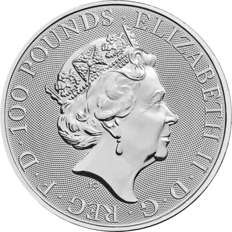
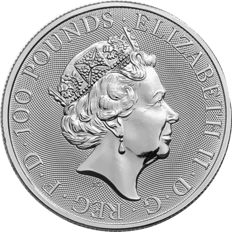
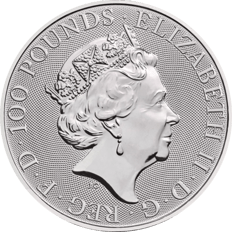
The value side bears the portrait of Queen Elizabeth II designed by Jody Clark. The background is executed in the typically English guilloché style, in which extremely fine, repeating patterns are engraved into the metal. The surrounding inscriptions state the face value, fine weight and fineness. The edge of the coin is reeded, another classic security feature. Anyone who appreciates the guilloché and honeycomb look in other series can turn their attention to the Vienna Philharmonic in platinum with its famous organ design.
The Queen's Beasts platinum coin is minted exclusively in a 1 oz denomination and issued in Bullion quality with no mintage limit. This clearly places the material value of the precious metal at the forefront. The key facts at a glance:
| Feature | Specification |
|---|---|
| Material | Platinum, fineness 999.5/1,000 |
| Fine weight | 31.103 g (1 troy ounce) |
| Face value | 100 pounds sterling (GBP) |
| Diameter | 32.69 mm |
| Thickness | approx. 2.7 mm |
| Edge | reeded |
| Mint quality | Bullion |
| Mint | British Royal Mint |
With a fineness of 999.5, platinum is one of the purest and at the same time one of the rarest investment metals of all. The compact dimensions of around 32.7 millimetres in diameter make the coin pleasantly manageable and easy to store. The coins are usually delivered capsuled or in coin pouches, and in wholesale quantities bundled in batches of ten pieces in tubes, with ten tubes per master box. Suitable coin capsules are ideal for the safe storage of individual pieces, while coin cassettes are recommended for complete sets of year issues.
Platinum is far rarer than gold: annual production is only a fraction of gold's, and most of it comes from just a few mining regions. Besides its use as an investment metal, platinum also plays a key role in industry and technology, for example in catalytic converters and hydrogen technology. This dual demand, from both investment and industry, gives the metal a character all of its own within the world of platinum coins.
Within the world of series, the Queen's Beasts competes above all with coins of unchanging design. While the Maple Leaf in platinum or the American Eagle in platinum carry the same design year after year, the Queen's Beasts scores points with its changing series character. In terms of price, however, it usually remains in a similar range to these classics, so the collector's appeal comes, in a sense, as a bonus.
As with all platinum coins, the premium over the pure material value is traditionally higher for platinum than for gold, since production volumes are smaller. Older, no-longer-minted years of issue can therefore develop an additional collector's surcharge over time. For guidance on current premiums and discounts, it is worth looking at related ranges such as platinum bars, which reflect the pure metal value with a particularly low premium.
An important difference from investment gold: platinum is not exempt from VAT in Germany. Unlike investment gold, which is exempt from VAT under the relevant regulations, platinum coins are generally subject to VAT upon purchase. In practice, the margin scheme is often applied to platinum coins, meaning that tax is only levied on the trading margin and not on the full amount.
Tax notice
For sales by private individuals, a one-year speculation period applies in Germany: if a platinum coin is held for longer than twelve months, any capital gain on sale is tax-free under current law. This does not replace tax advice; expert advice should be sought for individual cases.
These particularities clearly distinguish platinum from investment gold. Anyone wishing to make use of the tax advantages of the yellow metal will find a good starting point with the gold bullion coins.
The Queen's Beasts comes with several security features that make an authenticity verification easier: the fine honeycomb structure on the design side, the guilloché pattern on the value side, the reeded edge, and precisely defined dimensions and weights. Proven verification steps at a glance:
For storage at home, a combined solution of protective packaging and a secure storage location is recommended. The original capsule protects against scratches and fingerprints, while a safe or a bank safe deposit box protects against theft. Entire sets of year issues can be arranged neatly in coin cases or coin tubes. As a German family business with ISO-compliant authenticity verification and fully insured shipping, Kettner Edelmetalle places particular value on verified goods and secure logistics.
The great strength of the Queen's Beasts lies in its dual nature. As a classic bullion coin, it physically reflects the value of platinum as a precious metal and is therefore suitable for anyone who wants to diversify their wealth more broadly across different metals. As a design series with changing heraldic beasts, it simultaneously appeals to the hearts of collectors who want to assemble a complete cycle.
Anyone who prefers the systematic build-up of a precious metals position can take a look at the options offered by the savings plan products. And anyone who wants to continue the design world of the series across other metals can combine the platinum issues with the matching Queen's Beasts in gold to form a cohesive three-part collection. In this way, royal history is combined with the tangible value of one of the rarest precious metals in the world.
The series initially launched in gold and silver in 2016. The platinum editions have been issued since the 2017 year of issue, starting with the Lion of England design. In total, the series comprises ten heraldic beasts as well as a final Completer Coin from 2022.
The Queen's Beasts platinum coin is minted exclusively in a 1 oz denomination. It has a fineness of 999.5/1,000, a fine weight of 31.103 grams, a diameter of 32.69 millimetres and a face value of 100 pounds sterling.
No. Unlike investment gold, platinum is not exempt from VAT in Germany. The margin scheme is often applied, under which tax is only levied on the trading margin. After a holding period of more than one year, a private capital gain on sale is tax-free under current law.
The Completer Coin from 2022 marks the conclusion of the series and unites all ten heraldic beasts on a single coin. Like the other issues, it is available in gold, silver and platinum and is regarded as the collector's highlight of the entire cycle.
Platinum is mined in significantly smaller quantities than gold and silver and is at the same time strongly shaped by industrial demand, for example from catalytic converter and hydrogen technology. This results in distinctive price behaviour and often a higher premium over the pure material value.
Individual coins are usually delivered capsuled or in a coin pouch, while in wholesale quantities they are bundled in batches of ten pieces in tubes, with ten tubes per master box. For storage, coin capsules are recommended as scratch protection, along with a safe or bank safe deposit box for secure safekeeping.
 Queen's Beasts
Stay informed with product launches, financial news and exclusive offers. Sign up for our free newsletter today.
By entering your email address and clicking the "Submit" button, you give the following consent: "I agree to be informed by email about new products, financial news and exclusive offers, and therefore consent to the processing of my email address for the purpose of sending the newsletter. I can revoke this consent at any time without giving reasons, with effect for the future. The lawfulness of processing carried out prior to revocation remains unaffected."