Only 6 left to order
1 oz Platinum Vienna Philharmonic
£1,801.18
excl. UK import VAT and shipping
Available in 2–3 business days

 More than 300,000
 Over 30 years
 Secure shipping
 Google: 4.9/5
The Vienna Philharmonic bullion coins have a new family member in platinum. Austria's famous investment product featuring the instruments of the renowned Vienna orchestra is thus enriched from 2016 onwards with a variant in the denomination "1 ounce".


The Vienna Philharmonic in platinum is the only European bullion coin made from this rare precious metal, uniting two worlds: Vienna's musical tradition and the lasting value of a metal that is around 30 times rarer than gold. Since 2016, the Austrian Mint has struck the classic's familiar instrument design for the first time in pure platinum as well. The following overview examines the history, design, denominations, fineness, special tax aspects and storage, and places the platinum edition in context alongside its gold and silver siblings.
The Vienna Philharmonic is one of the best-known bullion coins in the world. What began in 1989 as a gold coin and was joined by a silver variant in 2008 gained a third family member in 2016 with the platinum edition. The coin is struck by the Austrian Mint, which is wholly owned by the Austrian National Bank and ranks among the world's leading mints for bullion coins.
Unlike the equally classic Vienna Philharmonic in gold, the platinum variant is a comparatively young product that benefits from the series' high level of recognition. It therefore competes directly with established platinum classics such as the Platinum Maple Leaf or the Platinum American Eagle. The coin is issued in Mint State (MS) quality with a fineness of 999.5/1,000 pure platinum.
The design of the Vienna Philharmonic was created by the Austrian Mint's long-standing chief engraver, Thomas Pesendorfer, and is identical across all three precious metals. It is devoted entirely to music, that language understood the world over, which gives the coin its special emotional appeal.
The reverse displays a carefully arranged selection of instruments from the world-famous orchestra: at the centre stands a cello, surrounded by the Vienna horn, bassoon, harp, and several violins and violas. The inscription WIENER PHILHARMONIKER frames the design, complemented by the word "Platin" indicating the material.
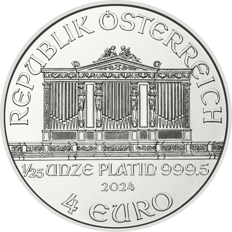
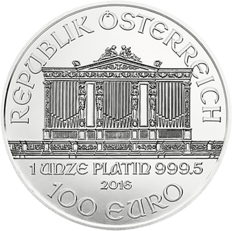
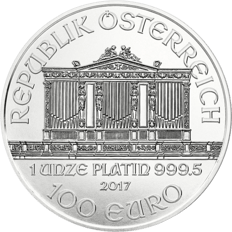
The obverse depicts the famous organ in the Golden Hall of the Vienna Musikverein, the very hall from which the New Year's Concert is broadcast around the world every year. Around the edge appear the issuing country REPUBLIK ÖSTERREICH, the fine weight, fineness, year of issue and face value. Anyone who appreciates the emotional character of the series will also find the same design on the silver editions of the Vienna Philharmonic.
The platinum edition is available in two weight classes. The large 1 oz coin has been available since 2016, while the significantly smaller 1/25 oz coin was added in 2017. This means the series covers both the classic investment segment and the gift segment.
Both editions are made of 999.5 platinum and, as official legal tender coins of the Republic of Austria, carry an embossed face value. For storing several coins, suitable coin capsules are a good choice, protecting the sensitive precious metal from scratches and fingerprints.
| Feature | 1 oz | 1/25 oz |
|---|---|---|
| Fineness | Platinum 999.5 | Platinum 999.5 |
| Fine weight | 31.10 g (1 oz) | approx. 1.24 g |
| Diameter | 37 mm | 13 mm |
| Face value | 100 euros | 4 euros |
| Edge | reeded | reeded |
| First issued | 2016 | 2017 |
Platinum is one of the rarest metals on Earth. The entire quantity ever mined would amount to only a fraction of the gold that exists, which is one reason why many investors use platinum to diversify their precious metals portfolio. In addition to its role as a store of value, platinum is a sought-after industrial raw material.
This dual demand from both investment and industry clearly distinguishes platinum from gold. Investors who wish to cover the full spectrum often supplement their holdings with platinum bars, which, from larger weights upward, often carry a lower premium relative to the material value than coins. An overview of the full range is provided by the platinum coins from various mints.
Platinum combines the aesthetics of a precious metal with the demand of an industrial raw material, a combination no other investment metal offers in this form.
A key difference between platinum and investment gold lies in taxation. While investment gold is exempt from VAT in Germany, platinum coins are generally subject to VAT (Value Added Tax). This explains the higher premium on the pure material value compared to gold coins.
Tax Note
Depending on the sales channel, platinum coins are traded either with the standard 19% VAT or under the margin scheme. In Germany, privately held precious metals are also subject to a one-year holding period, after which capital gains may be tax-free. This is general information and does not replace tax advice.
Anyone wishing to compare the tax treatment will find the VAT-exempt gold coins to be the more favourable option for pure precious metals investment, while platinum plays to its strengths in portfolio diversification.
Platinum is chemically extremely resistant, does not tarnish and, unlike silver, requires very little care. Nevertheless, the surface of the coins should be protected from mechanical damage, as scratches can reduce their collector's value.
Dry storage with a stable temperature is ideal. If the coin is handled, it is advisable to hold it by the edge to avoid fingerprints on the design surfaces.
Within the Vienna Philharmonic family, each precious metal has its own character. The gold edition is the established classic and particularly popular for traditional wealth investment thanks to its VAT exemption. The silver edition stands out with a low entry price and a large design surface.
The 1 oz coin has been struck by the Austrian Mint since 2016. Since 2017, a small 1/25 oz edition has complemented the series. Platinum is therefore the youngest member of the Vienna Philharmonic family, which began with gold in 1989 and was extended with silver in 2008.
The Vienna Philharmonic Platinum is made of 999.5/1,000 pure platinum. This fineness is the usual standard for platinum bullion coins. The 1 oz coin weighs 31.10 g and measures 37 mm in diameter.
Unlike investment gold, platinum is not exempt from VAT in Germany. Platinum coins are generally traded with 19% VAT or under the margin scheme. This tax is reflected in the premium on the pure material value.
The reverse shows a selection of orchestral instruments, including a cello, Vienna horn, bassoon, harp, violins and violas. The obverse depicts the organ of the Golden Hall in the Vienna Musikverein. The design was created by chief engraver Thomas Pesendorfer and is the same across gold, silver and platinum.
Platinum does not tarnish and is very easy to care for. To protect the surface from scratches, storage in coin capsules, coin pouches or coin cases is recommended. Larger holdings are often kept in a safe or bank safe deposit box. When handling the coin, it should only be touched by the edge.
Due to its low weight, the small 1/25 oz coin carries a significantly higher premium on the platinum price. It is therefore less suited as a pure investment and more interesting as a high-quality gift or as an entry point into the series, for example for personal occasions such as a birth or an anniversary.
 Vienna Philharmonic
Stay informed with product launches, financial news and exclusive offers. Sign up for our free newsletter today.
By entering your email address and clicking the "Submit" button, you give the following consent: "I agree to be informed by email about new products, financial news and exclusive offers, and therefore consent to the processing of my email address for the purpose of sending the newsletter. I can revoke this consent at any time without giving reasons, with effect for the future. The lawfulness of processing carried out prior to revocation remains unaffected."