Sold out

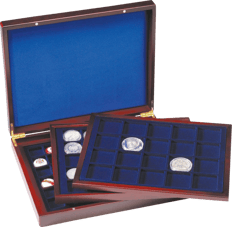
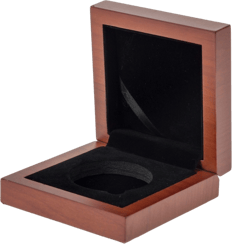
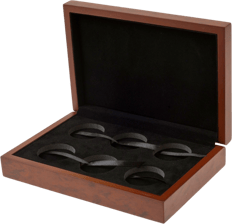
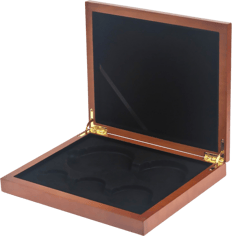
Coin Case Volterra Trio de Luxe with Square Compartments (with 30mm, 39mm, 48mm Ø)
£50.68
excl. UK import VAT and shipping
currently not available

 More than 310,000
 Over 30 years
 Secure shipping
 Google: 4.9/5
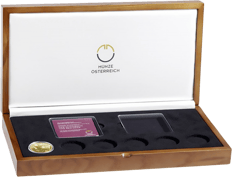
For an adequate presentation of your coins, elegant coin cases are the perfect choice. These boxes are ideal for storing collector's coins. The felt lining gives your coins a particularly elegant appearance. The coin case also provides additional space for storing the certificate of authenticity. The coin case is one of the most refined storage containers for coins.


Coin cassettes are among the most elegant storage solutions for a growing collection of bullion and collector's coins. They combine two requirements that matter equally to collectors: reliable protection against damage and an impressive presentation of each individual piece. This guide explains which materials and designs are available, how compartment sizes adapt to different coin diameters, how coin cassettes differ from coin cases and coin boxes, and what to look out for when buying one.
A coin cassette is a flat, usually lockable storage container fitted with one or more padded inserts. The interior is lined with soft, velour-like material or felt that protects the sensitive surface of the coins while also preventing electrostatic charging. This combination makes the cassette one of the most valuable forms of coin storage, suitable both for everyday use and as a dignified setting for presenting a gift.
Unlike simple protective sleeves, the cassette offers space for entire collecting areas. Many versions also include room for the certificate of authenticity, which documents the value, particularly in the case of collector's coins. Anyone wishing to organise their holdings systematically will find suitable additions throughout the accessories range, from cassettes to capsules to pouches and tubes.
The interior material plays a decisive role in protection. A velour or velvet-like lining wraps softly around the coin and prevents scratches that can occur from contact with hard surfaces. This protection is especially crucial for proof strikes (Proof), as even the slightest touch can leave visible marks. For extra protection, coins can first be placed in coin capsules, which then fit into the round compartments of the insert.

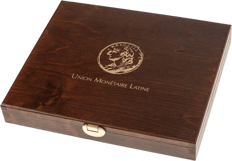
Coin cassettes are available in numerous materials. Classic versions are made of fine wood in mahogany or burl-wood style, while more affordable models are covered in linen, faux leather or leatherette. The choice depends on requirements and budget: for an especially impressive presentation of valuable pieces, a wooden cassette is ideal, while a simpler version is often sufficient for pure archiving.
Wooden cassettes are crafted from fine woods and lined on the inside with padded material in elegant shades such as blue, green, dark red or brown. This colouring makes the alloy of the coins, whether gold, silver or platinum, stand out especially well. The lid is often covered in satin or silk fabric and sometimes bears a gold-coloured embossing. Depending on size, wooden cassettes are fitted with one or several inserts.
Cassettes with a linen or faux leather covering are lighter and more affordable. They offer the same protection inside but forgo elaborate woodworking. For building a larger collection with several similar containers, they are a practical and stackable solution. It is also worth looking at the collector's accessories, which make handling coins easier.
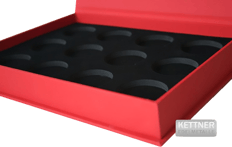
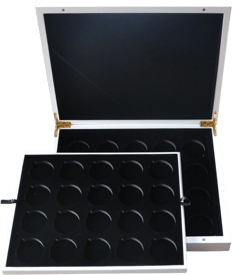
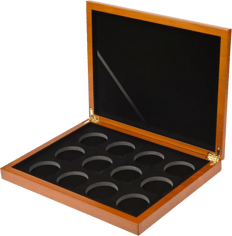
The heart of every coin cassette is the insert, also called a tray or tableau. It determines how many coins of which size will fit. There are basically two compartment shapes: round compartments for coins in capsules and square compartments for coins in coin pouches. Compartment sizes are adapted to the usual diameters of coins.

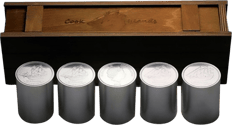
There are also special trays for specific series. These allow, for example, complete euro coin sets or series with a fixed number of pieces to be presented clearly. Anyone stockpiling many identical coins sensibly combines the cassette with coin tubes for the bulk and the cassette for the showpieces. For transporting larger holdings, a coin case is also recommended.
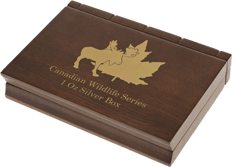
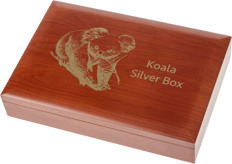
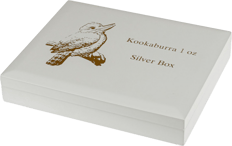
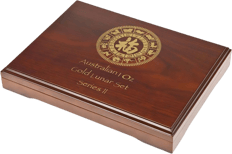
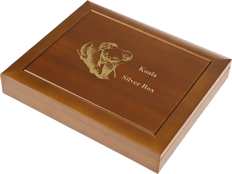
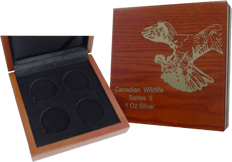
In addition to universal cassettes, there are boxes designed precisely for a particular coin series. They hold a fixed number of coins from a series and immediately show which pieces are still needed to complete it. Such boxes are popular, for example, for the Lunar Series II, for Koala silver coins or for the Canadian Wildlife issues. Matching wooden boxes are also available for the Swiss Vreneli.
Several systems are available for storing a collection, and they complement one another sensibly. The right choice depends on the size of the collection, the value of individual pieces and the desired level of presentation.
In practice, these systems are combined: the coin sits in a capsule, the capsule lies in the cassette, and several cassettes are stored together in a safe. Anyone wishing initially to protect only individual pieces can turn to coin pouches as an affordable entry-level solution.
A frequently asked question concerns the use of coin cassettes for bars. Since the insert trays of many cassettes feature square recesses, not only coins but also smaller bars can be stored in them. Bars are more compact than coins in comparison but generally have a greater height, which is why smaller bar sizes in particular are suitable for storage in the cassette.
It should be noted that many bars are supplied in a so-called blister pack, a sealed package that contains, alongside the bar, a certificate of authenticity with an individual serial number. These blister cards are larger than the compartments and often do not fit into the classic cassette. For unpackaged small bars from the range of gold bars or silver bars, however, the cassette is well suited. Anyone storing many sealed units is often better served with a can safe.
For a collection to retain its condition over the long term, the storage location plays a role alongside the cassette itself. Coin cassettes are designed to be stacked on top of one another and stored in a space-saving way, in a cupboard just as in a safe. Various locking systems offer additional protection against loss and unauthorised access.
A dry, temperature-stable place without direct sunlight is ideal. High humidity promotes the formation of tarnish on silver, which is why combined storage of capsule and cassette has proven effective. For smaller value units that should be kept discreetly, the disguised can safes are also a good option. Anyone looking for reference works on numismatics and coin studies will find what they need in the books section.
Practical note on storage
Coins should, as far as possible, not be touched with bare fingers on the edge or, worse, on the design surface. Skin oils can cause permanent stains. When transferring coins into the cassette, it is advisable to use cotton gloves or to handle them only by the edge.
Before buying a coin cassette, it is worth checking a few criteria so that the cassette remains suitable for the collection in the long term. The following overview summarises the most important points:
Collectors who build up their holdings as an inflation hedge often favour uniform, expandable storage. Those wishing to present individual showpieces, on the other hand, place more value on high-quality material and matching lid embossing. As a family business with over 280,000 customers, Kettner Edelmetalle offers a wide range of storage solutions, from simple boxes to fine wooden cassettes.
A coin cassette protects coins from scratches, dust and electrostatic charging while also allowing a clear, impressive presentation. The padded interior protects the sensitive surface, while compartments and inserts keep the coins organised.
A coin cassette is flat and designed to present one or a few inserts, while a coin case offers more volume and usually holds several stackable trays. The case is suited to extensive holdings and transport, the cassette rather to completed collecting areas.
Yes, many cassettes have round compartments specifically designed for coins in capsules. When buying, you should make sure that the compartment diameter matches the capsule size used, since the capsule is somewhat larger than the coin itself.
Smaller bars can be stored in cassettes with square compartments. Larger bars, and those supplied in a sealed blister pack with a certificate of authenticity, often do not fit the compartments, however, and are better kept in a safe.
For the impressive presentation of especially valuable pieces, a wooden cassette is ideal, as it effectively showcases the alloy of the coins. For pure archiving, a lighter version with a linen or faux leather covering is sufficient, which is also more affordable and stacks well.
A dry, temperature-stable place without direct sunlight is ideal. Since high humidity promotes the formation of tarnish on silver, the combination of capsule and cassette is recommended. For protection against loss, lockable cassettes can additionally be stored in a safe.
 Coin Cases
Stay informed with product launches, financial news and exclusive offers. Sign up for our free newsletter today.
By entering your email address and clicking the "Submit" button, you give the following consent: "I agree to be informed by email about new products, financial news and exclusive offers, and therefore consent to the processing of my email address for the purpose of sending the newsletter. I can revoke this consent at any time without giving reasons, with effect for the future. The lawfulness of processing carried out prior to revocation remains unaffected."