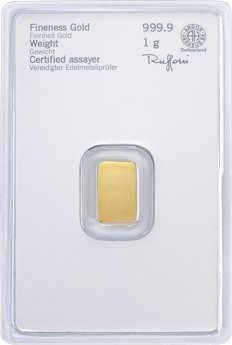
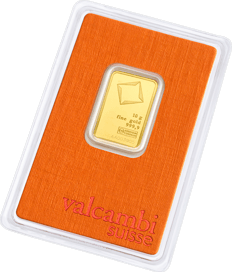
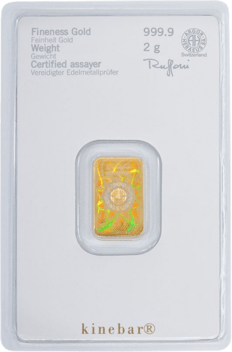
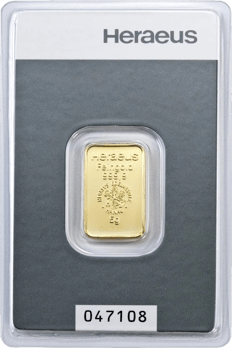
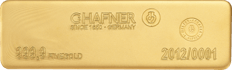
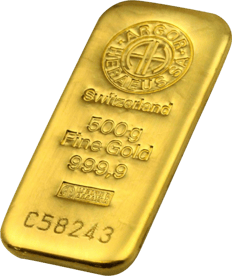
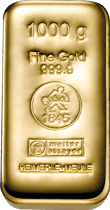
25 x 1g Gold Bar Heimerle und Meule UnityBar
£2,933.73£2,975.43
VAT-free and excl. shipping
Ships from 20/11/2026

 More than 300,000
 Over 30 years
 Secure shipping
 Google: 4.9/5


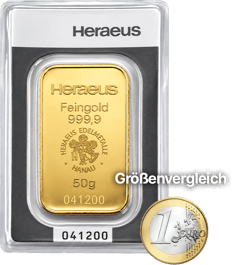
One family from one maker: the gold bars of Heimerle + Meule, all at the same scale. Up to 100 grams we show the minted ones. The larger sizes are only made cast. Click a weight to see all bars of that size.
Every size has a face of its own: from the gram to 100 grams the minted bar grows longer, wider and thicker, from 0.43 to 3.2 millimetres. Heimerle + Meule casts its kilo bar compact, 86 × 43 millimetres and 15.3 millimetres thick. Other makers cast it flat and long, about 117 × 52 millimetres and 9 millimetres thick.
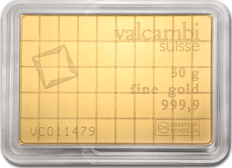
Divisible bars are made of many small bars, usually 1 gram each, that can be separated from one another.
View the divisible barsabout 12.5 kilograms
This is the format in which central banks hold their gold. According to the Bundesbank, its entire stock consists of such standard bars. One weighs roughly as much as a full crate of bottled water and is not even as large as a single water bottle.
When gold changes hands in the vaults of the Bank of England, the bar usually stays where it is. According to the Bank, only the owner changes in its records.
A minted bar is made like a coin: a blank is punched from rolled gold and then struck. A cast bar is made in a mould: molten gold fills it and solidifies.
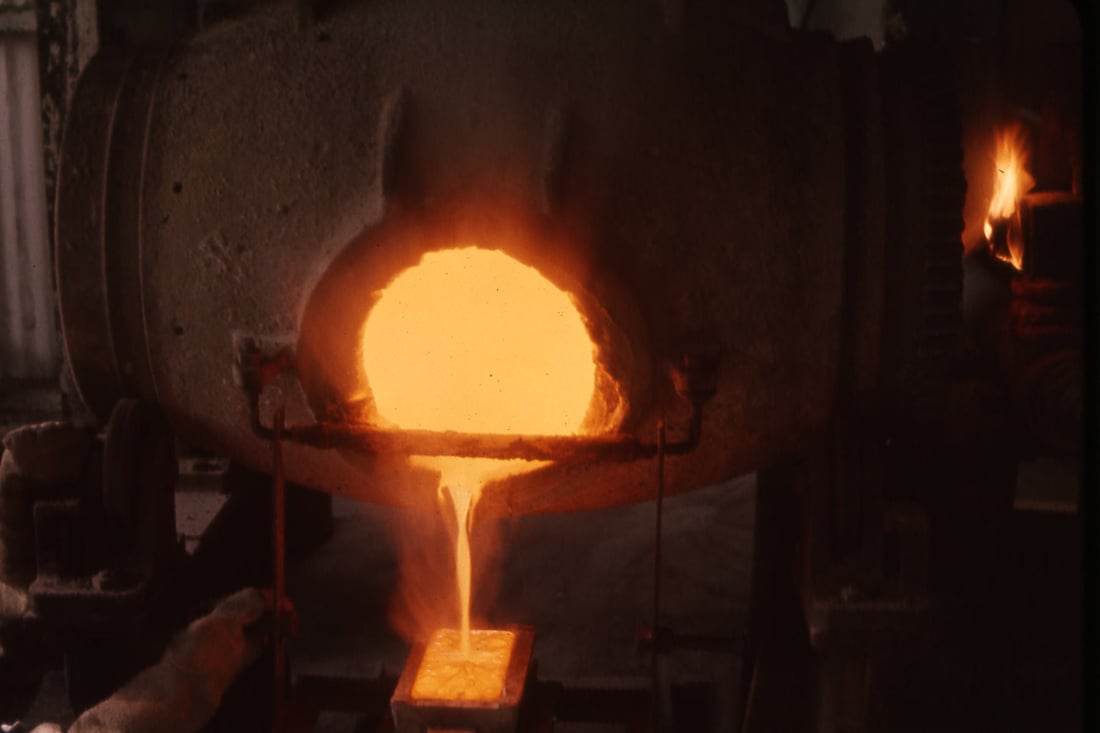
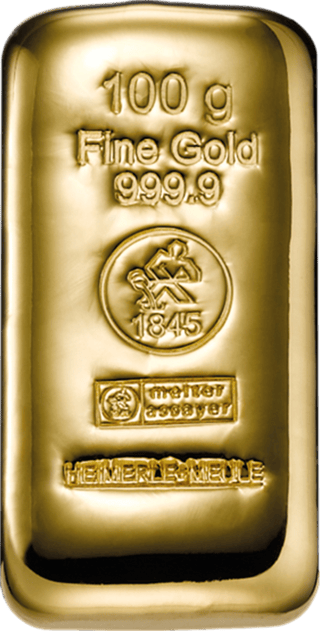 Castabout 40 × 20 mmabout 7.5 mm thick
The two bars shown here each weigh 100 grams and come from Heimerle + Meule. The minted one is flat, with crisply cut edges and a shiny face. The cast one has the smaller face and is more than twice as thick. Its edges are softly rounded.
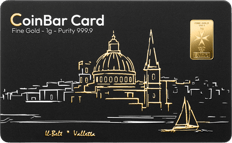
Both carry the maker, weight and fineness. Heimerle + Meule supplies the minted bar in a card and the cast bar sealed in foil with a certificate.
On the 100‑gram bar by Heimerle + Meule we show where maker, fineness and weight are written and what the marks next to them mean.
Front
HEIMERLE+MEULE at the foot of the bar, and once more at the top of the card, with the caster, the emblem of the house. The gold and silver refinery is based in Pforzheim. Its history begins in 1845.
100 g, right at the top of the bar, above the fineness.
FINE GOLD 999.9 means 999.9/1,000: of 1,000 parts, 999.9 are gold. The back of the card gives the same number.
The stamp “melter assayer” names Heimerle + Meule as the melter and assayer of the bar. To its left is the emblem of the house.
The foot of the card says “LBMA Good Delivery Refiner”. Since 3 June 2014, Heimerle + Meule has been on the Good Delivery List of the LBMA, the association of the London precious metals market. The list applies to the large bars of about 400 ounces. The mark refers to the maker, not to the individual bar.
Back
The top of the back says “Fine gold 999.9, Guaranteed purity”. Beside it is the signature of Georg Steiner, Managing Director of Heimerle + Meule.
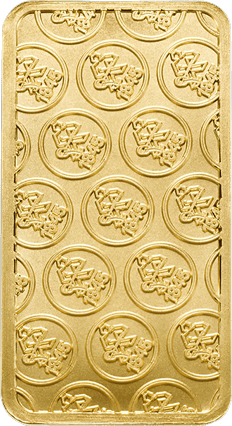
The back of the bar carries the round stamp of the house, row after row: the caster above the year 1845. He has been the emblem of Heimerle + Meule since 1933, and according to the maker every one of its gold bars bears him.
Tax law knows these details too: under § 25c of the German VAT Act, investment gold means gold bars of a weight accepted by the gold markets and a fineness of at least 995/1,000. The tax authorities mention punched or struck details of maker, fineness and weight. Investment gold is exempt from VAT in Germany.
“In principle, all gold bars have a number,” writes the Deutsche Bundesbank. Since 2015 it has published a list of all its bars every year, with number, weight and fineness. At the end of 2025 it listed 267,578 bars.
The maker assigns the number. There is no common format.
Stay informed with product launches, financial news and exclusive offers. Sign up for our free newsletter today.
By entering your email address and clicking the "Submit" button, you give the following consent: "I agree to be informed by email about new products, financial news and exclusive offers, and therefore consent to the processing of my email address for the purpose of sending the newsletter. I can revoke this consent at any time without giving reasons, with effect for the future. The lawfulness of processing carried out prior to revocation remains unaffected."