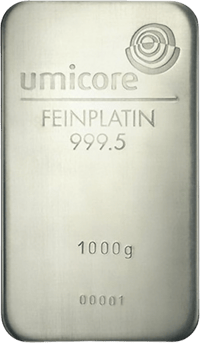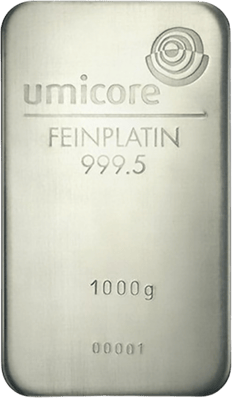
1kg Platinum Bar Umicore, Heraeus, Degussa, PAMP, UBS
£48,407.49
excl. UK import VAT and shipping
Available in 2–3 business days

 More than 310,000
 Over 30 years
 Secure shipping
 Google: 4.9/5
Precious metal bars are the most cost-effective way to invest in physical precious metals. The range of platinum bars is correspondingly extensive. We offer platinum bars in all denominations. For small investors, 1 g platinum bars are available, but it is also possible to purchase large bars weighing 1 kg.


Platinum and palladium are two of the six platinum-group metals. All six have “similar physical and chemical properties and tend to occur together in nature”, writes the U.S. Geological Survey.
Atomic number, symbol and name. The metal of this page is highlighted.
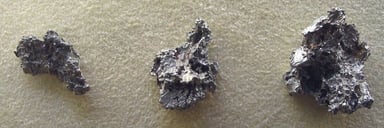
They come together in magma. When it becomes saturated with sulphur, a sulphide melt separates out, and the platinum-group metals preferentially concentrate in it. Deposits of this kind provide almost everything that is mined.
The upper crust contains, on average, half a milligram of platinum per tonne. Ores mined for platinum-group metals contain 5 to 15 grams of all six combined per tonne. Our own calculation: around 10,000 to 30,000 times as much.
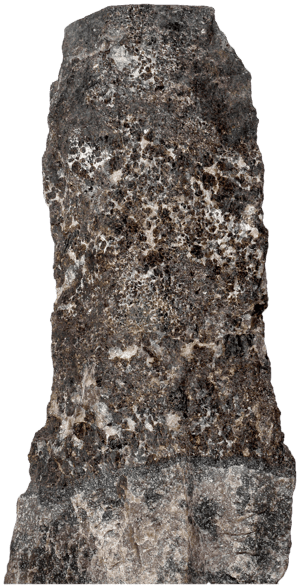
Platinum ends up mainly in minerals of its own. In most rocks they are tiny: from less than a thousandth to a few tenths of a millimetre.
“Most geologists can spend a lifetime working on rocks enriched in PGEs and never see a platinum-group mineral in a hand specimen.”
U.S. Geological Survey, 2017
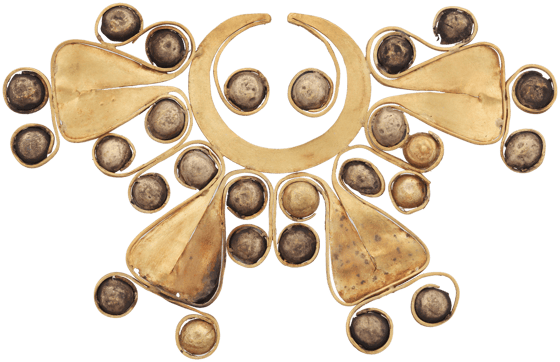
On the coast along what is now the border between Colombia and Ecuador, the La‑Tolita‑Tumaco culture knew platinum some centuries before Christ. Its goldsmiths combined it with gold: they sintered both into alloys, coated gold with platinum and plated objects with foil made of both metals. The sophistication of their metalworking was “in some cases, unique in the world”, writes David A. Scott.
Many centuries later, in 1786, Pierre François Chabaneau succeeded in producing malleable platinum in Madrid, aided by Fausto de Elhuyar. A royal decree of 1787 kept the process secret. The laboratory in Calle Hortaleza was called “Casa de la Platina”. There and in a second laboratory, 435 to 560 kilograms of platinum were produced.
The steps after the study in Mineralogical Magazine, 2020.
“the ingots, all too often cracked and sometimes even crumbled away under the hammer, all for no apparent reason”
Chaston, 1980, quoted in Mineralogical Magazine, 2020
A study from 2020 sees the cause here: the platinum still contained the other platinum-group metals.

William Willis invented platinum printing in 1873. The image first forms from light-sensitive iron salts. During development, these are dissolved out and replaced by platinum, as the Victoria and Albert Museum describes it. In the end, the image consists of platinum.
The prints were prized for their wealth of subtle tonal gradations, mostly silvery greys, and for their permanence. Today, platinum printing is enjoying a return in fine-art photography.
In 1886, Peter Henry Emerson shows cargo sailing boats near Cantley in Norfolk, waiting for the turn of the tide. The print is Plate XXIV of the book “Life and Landscape on the Norfolk Broads”.
In June 1924, A. F. Lombaard panned gravel from a dry river bed on the farm Maandagshoek in South Africa. He found “a few specks of heavy white metal” and immediately suspected platinum. His concentrate was sent to Hans Merensky on 7 June; on 12 August, Merensky joined him in the field.
The most important discovery followed in the first half of September: the rock layer now known as the Merensky Reef. The reports of 1925 do not say who took the first sample, and no one recorded the exact day.
A reef like this is usually a rock layer centimetres to metres thick, extending over tens to hundreds of kilometres. The Merensky Reef can be traced throughout the eastern and western parts of the Bushveld Complex.
The complex is around 2.05 billion years old and underlies an area of around 69,000 km². According to the U.S. Geological Survey (as of 2017), 7,200 tonnes of platinum-group metals have been mined there since the 1920s.
Diagram, not to scale: the band is drawn much thicker than it would be in proportion.
Six stages lie between the ore and the metal. At the refinery, the other metals are separated out first, then the six platinum-group metals from one another, until each is more than 99.99 per cent pure. They are supplied as bars, granules or a fine powder called “sponge”.
After the U.S. Geological Survey, 2017.
For wholesale trade in London and Zurich, the London Platinum and Palladium Market specifies what a bar must be like: 1 to 6 kilograms in weight, at least 999.5/1,000 fine, with edges that are not sharp.
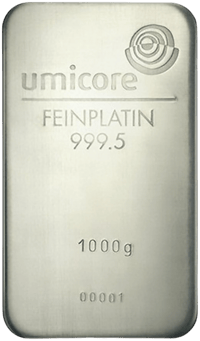
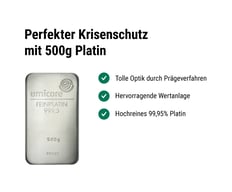
Diagram of the larger surface after the Good Delivery Rules, without real marks. Alongside it, a kilo bar from the shop.
In the ore, platinum usually occurs alongside palladium and the other four platinum-group metals; only the refinery separates them. The palladium page tells how the palladium coin of 2017 came into being.
Platinum is regarded as the precious metal of connoisseurs: rarer than gold, indispensable to industry, and for many investors a deliberately chosen counterweight within a portfolio. A platinum bar bundles this fascination into a pure, tangible form: a compact piece of metal with a fineness of 999.5/1,000, deriving its value solely from the material itself. The following sections cover the origin and special characteristics of platinum, the available denominations, production, authenticity, storage and the tax rules, presented compactly, factually and without detours.

The platinum bar is the most affordable and most direct way to invest physically in platinum. Unlike collector's coins, here only the metal itself counts: no design, no year of issue, no collector's premium. This is precisely what makes bars appealing to investors who simply want to build up substance and broaden their commodities portfolio. Platinum complements the classic building blocks of gold and silver with a metal that has its own price cycle and its own demand structure.
The name reveals the chequered history of the metal: in the 16th century, Spanish conquerors in South America came across a white metal which they disparagingly called platina, the diminutive form of plata, the Spanish word for silver. What was once considered a troublesome by-product developed over the centuries into one of the most sought-after raw materials of all. At times, platinum has even traded above the gold price. Those who opt for the bar form will find an extensive range; those who prefer minted designs will find what they are looking for among the platinum coins.
Platinum is one of the rarest precious metals on Earth. Annual production volumes are far below those of gold, and deposits are concentrated in just a few regions, above all South Africa, followed by Russia. This geographic concentration makes supply vulnerable to disruption and is one of the reasons for the often sharp price movements.
What sets platinum apart from gold is its enormous importance as an industrial metal. A large share of demand comes from the production of catalytic converters, from the chemical, glass and electronics industries, as well as increasingly from hydrogen technology, where platinum serves as a catalyst in fuel cells. This dual role, as both a store of value and a working material, gives the metal its own character: economic cycles and technological change affect its price more directly than they do with pure investment metals.
Platinum is exceptionally dense, corrosion resistant and chemically inert: it does not tarnish and retains its cool, silvery white lustre for decades. This durability is a tangible advantage for investors: a bar that is properly stored will still look like new even after years. For newcomers to precious metals, it is also worth taking a look at related ranges such as palladium bars, which are chemically closely related to platinum.
Over the years, fixed standard sizes have become established. Banks and specialist dealers typically carry platinum bars in weights of 1 g, 5 g, 10 g, 20 g, 1 oz, 50 g, 100 g, 500 g and 1 kg. Which size is right depends on budget and investment goal, an interplay between flexibility when it comes to a later sale and the premiums charged per gram.
Rule of thumb on the premium
The smaller the bar, the higher the percentage premium over the pure material value. Those who want to stay flexible and sell in stages should opt for small units. Those who want to buy as close as possible to the spot price should choose large denominations.
Platinum bars are produced in different ways, and the production method influences both appearance and price. Smaller bars are usually minted or stamped, which results in a very clean, detailed and uniform appearance. Larger units, generally from around 250 g upwards, are often cast. Casting is more economical, while the more elaborate minting process is reflected in a somewhat higher price.
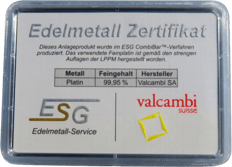
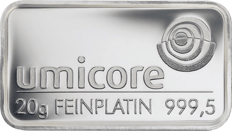
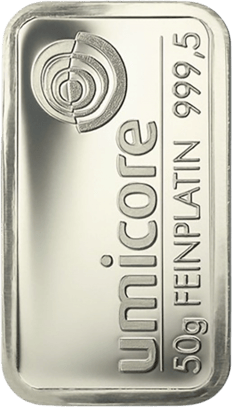
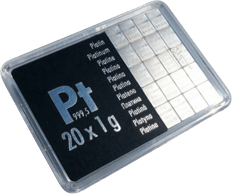
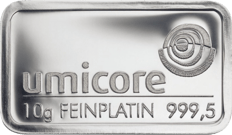
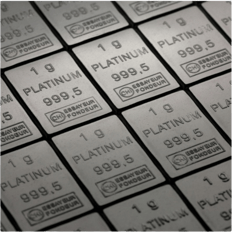
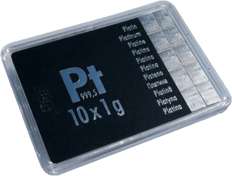
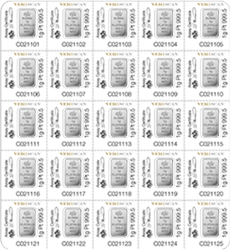
Alongside the classic forms, there are special variants. The CombiBar consists of a composite of individual 1-g tablets that can be broken off without loss along pre-stamped perforation lines. This combines the price efficiency of a larger bar with the divisibility of small units. Renowned manufacturers such as Heraeus, Umicore or Degussa also offer individually sealed bars that protect the metal permanently from external influences.
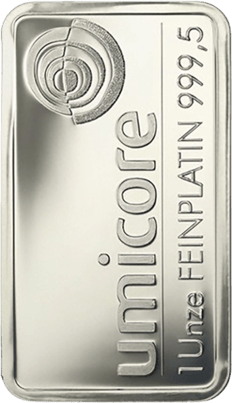
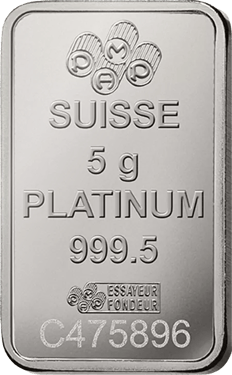
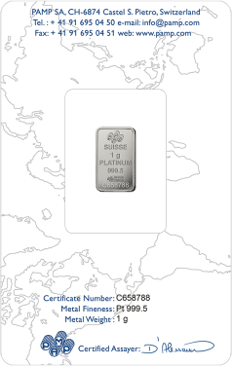
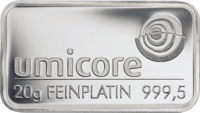
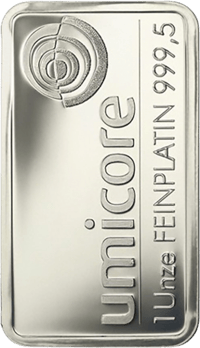
A high-quality platinum bar carries all relevant information directly on the metal or on the sealed packaging: metal designation, fine weight, fineness (999.5) and the manufacturer's hallmark. Bars from renowned refineries are usually also fitted with an individual serial number and sealed in a certified blister card or protective sleeve, this combination of bar and certificate should remain as intact as possible to preserve its value.
When buying, it is advisable to look for established brand manufacturers and a specialist dealer with careful verification. As an official partner of the South African Mint and with ISO-compliant authenticity verification, Kettner Edelmetalle places particular emphasis on this point. Anyone wishing to broaden their range further will also find comparable quality standards among the palladium coins and the platinum coins.
The price of a platinum bar is made up of several components. The basis is always the spot price, the current world market price for a troy ounce of platinum. On top of this come production costs, logistics and storage costs, as well as the dealer's margin. Because the spot price is newly determined several times a day, the bar price also changes continuously.
Platinum is traded primarily on international exchanges such as the London Metal Exchange (LME), the New York Mercantile Exchange (COMEX/NYMEX) and the Shanghai Futures Exchange. Historically, the platinum price reacts more strongly to economic fluctuations than gold does, because a large proportion of demand comes from industry. This opens up opportunities, but also brings with it noticeable price fluctuations. Those who wish to buy regularly and spread their purchases over time will find suitable options among the savings plan products.
Platinum is rare enough to fascinate, and industrially too important to ignore, a metal between the vault and the workshop.
Given the high value per gram, secure safekeeping is a central concern. In principle, there are three options: home storage in one's own safe, a bank safe deposit box, and safekeeping with a specialised service provider. Each option has its own advantages and disadvantages, ranging from the risk of theft to ongoing rental costs.
In every case, protection from environmental influences is important: bars should remain in their original sealed packaging or in a suitable capsule. Suitable accessories such as coin capsules and secure storage solutions such as tin safes help preserve their flawless condition over the long term. Anyone relying on a bank safe deposit box should factor the ongoing costs firmly into their calculations.
A decisive difference compared with investment gold: platinum is not exempt from VAT. While physical investment gold is VAT-free in Germany, the purchase of platinum bars is subject to the standard VAT rate of 19%. This applies under the usual standard taxation and noticeably increases the acquisition cost compared with a comparable investment in gold bars.
Tax notice
The purchase of platinum bars is subject to the full VAT rate of 19%. For a binding assessment of your personal situation, we recommend consulting a tax advisor; this text does not replace tax or legal advice.
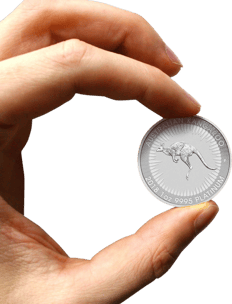
Besides bars, the range of minted platinum products has also expanded considerably. Anyone relying solely on material value and wanting to enter at a low cost is well served by bars or by pure bullion coins, both essentially follow the spot price. Classics of the investment world such as the Krugerrand or the Maple Leaf have long existed in platinum too.
Collector's coins, on the other hand, can develop a collector's value beyond the pure metal value, but require more explanation and are harder to assess. Anyone venturing into this field should do some research beforehand; an overview is provided by the collector's coins and the platinum coins. For pure wealth building, however, bars generally remain the clearest and most cost-effective choice.
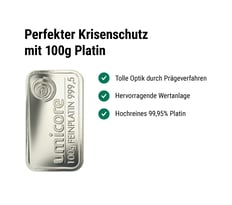
Investment platinum bars have a fineness of 999.5/1,000 across all manufacturers. This means they consist of 99.95% pure platinum, the established standard for investment bars.
Yes. Unlike investment gold, platinum is not exempt from VAT. The purchase of platinum bars is subject to the standard VAT rate of 19%. A tax advisor should be consulted for an individual tax assessment.
Small to medium units such as 10 g, 20 g or one troy ounce are suitable for getting started. They are easy to resell and flexible, but carry a higher percentage premium than large bars. Those who want to stay as close as possible to the spot price should choose larger denominations such as 500 g or 1 kg.
A CombiBar consists of a composite of individual 1-g tablets that can be separated without loss along pre-stamped perforation lines. In this way, it combines the more favourable terms of a larger bar with the divisibility of small units.
Platinum is rarer than gold and is in strong demand from industry, for example for catalytic converters and hydrogen technology. As a result, its price reacts more sensitively to economic conditions. For tax purposes, platinum is subject to 19% VAT, while investment gold is VAT-free.
It is advisable to store them in their original sealed packaging or in a suitable capsule, protected from environmental influences. Suitable storage locations include a home safe, a bank safe deposit box or a specialised safekeeping service; for safe deposit boxes, the ongoing costs should be factored in.
Stay informed with product launches, financial news and exclusive offers. Sign up for our free newsletter today.
By entering your email address and clicking the "Submit" button, you give the following consent: "I agree to be informed by email about new products, financial news and exclusive offers, and therefore consent to the processing of my email address for the purpose of sending the newsletter. I can revoke this consent at any time without giving reasons, with effect for the future. The lawfulness of processing carried out prior to revocation remains unaffected."