


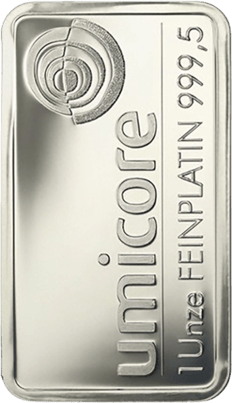
1 oz Platinum Bar Umicore, Heraeus, Degussa
£1,831.08
excl. UK import VAT and shipping
Available in 2–3 business days

 More than 300,000
 Over 30 years
 Secure shipping
 Google: 4.9/5
Platinum is one of the rarest precious metals in the world: only a fraction of the amount of gold mined is produced each year, and most of that flows directly into industry. This very scarcity makes the 1 oz platinum bar a special tangible asset: a piece of metal that fits in the palm of your hand, shines silvery white, and yet carries an astonishing value within it. The following sections cover origin and production, fineness, the various denominations, tax treatment, storage, and a comparison with gold and silver.
A troy ounce (oz) corresponds to exactly 31.1035 grams. The 1 oz platinum bar is thus a compact, internationally recognised unit that fits seamlessly into an existing precious metals portfolio. Investors value this format because it bundles a tangible counter-value without being as unwieldy as a large kilo bar. Anyone who adds platinum alongside 1 oz gold bars and silver diversifies their wealth with an additional metal that has its own supply and demand dynamics.
Platinum is not only a store of value but also a sought-after industrial raw material. Catalytic converters, hydrogen technology, medical technology and the jewellery industry continuously consume large quantities. This dual role, both investment metal and raw material at once, fundamentally distinguishes platinum from pure value-preservation metals and leads to its own distinctive price development. A look at the entire platinum range shows just how broad the selection has become, from bars to bullion coins.
The classic 1 oz platinum bar has a fineness of 999.5, meaning 99.95 percent pure platinum. Higher purities are unusual for this metal for production-related reasons, which is why 999.5 is considered the established standard for investment bars. During manufacturing, the metal is punched or stamped from a rolled platinum sheet and then marked with the relevant information.
The well-known mintings come from manufacturers with a long tradition. Bars from Heraeus or Umicore enjoy great trust in the market, because their brands are recognised worldwide and make later resale easier.
Because platinum closely resembles silver visually, authenticity verification is particularly important. A reputable specialist dealer delivers bars in sealed packaging, often in a so-called blister pack with an integrated certificate that can only be opened once. The unopened original condition is a strong argument when it comes to resale.
At Kettner Edelmetalle, products undergo an ISO-compliant authenticity verification and are shipped with an individual serial number and in secure packaging. Anyone who prefers to hold platinum in coin form will find a verified alternative with a state minting guarantee in the platinum coins.
A decisive difference from investment gold: platinum is not exempt from VAT. While physical investment gold is exempt from VAT in Germany, platinum bars are subject to the standard VAT rate of 19 percent. This surcharge should be factored into the calculation from the outset, as it reduces the later return and must first be recovered through price appreciation.
Tax notice
In Germany, platinum bars are subject to the standard VAT rate of 19 percent. However, after a holding period of more than one year, capital gains on physical precious metals are tax-free for private individuals. This is general information and does not replace tax advice.
Anyone who wants to compare the tax treatment of investment metals will find the counter-model to platinum in the VAT-exempt gold section. For long-term wealth planning, it is also worth taking a look at the retirement provision topic page.
Platinum bars are available from the gram range up to kilo bars. The choice of size is always a trade-off between the premium per gram and the later flexibility when selling. Small units are more expensive per gram but can be resold more selectively; large bars score with a lower price per gram.
Anyone who wants to get started step by step opts for manageable formats such as the 5 g platinum bar, the 10 g platinum bar or the 20 g platinum bar. These denominations are suitable for building wealth in stages and can be flexibly sold off in parts.
For larger investment amounts, the 50 g platinum bar, the 100 g platinum bar or, with the appropriate budget, the 500 g platinum bar and the 1 kg platinum bar are good options. The larger the unit, the lower the percentage premium usually is. The 1 oz bar occupies exactly the golden middle: an internationally recognised format with a balanced ratio of price and resale value.
Platinum fills its own niche in a portfolio. Visually it resembles silver, yet the value of a troy ounce is many times higher: a 1 oz platinum bar therefore stores a great deal of capital in the smallest of spaces. Compared to a 1 oz silver bar, this means significantly less volume for the same counter-value and thus less space required in the safe.
Compared to gold, platinum often behaves more independently, as its price is driven more strongly by industrial demand. A balanced precious metals portfolio therefore likes to combine several metals. Investors looking for classic investment staples also browse the gold coins or the silver coins to round off their diversification.
Platinum combines the value density of gold with the industrial relevance of a high-performance material, a combination that no other investment metal offers in this form.
Platinum is chemically extremely resistant and, unlike silver, does not tarnish. To ensure the bar nevertheless remains in Brilliant Uncirculated (BU) condition over the long term, protected storage is recommended, one that above all preserves the unopened blister pack and the serial number. Scratches or a damaged seal can reduce the resale value.
Further useful accessories for storage and presentation round off secure safekeeping.
The platinum market is comparatively small, which makes prices react more dynamically than those of gold. A substantial part of the mined supply comes from South Africa, supplemented by Russia and North America. Shifts in supply or industrial demand, for example due to the growing importance of hydrogen technology, can move the price noticeably. For investors, this means platinum is a metal with a long-term perspective that can nevertheless fluctuate in the short term.
When it comes to later selling or buying back, brand, original packaging and certificate all matter. Bars from well-known manufacturers and minted products from state mints can generally be resold more easily, because their value can be clearly assigned in the market. Anyone who prefers platinum in coin form will find globally recognised classics such as the platinum Maple Leaf or the platinum Vienna Philharmonic. As a building block of crisis provisioning, platinum can also be combined with the ideas from the inflation hedge section.
A troy ounce corresponds to exactly 31.1035 grams. A 1 oz platinum bar therefore contains around 31.1 grams of pure platinum at a fineness of 999.5.
Yes. Unlike physical investment gold, platinum bars are not exempt from VAT and are subject to the standard rate of 19 percent. This surcharge should be factored into the investment decision.
The annual mined supply of platinum is far below that of gold, and most of it is consumed by industry. As a result, comparatively few bars are available for the investment market, which limits supply.
Weight, density and the unopened original packaging with certificate and serial number are all telling indicators. At around 21.45 g/cm³, platinum is significantly denser than silver, which allows for easy differentiation. A specialist dealer with verified goods offers additional security.
That depends on the goal. The 1 oz bar offers a balanced ratio of premium and resale value. Smaller units are more expensive per gram but more flexible for later sale; larger bars reduce the percentage premium.
Ideally, the bar is stored in its unopened original blister pack, protected in a bank safe deposit box or home safe. The purchase receipt and certificate should be kept separately, so that authenticity and provenance can be proven at any time.
 1 oz Platinum Bar
Stay informed with product launches, financial news and exclusive offers. Sign up for our free newsletter today.
By entering your email address and clicking the "Submit" button, you give the following consent: "I agree to be informed by email about new products, financial news and exclusive offers, and therefore consent to the processing of my email address for the purpose of sending the newsletter. I can revoke this consent at any time without giving reasons, with effect for the future. The lawfulness of processing carried out prior to revocation remains unaffected."