


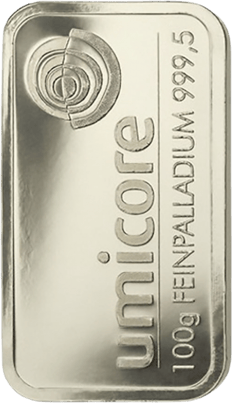
100g Palladium Bar Umicore, Heraeus, Degussa
£3,863.83
excl. UK import VAT and shipping
Available in 2–3 business days

 More than 310,000
 Over 30 years
 Secure shipping
 Google: 4.9/5
The 100 g palladium bar combines industrial demand and investment appeal in a handy format. Palladium is one of the rarest precious metals in the world: significantly less of it is mined each year than gold or silver. Anyone wishing to diversify their portfolio beyond the classic metals will find a substantial yet still easily tradable unit in a bar of this size. The following sections cover the origin and properties of the metal, the available manufacturers, authenticity features, tax treatment, proper storage, and a comparison with platinum, gold and silver.

Palladium belongs to the platinum group metals and was discovered in 1803 by the British chemist William Hyde Wollaston. At first glance it is often mistaken for silver, but chemically and in terms of investment behaviour it is considerably closer to platinum. Both metals are closely tied to industrial demand and react sensitively to economic cycles.
By far the largest share of global production comes from Russia and South Africa, with smaller deposits found in North America. This strong geographic concentration is one of the reasons why the palladium price has historically tended towards pronounced fluctuations. As a physical precious metal in bar form, however, this commodity class can be held tangibly and stored in one's own holdings, unlike purely exchange-traded paper instruments.
Around three-quarters of mined palladium goes into industry. The most important buyer is the automotive sector, which needs the metal for catalytic converters in petrol engines. Other areas of use include electronics, dental technology and the jewellery industry, where palladium serves, among other things, as an alloy component of white gold. This broad range of uses fundamentally distinguishes palladium from pure investment gold, whose demand is predominantly driven by investment. Anyone wishing to compare the entire segment will find further product forms in the overview of palladium.
A 100 g palladium bar consists of fine palladium with a fineness of 999.5/1,000, internationally established as an investment-grade quality close to what is known as "four nines". The 100-gram unit is value-dense: it bundles a comparatively high equivalent value into a very small space, yet remains flexible enough to be partially resold if needed.
Bars are punched out of rolled palladium sheet and then stamped. This manufacturing method ensures clean edges and a smooth, silvery-white gleaming surface. Smaller denominations such as the 50 g palladium bar or the 1 oz palladium bar are suitable for a staggered entry, while larger units reduce the premium per gram.
Palladium bars are produced by only a manageable number of specialised refineries. Established names include Umicore, Heraeus and Degussa, complemented internationally by producers such as Valcambi. Availability depends more heavily on market conditions than with gold, which is why the specific brand on offer can vary.
What matters for later resale is bankability: a bar is considered bankable if it comes from a recognised mint, has the required fineness and is correctly stamped. Kettner Edelmetalle stocks only such bars and subjects them to an ISO-compliant authenticity verification before shipping. Anyone interested in the landscape of manufacturers will find background information on Heraeus, Umicore and Degussa.
Because palladium visually resembles other white metals, authenticity verification plays a particularly important role. Reputable testing procedures combine several features: checking weight and dimensions, examining the stamping, and non-destructive measurements. A palladium bar with deviations in weight or dimensions should be viewed with suspicion.
The fully automated, ISO-compliant testing at the high-security logistics centre ensures that every bar delivered actually contains the stated fineness. Accessories such as suitable coin capsules additionally protect the sensitive surface from scratches and fingerprints.
Unlike investment gold, palladium is not exempt from VAT. When purchasing a palladium bar, the full standard tax rate applies: a significant difference compared with VAT-exempt investment gold. This surcharge must be factored into the calculation, as it noticeably increases the entry cost.
Tax Notice
In Germany, palladium and platinum bars are subject to VAT at the full standard rate. Investment gold, on the other hand, is exempt from VAT. Comparing the metal classes is therefore also worthwhile from a tax perspective. This is general information and not tax advice.
When it comes to a later sale, a speculation period may be relevant for physical precious metals under current law: if the bar is held for longer than one year as part of private assets, any capital gain is generally tax-free. Anyone looking for the tax-advantaged alternative will find it in the range of gold products and specifically among gold bars.
A 100 g palladium bar is compact and can easily be kept at home or in a bank safe deposit box. For home storage, a certified safe that is protected against burglary and fire is recommended. In any case, the question of insurance is important: assets of this magnitude should be covered under home contents insurance or through a separate policy.
For gentle safekeeping, coin cassettes or can safes are suitable, keeping the bar dust-free and protected from mechanical stress. Although palladium is not very prone to corrosion, clean, dry storage still preserves its Brilliant Uncirculated (BU) condition and thus its full value upon resale.
To put a palladium bar into perspective, it helps to look at the related precious metals. Each metal has its own demand profile and reacts differently to economic conditions and market cycles.
| Metal | Main demand | VAT |
|---|---|---|
| Palladium | Industry, catalytic converters | Full standard rate |
| Platinum | Industry, jewellery | Full standard rate |
| Gold | Investment, jewellery | Exempt (investment gold) |
| Silver | Industry, investment | Margin scheme/standard rate |
Palladium and platinum are heavily industry-driven and therefore more closely tied to global economic conditions. Anyone wishing to diversify more broadly often combines the metal with the more defensive silver, for example in the form of 100 g silver bars, or with a tax-advantaged holding of gold bars. Alternatively, the bar form is also available in other metal classes, such as a 100 g platinum bar, for a direct comparison of the same denomination.
Palladium is the precious metal that connects the industrial workbench with the investor's safe: rare, sought-after and tangible.
Standard investment-grade palladium bars consist of fine palladium with a fineness of 999.5/1,000. This value is stamped on the bar alongside the manufacturer, weight and serial number.
Yes. Unlike investment gold, palladium is not exempt from VAT. The full standard tax rate is charged on purchase. This information is general and does not replace professional tax advice.
Palladium bars are produced by only a few refineries, including Umicore, Heraeus and Degussa, as well as Valcambi internationally. Which specific brand is available depends on the current market situation.
Visually, palladium resembles silver, while in terms of investment behaviour it is closer to platinum. Both platinum group metals are strongly dependent on industrial demand, above all from the automotive sector, and consequently fluctuate more than gold.
A certified safe at home or a bank safe deposit box are recommended. Coin capsules and coin cassettes protect the surface from scratches. Dry, clean storage preserves the Brilliant Uncirculated (BU) condition and thus the value on resale.
A 100-gram bar usually has a lower premium per gram than small units and is therefore more cost-efficient in terms of material. Several smaller denominations, however, offer more flexibility for partial resale. The choice depends on the investment objective.
 100 g Palladium Bars
Stay informed with product launches, financial news and exclusive offers. Sign up for our free newsletter today.
By entering your email address and clicking the "Submit" button, you give the following consent: "I agree to be informed by email about new products, financial news and exclusive offers, and therefore consent to the processing of my email address for the purpose of sending the newsletter. I can revoke this consent at any time without giving reasons, with effect for the future. The lawfulness of processing carried out prior to revocation remains unaffected."