


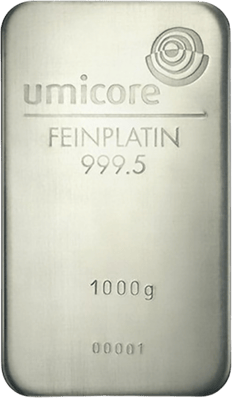
1kg Platinum Bar Umicore, Heraeus, Degussa, PAMP, UBS
£52,891.67
excl. UK import VAT and shipping
Available in 2–3 business days

 More than 300,000
 Over 30 years
 Secure shipping
 Google: 4.9/5
A 1 kg platinum bar is the flagship among platinum investment products: a hand-filling heavyweight that packs a considerable asset value into the smallest of spaces. Platinum is considered roughly 30 times rarer than gold, is indispensable for industry, and has at times historically even been more expensive than the yellow precious metal. Anyone who buys a kilo bar is consciously choosing a metal outside the mainstream. The following sections cover origin and manufacturers, fineness and dimensions, the tax particularities, authenticity verification, storage, and a comparison with other denominations and precious metals.

In the periodic table, platinum carries the element symbol Pt and the atomic number 78. It belongs to the group of platinum metals, which also includes palladium, rhodium, ruthenium, osmium and iridium. Chemically, platinum is extremely corrosion-resistant, ductile and heat-resistant, properties that make it equally valuable for industry, medicine and jewellery. A bar containing one kilogram of fine platinum embodies this rarity in its most concentrated form.
The kilo bar is aimed primarily at investors who want to bundle a larger sum into a single piece. Compared with many small units, the mark-up on the pure metal value, the so-called premium or spread, is proportionally lower because minting and handling costs are only incurred once. This makes the 1 kg bar the most cost-efficient way to hold physical platinum. Anyone who prefers to start more cautiously will also find significantly smaller entry sizes in the broader platinum bars range.
All commercially available platinum bars, from the smallest format to the kilo bar, have a fineness of 999.5, meaning a purity of 99.95 per cent. This standard is established internationally and is a prerequisite for a bar to be recognised as fine platinum in professional trading. A 1 kg bar therefore contains exactly 1,000 grams of pure platinum.
Depending on the manufacturer, kilo bars are offered either minted or cast. Minted bars receive their surface and the stamped details through high pressure and appear particularly even and glossy. Cast bars display a more rustic structure and are widespread in large weight classes. Both variants carry the most important markings as standard:
Kilo bars come from renowned international refineries. These include, among others, Umicore, Heraeus, Degussa, PAMP, Valcambi and UBS. Bars with LBMA certification, named after the London Bullion Market Association, enjoy high acceptance worldwide and can accordingly be resold without complication.
A key difference from investment gold: platinum is not exempt from VAT. While investment gold is exempt from VAT in Germany, platinum is subject to the full standard tax rate of 19 per cent. This mark-up must be factored in when buying, as it noticeably increases the entry price compared with the pure metal value.
Tax notice
In Germany, physical platinum is generally subject to the standard VAT rate. After a holding period of more than one year, any capital gain for private investors is exempt from income tax under the rules for private disposal transactions. This is general information and does not replace tax advice.
Anyone weighing up the tax side more closely often compares platinum with VAT-exempt investment gold, for instance with a 1 kg gold bar. For a more in-depth understanding of the metal as a whole, it is also worth taking a look at the platinum range page.
Authenticity plays a key role, especially with a high-value kilo bar. Reputable bars can be reliably identified by several characteristics. Important checkpoints are:
As a family business with ISO-compliant authenticity verification, Kettner Edelmetalle places great importance on ensuring that every bar reaches the buyer checked and flawlessly documented. Anyone who wants to complement their platinum with suitable collector's and security products will find appropriate solutions in the accessories section.
A 1 kg bar is compact and can be stored in a space-saving way, which is precisely what makes platinum's high value density so attractive. Several options are available for secure storage:
To protect against scratches and fingerprints, storage in suitable containers is recommended. For smaller units and collections, coin boxes or a lockable can safe are suitable, for example. Kettner Edelmetalle's insured shipping also ensures that the bar is protected on its way to its new owner.
Platinum occupies a special position among investment metals. Demand is strongly driven by industry, particularly by the automotive sector, where platinum is used in catalytic converters. This leads to more pronounced price fluctuations than with gold, but also opens up opportunities for investors who want to diversify their portfolio more broadly.
The platinum price is formed on the world market and reacts sensitively to industrial supply and demand. Because production volumes are heavily concentrated in a few countries, South Africa above all, supply bottlenecks can move the price quickly. For investors, this results in clear advantages as well as disadvantages:
When it comes to a later buy-back, the price achievable is based on the current platinum price minus a trading margin. Bars from well-known manufacturers with complete documentation can generally be resold most readily. Anyone who sees the kilo bar as a building block of a broader portfolio will find complementary formats in the entire platinum range.
Anyone who would rather hold platinum in the form of coins will find classics such as the Vienna Philharmonic, Maple Leaf or American Eagle among the platinum coins. Bars and coins can also be combined well to balance flexibility and value density.
The 1 kg platinum bar appeals to investors who want to convert a larger sum efficiently and in a single piece into physical precious metal. Due to its low percentage premium, it is particularly suitable for long-term wealth building. Anyone who would rather sell flexibly in smaller steps should consider splitting their holding, for instance in combination with a 100 g platinum bar or a 1 oz platinum bar.
Anyone who thinks in kilograms thinks in decades: the large bar is rarely an object for quick moves, but rather for steady hands.
As a general rule: platinum complements an existing precious metals portfolio but does not fully replace either gold or silver. Mixing several metals spreads dependence on individual markets. A look at the entire platinum bars range helps in finding the weight class that suits one's own strategy.
Commercially available platinum bars have a fineness of 999.5, i.e. a purity of 99.95 per cent. A kilo bar therefore contains 1,000 grams of pure platinum.
Unlike investment gold, platinum is not exempt from VAT. It is subject to the full standard tax rate of 19 per cent upon purchase, which increases the entry price compared with the pure metal value.
Bars from Umicore, Heraeus, Degussa, PAMP and UBS are widespread and internationally recognised. LBMA certification also makes a later resale easier.
As a rule, yes. Since minting and handling costs are only incurred once, the percentage premium on the metal value is lower for a kilo bar than for several small units of the same total weight.
The minting, serial number, weight and dimensions as well as the accompanying certificate are checked. Specialist dealers also use physical methods such as density measurement, ultrasound or X-ray fluorescence analysis.
A certified home safe or a bank safe deposit box is recommended. The sealed original packaging should remain intact, as it forms part of the authenticity documentation and protects the bar from scratches.
 1 kg Platinum Bars
Stay informed with product launches, financial news and exclusive offers. Sign up for our free newsletter today.
By entering your email address and clicking the "Submit" button, you give the following consent: "I agree to be informed by email about new products, financial news and exclusive offers, and therefore consent to the processing of my email address for the purpose of sending the newsletter. I can revoke this consent at any time without giving reasons, with effect for the future. The lawfulness of processing carried out prior to revocation remains unaffected."