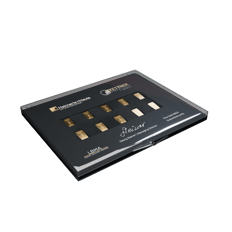
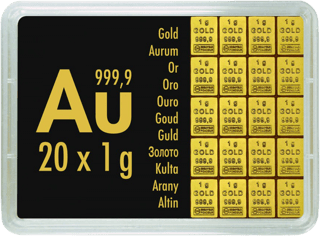
25 x 1g Gold Bar Heimerle und Meule UnityBar
£2,933.73£2,975.43
VAT-free and excl. shipping
Ships from 20/11/2026

 More than 300,000
 Over 30 years
 Secure shipping
 Google: 4.9/5

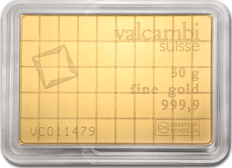
Gold CombiBars – a composite of small fine gold bars, each featuring a hallmark stamp. The bar weight, fineness, type of precious metal, and the manufacturer's logo are all embossed on each bar. Gold CombiBars can be separated from one another without any loss along pre-defined break points, making them ideal for crisis protection.


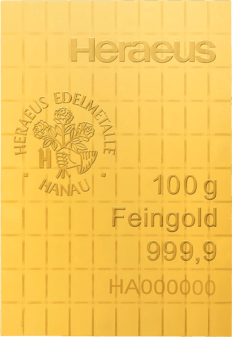
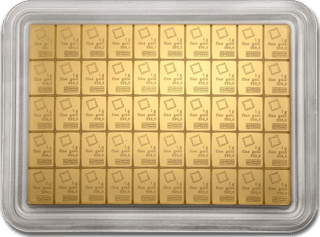
Many small bars together, each of which can be separated on its own: this comes in five forms. Only in one of them, the tablet, are the pieces firmly joined.
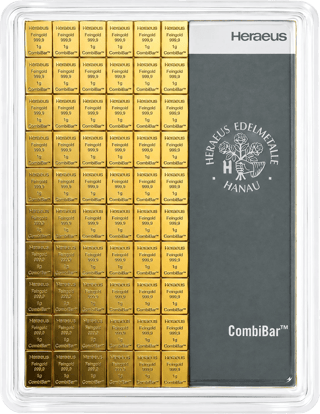
“20, 50 or 100 individual 1 g minted gold bars are [joined] together to form one large bar. The single 1 g bars can easily be separated from one another.”
Heraeus on its tablets, data sheet
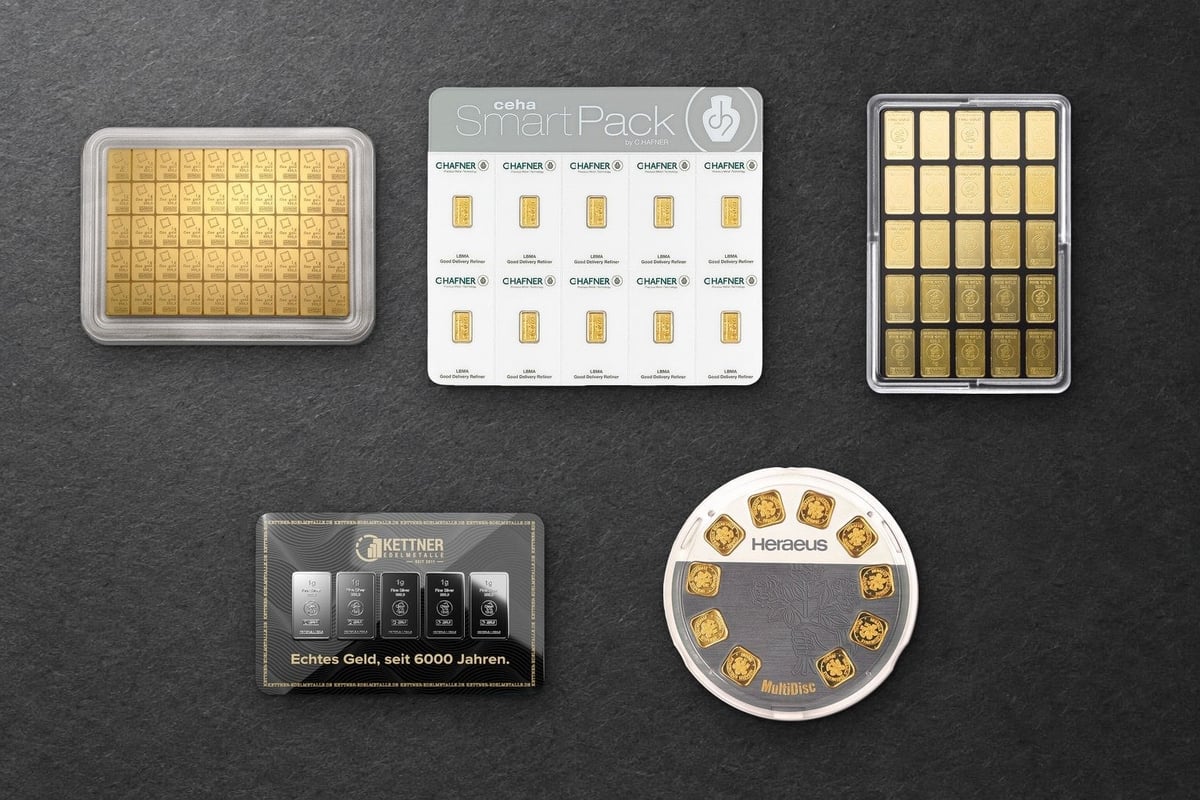
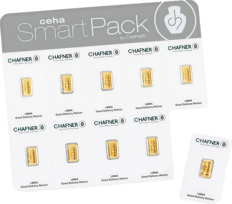
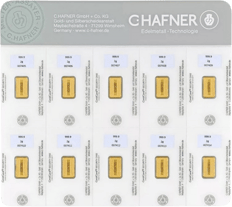
In the Smart Pack by C. Hafner, each bar sits in its own small card. “Each bar can be detached individually along a perforation,” writes the maker.
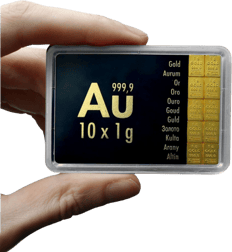
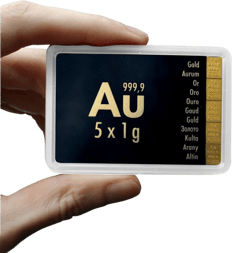
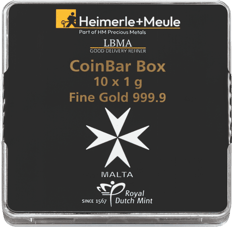
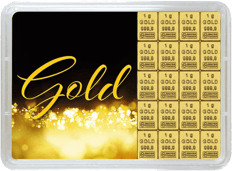
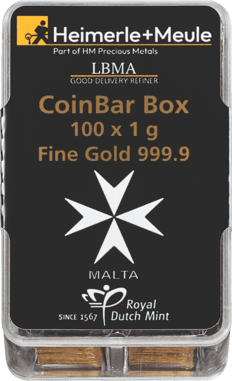
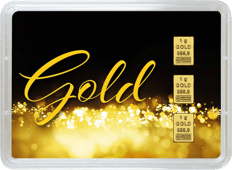
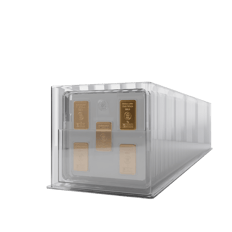
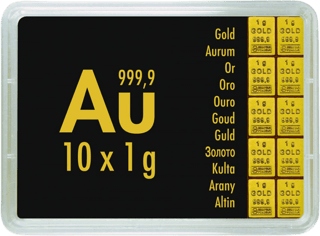
Heimerle + Meule places its UnityBars individually side by side in a capsule or box. Nothing is broken there; the maker heads its page “Snapping is a thing of the past”.
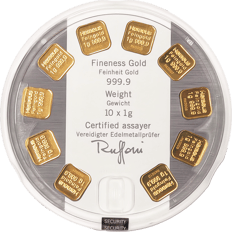
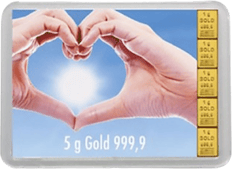
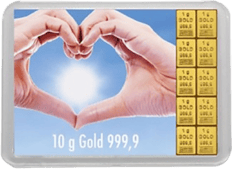
Then there are cards in which single bars are sealed in with space between them, and the MultiDisc by Heraeus: ten square bars of 1 gram each in round packaging.
Only the tablet has to be broken.
Schematic drawings after the product photos, not to scale.
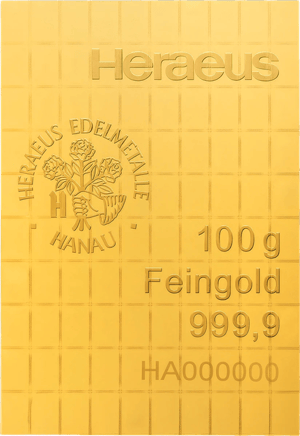
At Heraeus, the 100‑gram tablet measures 74 by 105 millimetres, the 50‑gram one 74 by 52.5. To within half a millimetre, these are the paper sizes DIN A7 and A8.
“The ESG divisible bars are DIN A7 or A8 in size and can be stacked perfectly in safes and safe deposit boxes.”
ESG Edelmetall‑Service in the trade journal zt, No. 6, June 2011, translated
The DIN 476 standard was published on 18 August 1922. Its largest sheet, A0, measures one square metre. Halve it along the long side and you get A1, and the aspect ratio stays the same, writes DIN, the German Institute for Standardization.
Divide the tablet of ten by ten pieces down the middle and you have two halves of 50 pieces each, each as large as the 50‑gram tablet: twice A8.
By calculation, each of the hundred pieces thus has a field of 7.4 by 10.5 millimetres, grooves included. This field, too, has the shape of the whole tablet.
The same area, a different thickness: the 100‑gram gold tablet from Heraeus is 0.85 millimetres thick, the 100‑gram silver tablet from Valcambi 1.5 millimetres. Tablets also come in platinum.
Halve the tablet and its shape stays the same, just as with paper.
Dimensions: Heraeus for gold, combibar.com for silver, the bank card to ISO/IEC 7810, format ID‑1. The field is calculated from the dimensions. At the same scale, not at a scale of 1:1.
The grooves between the pieces do not go through the tablet. A web of metal remains and holds the pieces together. That is how the patent specification for the tablet describes it.
“… preferably high enough that bending under the force of gravity is prevented, and at most high enough that the material connection can be destroyed by hand by bending or breaking.”
Patent specification on the bending strength of the web, translated
According to the patent specification, the web can be 0.05 to 0.4 millimetres thick, and the groove can open at an angle of about 10 to 60 degrees. The specification calls a groove thin if it is narrower than it is deep. These are ranges from the specification, not measurements of a particular tablet.
The groove cuts nothing out. It only pushes the metal aside, and the small bead that forms can be pressed flat again straight away during minting. So says the same specification.
Strong enough for gravity, yielding enough for the hand.
Diagram based on the figures in the patent specification, greatly enlarged. The drawing shows one example within the stated ranges, not to scale.
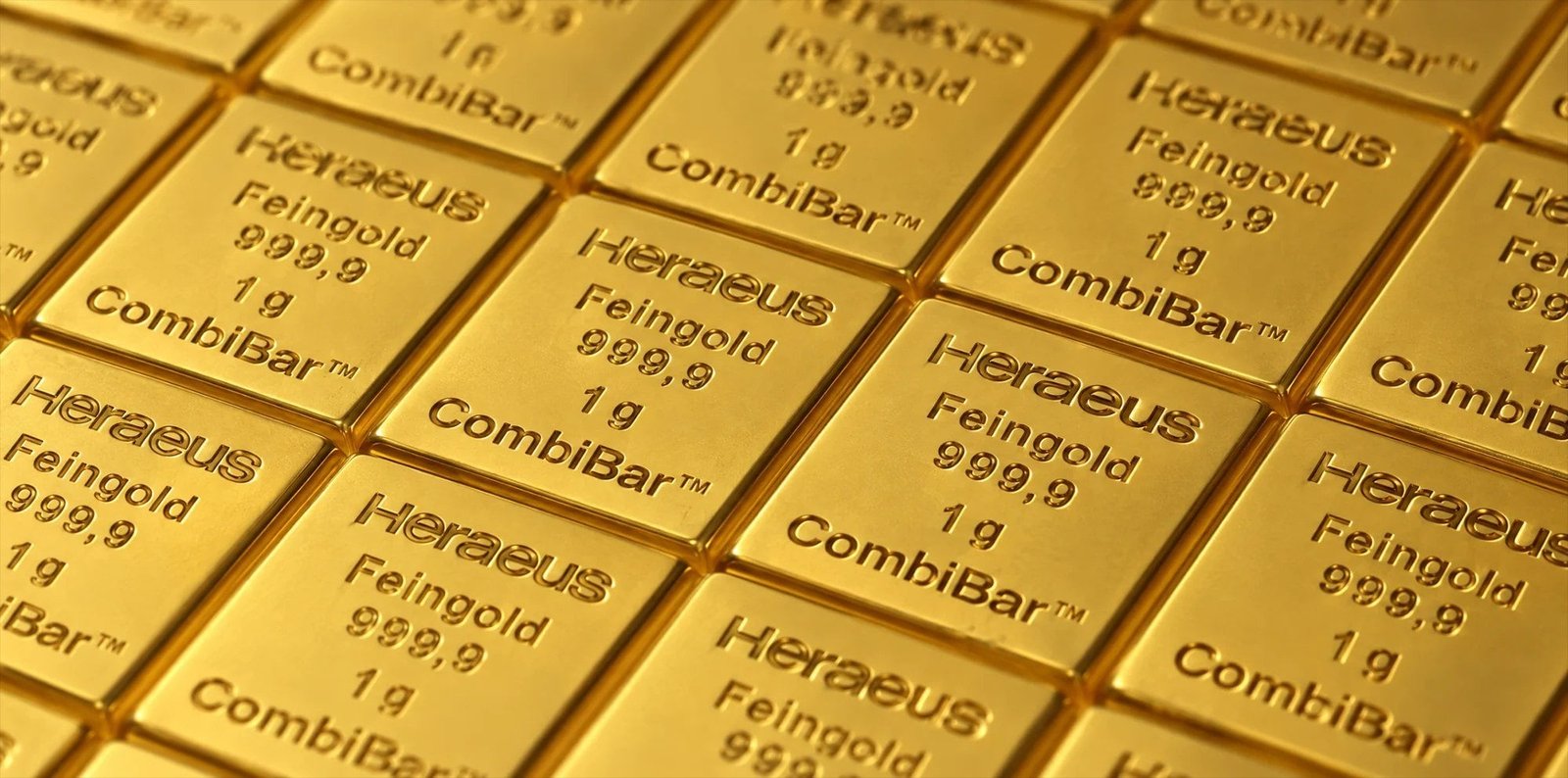
The same strike that forms the grooves stamps each piece with the maker’s mark, the weight and the purity. So says the patent specification. Even a single piece thus shows what it is.
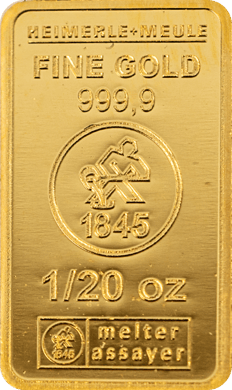
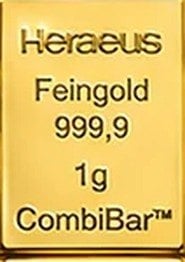
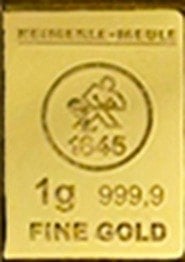
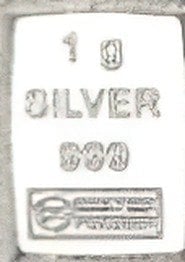
The product photos show how each house does it. Heraeus stamps “Feingold 999,9” and “1 g”, Heimerle + Meule its company mark with 1845 and “1g 999,9 FINE GOLD”, Valcambi on the silver tablet “1 g SILVER 999”.
So the fineness is not the same everywhere. The gold tablets bear 999.9/1,000, the silver tablets from Valcambi 999/1,000. On the silver bars from Heimerle + Meule it says 999,9.
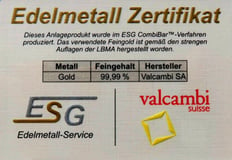
None of the pieces bears a number. At Heraeus, only the large bar bears a serial number, and the certificate comes with it in the plastic packaging. For the 50‑gram tablet from Valcambi, the reference work Gold Bars Worldwide 2011 names a tamper-proof sheath with a numbered certificate. With the Smart Pack by C. Hafner, each small card comes with its own certificate.
Weight and fineness are on every piece, a number on none.
Enlarged; the three pieces at the same scale, the back shown smaller. Details of product photos from the shop.
Handing over precious metal in pieces by weight is an old idea. In England, silver pennies were cut into halves and quarters until the 13th century whenever change was needed.
“… so that a halfpenny was literally half a penny and a farthing a quarter or ‘fourthing’.”
Royal Mint Museum, “Halfpenny and farthing”
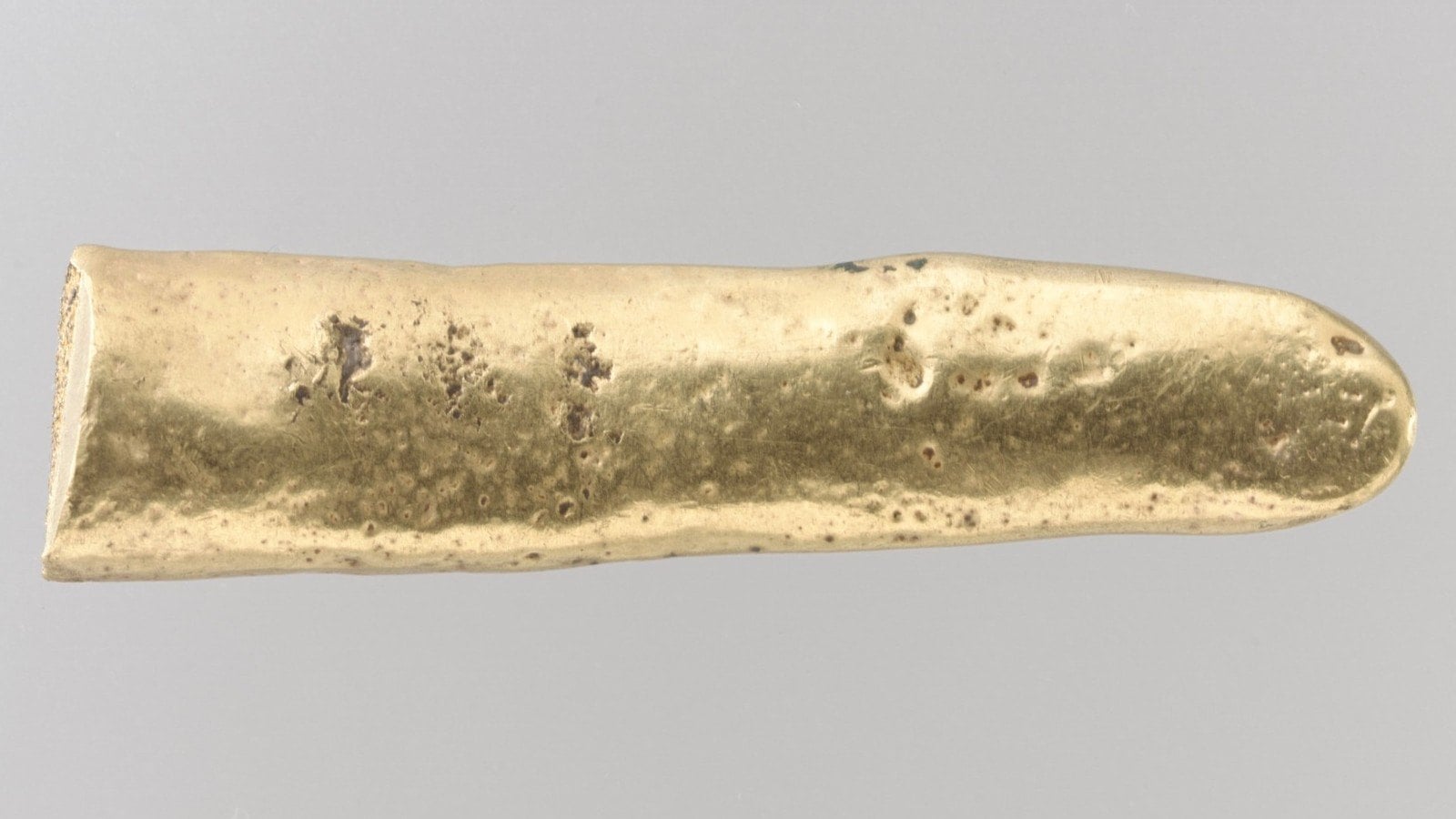
On the Schlei near Hedeby, archaeologists uncovered a hoard of around 200 objects, “mostly of silver: hacksilver, fragments of Arab coins (dirhams), ingot fragments and jewellery”, as the Schleswig‑Holstein State Archaeology Office reported in 2025. Paying by weight, with standardised sets of weights and accurate scales, arose at the end of the 9th and in the 10th century, at the same time as the rise of the trading centres Birka and Hedeby, writes the archaeologist Heiko Steuer.
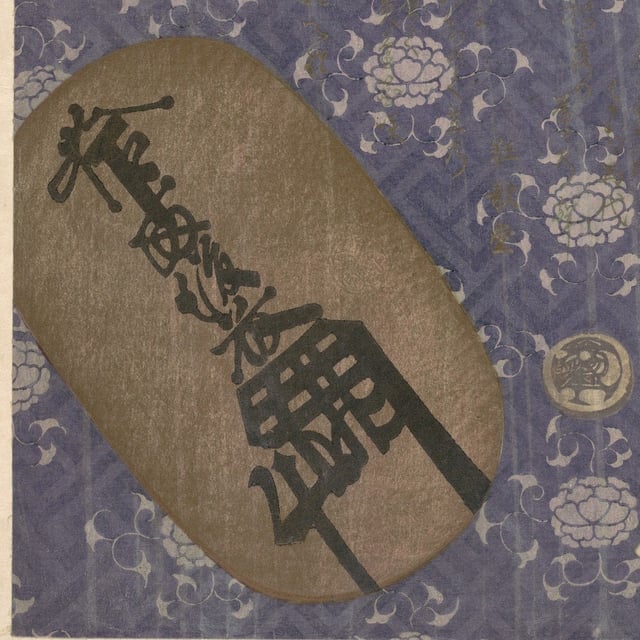
In Japan in the Edo period, silver was traded by weight, in the unit monme of 3.75 grams. Gold, by contrast, was counted in coins, writes the Currency Museum of the Bank of Japan.
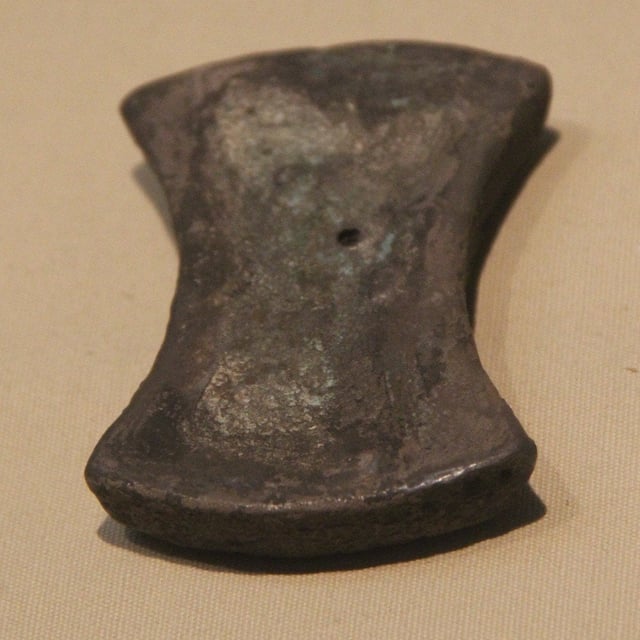
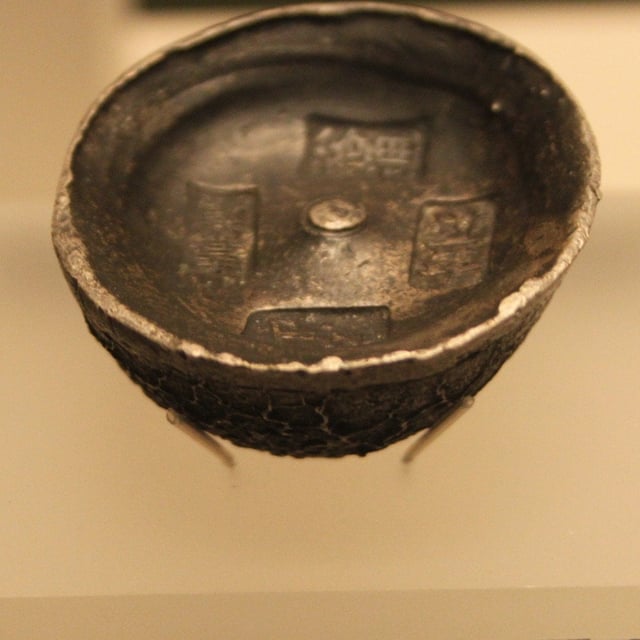
In China, silver ingots played an important part in domestic trade until 1933. Their stamps usually named the dynasty, the province and the guaranteed weight, reports the MoneyMuseum in Zurich.
The penny had to be cut up; the tablet is already divided.
 Gold CombiBars
Stay informed with product launches, financial news and exclusive offers. Sign up for our free newsletter today.
By entering your email address and clicking the "Submit" button, you give the following consent: "I agree to be informed by email about new products, financial news and exclusive offers, and therefore consent to the processing of my email address for the purpose of sending the newsletter. I can revoke this consent at any time without giving reasons, with effect for the future. The lawfulness of processing carried out prior to revocation remains unaffected."