Sold out

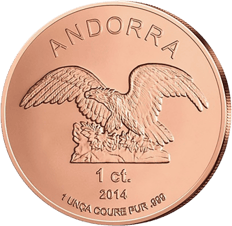
1 oz Copper Andorra Eagle 2014
£8.31
excl. UK import VAT and shipping
currently not available

 More than 300,000
 Over 30 years
 Secure shipping
 Google: 4.9/5


When the microstate of Andorra became the first European country to issue a copper coin in troy ounce format in 2014, it was a small numismatic sensation. The majestic eagle, which had already adorned the Principality's gold and silver coins, now landed on a semi-precious metal that had long been underestimated in the German-speaking collector community. This guide sheds light on the history, design, technical data, the curious face value, the tax treatment and the correct storage of the Andorra Eagle copper coin.
What has long been standard practice in the Anglo-Saxon world only reached continental Europe much later: collecting and investing not only in gold and silver, but also in copper coins. The Andorra Eagle marks a turning point here. The eagle design had already been minted on gold issues since 2002 and on silver issues since 2008 by the Principality, but the copper version from 2014 was the first of its kind in Europe and sparked noticeable enthusiasm among collectors.
Copper has a warm, reddish shimmer that clearly sets it apart visually from the cooler precious metals. For beginners, it is an affordable way to dive into the world of minting art without tying up large sums right away. Anyone generally interested in this segment will find numerous related series in the overview of copper coins, while copper bars represent the classic bar alternative. A look at the pure semi-metal itself is also worthwhile in the range around copper.
Andorra is a microstate in the Pyrenees, nestled between France and Spain. Despite its small size, the country has developed its own numismatic tradition. When hearing the term Eagle, many instinctively think of the North American bald eagle. Yet the kings of the skies are also at home in Europe, and one of them has graced the face of the Andorra Eagle for over a decade.
The first issue of the copper coin from 2014 was released with a fineness of 999/1,000, a weight of 31.1 grams, exactly one troy ounce, and a diameter of around 39.2 millimetres. These dimensions have remained unchanged, as have both motif sides. Anyone who appreciates the design in other metals will also find the coin as the Andorra Eagle in silver and as the Andorra Eagle in gold, ideal for anyone who wants to complete a series across multiple materials.
Not every Andorra Eagle is minted in the Principality itself. Many issues are produced as so-called agency issues, meaning coins that are manufactured on behalf of the issuing country by external, internationally renowned mints. In exchange for the minting licence, the government of the country of origin receives financial compensation. Well-known houses from this field can be found in the manufacturer overview, such as the Royal Canadian Mint, which is best known worldwide for its Maple Leaf series.
The coin bears its name for good reason. The value side shows a golden eagle native to Central Europe: wings spread wide, olive branches in its talons, in the approach to land on a rock. Along the upper edge is the inscription Andorra, below the bird the face value. On the gold and silver issues, the year of issue and weight information complete the picture.
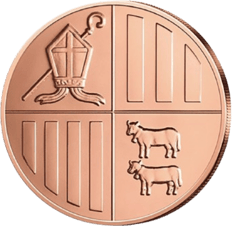
The reverse unfolds the Principality's coat of arms, divided into four equally sized fields. Each field tells a piece of the country's history:
This heraldic density turns the reverse into a small history book, setting the Andorra Eagle clearly apart from purely figurative animal series such as the Canadian Maple Leaf in copper or the Buffalo.
A coat of arms that tells the history of an entire country in four fields, on a coin barely larger than a two-euro coin.
The face value of the Andorra Eagle is a symbolic Céntim. This is a subunit of the so-called Diner, an artificial traditional currency that has been used for all of the Principality's bullion and commemorative coins since 2002. The term derives from the Catalan word for money, els diners.
The background is historically interesting: in 2002, the euro was introduced in Andorra, but the microstate was initially not permitted to produce its own euro circulation coins. As a way out, the Diner denomination was created for bullion and collector coins. This currency plays no role in regular payment transactions. For collectors, this is irrelevant, as the material value of the copper far exceeds the symbolic face value; the stamped value is purely a formality.
Good to know
Copper coins such as the Andorra Eagle are regarded as collector's and connoisseur's items. Their value derives from the design, mintage and condition, not from a precious metal spot price. Anyone wishing to invest in precious metals in the classic sense will find suitable alternatives in silver issues or bullion coins.
The Andorra Eagle in copper is designed as a classic one-troy-ounce coin. Unlike gold or silver series, there is no wide range of tenth or half-ounce formats here; the format is deliberately kept simple. The coin is typically offered in three packaging units:
A protective lacquer coating protects many copper coins from premature oxidation, as copper tends to form a dark patina when exposed to air. For long-term preservation, suitable accessories are also recommended: coin capsules protect individual pieces from fingerprints and moisture, while coin tubes keep entire rolls neatly stored.
Copper is a highly reactive metal. When it comes into contact with oxygen and air humidity, an oxide layer forms over time, something some collectors actually welcome but investors tend to find undesirable. Dry storage, avoiding direct finger contact and suitable protective sleeves help preserve the original mint lustre for as long as possible.
As with any collector's coin, storage determines the long-term condition. Copper is more sensitive to moisture and hand perspiration than gold, which is why careful handling is particularly important. Anyone wishing to organise a growing collection should turn to coin cassettes or a coin case, in which the pieces are stored without contact and protected from dust.
A few proven ground rules help to preserve condition:
Anyone who also collects classic precious metals alongside copper will find further useful tools for safe handling in the collector accessories range.
Copper is neither considered a precious metal for tax purposes nor does it benefit from the VAT exemption that applies to investment gold. Copper coins and bars are traded with standard VAT in Germany. This fundamentally distinguishes them from gold coins, which are exempt from VAT as investment gold, and from many silver coins taxed under the margin scheme.
For most buyers, the collector's value of the Andorra Eagle takes precedence over the pure material value anyway. This guide does not replace tax advice; for individual questions on taxation, consulting a tax advisor is recommended. For systematic wealth building with precious metals, it is also worth taking a look at savings plan products.
The Andorra Eagle appeals to several groups. For newcomers to numismatics, it is an affordable way to get to know collecting and develop a feel for minting quality, designs and condition. For experienced collectors, the appeal lies in its historical rank as the first European copper ounce and the attraction of a clearly limited, year-specific minting.
The coin also makes a fine gift: its striking eagle design and low price make it a charming present. Suitable ideas can be found in the gift ideas category. Anyone wishing to expand the series thematically will quickly come across related design worlds among the copper issues, such as the China Panda or the Indian Head.
The Andorra Eagle in copper is made of pure copper with a fineness of 999/1,000. It weighs 31.1 grams, corresponding to one troy ounce, and measures around 39.2 millimetres in diameter. These values have remained unchanged since the first issue in 2014.
The Céntim is a subunit of the Andorran traditional currency Diner, which has been used for bullion and commemorative coins since 2002. The face value is purely symbolic and plays no role in payment transactions. The material value of the copper lies well above this stamped value.
In 2014, Andorra became the first European country to issue a copper coin in troy ounce format. In doing so, the Principality brought a format to continental Europe that had already become established in the Anglo-Saxon world. The eagle design had already been known from the gold and silver issues.
Copper reacts with air humidity and can develop a dark patina. Dry, temperature-stable storage in coin capsules or tubes is recommended. Coins should only be held by the edge and not polished, as cleaning can reduce collector's value.
No. Unlike investment gold, which is exempt from VAT, copper coins are traded with standard VAT in Germany. Anyone seeking tax advantages based on precious metals should consider gold or silver issues instead. A tax advisor can clarify individual questions.
The copper coin is usually offered as a single piece, in tubes of 20 coins, and in master boxes of 500 coins. This covers both entry-level purchases and large-volume collection building.
 Andorra Eagle
Stay informed with product launches, financial news and exclusive offers. Sign up for our free newsletter today.
By entering your email address and clicking the "Submit" button, you give the following consent: "I agree to be informed by email about new products, financial news and exclusive offers, and therefore consent to the processing of my email address for the purpose of sending the newsletter. I can revoke this consent at any time without giving reasons, with effect for the future. The lawfulness of processing carried out prior to revocation remains unaffected."