Sold out

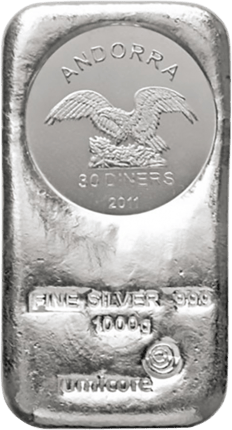
1 kg Silver Andorra Eagle 2010
£1,297.33
excl. UK import VAT and shipping
currently not available

 More than 300,000
 Over 30 years
 Secure shipping
 Google: 4.9/5
The Andorra Eagle silver coin is considered an insider tip among silver buyers. The reason for this is its price, which is very close to the silver spot price. The microstate of Andorra mints the coins at this sensational price. The selection of different denominations also supports various strategies for silver buyers.


The Andorra Eagle silver coin has earned a reputation among silver investors as a genuine insider's tip: struck from 999/1,000 fine silver, featuring a majestic eagle as its design and a premium that has traditionally stayed close to the silver spot price. Since its first year of issue in 2008, the coin has stood for a simple yet effective idea: as much pure silver as possible for as little mark-up as possible. This guide examines the history, design, denominations, authenticity, taxation and storage of this bullion coin from the Principality of Andorra.
The Andorra Eagle is one of those silver coins that deliberately focus on what matters most: the metal itself. As a so-called agency issue, the coin is not struck in the issuing country itself but in Germany, under licence from the Andorran government. This is precisely where the decisive advantage for investors lies: the premium over the pure material value is comparatively low, which is why the Andorra Eagle has traditionally been counted among the near-spot bullion coins.
Anyone looking to diversify broadly into silver will find in this coin a solid foundation for their portfolio. It pairs well with other classic bullion coins such as the Vienna Philharmonic or the Canadian Maple Leaf, which, although better known, are often traded at higher premiums. Within the broad range of silver coins, the Andorra Eagle thus takes on the role of the cost-conscious gram collector's choice.
Andorra is a microstate in the Pyrenees, nestled between France and Spain. The country has a distinctive feature at the head of state: alongside the French president, the Bishop of Urgell serves as the second head of state. This shared sovereignty is directly reflected in the coin's design, making the Andorra Eagle a small piece of European history captured in silver.
The eagle that gives the coin its name is deeply rooted in symbolism. As the king of the skies, the golden eagle represents courage, strength and freedom; in Andorra, it also finds its natural habitat in the Pyrenees. It is therefore no coincidence that the bird of prey was chosen as the design: a symbol investors will also recognise on numerous other coins, such as the American American Eagle or the Birds of Prey series.
The design of the Andorra Eagle has remained unchanged every year since its first minting, a deliberate decision to forgo changing annual designs, clearly positioning the coin as an investment product rather than a collector's series.
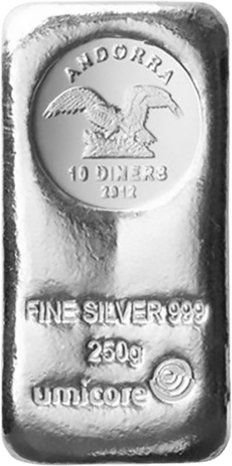
On the value side, an eagle spreads its wings, lands on a rock and holds olive branches in its talons, an ancient symbol of both peace and strength at once. Around the edge are the issuing country ANDORRA as well as details of the face value, year of minting, ounce size and fineness. On the one-ounce coin, the edge inscription reads, in essence, 1 Unça Plata Pura .999, Catalan for one ounce of pure silver.
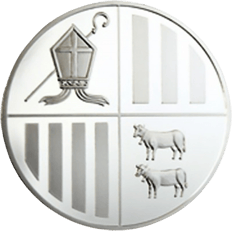
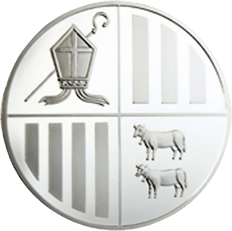
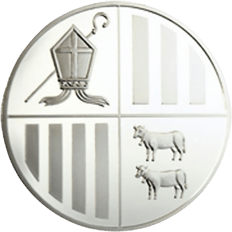
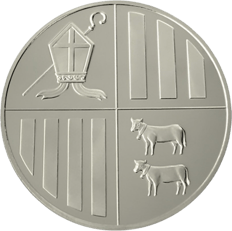
The reverse shows the principality's four-part coat of arms. It combines the crosier and mitre of the Bishop of Urgell, two cows as a symbol of the viscounty tradition, and several pales: three pales represent the historical County of Foix, while four pales symbolise the Catalan coat of arms. The edge of the coin is reeded and, besides its visual appeal, serves as an additional security feature.
The Andorra Eagle covers an exceptionally broad weight spectrum, from handy fractional pieces to massive large-format coins that rank among the largest bullion coins worldwide. All issues are struck from 999/1,000 fine silver. The following overview summarises the common denominations:
| Denomination | Fine weight | Diameter | Face value |
|---|---|---|---|
| 1/4 oz | 7.78 g | 20.2 mm | 25 cents |
| 1/2 oz | 15.56 g | 27.2 mm | 50 cents |
| 1 oz | 31.1 g | 38.5 mm | 1 diner |
| 1 kg | 1,000 g | 100 mm | 30 diner |
| 100 oz | 3,110 g | 120 mm | 100 diner |
| 200 oz | 6,220 g | 140 mm | 200 diner |
Those who prefer the compact bar format will find a worthwhile addition to their coin collection in classic silver bars or minted bars.
Every Andorra Eagle bears a face value in diner. There is a particular reason for this: since 2002, the euro has been Andorra's official currency, yet for its bullion and commemorative coins the country uses the traditional notional currency, the diner. The word derives from the Catalan els diners, which simply means money.
The engraved face value is purely symbolic: the true value of the coin lies in the fine silver it contains, not in the diner.
For investors, the face value is therefore of no practical significance: the material value exceeds it many times over. The Andorra Eagle shares this feature with many other bullion coins from the silver range, whose price is guided solely by the silver price.
Although the coin originates from Andorra, it is produced in renowned German mints. The mints involved include the Bayerisches Hauptmünzamt in Munich as well as B. H. Mayer and Geiger Edelmetalle. This German manufacturing stands for precise minting quality and reliable material accuracy.
In addition to the classic Brilliant Uncirculated (BU) version, individual years were also issued in special qualities such as Proof or as a high-relief strike with a more pronounced design relief. These variants were produced in significantly smaller mintages and are occasionally traded at higher premiums. Those who value German minting craftsmanship will find further issues in the range of the Bayerisches Hauptmünzamt.
The authenticity of an Andorra Eagle can be verified through several characteristics: the exact fine weight, the correct diameter, consistent sharpness of the design and the reeded edge of the coin. Since silver is non-magnetic, a simple magnet test alone can already reveal crude counterfeits. For a reliable check, buying from an established dealer is key: at Kettner Edelmetalle, every coin undergoes an ISO-compliant authenticity verification.
Proper storage also helps preserve value. Silver is sensitive to moisture and can tarnish, which is why dry, air-protected storage is recommended:
Unlike investment gold, silver in Germany is generally subject to VAT. However, bullion silver coins such as the Andorra Eagle are mostly offered in trade under the margin scheme taxed in accordance with §25a UStG. Under this scheme, tax is levied only on the trading margin, not on the full purchase price, which keeps the final price attractive for investors.
Note on the holding period
If a silver coin is held for longer than one year as part of private assets, any capital gain on its sale is, under current law, exempt from income tax. Tax information is of a general nature and does not replace individual advice.
Those with a general interest in silver as a store of value will find a broad overview of comparable coins in the silver bullion coins range.
The silver Andorra Eagle has been issued since 2008. It is produced as an agency issue under licence from the Andorran government in German mints, including the Bayerisches Hauptmünzamt.
As an agency issue, the premium over the pure material value is lower than that of many better-known bullion coins. The Andorra Eagle is therefore traditionally traded close to the silver spot price, making it attractive to price-conscious investors.
The Andorra Eagle has been issued in several weights, from 1/4 oz and 1/2 oz through the classic 1-ounce coin up to 1 kg, 100 oz and 200 oz. The 1-ounce issue is the most actively traded size and the easiest to resell.
The diner is a notional Catalan currency that Andorra has used for its bullion and commemorative coins since the euro became the official currency in 2002. The engraved face value is purely symbolic; the actual value is determined by the fine silver content.
Silver coins are subject to VAT in Germany, but are mostly offered under the margin scheme in accordance with §25a UStG, meaning only the trading margin is taxed. After a holding period of more than one year as part of private assets, any capital gain on sale is, under current law, tax-free.
Yes, in addition to the silver issue, the Andorra Eagle also exists as a gold coin, which has been on the market for longer. Both issues share the characteristic eagle design and the principality's coat of arms. The gold version can be found in the corresponding Andorra Eagle gold range.
 Andorra Eagle
Stay informed with product launches, financial news and exclusive offers. Sign up for our free newsletter today.
By entering your email address and clicking the "Submit" button, you give the following consent: "I agree to be informed by email about new products, financial news and exclusive offers, and therefore consent to the processing of my email address for the purpose of sending the newsletter. I can revoke this consent at any time without giving reasons, with effect for the future. The lawfulness of processing carried out prior to revocation remains unaffected."