Only 3 left to order
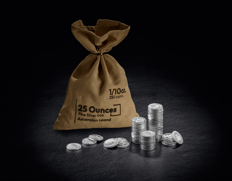
20 x 1 oz Silver Philharmonic 2026
£1,130.56
excl. UK import VAT and shipping
Ships from 23/11/2026

 More than 300,000
 Over 30 years
 Secure shipping
 Google: 4.9/5
Kettner Edelmetalle has been your specialist in precious metals for many years. We are happy to personally assist you in selecting your optimal investment strategy. Here you will find a large selection of our silver investment packages from our range.


Silver investor packages bundle together what investors otherwise have to assemble laboriously when buying individually: many identical troy ounces, a single year of issue, one packaging unit, one price. Instead of twenty separate coins, a sealed tube or a complete Masterbox goes straight into the vault, and the premium per ounce falls with every step up in package size. This guide explains how such packages are structured, which coin series and denominations they contain, what applies for tax purposes, how larger quantities of silver can be stored, and what to look out for when buying.
An investor package, also called an investment package in the trade, is not a product in its own right but a trading format: several identical silver coins or bars are traded as a sealed unit. Typical sizes are 20, 25, 50, 100 or 500 troy ounces, in the original packaging of the mint, with consecutive years of issue and an untouched surface. The advantage lies in the detail: buyers of a full unit typically pay a lower premium than when buying individual coins, because handling, capsules and packaging are only charged once.
Within the investor packages, this category is therefore aimed at investors who want to build up weight systematically, not at collectors chasing individual designs. Those who want to build up both metals in parallel will find an intermediate solution in the gold-silver mix.
Unopened original units have a practical side effect: they are easier to value later on, because the year of issue, quantity and condition can be identified without checking each piece individually.
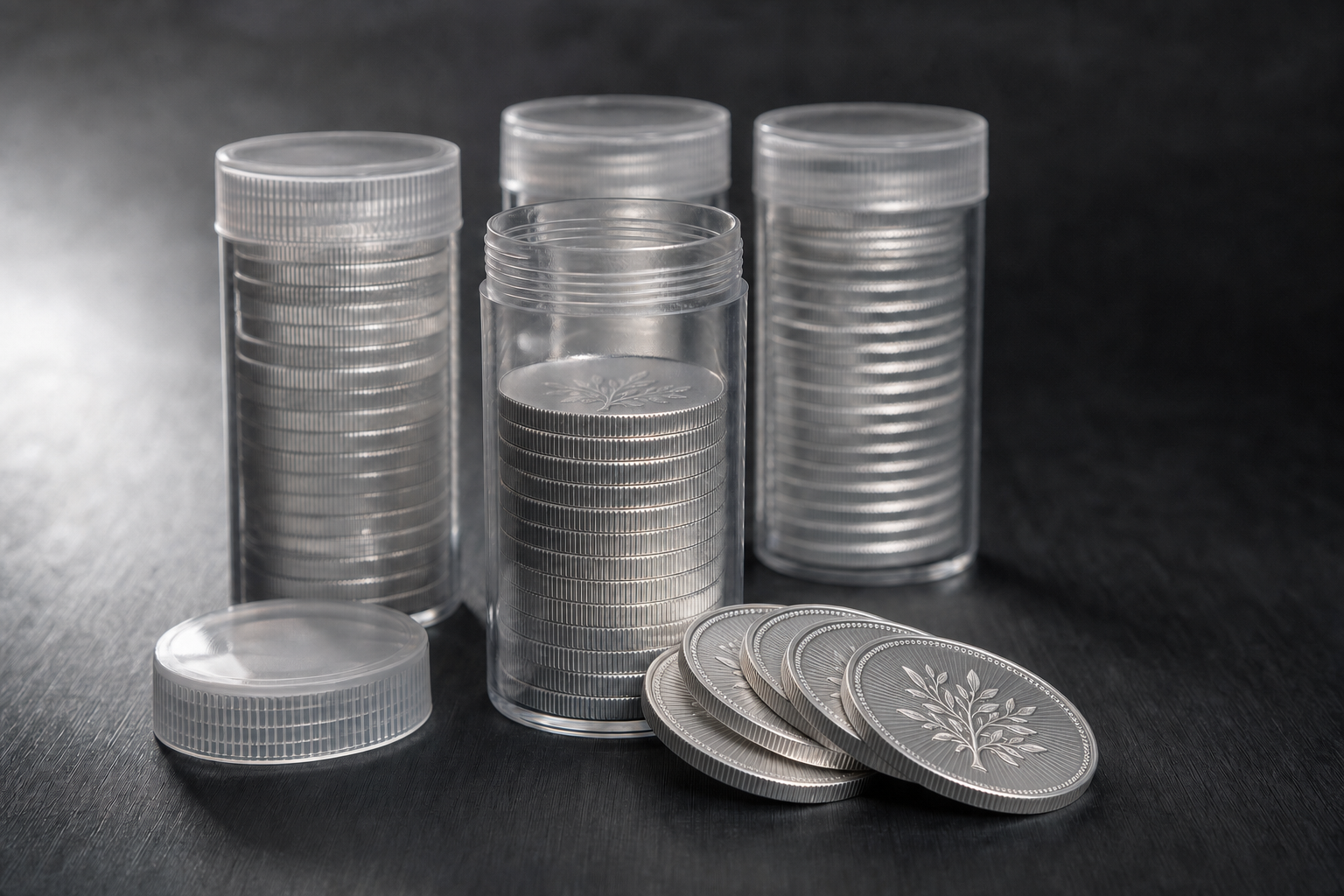
The silver price is set on the commodity markets in US dollars per troy ounce; everything above that is minting costs, logistics, trading margin and VAT. It is precisely this surcharge, the premium or agio, that is the only factor an investor can actually influence when buying. For small denominations it can amount to several times the premium of a one-ounce coin, while for a complete Masterbox it is at its lowest. Those building up weight for the long term therefore pay less attention to designs and more to the price per gram of fine silver.
Package goods consist almost exclusively of silver bullion coins, so-called bullion coins: high mintage, standardised fineness, known worldwide and therefore tradable at any time. The classics differ less in value than in character.
What matters is not the most beautiful design but liquidity: a coin that every dealer recognises can be sold on again even in turbulent market phases without any need for explanation.
Silver is bulky, which is the key difference from a gold investment. With a ratio of around 60 to 100 ounces of silver per ounce of gold, the same investment amount results in many times the weight. The choice of denomination is therefore always a compromise between a low premium and later divisibility.
| Unit | Fine weight | Premium | Typical suitability |
|---|---|---|---|
| 1/10 oz | approx. 3.11 g | very high | small-scale exchange, gift |
| 1/4 oz | approx. 7.78 g | high | fine divisibility in a crisis |
| 1/2 oz | approx. 15.55 g | elevated | middle ground between divisibility and cost |
| 1 oz | 31.103 g | moderate | standard for investor packages |
| 100 g bar | 100 g | low | compact weight accumulation |
| 1 kg bar | 1,000 g | lowest | larger sums, portfolio core |
The troy ounce, at 31.103 grams, has established itself as the benchmark unit: it is tradable internationally and available in every tube format. Those who focus on weight rather than piece count instead will find more affordable entry prices with silver bars, for example as 100 g silver bars or 1 kg silver bars. A special form are CombiBars, which can be broken into small units and thus combine the bar price with divisibility.
Anyone who buys silver in package sizes thinks in kilograms rather than pieces, and in decades rather than weeks.
Silver leads a double life. It is a precious metal with a monetary history going back thousands of years: for centuries, the silver thaler was the money of ordinary people, which is why silver is still regarded today as the poor man's gold. At the same time, it is an industrial metal that is barely replaceable due to its conductivity and antibacterial properties. Around half of global silver demand comes from industrial applications: photovoltaic modules, power electronics, contacts, sensors and medical technology. A significant proportion of this is consumed and never collected again, unlike gold, which remains almost entirely intact.
This dual role explains silver's typical characteristic: it fluctuates considerably more than gold. Industry associations have repeatedly reported a supply deficit in recent years because mine production and recycling failed to cover demand. Moreover, silver is largely produced as a by-product of lead, zinc and copper mining, which means that supply only reacts to price signals to a limited extent. How prices will develop as a result cannot be seriously predicted, but it can be said that the physical market is tighter than that of platinum or palladium in their respective niches.
The gold-to-silver ratio indicates how many ounces of silver one ounce of gold costs. Historically, it stood at 15 to 1 over long periods, and in recent decades mostly between 60 and 100. Investors use it as a guide for weighting their portfolio, for example when building a position through gold investor packages alongside a silver position. As a forecasting tool, however, the ratio is unsuitable; it merely describes a relationship, not a target level.
This is where the most important difference from a gold investment lies. While investment gold is exempt from VAT under § 25c UStG, silver is treated for tax purposes as an ordinary metal: in Germany, silver bars are subject to the standard VAT rate of 19%. For certain silver coins from third countries, the margin scheme under § 25a UStG may apply, under which tax is charged only on the trading margin; in this case, the price is shown without a separate VAT statement. This explains why silver coins often appear cheaper relative to their material value than bars.
Tax notice
Profits from the sale of physical silver are treated as a private disposal transaction under § 23 EStG. After a holding period of more than one year, any sales profit remains tax-free for private individuals; within that period, above the respective tax-free allowance, the individual's personal income tax rate applies. This information is general in nature and does not replace tax advice; binding information is provided exclusively by a tax adviser.
In practice, this means that for purely tax-driven investors, gold bullion coins are more attractive. Silver, on the other hand, scores well with small units, everyday exchangeability and diversification across several metals.
Ten kilograms of silver is not a piece of jewellery but a logistical undertaking. A Masterbox of 500 ounces corresponds to around 15.6 kg of fine silver and requires considerably more space than an equivalent amount in gold. Anyone building up investor packages should therefore clarify storage before making the first purchase.
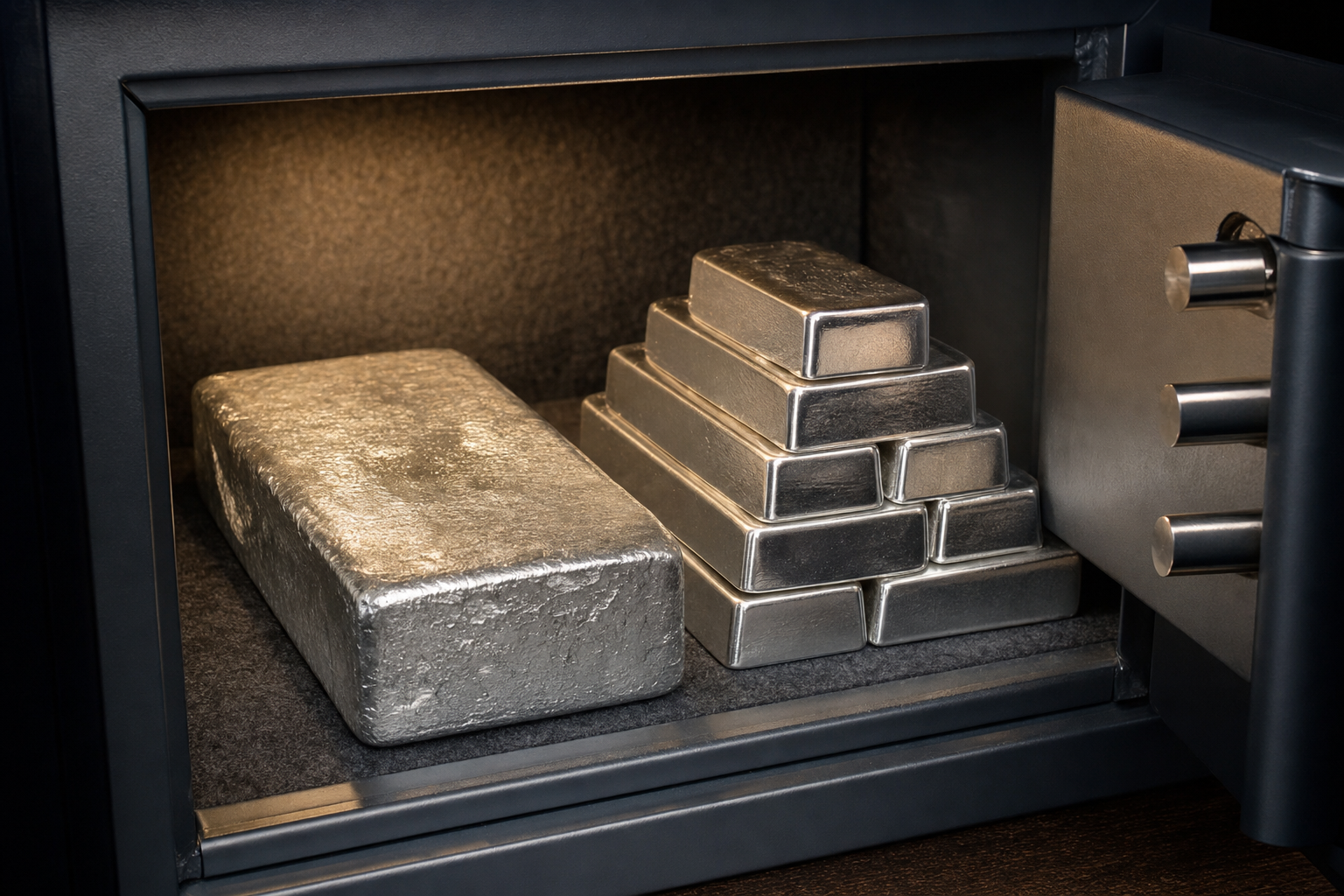
Two practical rules have proven effective: never touch the minted surface with bare fingers, and never try to polish tarnished coins. So-called milk spots on silver ounces are a manufacturing-related phenomenon and not a sign of a lack of authenticity or fineness.
Due to its low unit prices, silver is a preferred target for counterfeiting, usually via plated copper or tungsten cores. Standard products from well-known mints such as the South African Mint or the Perth Mint are therefore the safest choice, as is sourcing from established dealers rather than auction or classified-ad platforms. Physical silver can be checked using several characteristics:
Common mistakes when building up a silver position: too many small denominations with a high premium, exotic designs without a secondary market, purchases concentrated in a single market phase rather than staggered over time (here, savings plan products offer an alternative), and too large a silver allocation within the overall portfolio. As an admixture, silver fulfils its purpose; as a sole investment, it brings fluctuations that not every investment horizon can tolerate. In addition, crisis protection packages are less about weight and more about small, exchangeable units.
Generally from a complete coin tube of 20 or 25 troy ounces, since the premium per ounce is lower here than when buying individually. Full Masterboxes offer the lowest price per gram, because capsules and packaging are only charged once.
The pure fine silver content amounts to around 15.6 kilograms; with tubes and outer packaging, the total weight is somewhat higher. For storage, the load-bearing capacity of the furniture or safe floor and the space required should therefore be planned for.
The VAT exemption under § 25c UStG applies exclusively to investment gold. Silver is treated for tax purposes as an industrial metal and charged at 19%. For certain silver coins from third countries, the margin scheme under § 25a UStG can be applied, which reduces the effective tax burden.
Bars offer the lowest premium per gram and are suitable for pure weight accumulation. Coins come in smaller units, are better known internationally and are therefore more flexible when reselling. Many portfolios combine both: one-ounce coins for tradability, larger bars for cost efficiency.
The material value remains unchanged, since fineness and weight are not affected. For bullion coins, a dark patina or a milk spot has hardly any effect on the buy-back price. For collector's pieces in Proof quality, however, the visual condition is relevant to the price.
There is no blanket rate, since investment horizon and risk tolerance are individual. In practice, gold often serves as a lower-volatility core, while silver is added as an admixture with stronger price dynamics. Those who want to build up both metals at the same time will find ready-combined units in the gold-silver mix.
Signs include original packaging from the mint, clearly stated piece count and year of issue, verified goods and insured shipping. Kettner Edelmetalle uses an ISO-compliant authenticity verification process and a fully automated high-security logistics centre for this purpose. For well-known series, comparing against the current daily material value is also the simplest plausibility check.
 Silver
Stay informed with product launches, financial news and exclusive offers. Sign up for our free newsletter today.
By entering your email address and clicking the "Submit" button, you give the following consent: "I agree to be informed by email about new products, financial news and exclusive offers, and therefore consent to the processing of my email address for the purpose of sending the newsletter. I can revoke this consent at any time without giving reasons, with effect for the future. The lawfulness of processing carried out prior to revocation remains unaffected."