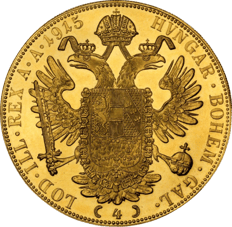
4 Gold Ducats New Minting
£1,547.65
VAT-free and excl. shipping
Available in 2–3 business days

 More than 300,000
 Over 30 years
 Secure shipping
 Google: 4.9/5
For decades, gold ducats were among the most important trade coins in the world. Today, the gold ducats of the Austrian Empire with a fineness of 986/1,000 are particularly popular bullion coins and collector's items. Current restrikes by the Austrian Mint bear the last official minting year 1915, as well as the insignia of the Habsburg imperial house. Available are restrikes of the 1 Ducat and the 4 Ducat coin.


Venice, 30 October 1284
Venice resolved to strike a gold coin “as good and fine in gold as the florin, or better”. A Latin dedication ran around the figure of Christ giving his blessing, and its last word is the name of the coin.
Sit tibi, Christe, datus, quem tu regis, iste ducatus
As far as the Levant
From 1857/58 the ducat was no longer legal tender in Austria. It was struck all the same, as a trade coin that was readily accepted above all in Africa, the Levant and Asia.
Sewn onto bonnets
In Dalmatia, Bosnia, Serbia, Bulgaria and Greece, four ducat coins bearing Franz Joseph’s portrait were worn as jewellery, sewn onto bonnets or hung from long chest pendants.
A hundred for Mozart
For his opera “The Abduction from the Seraglio”, Wolfgang Amadeus Mozart received one hundred imperial ducats.
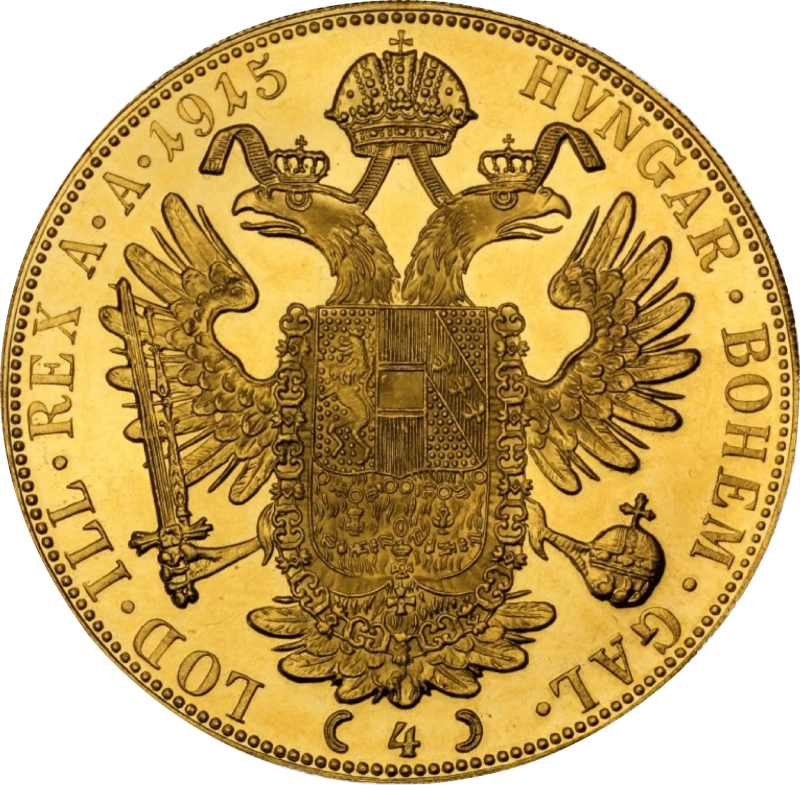
The legend is abbreviated Latin, on the single ducat as on the four ducat. Choose a side: below, every abbreviation is written out and translated.
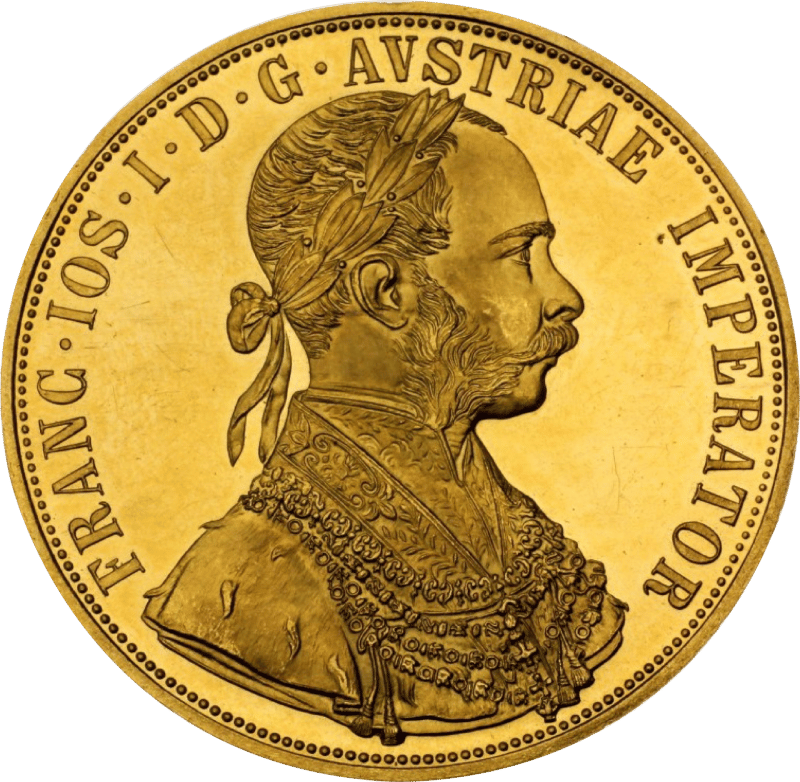
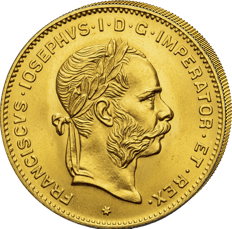
FRANC · IOS · I
Franciscus Iosephus I
Franz Joseph I
D · G
Dei Gratia
by the grace of God
AVSTRIAE IMPERATOR
Austriae Imperator
Emperor of Austria
The coin design dates from 1872. Franz Joseph reigned for almost 68 years, from 1848 to 1916, and his portrait is still struck on the ducat today, more than a hundred years after his death.
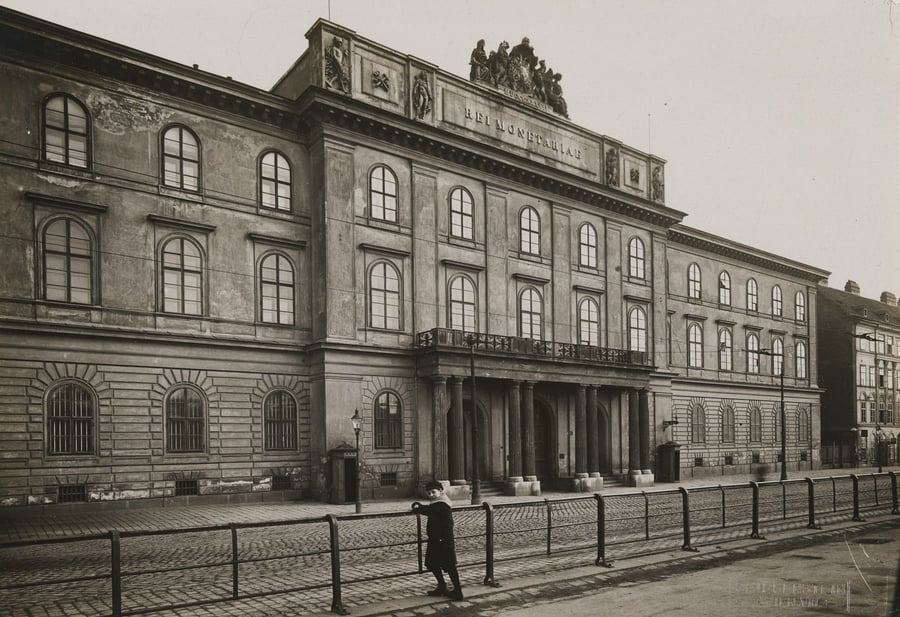
The ducats are made in Vienna, in the Austrian Mint’s building on the Heumarkt. It was built from 1835 as the Hauptmünzamt, the main mint, and coins are still struck there today.
“Newly struck trade coins … must correspond in the composition of their alloy, their dimensions and their appearance to the legal provisions that applied when they were originally struck; …”
Austrian Coinage Act 1988 (Scheidemünzengesetz), § 16
The law also requires a date from the time of the originals. The restrikes bear 1915. According to the Austrian Mint, the date recalls that the First World War brought gold coinage to an end that year, for the time being.
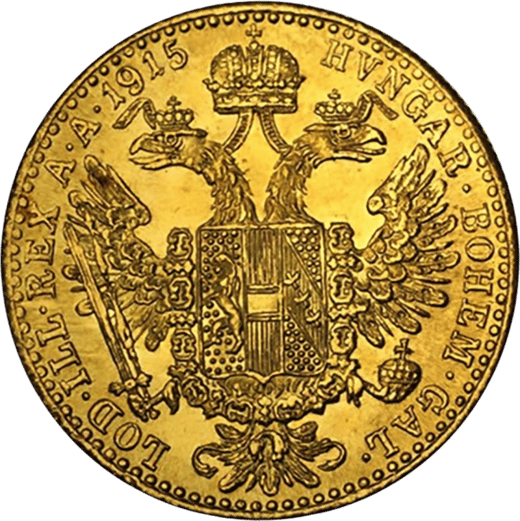
To give
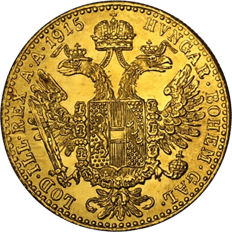
The ducat: Franz Joseph with a laurel wreath, the crowned double eagle on the reverse.
View the 1 ducat
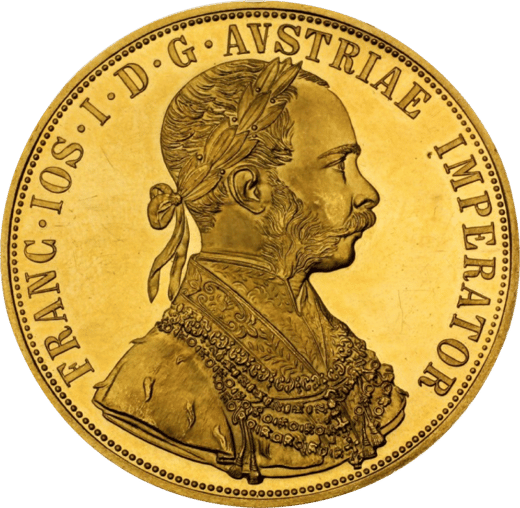
To collect
The four ducat with the emperor’s bust, the piece that once gleamed on traditional bonnets.
View the 4 ducats
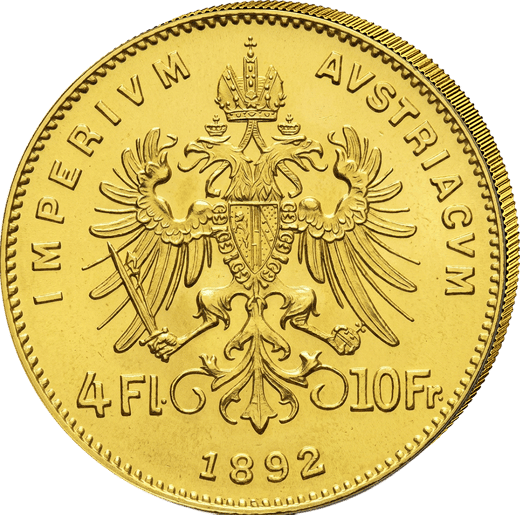
For connoisseurs
The gold florin dated 1892, which states its value in both florins and francs.
View the gold florin
Venice 1284. Vienna 1872. Still in gold today.
Historical details based on the Treccani encyclopaedia, the Deutsche Bundesbank, the Duden, the DWDS, the Online Etymology Dictionary, the MGM coin encyclopaedia, the Austrian Coinage Act 1988, the Austrian Mint, the Wien Geschichte Wiki, the Austrian National Library, the Mozarteum Foundation Salzburg and MünzenWoche. Image: Bruno Reiffenstein, the Hauptmünzamt on the Heumarkt, around 1910, Wien Museum.
When a single coin becomes, across centuries, a symbol of trust, trade and imperial splendour, it is the gold ducat. For over 800 years, fine ducat gold jingled through the trading houses of Europe, from Venice to the vast reaches of the Habsburg Empire. Today this tradition lives on in the restrikes of the Münze Österreich, whose fineness of 986/1,000 and portrait of Emperor Franz Joseph I delight investors and collectors alike. The following sections cover history, designs, denominations, fineness, tax treatment and the question of who benefits most from buying gold ducats.
The ducat is one of the longest-lived coin formats in world history. Its roots reach back to 13th-century Venice, where the zecchino, as a reliable trade gold coin, shaped commerce across the Mediterranean for centuries. From there, the format spread throughout Europe, wherever merchants needed a coin with consistent fineness and internationally recognised value.
In Austria, the ducat wrote a particularly long chapter. Until 1858, it served there as official legal tender, and even afterwards it continued to be minted as a trade gold coin. The last original year of minting was 1915, the very date that still appears on the official restrikes of the Münze Österreich today. These new mintings match the form and design of the gold ducats from 1872 to 1915, making a piece of Habsburg history accessible to everyone. Anyone interested in further coinage from this era will find related pieces in the German Empire range, as well as among the Crowns of the Danube Monarchy.
The design of the gold ducats tells of the self-image of a vanished great power. It is at once simple and magnificent, and it is precisely this tension that gives the coin its appeal.
On the obverse, both the single ducat and the four-ducat coin show the portrait of the Austrian emperor Franz Joseph I. On the smaller ducat, the depiction is deliberately simple: only the head, wearing a laurel wreath, is shown. The four-ducat coin goes considerably further, additionally depicting the upper body with hints of the uniform, the ermine cloak and the imperial pendant. The portrait is framed by the Latin inscription FRANC IOS I D G AUSTRIAE IMPERATOR, translated: Franz Joseph I, by the Grace of God Emperor of Austria.
The reverse bears the coat of arms of the Austro-Hungarian Empire with the famous Habsburg double eagle. The eagle holds the imperial sword and the imperial orb, symbols of imperial power. The legend LOD ILL REX A A 1915 HVNGAR BOHEM GAL refers to the dominions of Lodomeria, Illyria, Hungary, Bohemia and Galicia. On the four-ducat coin, the face value "4" additionally appears in brackets beneath the eagle. Anyone who appreciates the fine relief detail of historic coinage will also enjoy classic designs such as the Vreneli or the British Sovereign.

Gold ducats are offered in two classic sizes, which differ considerably in price and thus cover different needs. Both share the characteristic fineness of 986/1,000 pure gold, combined with a small proportion of copper that makes the coin harder and more resistant. It is precisely this alloy that bears the time-honoured name ducat gold.
Besides the classic ducats, collectors in this field occasionally encounter the gold gulden, or florin coinage, another historic trade coin of the empire with a comparable gold content. Anyone looking for a way in via small units will find alternatives among the 1g gold bars or in the divisible world of the Krugerrand Fractional Sets. For larger positions, it is worth looking at classic bullion coins such as the Maple Leaf or the Vienna Philharmonic, which is likewise produced by the Münze Österreich.
What does 986 ducat gold mean?
986/1,000 corresponds to 98.6 per cent pure gold. The remainder is copper, which makes the coin mechanically more stable. This means the fineness is higher than that of classic 22-carat coin gold (916.7/1,000), as used for the Krugerrand.
The gold ducat brings together two worlds that otherwise often exclude one another. On the one hand, thanks to its high fineness and modest premiums, it is an affordable alternative to many other gold coins, a prized form of investment particularly in Europe and the Alpine region. On the other hand, through its design and history, it carries an emotional value that goes far beyond the pure material price.
This dual nature shows itself on resale: gold ducats from the Münze Österreich are sought after by collectors and can sometimes achieve buy-back prices above the pure gold price. Anyone seeking a position purely oriented towards price performance can usefully combine ducats with standardised investment gold in bar form. The appeal of historic coinage, on the other hand, can be deepened with further German gold coins.
A ducat is more than its gold content, it carries the trading history of an entire continent in just a few grams of metal.
A key advantage of buying gold ducats is their tax treatment. Investment gold is exempt from VAT in Germany, provided it meets the statutory criteria for investment gold, which include gold coins with a fineness of at least 900/1,000 that have been or are minted as legal tender. 986 ducat gold, with its high gold content, comfortably exceeds this threshold.
For private investors, it is also the case that after the one-year holding period has elapsed, any capital gain from physical gold is exempt from income tax in Germany. Gold ducats are accordingly traded without VAT, like other bullion coins. The detailed framework and your specific personal situation should be clarified with a qualified tax advisor; this is general information, not tax advice. Anyone wishing to make broader use of these tax advantages will find suitable additions across the entire range of gold bullion coins.
Tax Note
Investment gold is exempt from VAT in Germany under the applicable regulations. Gold ducats with 986 fineness meet the criteria for investment gold. For specific tax questions, investors are best advised to seek individual, qualified advice.
As with all precious metal products, authenticity plays a central role. Because of their small size and precise relief, gold ducats have clear verification features: the exact weight, the defined thickness and the characteristic diameter can be reliably checked with a precision scale and a calliper. At Kettner Edelmetalle, every piece undergoes an ISO-compliant authenticity verification before it is dispatched via insured shipping.
For secure storage, well-fitting coin capsules are recommended, and for larger holdings, organised coin cases. This keeps the sensitive surfaces of the soft gold pristine over the long term.
Gold ducats appeal to a broad target group. Newcomers appreciate the low unit price of the single ducat and the opportunity to invest in physical gold with small amounts. Collectors love the historical depth and the imperial design. And anyone wishing to diversify their wealth broadly can add the ducat as a European traditional coin to a portfolio of international classics such as the Krugerrand or the American Eagle. In this way, the gold ducat combines three roles in one small, gleaming object: a store of value, a witness to history and a gift idea.
1915 was the last original year of minting for Austrian gold ducats. The Münze Österreich still produces official restrikes today that bear this historic year and match the form and design of the coins minted between 1872 and 1915.
The 1 ducat contains around 3.44 grams of fine gold and is the affordable entry point. The 4 ducats weigh around 13.768 grams of fine gold and show a more elaborate portrait of the emperor, as well as the face value "4" in brackets. Per gram, the 4 ducats usually carry a somewhat lower premium.
986/1,000 means that the coin is 98.6 per cent pure gold. The small proportion of copper makes the so-called ducat gold harder and more resistant. This means the fineness is higher than the 22-carat coin gold used in many other bullion coins.
With their high fineness, gold ducats meet the criteria for investment gold and are traded without VAT in Germany. In addition, after the one-year holding period has elapsed, any capital gain is exempt from income tax for private individuals. For your individual situation, qualified tax advice is recommended.
Yes, the 1 ducat in particular is a popular gift for births, christenings or anniversaries, thanks to its low unit price and attractive design. It combines a lasting material value with historic charm and can be presented decoratively in a coin capsule.
Since gold is a soft metal, gold ducats should be stored with as little handling as possible. Well-fitting coin capsules protect the fine relief from scratches, while larger collections can be kept neatly and securely in coin cases.
 Ducats
Stay informed with product launches, financial news and exclusive offers. Sign up for our free newsletter today.
By entering your email address and clicking the "Submit" button, you give the following consent: "I agree to be informed by email about new products, financial news and exclusive offers, and therefore consent to the processing of my email address for the purpose of sending the newsletter. I can revoke this consent at any time without giving reasons, with effect for the future. The lawfulness of processing carried out prior to revocation remains unaffected."