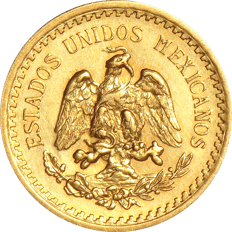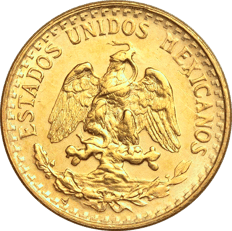
Only 3 left to order
2 Mexican Peso Centenario Gold
£246.58
VAT-free and excl. shipping
Available in 2–3 business days

 More than 300,000
 Over 30 years
 Secure shipping
 Google: 4.9/5
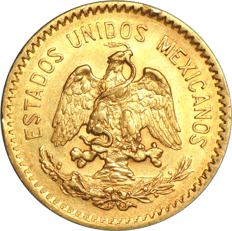
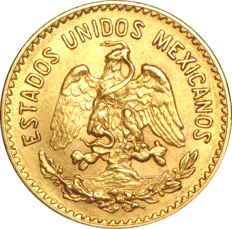
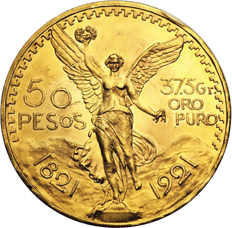
The Mexican Peso Centenario is a famous gold coin that was originally minted in 1921 by the Mexican Mint (La Casa de Moneda de México) to celebrate the centenary of Mexico's independence from Spain. The obverse of the coin features the image of the "Winged Victory", a famous Mexican statue symbolising freedom and independence, as well as the two legendary volcanoes Popocatépetl and Iztaccíhuatl in the background. The reverse features the Mexican coat of arms and an eagle.


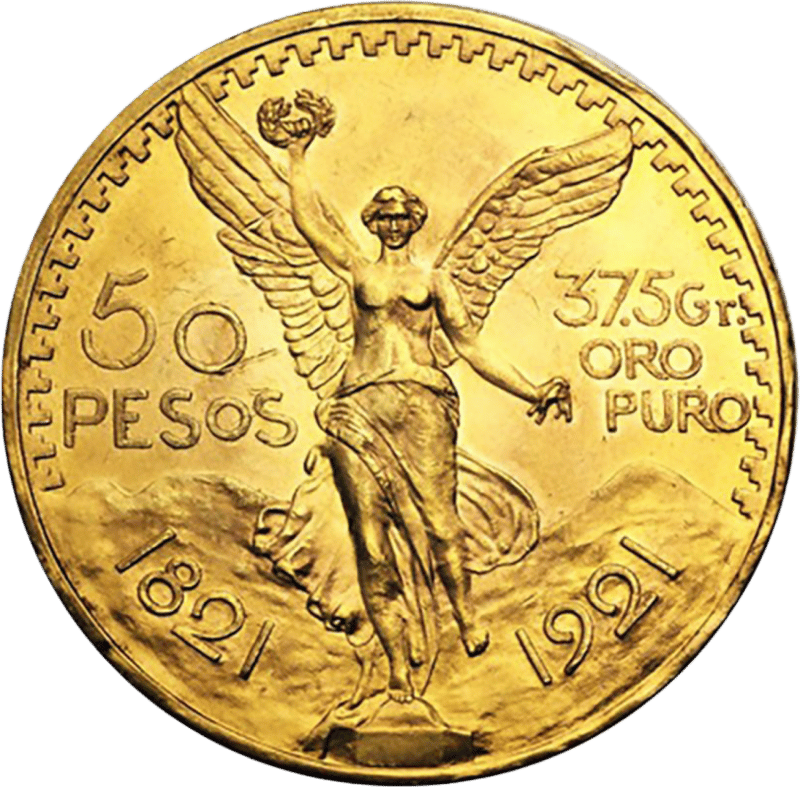
The picture side
In front stands the winged goddess of victory, behind her two volcanoes.
The laurel wreath
In her raised hand she holds the victor’s wreath.
The broken chains
From her other hand hang broken chains, an image of the end of Spanish rule.
The two volcanoes
In Nahuatl, Popocatépetl means “smoking mountain” and Iztaccíhuatl “white woman”. Both rise on the eastern edge of the Valley of Mexico.
For the centenary celebrations in 1921, Mexico even had a replica of Popocatépetl “erupt” out of a lake in a park, with lights and fireworks.
At the bottom of the picture side
On 27 September 1821, the Army of the Three Guarantees entered Mexico City, and independence was complete. The uprising had begun eleven years earlier. For the hundredth anniversary, this coin appeared in 1921, and on the right is the year it was struck.
The same goddess of victory stands on the Independence Column in Mexico City: the gilded Victoria, popularly known as “el Ángel”. The column was inaugurated in 1910, for the hundredth anniversary of the uprising. In the earthquake of 28 July 1957, the figure fell from the column.
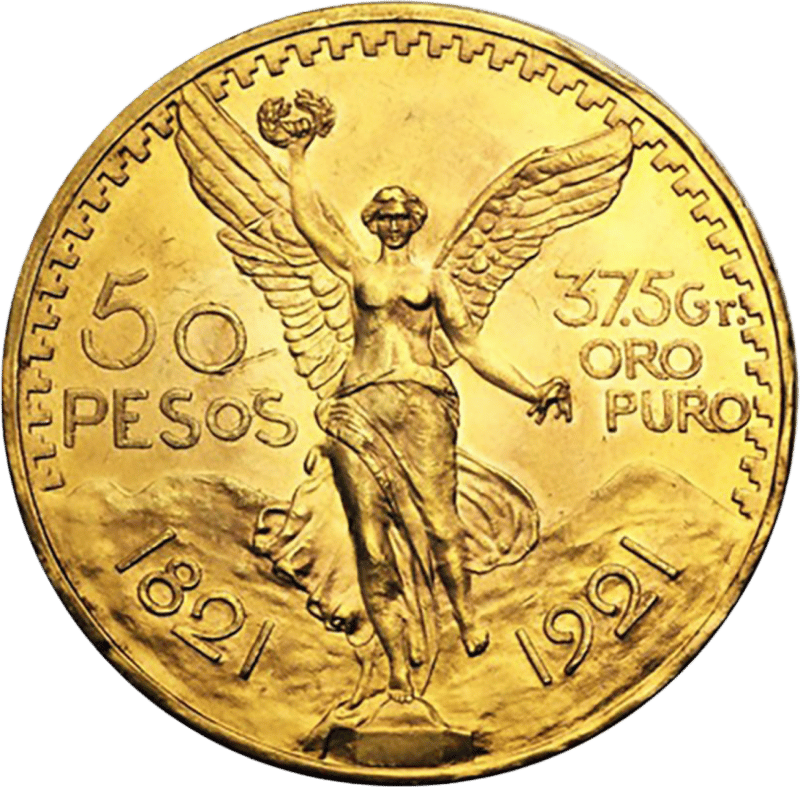
1821Independence is complete.
1921The year this piece was struck.
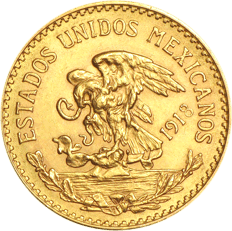
20 pesos “Azteca”
Since it was first struck in 1917, the gold 20 pesos has shown the Piedra del Sol, popularly called the “Aztec calendar”. The basalt stone measures 3.60 metres in diameter and weighs over 24 tonnes.
Workers found it on 17 December 1790 while paving the Plaza Mayor, with the relief facing down. From 1791 it was built into a tower of the cathedral. In 1885 it was moved to the National Museum, which was housed in the old mint building. There, where precious metals had once been melted and minted, it remained until 1964. Since then it has stood in the Museo Nacional de Antropología.
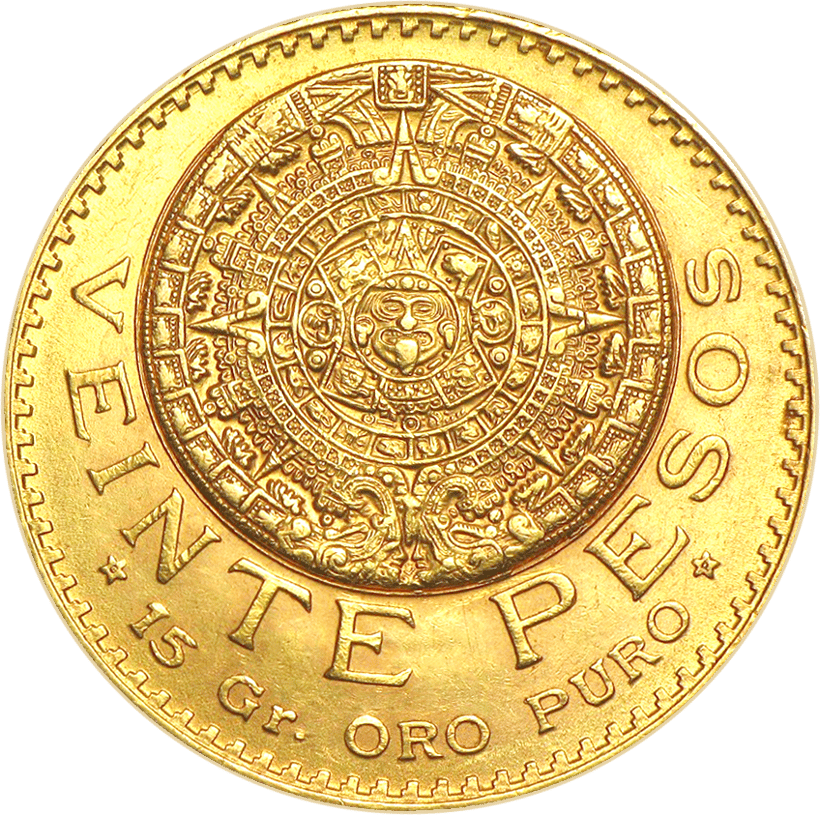
The coinage law of 1905 set the peso at 0.75 grams of fine gold. That is why every coin in the family contains its face value times 0.75 grams, and all are 900 fine.

Centenario
50 pesos · 37.5 g fine gold
Victoria before the volcanoes
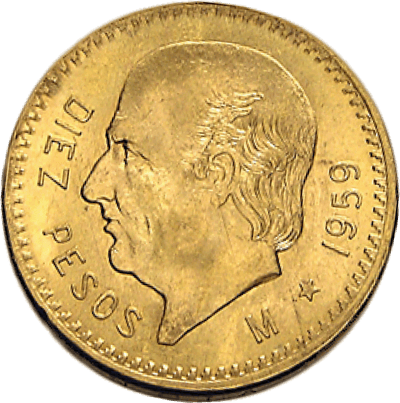
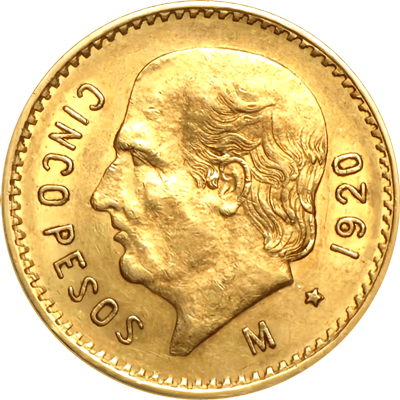
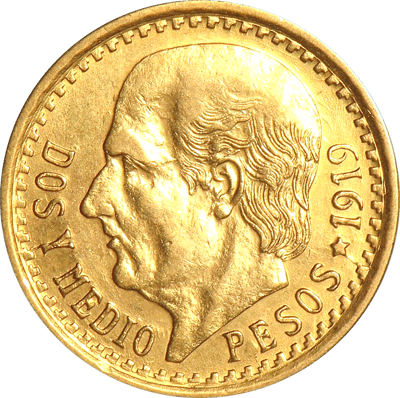
¼ Hidalgo
2.5 pesos · 1.875 g fine gold
Miguel Hidalgo
On 16 September 1810, Miguel Hidalgo called for the uprising. The Hidalgo coins of 1905 were the Republic’s first coins to show a national hero. The smallest is called ⅕ Hidalgo, but does not show him.
The frozen dates
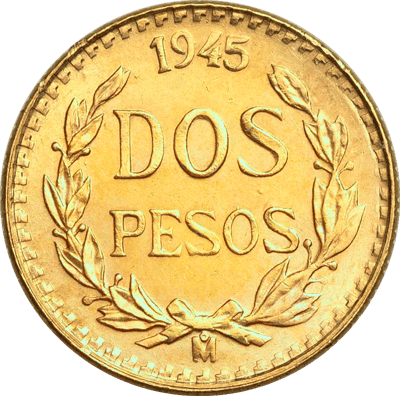
For decades afterwards, Mexico went on restriking the coins with a fixed date: 1947 on the 50 pesos, 1959 on the 20 and 10 pesos, 1955 on the 5 pesos, 1945 on the 2.5 and 2 pesos. A 50 pesos dated 1947 may therefore come from the year 1947 or from a later restrike. These are official strikes, not replicas.
The column has had a new Victoria since 1958.The coin has had the same one since 1921.
Details based on Banco de México (Familia del Centenario), the PCGS coin reports of 22 March and 5 May 2021, a study of the gold standard in Mexico from 1905 to 1910, Arqueología Mexicana and INAH on the Piedra del Sol, UNAM’s Revista de la Facultad de Medicina on the Independence Column, the Spanish-language Wikipedia for the dates of 1791, 1957 and 1958, the Mexican Ministry of Defence on 27 September 1821, a contribution by Michael J. Gonzales on the 1921 celebrations published by the University of London, a geological study of the Sierra Nevada, UNAM’s Gran Diccionario Náhuatl and photographs of the pieces shown.
Hardly any gold coin tells its nation's history as proudly as the Centenario from Mexico. Minted since 1921 by the Casa de Moneda de México, the coin originally celebrated the hundredth anniversary of independence from Spain, making it one of the first modern gold bullion coins ever. The following sections cover the history and design, the available face values and denominations, fineness and authenticity, the tax particulars, and the question of why the Centenario is equally popular among investors and collectors.

Mexico's definitive independence in 1821 was preceded by an eleven-year struggle for liberation, which followed the declaration of independence of 1810 that Spain initially did not recognise. Exactly one hundred years later, in 1921, the Mexican mint released the 50-peso gold coin to honour this anniversary. The name Centenario (Spanish for centenary) is thus entirely fitting. The engraved double date "1821-1921" still commemorates the signing of the Treaty of Córdoba, which made Mexico a sovereign state.
This makes the Centenario one of the earliest investment coins of the modern era. This status is often credited to the Krugerrand from South Africa, which, however, only appeared in 1967: the Mexican Centenario is around four decades older. As a former circulating coin, it was at the time a common means of payment and is stylistically classified within the so-called Hidalgo tradition, named after the Mexican independence hero Miguel Hidalgo. Anyone wishing to discover the full spectrum of international coinage will find a wide range of bullion and collector's items in the parent category Gold coins.
The Casa de Moneda de México is one of the oldest mints on the American continent, founded as early as 1535. In the 1930s, it minted between 90,000 and 1.5 million Centenario gold coins annually. After the end of the original minting series in 1947, official restrikes followed, bearing the frozen date "1947", one reason why the Centenario remains available today in large quantities and at attractive premiums. In trade, the 50-peso Centenario is classified under the classic Mexico-Hidalgo type; it should not be confused with the more modern Bicentenario, which was issued in 2010 for the two-hundredth anniversary.
The fineness of the Centenario gold coins is consistently 90 per cent gold, equivalent to 21.6 carats. This alloy with a copper content makes the coins more resistant to scratches and wear, a principle later adopted by the Krugerrand as well. Historically, the entire Hidalgo series was issued in several peso denominations:
Strictly speaking, Centenario originally refers only to the 50-peso coin, but in international trade the term is often used for the entire family of Mexican peso gold coins. Smaller denominations are somewhat more expensive per gram because the minting effort is relatively higher; in return, they offer more flexibility when it comes to later resale. Anyone seeking particularly large units can alternatively turn to classic gold bars, while for regular wealth building the offers in the savings plan products section are worth considering.
| Face value | Weight | Fine weight | Fineness | Diameter |
|---|---|---|---|---|
| 2 Pesos | 1.667 g | 1.50 g | 90.0% | 13.00 mm |
| 2.5 Pesos | 2.083 g | 1.875 g | 90.0% | 15.50 mm |
| 5 Pesos | 4.167 g | 3.75 g | 90.0% | 19.00 mm |
| 10 Pesos | 8.333 g | 7.50 g | 90.0% | 22.50 mm |
| 20 Pesos | 16.667 g | 15.00 g | 90.0% | 27.50 mm |
| 50 Pesos | 41.667 g | 37.50 g | 90.0% | 37.00 mm |
The coin's design remained unchanged throughout the entire minting period, a rare case of design consistency over an entire century. The obverse shows the winged goddess of victory (Spanish: Victoria Alada) with flowing robes, raising a laurel wreath in her right hand and holding broken chains in her left, a powerful symbol of victory in the war of independence. This figure is modelled on the famous statue El Ángel de la Independencia in Mexico City.
In the background, the two Mexican volcanoes Popocatépetl and Iztaccíhuatl are depicted in outline. The reverse features the Mexican coat-of-arms eagle, perched on a cactus and holding a snake in its beak, the central symbol of Mexican statehood. Anyone drawn to the emotional power of historical designs will find in the Vreneli category a European bullion coin with similarly strong national symbolism.
A Centenario is more than an ounce of gold: it carries the history of freedom of an entire nation in minted form.
Because the Centenario is a coin minted over decades with a mintage in the millions, counterfeits unfortunately also exist in circulation. However, genuine coins can be reliably identified by several characteristics. The exact dimensions from the table above are decisive: a 50-peso coin weighs 41.667 g with a diameter of 37 mm; any deviation indicates a counterfeit.
At Kettner Edelmetalle, all purchased items undergo an ISO-compliant authenticity verification before being offered for sale again. Anyone wishing to store coins safely and in a way that preserves their value will find suitable protective solutions in the coin capsules section, which protect against scratches and environmental influences.
The Centenario meets the criteria for investment gold and, when purchased in Germany, is exempt from VAT under the applicable regulations. Tax advantages can also arise on a later sale: if physical gold is held for longer than one year, any capital gain is tax-free after the holding period. This information is general in nature and does not replace individual tax advice.
Tax notice
Investment gold is exempt from VAT in Germany. After a holding period of more than one year, capital gains on physical gold are generally tax-free. For the specific assessment of individual cases, consulting a tax advisor is recommended.
The same applies to storage as with other bullion coins: a bank safe deposit box or a high-quality home safe provides protection against theft, while coin capsules and cases preserve the condition of the coin. Larger holdings can be neatly organised in special coin cases. As a general rule, gold should be regarded as a long-term component of retirement provision and inflation protection.
The Centenario ranks among the world's great classic bullion coins, but differs in several respects. While modern bullion coins such as the Maple Leaf from Canada or the American Eagle are reissued every year, the Centenario scores points for its historical aura and its unchanged design since 1921.
Particularly interesting is the comparison with the Vienna Philharmonic: both coins combine national cultural identity with the sober purpose of investment, one through the music of the world's most famous orchestra, the other through Mexico's history of freedom. The Philharmonic is purer, with a fineness of 999.9/1,000 fine gold, while the Centenario is more robust in handling thanks to its copper content. Anyone looking for a copper-alloyed bullion coin with a similar tradition will also find what they need in the South African Krugerrand. Lovers of European classics will also find it worthwhile to look at the British Sovereign.
Centenario is Spanish for centenary. The 50-peso gold coin was issued in 1921 to mark the hundredth anniversary of Mexican independence from Spain and therefore bears the double date 1821-1921.
The Centenario consists of an alloy with 90 per cent gold, equivalent to 21.6 carats. The 50-peso issue contains 37.5 grams of fine gold with a total weight of 41.667 grams. The copper content makes the coin more resistant to wear.
Yes. The Centenario first appeared in 1921 and is therefore around four decades older than the Krugerrand, introduced in 1967. It ranks among the earliest modern gold bullion coins ever.
No. As investment gold, the Centenario is exempt from VAT in Germany. After a holding period of more than one year, any capital gain is generally tax-free. A tax advisor should be consulted for individual cases.
The Mexican peso gold series comprises the face values of 2, 2.5, 5, 10, 20 and 50 pesos. In the strict sense, the Centenario refers to the 50-peso coin, although in trade the term is often used for the entire family.
Genuine coins correspond exactly to the official values for weight, diameter and fineness. Gold is not magnetic, and the relief of the goddess of victory is sharply defined. In case of doubt, a professional check using ultrasound or X-ray fluorescence provides certainty.
 Centenario
Stay informed with product launches, financial news and exclusive offers. Sign up for our free newsletter today.
By entering your email address and clicking the "Submit" button, you give the following consent: "I agree to be informed by email about new products, financial news and exclusive offers, and therefore consent to the processing of my email address for the purpose of sending the newsletter. I can revoke this consent at any time without giving reasons, with effect for the future. The lawfulness of processing carried out prior to revocation remains unaffected."