


Sold out

1 Ounce Palladium Maple Leaf
£1,051.76
excl. UK import VAT and shipping
currently not available

 More than 300,000
 Over 30 years
 Secure shipping
 Google: 4.9/5
The palladium Maple Leaf is one of the rarest appearances in the realm of classic bullion coins, struck by the Royal Canadian Mint, issued in only a few years and sought after by all those who want to set accents beyond gold and silver. When the Canadian mint first struck the familiar maple leaf in palladium in 2005, the first issue sold out within days. The following sections cover history, design, technical data, authenticity features, tax treatment and the question of why the rare white metal palladium exerts such a special fascination.
The Maple Leaf series began in 1979 with a gold coin and became, over the decades, the most widely traded bullion coin family alongside the Krugerrand. Silver and platinum were added in 1988, before the Royal Canadian Mint took the logical final step and opened the palladium portfolio in 2005. This made the Maple Leaf, alongside the Cook Islands Bounty, one of the few bullion coins to be struck in all four investment metals with one and the same design.
Demand was enormous: the first issue of around 40,000 pieces sold out so quickly that re-strikes became necessary. However, as early as the end of 2007, the mint discontinued regular production again, the short issue period between 2005 and 2007 makes the early years sought-after pieces today. Those wishing to view the series in full will find the related issues under palladium coins as well as the sister edition from Cook Islands.
The Royal Canadian Mint is regarded as one of the technically leading mints in the world and is known for its exceptionally high fineness levels. This reputation transfers directly to the Palladium Maple Leaf, whose purity and finish meet the high standard of Canadian bullion coins.
The obverse of the coin is identical across all four metals, which is part of the appeal for collectors. The obverse shows the sugar maple leaf so characteristic of Canada, rendered in a natural, finely detailed depiction. It is also the central element of the Canadian flag and gives the entire series its name. At the top edge, the word Canada curves along the rim, and the fineness details are noted, as is customary in a bilingual country, in both English and French.
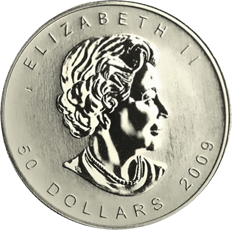
The reverse bears the portrait of Queen Elizabeth II, inscribed with the monarch's name, below which appear the face value of 50 Canadian dollars and the year of issue. The designs remained unchanged throughout the entire issue period from 2005 to 2007. Those who appreciate the same maple leaf in other metals will find it in the Gold Maple Leaf, the Silver Maple Leaf and the Platinum Maple Leaf.

Unlike the Gold Maple Leaf, which is available in numerous sizes from one gram up to one troy ounce, the Palladium Maple Leaf was issued exclusively in the 1 troy ounce version. This limitation keeps the series manageable and valuation transparent, since only a single format exists.
The face value of 50 Canadian dollars is purely symbolic and lies far below the actual material value, it merely documents the coin's status as official legal tender. The coin's actual value is determined by the palladium price. At the time, the coin was sold either individually in a protective sleeve, in a tube of 25 pieces, or in a master box of 500 pieces, formats that still prove their worth for orderly storage today and can be replicated with suitable coin tube accessories.
Palladium belongs to the platinum group metals and is considerably rarer than gold. Its largest area of demand lies in industry, above all in catalytic converters for the automotive sector. This strong industrial link means that the palladium price often moves differently from classic precious metals and can show at times considerable swings.
Visually, palladium is easy to recognise: it shows a cool, silvery white lustre, but is noticeably lighter than platinum. For investors wishing to diversify their precious metals portfolio beyond the classics, this white metal offers a distinctive facet. Those who also collect other bullion coin icons often combine the Palladium Maple Leaf with the Vienna Philharmonic in platinum or the American Eagle. In addition to coin form, classic bar formats are also available with palladium bars, while the entire segment can be viewed under palladium.
A coin that exists for only three years of issue tells a short but intense story, and that is precisely what makes it so appealing to connoisseurs.
Even though the Palladium Maple Leaf does not carry an elaborate security feature like the micro maple leaf introduced later on the gold variant, its authenticity can be verified reliably through several physical properties.
At Kettner Edelmetalle, every coin undergoes an ISO-compliant authenticity verification before leaving the logistics centre. Those who value documented provenance will find further verified issues from the mint in the overview of Canadian coinage.
A decisive difference compared with the Gold Maple Leaf concerns VAT. While investment gold is VAT-exempt in the EU, palladium coins are subject to the full VAT rate. For tax purposes, palladium is treated as an industrial metal and does not enjoy the tax privilege granted to investment gold.
Tax notice
Palladium and platinum coins are subject to the full VAT rate in Germany, in some cases mitigated by the margin scheme applied in trade. Investment gold, by contrast, is VAT-exempt. This is general information and does not replace tax advice.
For tax-optimised precious metals saving, a look at gold coins and gold bars therefore remains relevant, while palladium tends to serve as a targeted addition for diversification. Those wishing to explore the classic bullion coin world more broadly will find what they are looking for among the bullion coins.
Palladium is chemically resistant and, unlike silver, practically does not tarnish. Nevertheless, every bullion coin benefits from careful storage to avoid scratches and edge knocks that could diminish its condition. Since the Palladium Maple Leaf was issued only in Brilliant Uncirculated quality, a flawless condition has a positive effect on its collector's value.
Airtight coin capsules in the appropriate size are recommended, as is padded storage in coin cases. For larger holdings, tubes and master boxes are suitable, which already served as the coin's standard format at the time of issue. Kettner Edelmetalle ships fully insured as a matter of principle, so the journey from the high-security logistics centre to your doorstep is fully covered.
The Royal Canadian Mint began striking the coin in 2005. Regular production was discontinued again as early as the end of 2007, meaning the series essentially covers only the years 2005 to 2007. This short issue period contributes to its rarity.
The Palladium Maple Leaf is made of 999.5 fine palladium (99.95%) and weighs a full troy ounce, i.e. around 31.10 g of fine weight. It was issued exclusively in this 1 troy ounce size with a diameter of approximately 34 mm.
No. Unlike investment gold, palladium coins are subject to the full VAT rate in Germany, as palladium is treated for tax purposes as an industrial metal. The margin scheme is applied in some cases within the trade.
Palladium, like platinum, belongs to the platinum group metals, but is lighter and usually less expensive than platinum. Visually it shows a cool, silvery white lustre and, unlike silver, practically does not tarnish. Its demand is strongly shaped by industry.
The sugar maple leaf is the national symbol of Canada and has consistently adorned the series since 1979. Alongside the Cook Islands Bounty, the Maple Leaf is one of the few bullion coins struck in gold, silver, platinum and palladium with the same design, a deliberate hallmark of the Royal Canadian Mint.
Since the coin was issued only in Brilliant Uncirculated quality, careful handling is worthwhile. Airtight coin capsules protect against scratches and edge knocks, and larger holdings can be organised in tubes or master boxes. Flawless condition has a positive effect on collector's value.
 Maple Leaf
Stay informed with product launches, financial news and exclusive offers. Sign up for our free newsletter today.
By entering your email address and clicking the "Submit" button, you give the following consent: "I agree to be informed by email about new products, financial news and exclusive offers, and therefore consent to the processing of my email address for the purpose of sending the newsletter. I can revoke this consent at any time without giving reasons, with effect for the future. The lawfulness of processing carried out prior to revocation remains unaffected."