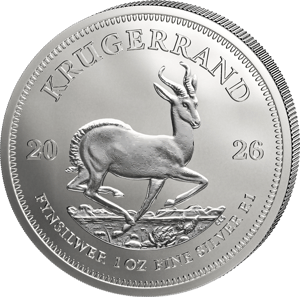
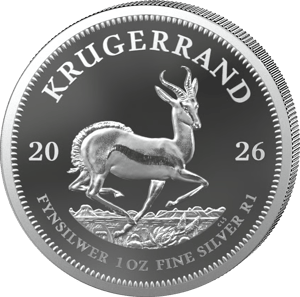
1 Ounce Silver Krugerrand 2026
£55.30
excl. UK import VAT and shipping
Available in 2–3 business days

 More than 300,000
 Over 30 years
 Secure shipping
 Google: 4.9/5

Feeling that flutter of excitement again? Time for new silver treasures? Silver coins have fascinated people since the days of ancient Egypt. Collectors and investors are discovering their latest favourite pieces right now. Expand your silver treasure too – our offers are better than ever.


Ten of these bullion coins are issued as one ounce of silver, the Panda as 30 grams since 2016. What sets them apart is the country, the design, the fineness and a few millimetres.
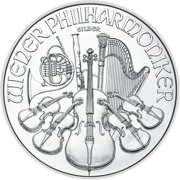 37 mmVienna PhilharmonicAustria
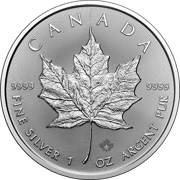 38 mmMaple LeafCanada
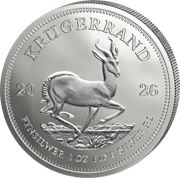 38.725 mmKrugerrandSouth Africa
All coins at the same scale, diameters according to the mints and central banks. For the Kangaroo, Kookaburra, Koala and Lunar, the Perth Mint gives maximum sizes, here for the 2026 issue.
A bullion coin is weighed silver bearing the stamp of a state. Five details almost always appear on it. On the Vienna Philharmonic, you will find all five on the side with the organ.
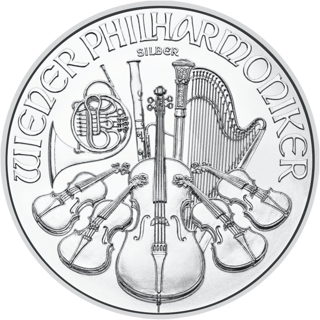 Side with the instruments
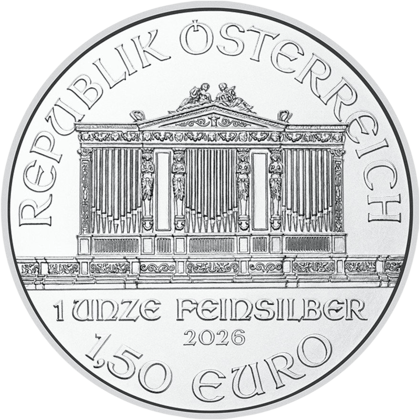 Side with the organ
REPUBLIK ÖSTERREICH, the Republic of Austria. The country that issues the coin.
1 UNZE, one ounce. This means the troy ounce, the unit of weight for precious metals: 31.1 grams. Almost all mints state the silver content of their bullion coins in troy ounces.
1,50 EURO. With this face value, the Vienna Philharmonic is legal tender in Austria. As a rule, the face value is what sets a coin apart from a medal.
FEINSILBER, fine silver. There is no number on the Vienna Philharmonic. Münze Österreich gives 999/1,000: of 1,000 parts, 999 are silver. The Maple Leaf carries the number itself: 9999, that is 999.9/1,000.
2026. The year of the coin, usually also the year it was struck. On the Vienna Philharmonic, only this number changes from year to year; the design stays the same.
 Philharmonic |  Maple Leaf | Libertad |
|---|---|---|
| Issuing country | ||
| REPUBLIK ÖSTERREICH | CANADA | ESTADOS UNIDOS MEXICANOS |
| Weight | ||
| 1 UNZE | 1 OZ | 1 ONZA |
| Face value | ||
| 1,50 EURO | 5 DOLLARS | no face valuenone |
| Fineness | ||
| FEINSILBER | 9999FINE SILVERARGENT PUR | PLATA PURALEY .999 |
| Year | ||
| 2026 | 2026 | 2024 |
The Libertad carries no face value. Mexican coinage law requires it to state its fine silver content instead: 1 ONZA PLATA PURA. It is still legal tender in Mexico.
For the classic bullion coins, the design is the trademark. It stays; the year changes. That is why some offers read “various years”. With the annual designs, it is the years that people collect.
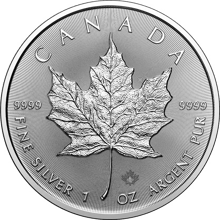 2026
Maple Leaf
Since the first Silver Maple Leaf in 1988, the ounce has carried the same maple leaf.
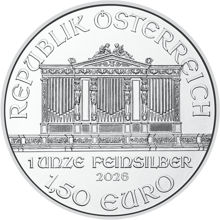 2026
Vienna Philharmonic
In silver since 2008, always with the same organ and the same instruments.
American Eagle
It has carried the Walking Liberty since 1986. Since mid‑2021, the reverse has shown a new eagle; the 2021 issue exists with both.
Today the Krugerrand, the Kangaroo and the Britannia bullion coin do the same. The proof Britannia, by contrast, gets a new design every year.
China Panda
A new panda design almost every year. The other side always shows the Temple of Heaven.
Lunar III
Each year an animal of the lunar calendar. After the Horse in 2026 comes the Goat in 2027, the eighth animal of the third series.
Kookaburra
A new image of the bird every year since 1990.
Koala
A new koala every year since 2007.
The silver Krugerrand comes as a bullion coin and in proof quality. Both measure 38.725 millimetres and carry the same design with the same details.
What usually sets bullion and collector coins apart:
Bullion coin
Uncirculated, without a mirror finish.
Proof
Die and blank are polished to a high shine. The result is a mirror field with frosted design and lettering.
Bullion coin
No fixed mintage; coins are struck to demand.
Proof
Fixed; for the Krugerrand 2026, a mintage of 10,000.
Bullion coin
In large quantities on high‑speed presses, usually with a single strike.
Proof
Usually in small batches on manually operated presses, often with two or three strikes.
Bullion coin
Packed in bulk, for example in tubes.
Proof
Individually in a capsule and case, with a certificate of authenticity. The coin stays in its capsule.
Silver reacts with sulphur compounds in the air. A wafer‑thin layer of silver sulphide grows on the surface, and its colour changes with its thickness. This is natural and no reason to clean a coin.
thin layer
thick layer
What collectors call toning is the same layer.
Milk spots are white marks that can appear on silver bullion coins. The mints link them to production; according to the Royal Canadian Mint, there is no single cause. They do not change the silver content.
Since the 2018 issue, the Royal Canadian Mint has given the silver Maple Leaf a surface protection called MINTSHIELD. According to the mint, it significantly reduces milk spots, but it cannot prevent them entirely.
Hold the coin by its edge, between thumb and forefinger. Fingerprints leave salt on the silver. The salt combines with the silver, and the print can darken later.
Modern coins are best kept in their tube or capsule. Never take a proof coin out of its capsule.
Dips contain acids, polishes contain abrasives. Both attack the surface, and any polishing removes silver.
Stay informed with product launches, financial news and exclusive offers. Sign up for our free newsletter today.
By entering your email address and clicking the "Submit" button, you give the following consent: "I agree to be informed by email about new products, financial news and exclusive offers, and therefore consent to the processing of my email address for the purpose of sending the newsletter. I can revoke this consent at any time without giving reasons, with effect for the future. The lawfulness of processing carried out prior to revocation remains unaffected."