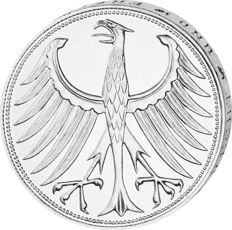
1 oz Silver German Eagle 2026
£55.33
excl. UK import VAT and shipping
Ships from 11/12/2026

 More than 310,000
 Over 30 years
 Secure shipping
 Google: 4.9/5


The German Eagle is one of the most sought-after German silver coin series and combines national symbolism with the timeless value of physical silver. Minted in 999 fine silver and available in several compact denominations, the series appeals to collectors and investors alike who want to build up their precious metals portfolio in small, flexible units. This guide looks at the design and symbolism, the available sizes, authenticity features, the tax treatment of silver, and sensible storage, so that a well-founded purchase decision rests on knowledge rather than gut feeling.
The eagle has been one of the most important heraldic symbols in German-speaking countries for centuries. As early as the Holy Roman Empire, the Reichsadler (imperial eagle) served as a symbol of power, and to this day the federal eagle forms the state coat of arms of the Federal Republic of Germany. The German Eagle silver coin series takes up this tradition and translates it into a modern, elaborately designed investment product. Unlike historical coins from the German Empire, this is a contemporary minting that reinterprets the familiar eagle motif with fine relief work.
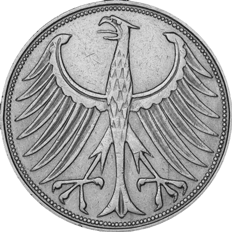
The obverse shows a majestic eagle with widely spread wings, whose plumage is worked out in great detail. The design is framed by the inscription Einigkeit und Recht und Freiheit, the opening words of the third verse of the German national anthem. Anyone wishing to delve deeper into the historical symbolism of the eagle in a coin context will find numerous other designs of cultural and national significance in the wide range of silver coins.
The eagle's symbolic history goes back a long way: already in ancient Rome the eagle was regarded as a sign of power and sovereignty; later it was adopted by the Holy Roman Empire and numerous European monarchies. In Germany, today's federal coat of arms developed over the centuries from the single-headed imperial eagle. By taking up this deeply rooted heraldic symbol, the series combines numismatic tradition with a contemporary investment product, an approach that enhances the coin both culturally and emotionally.
The reverse complements the eagle motif with an artistic depiction of Germania, the allegorical embodiment of German identity. Shown as a warrior with a spear, an oak-leaf wreath and an enthroned eagle on her helmet, the design continues the iconic visual language that has also made other German coins, such as the Germania silver coins, famous. The Latin inscription Perpetua Securitas, eternal security, underscores the coin's character as a store of value.
A key advantage of the series lies in its wide choice of sizes. While classic bullion coins usually focus on the full ounce, the German Eagle is deliberately also available in very small denominations. This significantly lowers the entry price and makes the coin a flexible building block for gradually building up wealth.
In uncertain times, small denominations offer a practical side benefit: they can be divided and passed on in small steps more easily than would be possible with large silver bars. Anyone wishing to secure a larger quantity of silver at the lowest possible premium, on the other hand, gets better value with the full ounce or with bars. Both strategies can easily be combined.
Beyond individual coins, the German Eagle is also available in practical bundles, such as packs of 10, 25, 50 or 100. Such bulk units reduce the price per piece and simplify storage. Suitable coin tubes, which hold several coins of the same size together in a dust-proof way, are ideal for keeping such collections in order.
All coins in the series are made of 999 fine silver and are supplied in Brilliant Uncirculated (BU) quality. The high fine silver content makes the coins soft and prone to scratching, which is why each specimen is supplied as standard in a protective coin capsule. The embossed face value refers to the issuing country, Liberia, a concept common with bullion coins that legally designates the coin as official legal tender.
Unlike well-known state-issued bullion classics such as the Vienna Philharmonic or the Maple Leaf, the German Eagle is an in-house minting by Kettner Edelmetalle. This allows for an attractive price-to-value ratio, since the path from manufacturer to buyer is short.
The current years of issue in the series are produced in a high-quality prooflike finish. Here, mirror-polished surfaces meet matte-finished relief elements, so that the eagle motif stands out in a sculptural way. In terms of appearance, this finish lies between the classic Mint State (MS) minting of common bullion coins and the elaborate Proof finish typical of pure collector's coins. This adds significant visual value without the coin losing its character as an affordable precious metal product.
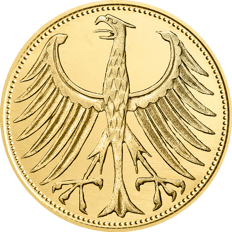
The eagle motif appears not only in silver but also as a gold edition in very small weights. Anyone looking for a direct comparison of the precious metals, or wishing to add a gold variant to the series, will find corresponding pieces in the German gold coins section.
Typical key facts of the series
With physical silver, authenticity verification is a legitimate concern. Bullion coins made of 999 silver can be reliably assessed using several criteria. The decisive factors are exact weight and diameter, a clean relief edge and the characteristic sound of pure silver.
Kettner Edelmetalle relies on ISO-compliant authenticity verification and a fully automated high-security logistics centre. Anyone wishing to look into the subject in more depth will also find basic information about the precious metal in the silver section.
The tax treatment clearly distinguishes silver from gold. While investment gold is exempt from VAT, silver coins are generally subject to VAT, often in the form of the margin scheme, which limits the effective mark-up.
Tax note
Profits from the private sale of silver coins are generally tax-free once the one-year speculation period under Section 23 of the German Income Tax Act (EStG) has elapsed. This information does not replace tax advice; a tax advisor should be consulted for individual cases.
This one-year holding period is a particularly relevant aspect for long-term oriented investors. Anyone viewing silver as a building block against currency devaluation will find further considerations in the inflation hedge section, as well as with the American Eagle silver coins, which are also among the most actively traded silver coins.
The price of a silver coin consists of two components: the current silver price (spot price) for the pure material value, and the premium (minting, distribution and trading costs). With small denominations, the premium per gram is naturally higher than with the full ounce or with bars, because the minting effort per piece remains roughly the same but is spread over less precious metal. Anyone focused on maximum material value per euro therefore chooses larger units; anyone prioritising flexibility and divisibility knowingly accepts the higher premium.
The silver price typically fluctuates more strongly than the gold price, since the metal depends on both investment demand and industrial demand. This greater volatility can be seen as an opportunity over the long term, but also as a burden during turbulent phases. A serious forecast of future price trends is not possible; the historical context merely shows that silver has been valued as a scarce tangible asset over long periods.
The material value of a coin follows the market; its appeal to collectors and its symbolic power, however, remain independent of the daily price.
Anyone wishing to buy regularly, independent of the daily price, can make use of the so-called cost-average effect through a silver savings plan and thus arrive at a smoothed entry price over time. For investors who use precious metals specifically as a building block against loss of purchasing power, the inflation hedge section offers further background.
Silver is not only an investment object but also a sought-after industrial raw material. Solar technology, electronics and medical technology require the metal in growing quantities, while supply is limited. This dual role makes silver a special tangible asset: it combines the emotional and cultural component of a beautifully designed coin with the sober character of a scarce raw material.
For many investors, the idea of diversification, spreading wealth across several asset classes, is paramount. Precious metals are traditionally regarded as a complement to classic financial investments. Anyone wishing to invest in physical silver regularly and predictably can do so via savings plan products and thus build up holdings piece by piece, independent of the current silver price. Tangible assets also play a complementary role for some investors in long-term retirement provision.
Proper storage preserves the value and appearance of the coins. Since 999 silver is sensitive to touch, moisture and sulphur compounds in the air, protected storage is important. Tarnishing does not change the precious metal weight, but it can impair the appearance.
Suitable coin cassettes or a coin case, which combine collecting and protection, are recommended for orderly storage. At Kettner Edelmetalle, shipping is also always carried out 100% insured, so that the coins arrive safely with the recipient.
The series appeals equally to two groups of buyers. Collectors appreciate the elaborate design, the national symbolism and the possibility of building up a sequence of years of issue. Investors benefit from the high fine silver content, the low entry price of small denominations and the flexibility when selling individual units later.
A small silver coin is also popular as a gift with lasting value, for example as a present with genuine precious metal content. Anyone wishing to explore the field of German coins further will find a wide range of complementary designs and series in the other silver coins section.
All coins in the series are made of 999 fine silver and are supplied in Brilliant Uncirculated (BU) quality in a protective coin capsule.
The German Eagle is available in several sizes, including 1/20 oz, 1/10 oz, 1/4 oz and 1 oz. The 1/10 oz is considered the most sought-after variant, as it combines a low entry price with a handy format.
The obverse shows an eagle with spread wings as well as the inscription Einigkeit und Recht und Freiheit. The reverse depicts Germania as a warrior and bears the inscription Perpetua Securitas.
Unlike investment gold, silver is subject to VAT, often in the form of the margin scheme. Profits from private sales are generally tax-free once the one-year speculation period under Section 23 of the German Income Tax Act (EStG) has elapsed. Tax advice is recommended for individual cases.
Coin capsules to protect individual pieces, as well as dry, cool storage, are recommended. Larger collections can be organised in coin cassettes or a coin case and, if necessary, kept in a safe deposit box.
Yes. Thanks to the small denominations and low entry price, the series is well suited to gradually building up a silver holding and is also popular as a gift with genuine precious metal value.
Many bullion coins are formally issued by an issuing state and carry an embossed face value that legally designates them as official legal tender. In the case of the German Eagle, Liberia plays this role. However, what actually matters for the real value is not the low face value but the material value of the fine silver contained.
The series combines both aspects. Due to the high fine silver content and the small, divisible denominations, it has a clear investment character. At the same time, the elaborate prooflike minting, the national design and the possibility of collecting years of issue appeal to collectors. This dual role makes it interesting for different groups of buyers.
The price consists of the material value (silver price) and the premium for minting and trading. Since the minting effort per coin remains roughly the same, the premium per gram is higher for small units than for the full ounce. Anyone focused on the highest material value per euro chooses larger units; small denominations, in turn, offer greater flexibility.
 German Eagle
Stay informed with product launches, financial news and exclusive offers. Sign up for our free newsletter today.
By entering your email address and clicking the "Submit" button, you give the following consent: "I agree to be informed by email about new products, financial news and exclusive offers, and therefore consent to the processing of my email address for the purpose of sending the newsletter. I can revoke this consent at any time without giving reasons, with effect for the future. The lawfulness of processing carried out prior to revocation remains unaffected."