1 Ounce Silver Somalia Elephant 2026
£67.93
excl. UK import VAT and shipping
Available in 2–3 business days

 More than 300,000
 Over 30 years
 Secure shipping
 Google: 4.9/5
Although Germany does not have its own bullion coin, there are some investment products that originate here: The African Wildlife series is, unexpectedly, a product of the mint "Bayerisches Hauptmünzamt" in Germany. The silver coins of the Somalia Elephant are therefore agency coins issued under the licence of African countries. The coins are available in 1 ounce and 1 kilogram and are now also minted in numerous additional denominations.


The Somalia Elephant is one of the most popular silver bullion coins in the world and combines two worlds that rarely come together: the sober charm of an affordable bullion coin and the emotional fascination of a genuine collector's series. Each year, the elephant of the African Wildlife series appears under the coin dies with a new design, turning collecting into a small journey through the African savannah. This guide covers the history, denominations, design tradition, authenticity, taxation and storage of the silver coin featuring the grey giant.
The history of the series begins as early as 1999: back then, the elephant still appeared under the flag of Zambia. It was not until 2004 that Somalia took over as issuer and redesigned the value side; since then, the coin has carried a face value in Somali shillings. The former Zambia Elephant thus became the Somalia Elephant that remains sought after to this day, internationally also known as the Somalia Elephant, which quickly became the most in-demand issuing country of the series.
The origin of the minting is remarkable: although it is formally an African issue, the coin is produced in Germany. It is struck as a so-called agency issue at the Bayerisches Hauptmünzamt, a detail that surprises many investors. Since 2014, the German-Swiss Geiger Edelmetalle AG has been entrusted with producing the ounce. German and European minting craftsmanship thus stands behind the African design.
The elephant was not Somalia's first silver project. It was preceded by the monkey series The African Monkey, which ran from 1998 to 2004. After its discontinuation, the thick-skinned animal took centre stage and became the country's flagship series. Anyone wishing to place the series in a broader context will find numerous related design series in the silver coins range.
The core of the series is the 1 oz coin, with a fineness today of 999.9/1,000 fine silver. It has been continuously available since 2004, meets international investment standards and is part of the standard range of every precious metals dealer. Its low premium over the silver price makes it particularly attractive for beginners.
Over the years, numerous additional weights have been added, so that the elephant now offers one of the broadest denomination families among bullion coins:
The smaller denominations carry a higher percentage premium, because minting effort and handling per gram increase. Anyone wishing to buy as close as possible to pure material value therefore usually opts for the ounce or the kilo coin. A similar logic applies to almost all bullion coins: a look at the Vienna Philharmonic or the Canadian Maple Leaf shows comparable patterns in price tiering.
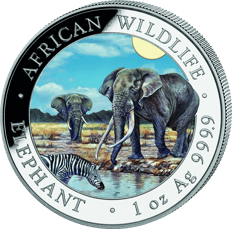
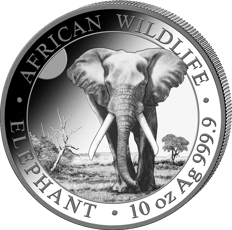
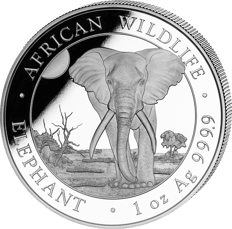
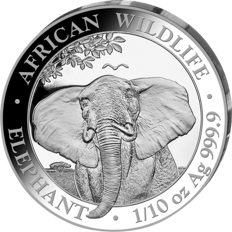
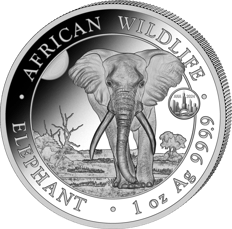
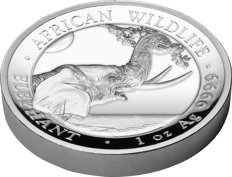
The heart of the series is its changing design. While classics such as the Maple Leaf barely change their design over decades, the Somalia Elephant presents a new elephant depiction year after year. Sometimes the bull strides alone through the savannah, sometimes it stands within its family group, sometimes in front of striking landscapes. The 2006 year of issue, for example, shows the elephant in front of Mount Kilimanjaro, a design that remains especially popular among collectors to this day.
It is precisely this variety that creates the appeal: a Somalia Elephant collection tells an ongoing visual story in which no year resembles another. For many collectors, assembling the various years of issue becomes a passion that lasts for decades.
No year of issue resembles another: therein lies the special charm of the grey giant from Africa.
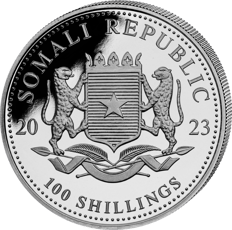
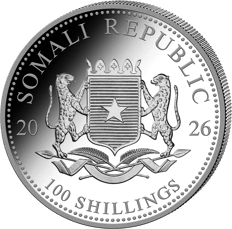
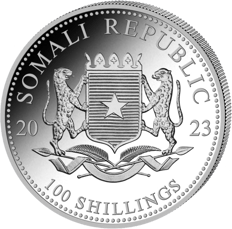
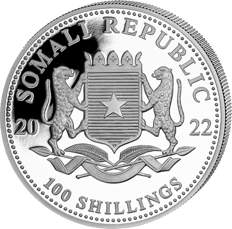
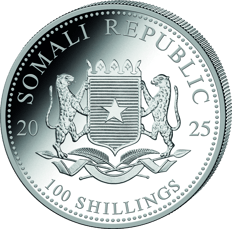
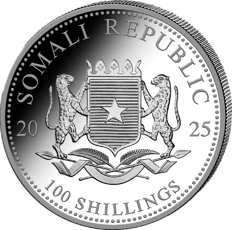
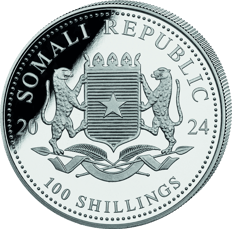
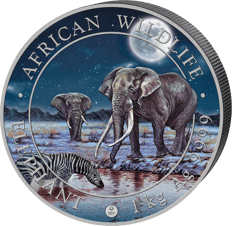
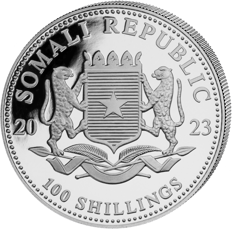
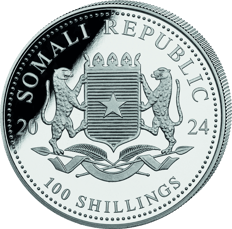
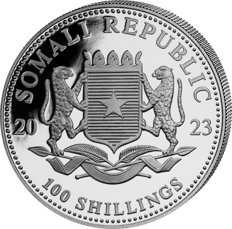
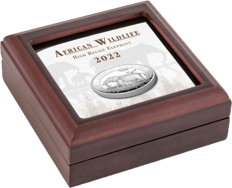
On the value side, the coin remains true to its origin: visible are the coat of arms of Somalia, the country designation, the year of minting and the face value in Somali shillings. The same visual language is found on its golden sister, which can be found in the range of Somalia Elephant gold coins. Alongside the classic strikes, partially gilded and coloured silver coins regularly appear, as well as specially packaged editions that showcase the design in artistic style.
As official legal tender of Somalia, every coin carries an embossed face value. The 1 oz issue is denominated at 100 SOS, the kilo coin at 2,000 SOS. This face value is purely symbolic: the actual value of the coin derives from its silver content and, for older years of issue, from the collector's premium.
A curious episode in the series' history concerns precisely this face value: up to 2006, the ounce was denominated at 1,000 SOS. This comparatively high value was corrected to 100 SOS from 2007 onwards, with the value side adjusted accordingly. It is often such transitional years of issue that make the elephant particularly appealing to collectors. Anyone generally interested in the legal tender status of modern coin issues will find further examples among the collector's coins.
The Somalia Elephant silver coin impresses with a clean strike in Mint State (MS), with clear contours and an attractive lustre. Originally, the fineness was 999/1,000; with the change around 2016/2017 it was raised to 999.9/1,000, almost pure fine silver. This means the coin meets the highest demands of international investors.
Several characteristics work together to verify authenticity, as with any bullion coin:
As an official partner of the South African Mint and with ISO-compliant authenticity verification, Kettner Edelmetalle relies on verified goods sourced directly from the mints. Anyone wishing to delve deeper into the subject will find the fundamentals on silver in the overarching range.
The Somalia Elephant has long moved beyond its origins as a pure bullion coin. Two characteristics make it special:
This dual role distinguishes the elephant from purely speculation-driven issues and makes it a rewarding entry point for anyone who wants to combine investment with the pleasure of collecting. Special strikes with a privy mark, for example for the World Money Fair in Berlin, as well as limited sets, broaden the field for ambitious collectors. Anyone who loves the collecting aspect will also find similarly design-rich sequences of years of issue in the Koala series or with the China Panda.
In Germany, silver coins are subject to VAT, unlike investment gold. For silver bullion coins from non-EU countries, the margin scheme generally applies, which reduces the tax burden compared with standard taxation. After a holding period of more than one year, any private capital gain is tax-free. Specific tax questions should always be clarified with a tax adviser.
Care instructions
Fine silver oxidises on contact with air and tends to develop milk spots, a phenomenon that also affects other coins such as the Maple Leaf. Coins should therefore always remain in their capsule and should not be touched with bare fingers.
For safe storage, high-quality accessories are recommended: individual pieces are optimally protected in a coin capsule, while entire collections can be kept neatly organised in a coin case. Since the coins are often delivered loose in tubes straight from the mint, reputable dealers additionally pack them individually to avoid transport damage. For larger holdings, it is worth considering a bank safe deposit box or an insured home safe.
In the competition among silver bullion coins, the Somalia Elephant positions itself between the static classics and purely collector-oriented series. Important reference points include:
Compared with these classics, the elephant plays to its strength of a changing design without losing its investment character. Anyone looking for thematically related animal motifs will also find what they need with the Big Five or the African Springbok, both of which capture the fascination of African wildlife.
Although the coin is issued in the name of Somalia, it is produced as an agency issue at the Bayerisches Hauptmünzamt in Germany. Since 2014, Geiger Edelmetalle AG has been entrusted with producing the ounce.
Originally, the fineness was 999/1,000. With the change around 2016/2017 it was raised to 999.9/1,000, in other words almost pure fine silver. The 1 oz issue contains 31.1 grams of silver.
The annually changing elephant design is the trademark of the African Wildlife series. It makes collecting appealing, since each year of issue shows its own design, creating an ongoing collection.
In addition to the classic 1 oz, there are the fractional pieces of 1/10, 1/4 and 1/2 oz, as well as larger issues of 2 and 5 oz. The massive kilo coin has rounded off the range at the top end since 2011.
Both. With its low premium, the ounce is suitable as a solid investment object, while the changing design and limited special editions also make the series attractive for collectors. Early years of issue are now traded at a premium.
Silver oxidises in air and tends to develop milk spots. It is best for the coins to remain in a coin capsule and to be handled only by the edges. Larger collections can be safely stored in a coin case or a safe.
 Somalia Elephant
Stay informed with product launches, financial news and exclusive offers. Sign up for our free newsletter today.
By entering your email address and clicking the "Submit" button, you give the following consent: "I agree to be informed by email about new products, financial news and exclusive offers, and therefore consent to the processing of my email address for the purpose of sending the newsletter. I can revoke this consent at any time without giving reasons, with effect for the future. The lawfulness of processing carried out prior to revocation remains unaffected."