Only 5 left to order
1/4 oz Gold Golden Eagle 2026 (Mintage: 299 | Proof)
£1,074.50£1,657.56
VAT-free and excl. shipping
Available in 2–3 business days

 More than 300,000
 Over 30 years
 Secure shipping
 Google: 4.9/5
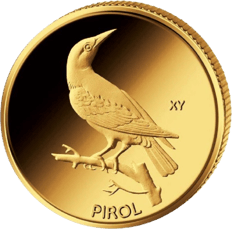
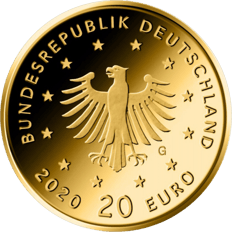
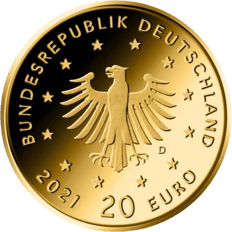
On the design sides of the 20 Euro Native Birds gold coins, a different bird native to Germany will be depicted each year, along with the engraved name of that bird and the mint mark of the issuing mint. The coins, struck from 999.9 gold, have a fine weight of 1/8 oz (approximately 3.89 g). The coins are issued by the Federal Ministry of Finance of the Federal Republic of Germany.


On 27 May 2015, the German Federal Government decided on a series of six 20‑euro gold coins on the theme “Native Birds”. According to the Federal Ministry of Finance, it follows on from the “German Forest” series. The motifs were based on a concept by the zoologist Prof. Dr. Josef H. Reichholf on typical native bird species.
Bodo BroschatBerlin
František ChocholaHamburg
 Golden oriole2017
 Black woodpecker2021
Adelheid FussGeltow
The picture sides of the six coins, two by each artist. Product photos from the shop.
The motifs were developed in an art competition. The first prizes went to three artists, and each designed two birds. Adelheid Fuss also designed the value side.
From 2016 to 2021, one bird appeared each year, always in June: first the nightingale on 23 June 2016, last the black woodpecker on 21 June 2021.
“The character of the series is supported by the uniform value side, on which only the year of issue is adjusted.”
Federal Ministry of Finance on 27 May 2015, quoted from MünzenWoche, translated

Since 1971, NABU and LBV have chosen a Bird of the Year, now by public vote. The very first was the peregrine falcon. It was proclaimed by NABU, which was then still called Deutscher Bund für Vogelschutz.
Later came the black woodpecker in 1981, the golden oriole in 1990, the nightingale in 1995 and the eagle‑owl in 2005. The white stork was the only one of the six to be Bird of the Year twice, in 1984 and 1994.
All six only appeared on the coins years later, and in a different order: first the nightingale in 2016, the peregrine falcon not until 2019, as the fourth. With the two lists side by side, 13 years lie between election and coin for the eagle‑owl, 48 for the peregrine falcon.
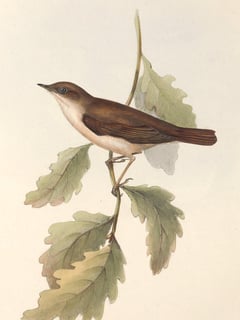
The nightingale is often heard, but it sits well hidden in the bushes. The golden oriole is more often heard than seen, and the shy black woodpecker is given away by its voice. That is how NABU describes it.
The sounds written as NABU writes them. The round close-ups come from the product photos of the coins.
In its breeding area, a male nightingale sings around the clock until it has found a female, and after that only by day. In one hour it can deliver more than 400 phrases in a row. Loud, rhythmically repeated syllables in its song are known in German as the “Nachtigallenschlag”.
The eagle‑owl owes its German name, Uhu, to its deep call “u‑uuooh”.
The white stork clatters its bill at the nest. The peregrine falcon is missing from the sound picture, as it is not very vocal.
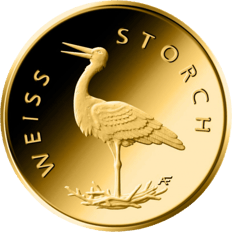
“The motif of a clattering white stork follows the swift peregrine falcon in 2020.”
Münze Deutschland on the 2020 issue, translated
Their breeding sites lie at very different heights. The nightingale nests well hidden on the ground or just above it. The black woodpecker chisels a hole into old trees. Its upright oval entrance measures about 9 × 12 cm.
Many other animals move into its holes as “new tenants”, writes NABU.
The golden oriole’s nest hangs in a fork of branches high in the crown. The white stork builds on roofs, chimneys and masts, and its nest of branches grows up to 2 metres wide.
The eagle‑owl breeds on steep rock faces and in quarries. The peregrine falcon also breeds on rock faces, but also in church towers and on bridge piers.
Today, according to LBV, around 1,800 pairs of peregrine falcons breed in Germany again. In Bavaria, buildings and other structures make up just over 50 per cent of the known breeding sites.
The order is approximate and shows no metres. Old bird plates, credits in the sources.
Before the birds, the “German Forest” series appeared from 2010 to 2015. After the black woodpecker, the story continued in 2022 with the “Return of the Wild Animals” series.
The 20-euro gold coins of the Native Birds series are among the most popular German collector's coins of recent times: six issues, six bird designs, struck from 999.9 fine gold and weighing just 3.89 grams. Between 2016 and 2021, a new design was issued each year, created by renowned medal artists and issued by the Federal Ministry of Finance. This guide places the series in context, explains the mints and letters, examines the collector's and investment aspects, and answers the most frequently asked questions.
After the great success of the gold euro series dedicated to the UNESCO World Heritage and to the German Forest, the Federal Republic continued its nature-themed tradition of 20-euro gold coins with the Native Birds series from 2016 onwards. At the heart of the series is Germany's native birdlife: from the delicately singing nightingale to the powerful peregrine falcon, the fastest animal in the world. The series thus combines intricate minting artistry with a piece of German natural history, a combination that appeals equally to collectors and gold investors.
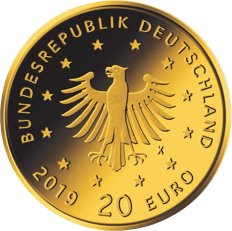
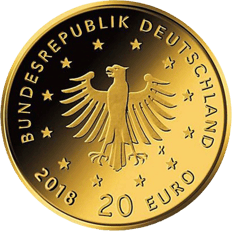
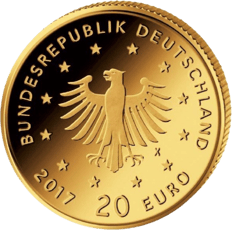
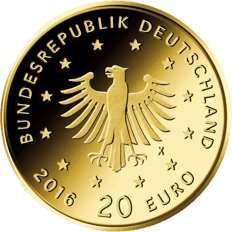
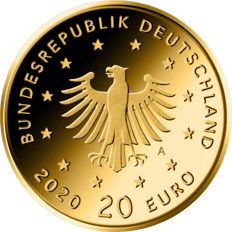
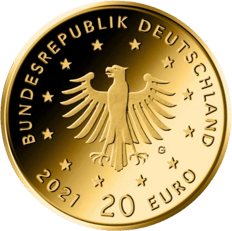
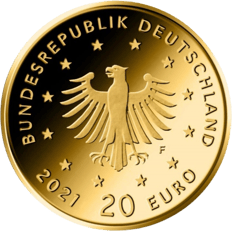
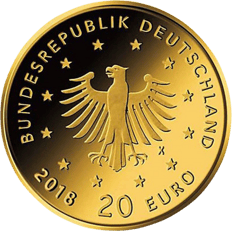
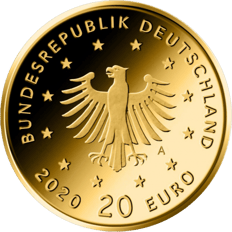
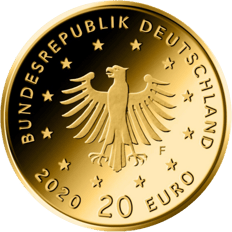
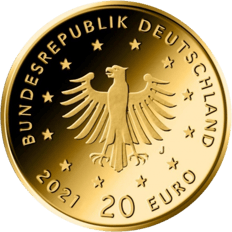
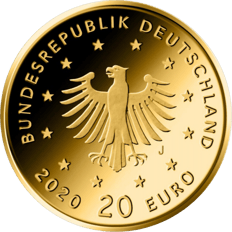
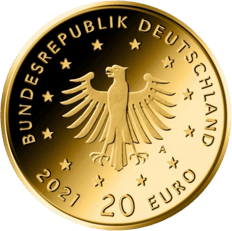
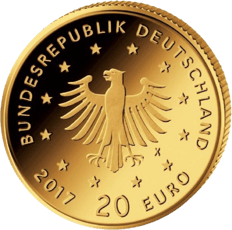
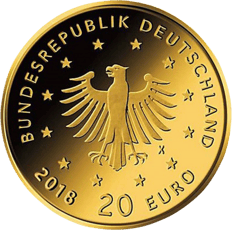
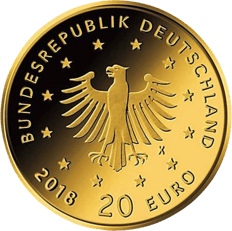
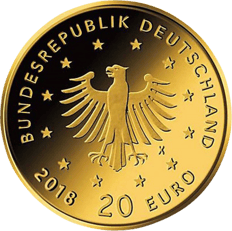
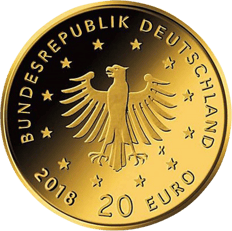
Each coin bears a different bird design on its obverse, together with the engraved name of the species and the mint mark of the issuing mint. The reverse is adorned with the federal eagle and the face value of 20 euros. The designs were conceived as official German commemorative coins, yet they are traded predominantly as an investment in physical gold. Anyone looking for the full range of German issues will find them in the German gold coins category.
All issues in the series share an identical technical design, which makes collecting and comparing them easier. They are struck from fine gold with a fineness of 999.9/1,000 in Brilliant Uncirculated (BU) quality. This consistent design makes the coins a compact building block for any holding of gold coins.
At just 3.89 grams, the Native Birds coins are among the smaller gold coins and are therefore well suited as an entry point or as a complement alongside classic bullion coins such as the Krugerrand or the Vienna Philharmonic. Those who prefer smaller denominations will also find comparable options among 1/10 oz gold bars.
One feature that makes the series particularly appealing to collectors is that minting is spread across five German mints. Each mint marks its coins with its own mint letter, struck on the obverse.
Because the mintage is divided equally among the five locations, every design exists in five letter variants. Collectors therefore often aim to put together the complete set of all five mint letters for a given year. Not every letter remains permanently available, which makes certain variants more sought after on the market than others. The coins were issued through the official sales office for collector's coins of the Federal Republic.
Good to know
Although the series was officially struck in Brilliant Uncirculated (BU) quality, the surface finish often looks of a higher quality than usual BU strikes, thanks to the fine relief design. The Native Birds series was never issued in silver: for silver coins, German minting tradition favours other designs.
The designs are based on a concept by the German zoologist Prof. Dr. Josef H. Reichholf on typical native bird species. The designs were chosen through an artistic competition, which gives the series an unusually lively and nature-inspired visual language.
The award-winning designs come from three medal artists: Bodo Broschat (Berlin) created the nightingale and the peregrine falcon, František Chochola (Hamburg) designed the golden oriole and the black woodpecker, and Adelheid Fuß (Schwielowsee) was responsible for the eagle-owl and the white stork, as well as the shared reverse featuring the federal eagle. This artistic signature makes the series a collector's item that goes beyond its pure gold value, an aspect equally valued in other German coinages such as the Goldmark or issues of the German Empire.
A coin depicting a native bird captures a piece of familiar nature cast in gold, which is precisely what gives it its special appeal.
The 20-euro gold coins meet the criteria for investment gold and are exempt from VAT in Germany. This means no VAT is charged on purchase, a key difference compared with many silver coins, which are subject to the margin scheme.
Tax note
In Germany, investment gold is exempt from VAT pursuant to § 25c UStG. Furthermore, after a holding period of more than one year, any capital gain from the sale of privately held gold is tax-free. This information is of a general nature and does not replace individual tax advice.
Because physical gold is traditionally regarded as a building block for diversifying wealth, many collectors place these coins somewhere between a pure collector's item and a store of value. Those seeking a purely investment-focused option tend to opt for larger denominations such as a 100 g gold bar.
The small diameter of 17.5 mm makes the coins sensitive to scratches and fingerprints. To preserve their value, the rule is: handle them only by the edge wherever possible and store them in a protected way. Suitable accessories help preserve the minting quality in the long term.
Because the series was concluded with the 2021 year of issue and mintages are limited, individual letter variants and the rare peregrine falcon in particular are in demand on the market. The successor theme from 2022 onwards continues under the title Return of the Wildlife, for example with designs such as the grey seal, and follows on seamlessly from the bird series in technical terms.
The series comprises six designs, issued annually from 2016 to 2021: nightingale (2016), golden oriole (2017), eagle-owl (2018), peregrine falcon (2019), white stork (2020) and black woodpecker (2021). Each design was struck at five German mints and therefore exists in five letter variants.
The letters indicate the mint: A stands for Berlin, D for Munich, F for Stuttgart, G for Karlsruhe and J for Hamburg. Since the mintage is distributed evenly, every design exists in all five variants, which is why many collectors aim to assemble the complete set for a given year.
Each coin consists of fine gold with a fineness of 999.9/1,000 and weighs 3.89 grams, which corresponds to one eighth of a troy ounce. The diameter is 17.5 mm and the edge is reeded.
Yes. As investment gold, the 20-euro gold coins are exempt from VAT pursuant to § 25c UStG. In the case of a private sale after a holding period of more than one year, any profit is also tax-free. For a binding assessment, individual tax advice is recommended.
Particularly sought after is the 2019 peregrine falcon, considered one of the rarest years in the series. In general, the desirability of individual issues depends on the design, mint letter and availability; complete letter sets are often hard to find on the market.
The bird series ended with the black woodpecker in 2021. From 2022 onwards, the nature-themed topic continues under the title Return of the Wildlife, for example with designs such as the grey seal. These issues retain the format, fineness and 1/8 ounce weight of the bird series.
 Native Birds
Stay informed with product launches, financial news and exclusive offers. Sign up for our free newsletter today.
By entering your email address and clicking the "Submit" button, you give the following consent: "I agree to be informed by email about new products, financial news and exclusive offers, and therefore consent to the processing of my email address for the purpose of sending the newsletter. I can revoke this consent at any time without giving reasons, with effect for the future. The lawfulness of processing carried out prior to revocation remains unaffected."