Only 2 left to order
1/8 oz Gold 20 Euro - German Forest (Spruce 2012)
£562.94
VAT-free and excl. shipping
Available in 3–4 business days

 More than 300,000
 Over 30 years
 Secure shipping
 Google: 4.9/5
The 20-euro gold coin of the Federal Republic of Germany is a great success. Six editions of the Deutsche Wälder coin (gold euro) were issued between 2009 and 2015, each featuring a tree species on the coin's reverse. The gold coins have since risen significantly in value and still hold great potential for collectors of rare coins. Thanks to guaranteed German quality, the Deutsche Wälder coin is internationally renowned.


From oak to linden
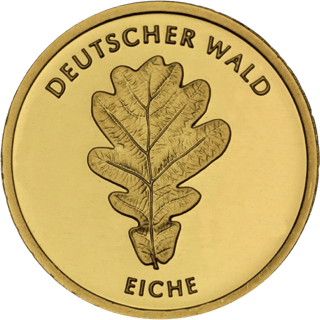
Each coin bears a single leaf or twig. Arched across the top is the series name, “German Forest”, and at the bottom the name of the tree.
2010
Design: Heinz Hoyer
The Federal Republic’s first 20‑euro gold coin. Its leaf is familiar from small change: the German 1‑, 2‑ and 5‑cent coins show an oak twig.
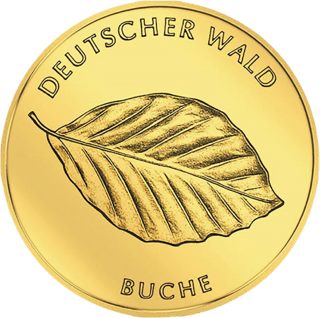
2011
Design: Frantisek Chochola
Without human intervention, the common beech would be the dominant tree on two thirds of Germany’s land area. Two days after the coin was issued, UNESCO added five ancient beech forests in Germany to its World Heritage List.
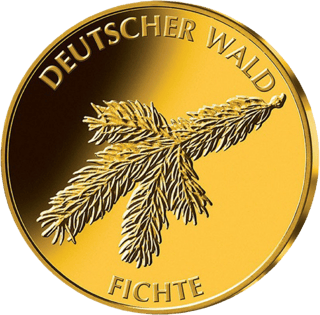
2012
Design: Frantisek Chochola
When the coin was issued in 2012, the spruce was the most common tree in Germany’s forests. Storms, drought and bark beetles have since cost it a great deal of ground, and today it is in second place.
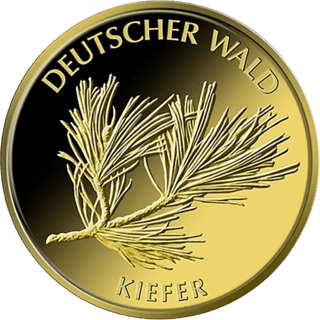
2013
Design: Frantisek Chochola
Today the most common tree in Germany’s forests, at home above all in the lowlands from Lower Saxony to Brandenburg. The coin was unveiled in Bad Freienwalde in Brandenburg.
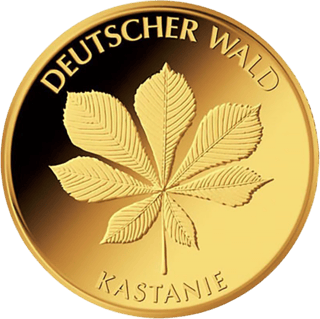
2014
Design: Heinz Hoyer
The leaf with seven fingers belongs to the horse chestnut, which originally comes from the Balkans. Brewers liked to plant it on top of their beer cellars because its large leaves kept the ground above shady and cool.
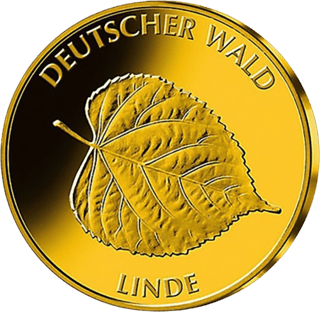
2015
Design: Frantisek Chochola
With it, the series came to an end. In the Middle Ages, justice was administered under court lindens, and linden wood is so easy to work that woodcarvers value it.
All six: 1/8 oz of fine gold (3.89 g, 999.9), 17.5 mm, brilliant uncirculated. Each year’s coin was struck in equal numbers in Berlin, Munich, Stuttgart, Karlsruhe and Hamburg, recognisable by the mint mark A, D, F, G or J.
The main tree species
Just under a third of Germany is forest. Pine, spruce, beech and oak together make up just over 70 per cent of it.
Where the word comes from
The “Sylvicultura oeconomica” by Hans Carl von Carlowitz, head of the Saxon mining authority in Freiberg, appeared in 1713. It is regarded as the first comprehensive work on forestry.
Mines and smelters in the Ore Mountains, including the silver mines around Freiberg, consumed so much wood that it grew scarce. Carlowitz therefore called for felling only as much as grows back.
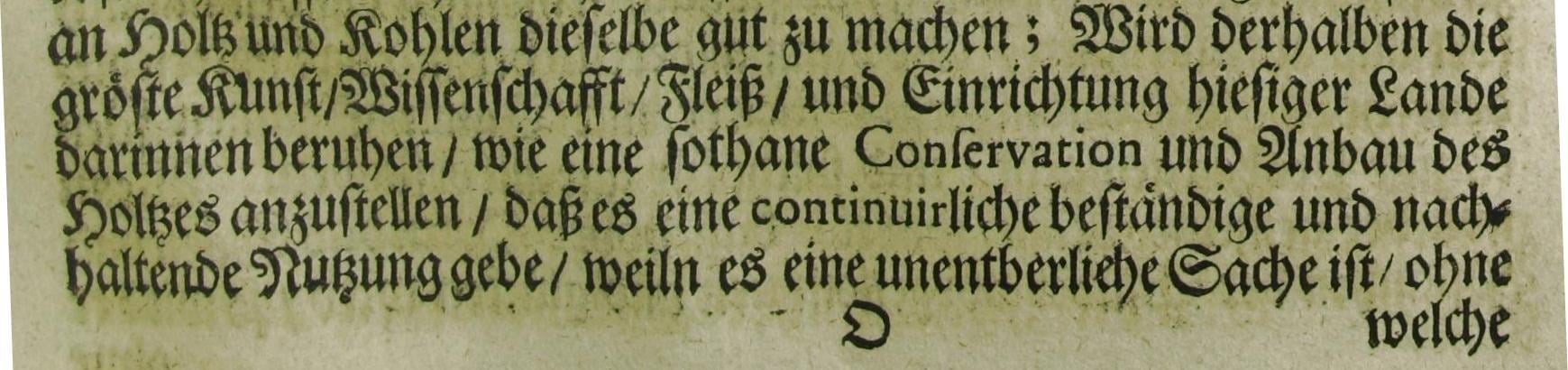
“… daß es eine continuirliche beständige und nachhaltende Nutzung gebe …”
Sylvicultura oeconomica, Leipzig 1713 (“that there be a continuous, steady and sustained use”). Digitised copy: SLUB DresdenThis sentence is regarded as the birth of a term: sustainability.
The coin series also has a mission. According to the Federal Ministry of Finance, it is meant to “help awaken and strengthen feeling and understanding for the protection of our forests”.
From 2016 to 2021, the 20‑euro gold coin showed native birds, from the nightingale to the black woodpecker.
A single oak leaf, a spruce twig, the heart-shaped leaf of the linden tree: hardly any German gold coin tells so much of a sense of home in so little space as the 20-euro gold coin “German Forest”. Between 2010 and 2015, the Federal Republic of Germany issued six editions of this series, each dedicated to a native tree species. This overview explains the history and designs of the series, the technical data of the individual coins, the role of the five German mints, as well as tax and practical questions surrounding purchase, storage and collecting.
The series marks a small milestone in German numismatics: with the Oak 2010, the Federal Republic issued its first-ever 20-euro gold coin. It was issued by the then Sales Office for Collector Coins, which today operates under the name Münze Deutschland. Over six years, this created a closed set of six designs, a collecting area with a clear beginning and end that is popular among collectors precisely because of its completeness.
Unlike pure investment bars, the series combines two worlds: it consists of pure fine gold and therefore follows the gold price, yet at the same time carries a narrative, collectible character. Anyone interested in further German gold coins will find this series a particularly accessible entry point. The idea was continued from 2016 with the thematically related series Native Birds, which carried on the concept of the 20-euro gold coin.
The essentials at a glance
All coins follow a uniform design concept that underlines the series character: the design side always shows a single, intricately detailed leaf, or in the case of conifers, a twig. Above it is the inscription “DEUTSCHER WALD”, and below it the name of the tree depicted. The rest of the surface is deliberately left blank, giving the design a calm, almost minimalist effect. The designs were created by the artists Heinz Hoyer and Frantisek Chochola.
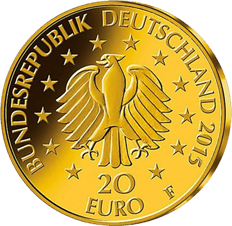
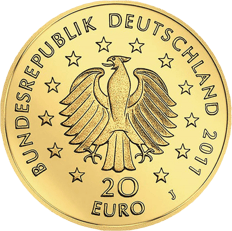
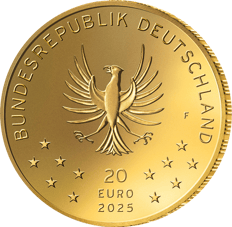
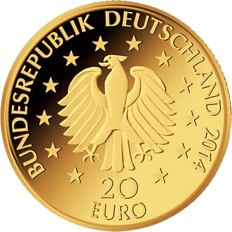
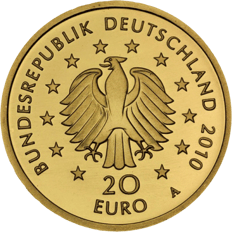
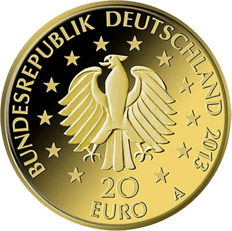
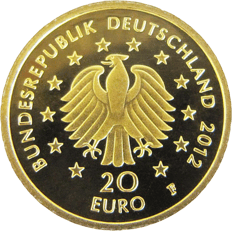
The reverse is identical across all editions. It shows the German federal eagle, framed by the twelve stars of Europe, along with the inscription “BUNDESREPUBLIK DEUTSCHLAND”, the year, the face value of 20 euros, and the respective mint mark. This consistent appearance gives the series a high degree of recognisability throughout.
A forest cast in gold: six leaves, six years, one complete story of German nature.
All six editions share the same physical properties. They consist of 999.9 fine gold and each weigh 3.89 grams, corresponding to a fine weight of 1/8 oz. The diameter is 17.5 millimetres, the thickness around 1.15 millimetres, and the edge is reeded. The coins were issued in Mint State (MS) quality.
The 1/8 oz denomination is a genuine unique selling point. Most international bullion coins, such as the Krugerrand, the Maple Leaf or the Vienna Philharmonic, rely on common fractional sizes such as 1/10, 1/4 or 1/2 oz. The 1/8 oz makes the “German Forest” series distinctive and creates a handy format in which the leaf design is shown off to good effect. Anyone who prefers classic investment gold will find an alternative entry-level size with small gold bars.
| Characteristic | Specification |
|---|---|
| Face value | 20 euros |
| Material | 999.9 fine gold |
| Weight | 3.89 g (1/8 oz) |
| Diameter | 17.5 mm |
| Thickness | approx. 1.15 mm |
| Edge | reeded |
| Strike quality | Mint State (MS) |
| Mintage per year | 200,000 pieces |
A special feature of German coins is the involvement of several mints: Germany is the only country in the eurozone that has its coins struck at multiple locations. All five state mints were involved in the “German Forest” series, with the total mintage divided equally among them. The respective mint mark on the value side reveals where a coin was produced, a detail that many collectors deliberately seek to complete.
For collectors, this system opens up an additional dimension: those who wish can not only complete the six tree species but also aim to collect every mint mark. This way, a manageable set of six quickly grows into a more extensive collection. Further coinage from traditional German houses can also be found among the gold coins of the German Empire and in the Gold Mark category.
The series enjoys a good reputation because it appeals to two types of investors at once. On the one hand, its value follows the pure gold price, so the coins are usually traded close to their material value. On the other hand, the completed, purely German issuing policy gives them a collector appeal that goes beyond their gold content. The numbered certificates of the early years add further to their charm.
Because each edition was limited to 200,000 pieces, the supply is finite: the series is not being continued and therefore cannot be “diluted” either. Specific future price developments naturally cannot be predicted, and this overview does not constitute investment advice. Those who view the series as a building block of a broader precious metals portfolio often combine it with gold bars or internationally established investment classics such as the Vreneli.
Gold coins are subject to a regulation in Germany that is attractive for investors. As investment gold, the coins of the “German Forest” series are generally exempt from VAT. Investment gold includes gold coins with a fineness of at least 900/1,000 that were minted after 1800, that were or are legal tender, and whose selling price does not significantly exceed the value of the gold they contain, criteria that this series fulfils.
Tax notice
Investment gold is exempt from VAT when purchased in Germany. If physical gold is held in private ownership for longer than one year, a subsequent sale is tax-free under current law. This information does not replace individual tax advice.
This combination of VAT exemption and potential tax exemption after the holding period makes physical gold attractive to many investors. Anyone who wants to build up their gold holdings systematically will find a structured approach in savings plan products.
Due to the small format and the high value per coin, careful handling is worthwhile. Authenticity can be assessed using several features: the exact weight of 3.89 grams, the diameter of 17.5 millimetres, the reeded edge design, and the accompanying certificate stating details of the mint. Reputable dealers verify precious metals using standardised procedures before they are offered for sale.
Gold coins should be stored with as little handling as possible and well protected. Individual coin capsules are ideal, protecting against scratches and fingerprints. For a complete series, a coin case is recommended, in which the six editions can be kept in an organised way; at the time, some sets were even supplied in a specially made wooden box crafted from German beech.
Since fine gold is a comparatively soft metal, the coins should only be touched by the edge, ideally while wearing cotton gloves. Cleaning is generally not advisable, as it can damage the surface and reduce the collector value. Further storage accessories can be found in the Accessories category.
The 20-euro “German Forest” gold coin appeals to a broad target audience. For newcomers, its small 1/8-oz format and comparatively moderate capital outlay make it an accessible way into physical gold. For collectors, its six designs and five mint marks offer an appealing, clearly defined collecting area. And anyone who appreciates German minting craftsmanship and native nature will find in it a piece of gold with added emotional value.
As an addition to an existing holding, the series sits well alongside classic gold coins from international mints. In this way, a personal holding can be built up that combines the investment aspect with collecting pleasure, from established investment classics through to this very German chapter of numismatics.
The series comprises six editions issued between 2010 and 2015: Oak (2010), Beech (2011), Spruce (2012), Pine (2013), Chestnut (2014) and Linden (2015). Each coin is dedicated to a native tree species.
Each coin weighs 3.89 grams and consists of 999.9 fine gold. This corresponds to a fine weight of 1/8 oz, a denomination that distinguishes this series from many international bullion coins.
These mint marks indicate in which of the five German state mints a coin was produced: A stands for Berlin, D for Munich, F for Stuttgart, G for Karlsruhe and J for Hamburg. Collectors often aim to acquire all mint marks.
Yes. As investment gold, the series is exempt from VAT in Germany, since it meets the legal criteria for investment gold. For an individual tax assessment, professional advice is recommended.
After the completion of the forest series in 2015, the Federal Republic continued the 20-euro gold coin from 2016 with the “Native Birds” series, which adopted the same format and nature-oriented theme.
Individual coin capsules are recommended to protect against scratches, along with a coin case for the complete series. The coins should only be handled by the edge and not cleaned, in order to preserve the surface and the collector value.
 Gold Euro German Forest
Stay informed with product launches, financial news and exclusive offers. Sign up for our free newsletter today.
By entering your email address and clicking the "Submit" button, you give the following consent: "I agree to be informed by email about new products, financial news and exclusive offers, and therefore consent to the processing of my email address for the purpose of sending the newsletter. I can revoke this consent at any time without giving reasons, with effect for the future. The lawfulness of processing carried out prior to revocation remains unaffected."