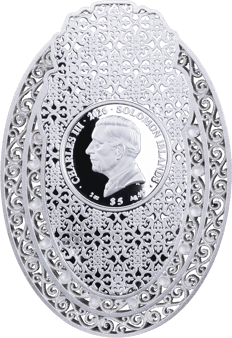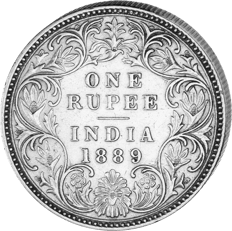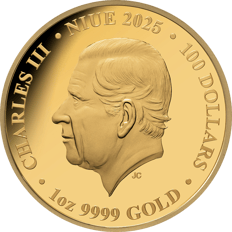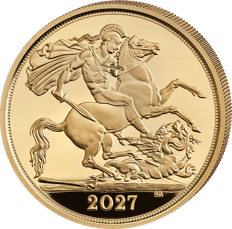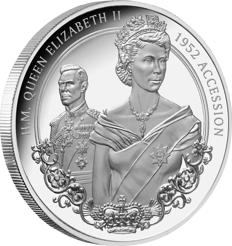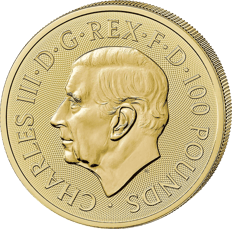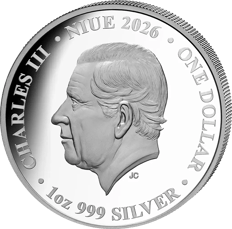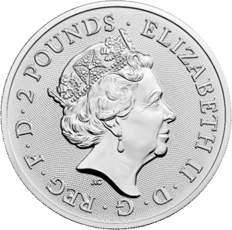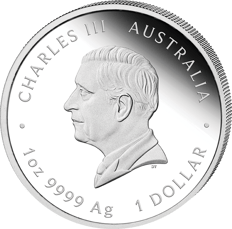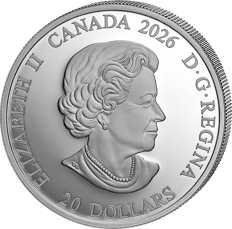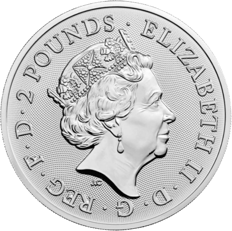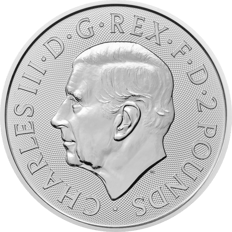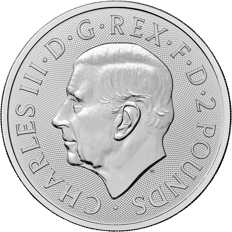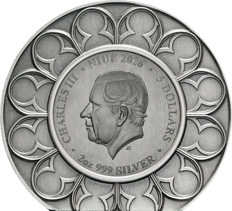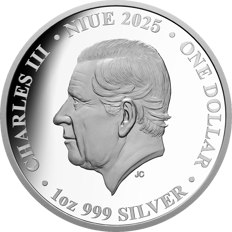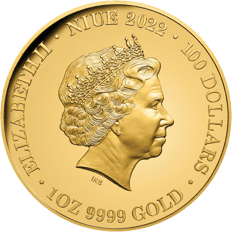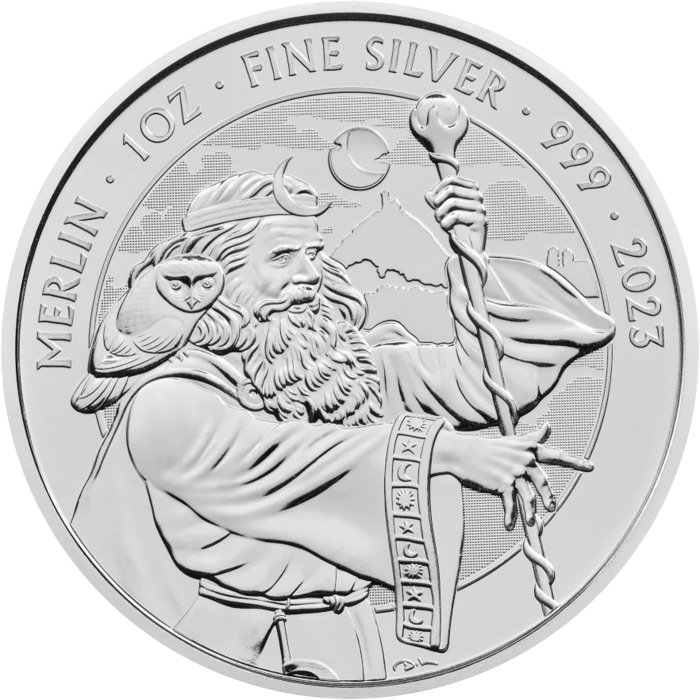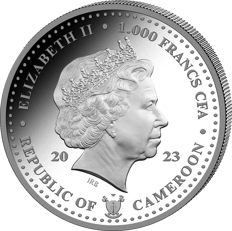
1 oz Silver King Charles III. and Camilla 2023 (Mintage 5,000)
£82.65
excl. UK import VAT and shipping
Available in 2–3 business days

 More than 300,000
 Over 30 years
 Secure shipping
 Google: 4.9/5
The global influence has led to the British head of state being omnipresent in the precious metals sector. However, the English language is also widely spoken, and this ensures that there is still great interest in British history today. But the country also continually produces new icons and defining figures who conquer the world in no time at all, which is why the term British cult has also taken hold.


Each of these five figures begins with a few lines and grows with every new text: a forest changes, a role is rewritten, a second grave appears, doubters get an answer, three voices come together in one name. Each chapter shows one such step and, at the end, the coin from the Royal Mint’s “Myths and Legends” series.
Robin Hood
Robin Hood appears in many old texts, but not always in the same forest. Ballads, songs that tell a story, and chronicles, histories ordered by year, place him now in Sherwood, now in Barnsdale, once also in Inglewood, and some name no forest at all. According to the Robin Hood Project of the Robbins Library, the name Barnsdale comes up far more often before 1500; by the 17th century Sherwood seems to have moved to the front, the forest most people link with Robin Hood today.
Schematic, not to scale
Time wanders too: Wyntoun places Robin Hood under the year 1283, Walter Bower, around 1440, in the year 1266, and John Major, in 1521, in the last years of the 12th century.
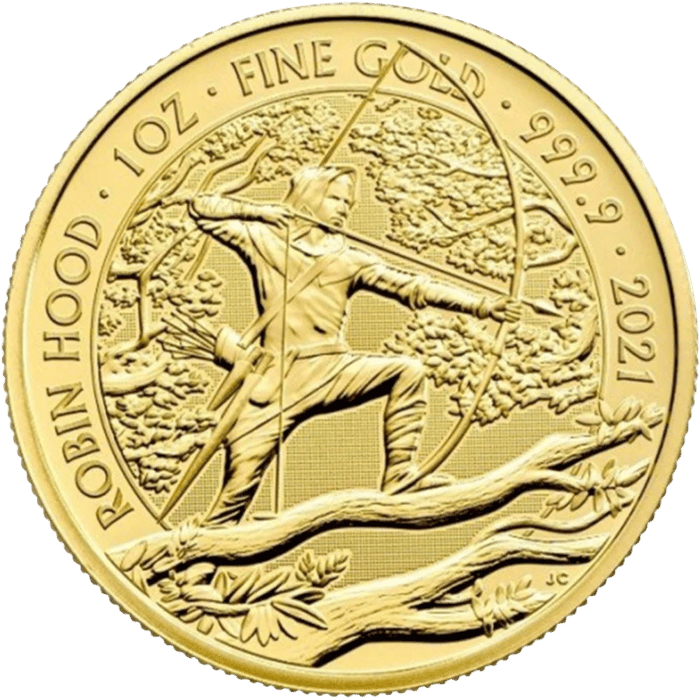
On the picture side Robin Hood stands with a bow in the forest, among branches and leaves: a forest without a name.
Maid Marian
Marian does not appear in the early ballads about Robin. French pastourelles, songs about a shepherdess, know a Marion instead; if she has a partner, he is called Robin. Around 1283 Adam de la Halle makes this into the play with songs Robin et Marion, and his Robin is a peasant, not an outlaw. In England, records from Kingston of 1509/10 name Marian for the first time, at a Robin Hood play. After that, stage and poetry rewrite her role again and again.
it may be her complexity takes her back before the early outlaw ballads to the medieval French pastourelle tradition.
Stephen Knight in the Robin Hood Project
Characters
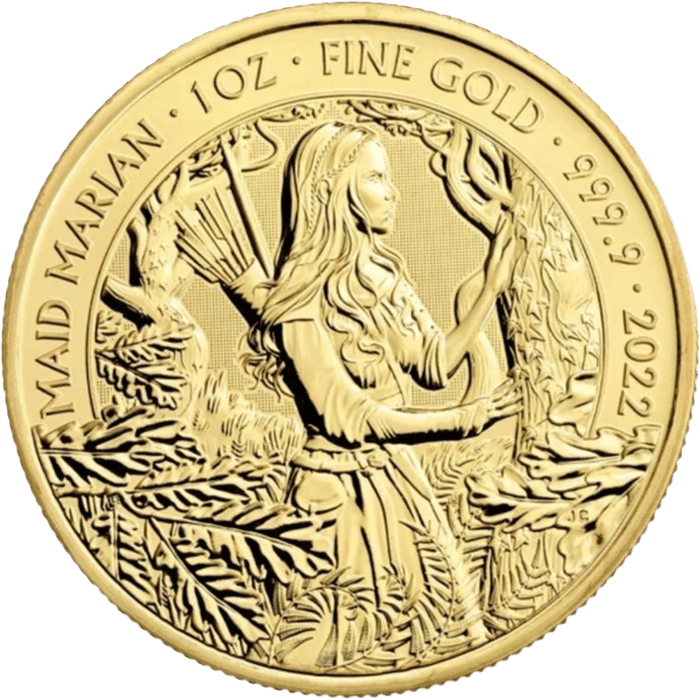
On the picture side Marian stands with long hair among branches, ferns in front. Which of her roles she plays, the picture leaves open.
Little John
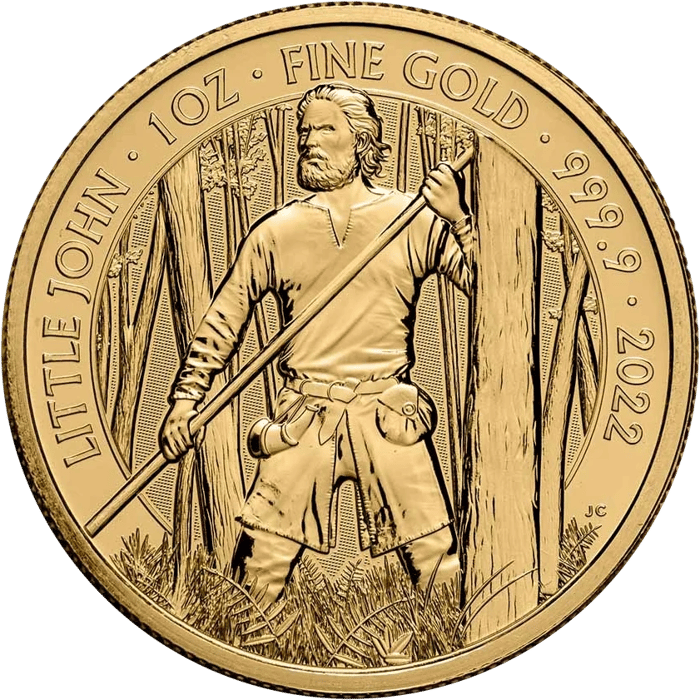
With Little John, two things grow over the years: his name and his grave. Andrew of Wyntoun already writes the name around 1420; an explanation comes from a ballad whose text is traced back to the years 1680 to 1685. A Scottish print from around 1536 to 1540 lays his bones at Pette; in the 17th century the antiquary Roger Dodsworth notes a grave at Hathersage in Derbyshire. The Victorian headstone there calls him the friend and lieutenant of Robin Hood.
HERE LIES BURIEDLITTLE JOHNTHE FRIEND ANDLIEUTENANTOF ROBIN HOOD
First sentence of the inscription on the Victorian headstone at Hathersage, wording after the Derbyshire Historic Environment Record.
The record It calls it a “so-called” grave.
On the picture side Little John stands in the forest, among tall tree trunks and grass.
King Arthur
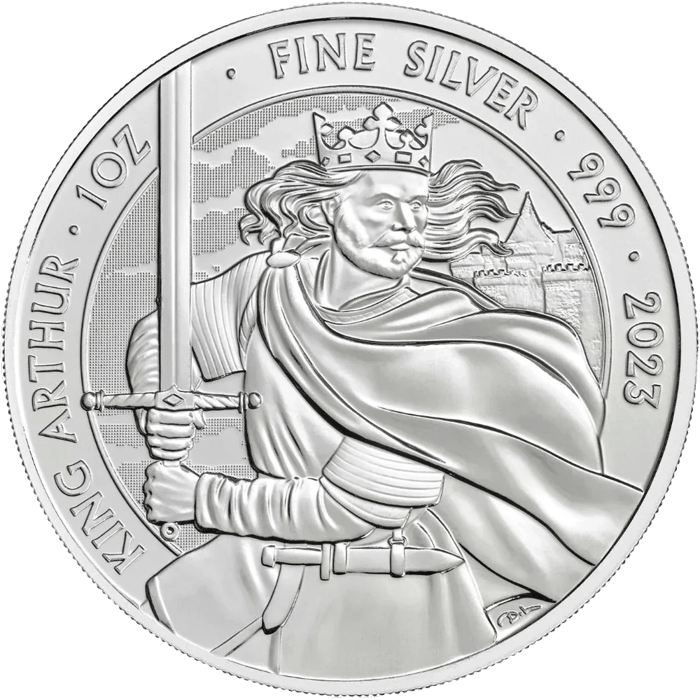
With King Arthur, the legend grows as texts cite one another. Geoffrey of Monmouth tells of him in his Latin history of Britain, which existed by 1138. In 1485 William Caxton prints Thomas Malory’s book Le Morte Darthur, and in his preface the gentlemen who urge him to print it answer doubts with witnesses.
Geoffrey of Monmouth
cites the very old book
Names as his source a “librum vetustissimum” (roughly: very old book) which, he says, Walter, Archdeacon of Oxford, had given him.
The very old book
No trace of such a manuscript has been found, and most readers, then as now, doubt that the book existed.
William of Newburgh
rejects Geoffrey of Monmouth
“let this fabler, with his fictions, be instantly rejected by all”
William Caxton, preface
names Galfridus as a witness
Caxton objects to the gentlemen: “divers men hold opinion that there was no such Arthur”. One of them names witnesses:
The manuscript from Winchester
perhaps lay in Caxton’s workshop
A copy of Malory’s text; according to the British Library it “differs significantly from the printed edition”. On four pages, offsets of printer’s ink can be seen.
The circle closes: in the preface to the print, one witness is a Galfridus, in the usual reading the author whom Newburgh had rejected.
On the picture side King Arthur stands in a wide cloak, his hair in the wind, a tower behind him.
Merlin
Merlin grows together from three voices. In the Historia Brittonum of Nennius, from the 9th century, a boy named Ambrosius foretells the future. Welsh poems tell of Myrddin, a seer. And by 1135 prophecies of Merlin by Geoffrey of Monmouth are in circulation. In Geoffrey’s history of Britain the figure is called Merlin Ambrosius and does not meet Arthur; only later tales have Merlin take part in Arthur’s upbringing.
Merlin
According to Tatlock, whom the Camelot Project cites, Geoffrey reshaped the Welsh name Myrddin into Merlin.
The reverse path is possible too, from Geoffrey’s Vita Merlini to the Welsh poems; most scholars see it the other way round. William of Newburgh calls the prophecies “the mendacious predictions of one Merlin”.
On the picture side Merlin stands with a long beard, an owl on his shoulder, behind him a hill with a tower.
The Royal Mint began its series in 2021 with Robin Hood, and each figure has its own picture side in it. So the legends keep growing.
Over time, reinterpretations of these myths and legends create new narratives and meanings
The Royal Mint, “Myths and Legends”
 British Cult
Stay informed with product launches, financial news and exclusive offers. Sign up for our free newsletter today.
By entering your email address and clicking the "Submit" button, you give the following consent: "I agree to be informed by email about new products, financial news and exclusive offers, and therefore consent to the processing of my email address for the purpose of sending the newsletter. I can revoke this consent at any time without giving reasons, with effect for the future. The lawfulness of processing carried out prior to revocation remains unaffected."