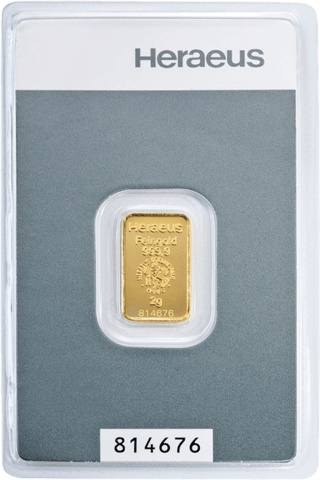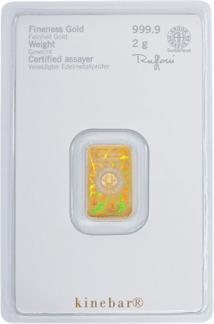
2g Kinebar® Gold Bar Heraeus
£279.55
VAT-free and plus shipping costs
Available in 4–5 business days

 More than 280,000
 Over 30 years
 Secure shipping
 Google: 4.9/5
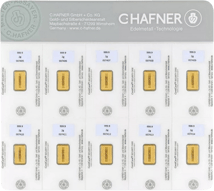
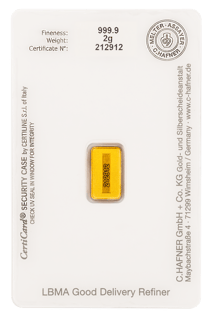
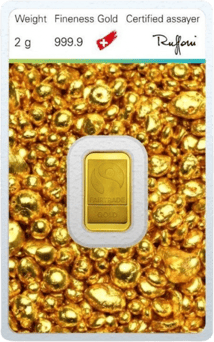
2 g gold bars can usually be purchased as so-called Kinebar, heat-sealed in a blister pack. Buying gold in small denominations is becoming increasingly relevant for investors who are also thinking about crisis protection. The smaller a piece of gold is, the easier it is to use as a means of exchange. The heat-sealed bars (also available as Fairtrade) carry an individual serial number and a certificate of authenticity. This makes it easy to resell 2 g gold bars.


The gram was laid down in Paris, in the law of 18 Germinal, Year III, which by our calendar was 7 April 1795. Article 5 reads:
“Gramme, le poids absolu d’un volume d’eau pure égal au cube de la centième partie du mètre, et à la température de la glace fondante.”
Law of 18 Germinal an III (7 April 1795), Article 5
This means the weight of pure water in a cube with edges of one centimetre, at the temperature of melting ice. The kilogram was merely its multiple: Article 7 calls it the weight of a thousand grams.
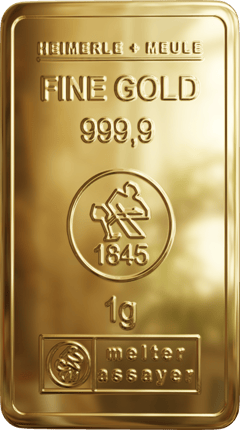
Both at the same scale. The cube shows the gram as defined by the law of 1795. Beside it is a bar of 1 gram by Heimerle + Meule, with the dimensions given by the maker.
Twenty drops of water from a standard dropper together weigh about one gram.
In Germany, the gram has applied since 1 January 1872, as laid down in the Maß‑ und Gewichtsordnung of 17 August 1868, the weights and measures act of the North German Confederation. Article 6 states: “The kilogram is divided into 1,000 grams”. And: “Half a kilogram is called the pound.”
From 1889, the measure was tied to a cylinder of platinum and iridium, the International Prototype of the Kilogram near Paris. The first General Conference on Weights and Measures resolved: “This prototype shall henceforth be considered as the unit of mass.” Germany’s copy, number 52, is kept under two glass bell jars at the Physikalisch‑Technische Bundesanstalt (PTB), the national metrology institute, in Braunschweig.
According to the PTB, the last comparisons showed that the difference between the prototype and its copies had grown to 50 micrograms, “about the same mass as the wing of a fly”. Since 20 May 2019, the kilogram has been tied to a constant of nature, the Planck constant.
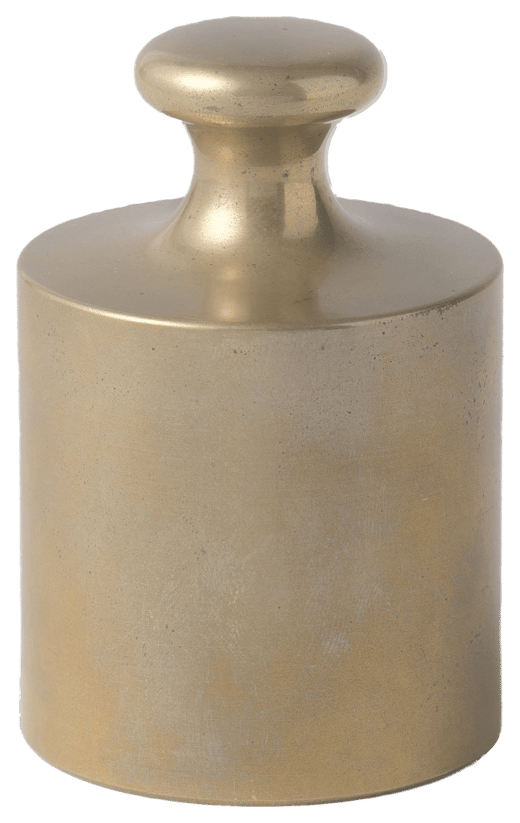
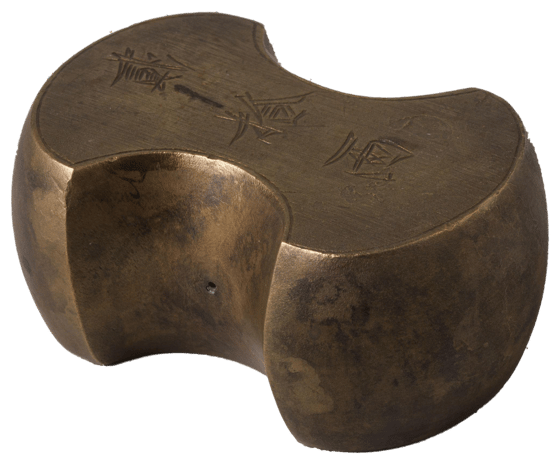
The gram is not the measure for gold everywhere. In Vietnam, people count in lượng and chỉ. A government decree laid this down in 2012: one lượng is 37.5 grams, one chỉ 3.75 grams, both only for weighing gold and silver.
In Hong Kong, the Chinese Gold and Silver Exchange Society trades gold in taels. There, one tael is 37.429 grams.
The troy ounce, in which many coins and bars are weighed, is also built from a smaller measure, the grain: 480 grains make one troy ounce, and one grain weighs 64.79891 milligrams. This is set out in Handbook 44 of NIST, the U.S. National Institute of Standards and Technology.
The values are given by Decree 86/2012 of the Vietnamese government, the Chinese Gold and Silver Exchange Society in Hong Kong and NIST. The troy ounce and the tael are rounded to two decimal places.
Gold that comes out of the ground today is usually invisible, locked away in the rock. In the second quarter of 2022, the ore processed by gold mines worldwide contained an average of 1.29 grams of gold per tonne. Metals Focus reports this in an article for the World Gold Council.
By calculation, one gram of gold is therefore contained in about 775 kilograms of ore, just over three quarters of a tonne.
Diagram: the square stands for one tonne. Only the golden dot is not to scale. At the same scale, it would be smaller than a pixel.
Ordinary rock holds far less gold still. On average, the Earth’s crust contains 0.004 grams per tonne, according to the U.S. Geological Survey. By calculation, that would be 250 tonnes for one gram.
On the Witwatersrand in South Africa, about 5.87 billion tonnes of rock were mined and milled from 1886 to 2005. On average, they yielded 8.07 grams of gold per tonne.

The Rhine carries gold too, in tiny flakes. The Federal Institute for Geosciences and Natural Resources (BGR) writes:
“In the Rhine, placer gold occurs almost exclusively in the form of the finest flakes up to 0.3 mm in diameter and 0.003‑0.005 mg in weight.”
Federal Institute for Geosciences and Natural Resources, Commodity Top News No. 30, 2009
By calculation, one gram of Rhine gold is therefore 200,000 to about 330,000 flakes.
Both at the same scale. The fine circle only shows where the flake lies. The maximum size of the flakes is given by the Federal Institute for Geosciences and Natural Resources, the dimensions of the bar by Heimerle + Meule.
In 1960, a gravel works near Bruchhausen, south of Karlsruhe, separated 21.3 grams of gold from 50,000 cubic metres of gravel. By calculation, that makes about 2,350 cubic metres of gravel for one gram.
The gold panners had a rule of thumb: for panning to be worthwhile, a shovelful of sand had to contain 10 to 20 flakes near Strasbourg and at least 40 to 50 near Mannheim. Downstream, the flakes become ever finer.
In 1874, the Karlsruhe Mint received its last Rhine gold: 89.8 grams.
How fine gold becomes a small minted bar is described step by step in the reference work Gold Bars Worldwide, based on information from the Perth Mint in Australia. For this, the gold is rolled into a strip.
Before the blanking press runs, individual trial blanks are cut from the strip with a hand press and weighed. If one is too heavy, the strip goes through the rolling mill once more.
Then a press punches the blanks out of the strip, and every single one is weighed. Blanks that are too light or clearly too heavy go back into the melt, as does the webbing left over from the strip.
The blank is struck between two dies, while a ring, the collar, holds its shape. Sometimes it takes more than one strike.
15,000bars of standard quality, at most, can be struck with one die. After about 5,000, it is usually repolished.
Diagram based on information from the Perth Mint.
Receive a free and individual precious metals offer matching your financial goals within just a few minutes.
 Request offer now
Ein 2 g Goldbarren passt in jede Hosentasche, ist kaum größer als ein Fingernagel – und trägt trotzdem echtes Feingold von 999,9er Reinheit in sich. Genau diese Kombination aus geringem Gewicht, überschaubarem Kaufpreis und maximaler Handelbarkeit macht die kleine Stückelung so beliebt: als Einstieg ins Thema Gold, als Geschenk mit bleibendem Wert und als flexibler Baustein für den privaten Krisenschutz. In den folgenden Abschnitten geht es um Herstellung, Kinebar-Technik, Preisaufbau, steuerliche Behandlung, Aufbewahrung und die häufigsten Fragen rund um den 2-Gramm-Goldbarren.
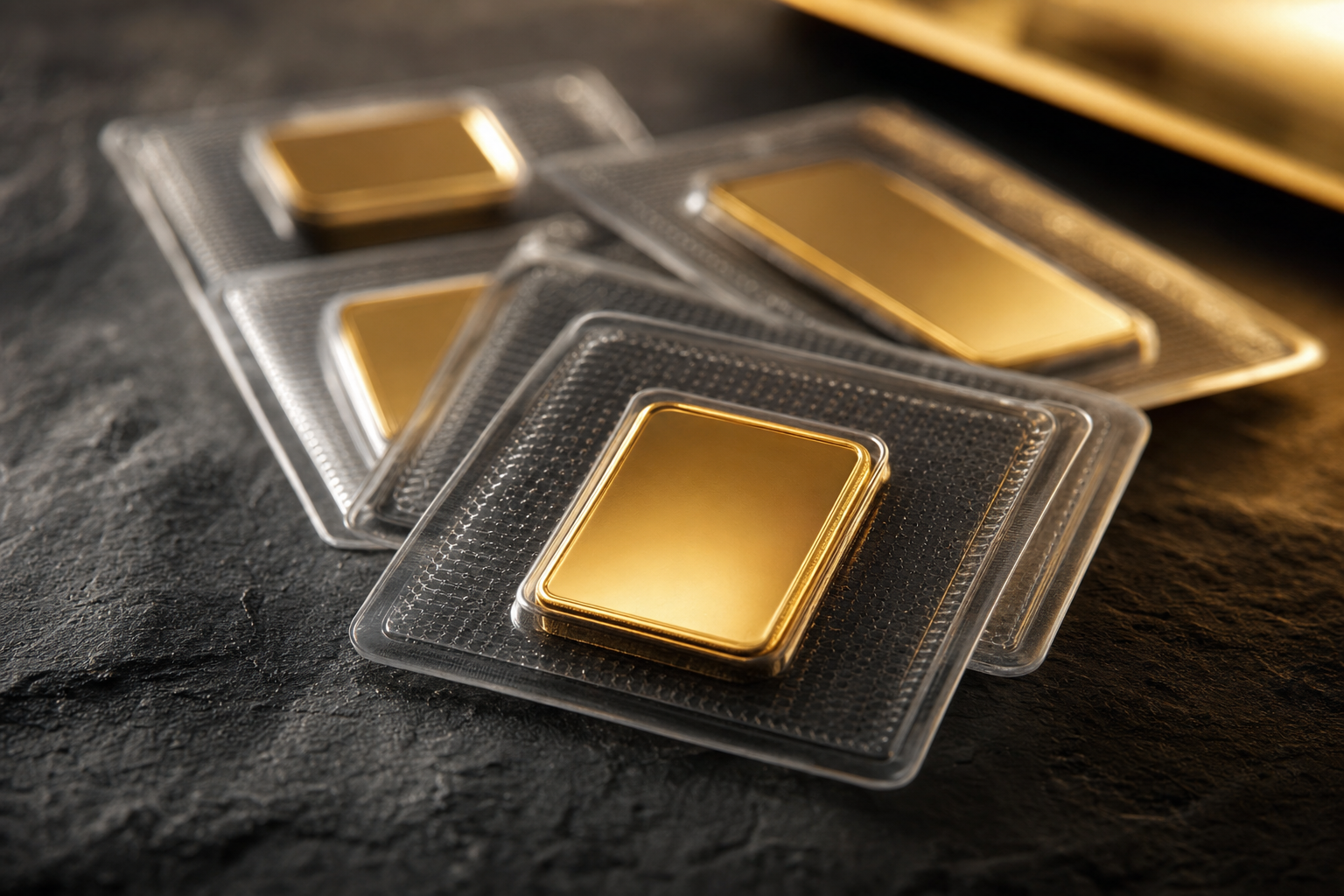
Ein 2 g Goldbarren ist ein geprägter Kleinbarren aus reinem Anlagegold mit einem Feingehalt von 999,9/1000. Innerhalb der Kategorie der Goldbarren gehört er zu den kleinsten praktisch handelbaren Formaten und bildet zusammen mit dem 1 g Goldbarren und dem 2,5 g Goldbarren das Segment des sogenannten Kleingolds. Wer sich Schritt für Schritt eine Position aufbauen möchte, greift oft zu mehreren kleinen Einheiten statt zu einem einzelnen großen Barren.
Der Reiz liegt in der Teilbarkeit: Statt einen 100-Gramm-Barren im Ganzen veräußern zu müssen, lässt sich mit vielen kleinen Barren gezielt genau die Menge Gold verkaufen, die gerade benötigt wird. Diese Flexibilität ist das zentrale Argument für die 2-Gramm-Einheit und unterscheidet sie deutlich von großen Formaten wie dem 100 g Goldbarren.
Kleine Goldbarren werden nicht gegossen, sondern aus einem gewalzten Goldblech geprägt beziehungsweise gestanzt. Bei einem Gewicht von nur zwei Gramm ließe sich ein sauberer Guss technisch kaum realisieren – die feine, gestochen scharfe Prägung mit Herstellerlogo, Gewichts- und Feingehaltsangabe entsteht deshalb unter hohem Druck im Prägewerkzeug.
Diese aufwendige Fertigung erklärt, warum der Preis pro Gramm bei sehr kleinen Barren spürbar über dem reinen Goldpreis liegt. Renommierte Prägestätten wie Heraeus, C. Hafner und Argor Heraeus versehen ihre Barren mit einer eigenen Signatur, die im Fachhandel weltweit anerkannt ist.
Eine Besonderheit im Kleingold-Segment ist der Kinebar: Auf der Rückseite trägt er ein feines Kinegramm – ein bewegliches Hologramm, das sich beim Kippen des Barrens verändert. Dieses optische Sicherheitsmerkmal ist mit einfachen Mitteln praktisch nicht zu fälschen und macht den Barren auf einen Blick als echt erkennbar. Kinebarren werden fest im transparenten Blister versiegelt geliefert, sodass Hologramm und Prägung geschützt bleiben.
Der überwiegende Teil der 2-Gramm-Barren wird eingeschweißt im Blister ausgeliefert. Diese versiegelte Verpackung erfüllt gleich mehrere Funktionen: Sie schützt das weiche Feingold vor Kratzern, hält den Barren sauber und bewahrt zugleich die Zertifizierung. Viele Barren tragen eine individuelle Seriennummer, die auf einem beiliegenden Echtheitszertifikat vermerkt ist.
Seriennummer plus Zertifikat erleichtern den späteren Wiederverkauf erheblich, weil sich Herkunft und Echtheit lückenlos nachvollziehen lassen. Wer die Versiegelung intakt lässt, erhält sich diesen Vorteil dauerhaft. Zur Echtheitsprüfung dienen typischerweise folgende Merkmale:
Bei kleinen Stückelungen macht der Herstellungsaufwand einen größeren Anteil am Endpreis aus als bei schweren Barren. Das bedeutet: Der Aufschlag über den Materialwert ist bei einem 2-Gramm-Barren prozentual höher als etwa bei einem 50 g Goldbarren oder einem 1 kg Goldbarren. Diesen Mehrpreis erkauft man sich bewusst mit maximaler Flexibilität.
Gerade in unsicheren Zeiten zeigt sich der Vorteil kleiner Einheiten: Ein Barren mit geringem Wert lässt sich leichter weitergeben oder eintauschen als ein hochpreisiges Stück, für das nicht jeder Gegenüber die passende Summe aufbringen kann. Kleingold gilt daher als praktischer Baustein für den Inflationsschutz und die private Vorsorge.
Nicht die Größe eines Barrens entscheidet über seinen Nutzen, sondern wie gut er sich im Ernstfall wieder zu Geld machen lässt.
Wer regelmäßig kleine Mengen ansparen möchte, findet in den Sparplan-Produkten eine bequeme Alternative zum wiederholten Einzelkauf – das Prinzip bleibt dasselbe: Vermögen in kleinen, gut handelbaren Portionen aufbauen.
Ein wesentlicher Vorteil aller Goldbarren betrifft die Umsatzsteuer. Anlagegold ist in Deutschland von der Mehrwertsteuer befreit, sofern es die gesetzlichen Kriterien an Feingehalt und Form erfüllt – der 2-Gramm-Barren aus 999,9er Gold gehört eindeutig dazu.
Steuerlicher Hinweis
Anlagegold ist gemäß den Regelungen zur Umsatzsteuerbefreiung mehrwertsteuerfrei. Gewinne aus dem Verkauf von physischem Gold können nach einer Haltedauer von mehr als einem Jahr steuerfrei bleiben. Dies ist eine allgemeine Information und ersetzt keine steuerliche Beratung.
Damit unterscheidet sich Gold deutlich von Silber, das im Regelfall der Differenzbesteuerung unterliegt. Wer die steuerlichen Rahmenbedingungen zusammen mit dem Ziel der Altersvorsorge betrachtet, findet in physischem Gold ein transparentes und gut nachvollziehbares Instrument.
So klein ein 2-Gramm-Barren ist, so leicht kann er auch verlegt werden. Für die Lagerung empfiehlt sich deshalb Ordnung und Schutz vor mechanischer Beanspruchung. Der versiegelte Blister ist bereits ein guter Grundschutz; für größere Bestände lohnt sich passendes Zubehör.
Für unterwegs oder als kompakten Notgroschen eignen sich kleine Barren besonders gut, weil sie diskret und platzsparend sind. Ergänzend lassen sich Silberbarren beimischen, um das eigene Edelmetall-Depot breiter aufzustellen.
Kaum ein anderes Geschenk verbindet ideellen und realen Wert so unmittelbar wie ein kleiner Goldbarren. Zu Geburtstagen, zur Geburt, zur Konfirmation oder als Start ins Berufsleben ist der 2-Gramm-Barren ein bleibendes Präsent, das im Gegensatz zu vielen Konsumgütern seinen Materialwert behält. Der versiegelte Blister wirkt zudem wertig und ist ohne weiteres Verpacken vorzeigbar.
Wer statt eines Barrens lieber ein Motiv verschenken möchte, findet in den Goldmünzen eine schöne Ergänzung – etwa klassische Anlageklassiker wie den Krügerrand. Der 2-Gramm-Barren punktet dagegen mit seinem klaren, sachlichen Charakter und dem günstigen Einstiegspreis.
Kleine Barren müssen aus Goldblech geprägt und einzeln verpackt werden. Dieser Fertigungs- und Verpackungsaufwand verteilt sich auf nur zwei Gramm Material und macht daher einen prozentual höheren Anteil am Endpreis aus als bei schweren Barren. Der Mehrpreis ist der Preis für die hohe Flexibilität und Handelbarkeit.
Ein Kinebar trägt auf der Rückseite ein Kinegramm, ein bewegliches Hologramm, das beim Kippen seine Erscheinung ändert. Dieses optische Sicherheitsmerkmal ist kaum zu fälschen und erlaubt eine schnelle Echtheitseinschätzung ohne technische Hilfsmittel.
Nein. Der versiegelte Blister mit Seriennummer und Echtheitszertifikat ist ein wichtiger Vertrauensanker beim Wiederverkauf. Eine ungeöffnete Verpackung erleichtert die Echtheitsprüfung und wird von Käufern in der Regel bevorzugt.
Ja. Als Anlagegold mit einem Feingehalt von 999,9/1000 ist der 2-Gramm-Barren von der Mehrwertsteuer befreit. Für die konkrete steuerliche Behandlung im Einzelfall empfiehlt sich die Rücksprache mit einem Steuerberater.
Fairtrade-zertifiziertes Gold stammt aus verantwortungsvoll arbeitenden Minen, die soziale und ökologische Standards einhalten. Es enthält dasselbe Feingold wie ein herkömmlicher Barren, verbindet die Anlage jedoch mit einem nachvollziehbaren, fairen Bezugsweg.
Er eignet sich für Einsteiger mit kleinem Budget, für alle, die Gold in gut teilbaren Portionen aufbauen wollen, sowie als hochwertiges Geschenk. Auch als kompakter Notgroschen für den privaten Krisenschutz ist die kleine Stückelung beliebt.
 2 g Goldbarren
Stay informed with product launches, financial news and exclusive offers. Sign up for our free newsletter today.
By entering your email address and clicking the "Submit" button, you give the following consent: "I agree to be informed by email about new products, financial news and exclusive offers, and therefore consent to the processing of my email address for the purpose of sending the newsletter. I can revoke this consent at any time without giving reasons, with effect for the future. The lawfulness of processing carried out prior to revocation remains unaffected."