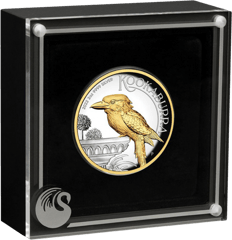
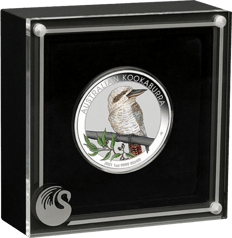
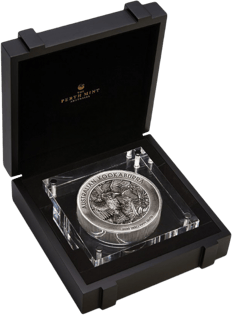
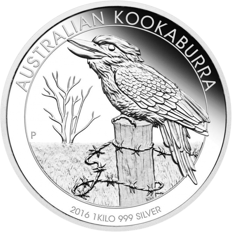
1 oz Silver Kookaburra 2026
£57.84
excl. UK import VAT and shipping
Ships from 20/11/2026

 More than 300,000
 Over 30 years
 Secure shipping
 Google: 4.9/5
The Kookaburra in silver is adorned by a famous resident of Australia. It gets its name from its partially blue upper plumage. The kingfisher is therefore depicted with changing designs on the reverse of the silver coins, which is decorated with a shiny rim. In the first year of issue in 1990, the Perth Mint produced the coin in Mint State (MS) (initially with a mintage of 500,000 pieces). We also carry the Kookaburra as a 1/10 ounce in gold.


Few bullion coins combine sober investment appeal and lively collecting pleasure as charmingly as the Kookaburra. Since 1990, the Australian Perth Mint has minted this silver coin featuring the design of the laughing kingfisher, and because the design changes year after year, pure investment silver becomes a small series to collect. This guide covers the history, denominations, fineness, special editions, mintages, premium and tax treatment of the Kookaburra silver coin.

The coin's name derives from the kookaburra, the Aboriginal Australian term for the native kingfisher (family Alcedinidae). Its distinctive call, reminiscent of human laughter, earned the largest member of the species the German name Lachender Hans. The bird grows up to 45 centimetres in length and lives in the forests and open bushland of Australia. Characteristic features include its pointed, straight beak and its upper plumage, which shimmers slightly bluish in places.
The Perth Mint has made this lively animal the face of one of its best-known coins. Anyone with a passion for Australian animal designs will find related classics in our range, such as the Silver Koala or the Silver Kangaroo, all produced by the Perth Mint or the Royal Australian Mint respectively.
The story begins in 1990, when the Perth Mint issued the first one-ounce Kookaburra, at the time with a face value of 5 Australian dollars. Larger formats were added as early as 1991, and in 1992 the mint reduced the face value of the one-ounce coin to 1 AUD. This made the Kookaburra the first Australian silver bullion coin with an annually changing design, laying the foundation for a principle that later shaped other Australian series as well.
Over the decades, the Kookaburra established itself alongside classics such as the Canadian Maple Leaf, the British Britannia or the American Silver Eagle. What sets it apart from these is the combination of solid investment appeal and a design that is newly created every year, a small piece of design tradition that keeps the series alive to this day. For the 35th anniversary in 2025, the Perth Mint honoured the series' long history with specially designed editions.
While the Maple Leaf has shown the same maple leaf for decades, the Perth Mint redesigns the Kookaburra every year: sometimes a single bird on a branch, sometimes a pair, sometimes a scene with chicks in the nest. For pure silver investment, this is of little consequence, as the silver value remains the same. For collectors, however, a particular appeal arises: older vintages with a low mintage or a particularly sought-after design can command a premium above the pure material value over the years. There is, however, no guarantee of this.
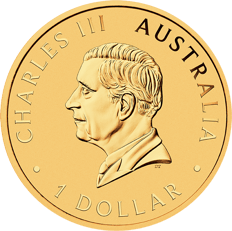
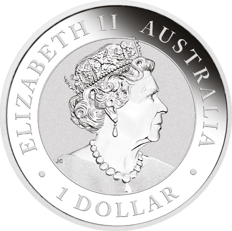
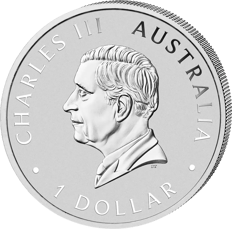
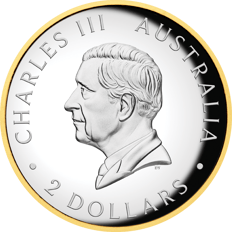
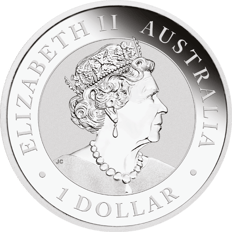
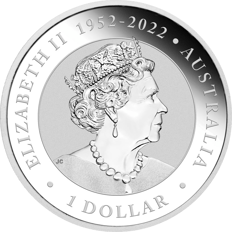
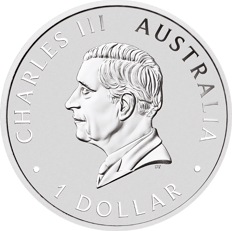
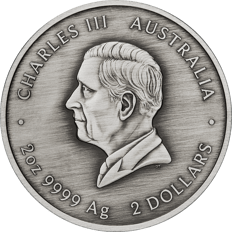
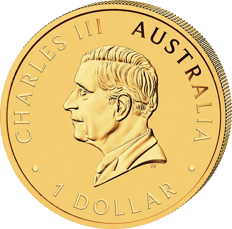
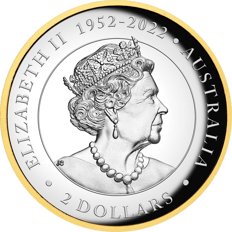
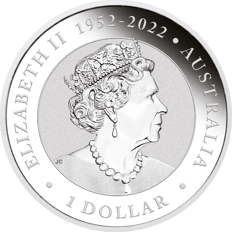
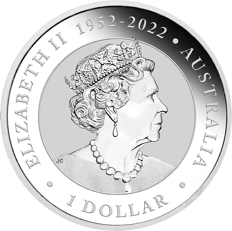
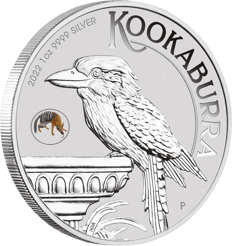
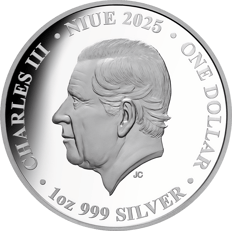
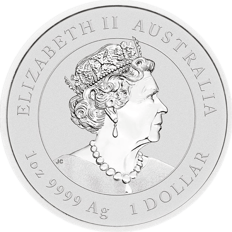
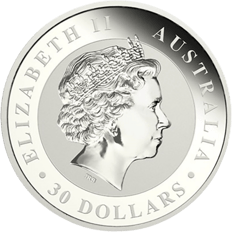
The design side always shows one or more kookaburras in their natural environment, surrounded by the inscription The Australian Kookaburra, the fine weight and the year of issue. The value side long followed the classic pattern of Commonwealth coins: until 2022 it bore the portrait of Queen Elizabeth II, and since the 2023 issue it has shown the likeness of King Charles III. This makes the Kookaburra, at the same time, a small historical record of recent British-Australian history.
The standard coin is made of pure fine silver and, in its most common variant, weighs one troy ounce (31.1035 grams) with a diameter of around 40.6 millimetres. In the first few decades, the fineness was 999; since the 2018 issue, the Perth Mint has minted the Kookaburra in 999.9 fine silver. All sizes feature a reeded edge as a classic security feature.
The series covers an unusually wide range of weights, from the handy one-ounce coin to the massive one-kilogram coin:
| Size | Fine weight | Diameter | Face value (from 1992) | Minted since |
|---|---|---|---|---|
| 1 oz | 31.10 g | 40.6 mm | 1 AUD | 1990 |
| 2 oz | 62.20 g | 53.3 mm | 2 AUD | 1991 |
| 10 oz | 311.0 g | 75.5 mm | 10 AUD | 1991 |
| 1 kilogram | 1,000 g | 101.0 mm | 30 AUD | 1991 |
Each denomination has its own character:
The 2 oz variant was last issued as a regular edition in 2009, while the one-ounce, 10-ounce and kilogram coins continue to appear regularly to this day. Collectors who build the series across different sizes often combine it with other Perth Mint issues such as the Lunar series.
Fineness over time
Older vintages up to 2017 carry a fineness of 999; from 2018 onwards the Perth Mint raised it to 999.9. For the pure silver content, the difference is minimal, but it is a useful detail for the exact description of a particular vintage.
In addition to the standard coin, the Perth Mint regularly issues special editions aimed primarily at collectors. Two of these have established themselves as firm favourites and are especially sought after among enthusiasts.
For the World Money Fair in Berlin, the world's largest coin fair, a colour-enhanced variant of the Kookaburra is regularly released in a particularly limited quantity. The colouring highlights the design and makes the coin an eye-catcher. Such editions are produced in small mintages; their price lies well above the pure silver value. Anyone specifically looking for colour-enhanced coins will find more in our range of coloured silver coins.
At coin fairs such as the ANDA in Australia, the Perth Mint releases versions with an additional privy mark, a small additional mintmark, while the main design of the vintage stays the same. These hidden marks denote their own, usually low mintage and make it possible to strike a design again even when the regular mintage has already been exhausted. In the past, native animals, among other things, have served as privy marks. The surcharge reflects the rarity, not the material value. Such coins are thematically close to classic collector's coins.
The mintage of the Kookaburra varies considerably from year to year. In the early years, the mintage of the one-ounce coin was usually between 80,000 and 300,000 pieces. Since 2011, the Perth Mint has often capped the mintage of the one-ounce coin at 500,000 pieces per year, a level that was indeed reached in several years. Once the maximum is reached, the vintage is considered sold out, and older issues can gain value on the collector's market.
Within the broad range of silver coins, the Kookaburra is therefore one of the series where it is particularly worthwhile to look closely at the individual vintage.

The most important term when buying any silver coin is the premium, the surcharge above the pure material value that covers minting, distribution and trading margin. For silver, this is proportionally higher than for gold, partly due to the tax treatment: while investment gold is exempt from VAT in Germany, silver coins are subject to VAT.
Because the Kookaburra is minted outside the European Union, many denominations can be traded under the margin scheme. Under this scheme, VAT is charged only on the difference between the purchase and selling price, not on the full value of the goods, a model that can noticeably reduce the final price compared to standard taxation.
What is worth paying attention to when buying a Kookaburra:
This overview is of a general nature and does not constitute investment advice. Those wishing to buy regularly will find suitable building blocks among our savings plan products.
Silver reacts more sensitively to environmental influences than gold and can tarnish if stored unfavourably. For preserving the value of a Kookaburra, particularly for collector qualities in Mint State or Proof, protection against moisture, fingerprints and scratches is crucial. Snugly fitting coin capsules, which keep the coin stored without any contact, have proven effective.
Anyone wishing to organise a larger collection can turn to coin cases or coin tubes, which bundle several ounces in a space-saving way. This keeps changing vintages neatly sorted and visually protected, a factor not to be underestimated if older issues are to be resold at some point.
The Kookaburra is made of pure fine silver. Older vintages were minted in 999 fineness (99.9 percent), and since the 2018 vintage in 999.9. The standard coin weighs one troy ounce (31.1035 grams); there are also formats of 2 ounces, 10 ounces and one kilogram.
The Perth Mint has issued the one-ounce Kookaburra since 1990, with the larger denominations added from 1991. This makes the series one of the long-established silver bullion coins.
The Perth Mint redesigns the Kookaburra motif every year. For pure investment purposes, this is of no consequence, as the silver value remains the same. For collectors, however, this creates an incentive, since individual vintages and designs can be in different demand.
The coloured WMF edition is released for the World Money Fair in Berlin in a small mintage, while the ANDA versions carry an additional privy mark. Both are collector editions with a significantly higher premium than the regular coin.
Silver coins are subject to VAT in Germany, while investment gold is exempt. In addition, the relative minting cost is higher when the material value is lower. Both factors increase the percentage premium compared to gold.
That depends on the goal. Standard coins from current vintages are suitable for silver investment based on material value. Coloured and privy-mark editions are collector's items whose value depends more heavily on demand and rarity. An increase in value is not guaranteed in any case.
 Kookaburra
Stay informed with product launches, financial news and exclusive offers. Sign up for our free newsletter today.
By entering your email address and clicking the "Submit" button, you give the following consent: "I agree to be informed by email about new products, financial news and exclusive offers, and therefore consent to the processing of my email address for the purpose of sending the newsletter. I can revoke this consent at any time without giving reasons, with effect for the future. The lawfulness of processing carried out prior to revocation remains unaffected."