Only 2 left to order
1 oz Gold Mexico Libertad
£4,533.17
VAT-free and excl. shipping
Available in 2–3 business days

 More than 300,000
 Over 30 years
 Secure shipping
 Google: 4.9/5
The Libertad gold coin, also known as "Onza", "Siegesgöttin", "Freiheitsgöttin" or "Victory" from the Casa de Moneda de México, is one of the most traditional coins in South America, which is increasingly gaining popularity in Europe as a bullion coin.


Few bullion coins combine mythology, history and the lustre of gold as impressively as the Mexican Gold Libertad. Struck by the oldest mint of the American double continent, it depicts the winged goddess of victory against the backdrop of two mighty volcanoes: a design that fascinates connoisseurs worldwide. As one of the oldest modern bullion coins and at the same time one of the rarest gold coins of its class, the Libertad holds a special position. This guide sheds light on its history, design, denominations, fineness, mintages, authenticity features and tax particulars, and explains why the Mexican Onza has long been sought after far beyond Latin America.
The Gold Libertad is a bullion coin from Mexico that has been struck since 1981 by the Casa de Moneda de México. This makes it, together with the South African Krugerrand and the Canadian Maple Leaf, one of the oldest modern investment gold coins of all. It is often simply called Onza ("ounce"), less commonly the "goddess of victory" or "goddess of liberty". Its current fineness is 999/1,000 pure gold.
One particular feature stands out immediately: the Libertad carries no stamped face value. As with the Krugerrand, its monetary value is derived solely from the current gold price, with the fine weight and fineness factored into the calculation. In Mexico, however, the coin is nonetheless recognised as legal tender. On the German market, the Gold Libertad has been more widely available since around 2007 and is increasingly popular with collectors and investors alike, not least due to its low mintages. Anyone interested in further classic coin issues will find numerous related bullion coins in the gold coins range.
The roots of the Libertad reach deep into Mexico's minting tradition. The Casa de Moneda de México is the oldest mint in North and South America: coins were already being struck there under Spanish rule from as early as 1535. However, the modern Gold Libertad emerged as the direct successor to the famous Mexican gold peso coins, above all the legendary 50-peso piece, which was struck until 1972 and ranked among the most widely traded gold coins in the world.
When the Krugerrand ushered in the era of the modern bullion coin in 1967, Mexico followed suit in 1981 with the Libertad. The first generation still had a fineness of 900/1,000, alloyed with silver, and a comparatively coarse strike. A milestone followed in 1991: the fineness was raised to 999/1,000. In 1996, the mint fundamentally revised the design and format: since then, the Libertad has retained the appearance that still defines it today.
A coin that does not merely weigh gold, but tells the story of freedom of an entire nation.
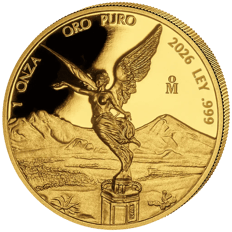
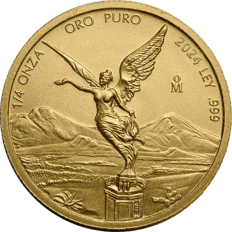
The heart of the Libertad is its extraordinary design. On the obverse sits the goddess of victory, Victoria, often equated with the goddess of liberty, Libertas, whose origins lie in Greek and Roman mythology. The depiction is modelled on the famous monument El Ángel de la Independencia in Mexico City, a symbol of Mexico's struggle for independence. With outstretched wings and a raised arm, the figure appears as though she is about to rise from her column into the sky.
In the background rise the two legendary volcanoes Popocatépetl and Iztaccíhuatl, two of the highest mountains in the Americas. The expansive steppe landscape in front of them gives the design spatial depth. Around the edge are the inscription ORO PURO (fine gold), the weight indication such as 1 ONZA, the respective year of minting, and the fineness indication LEY .999.
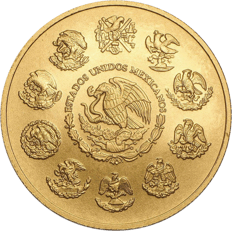
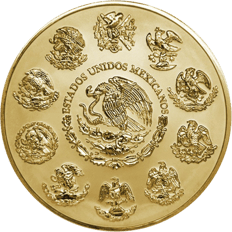
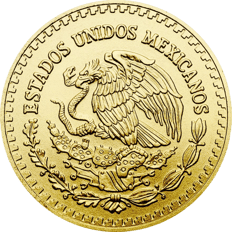
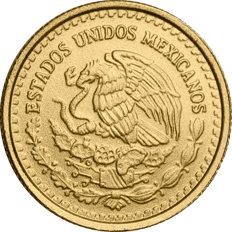
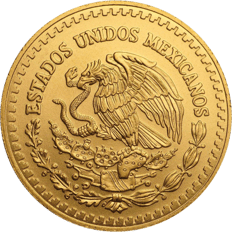
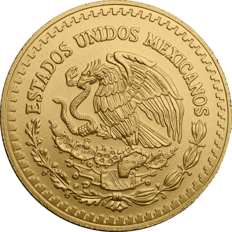
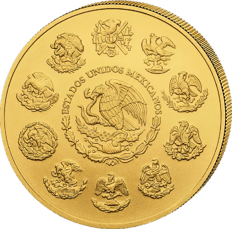
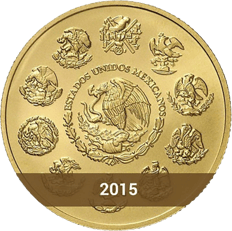
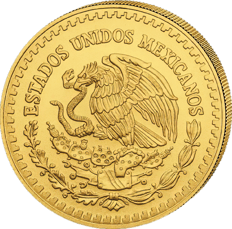
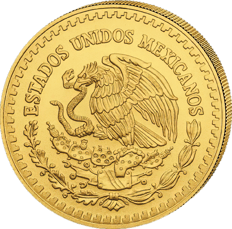
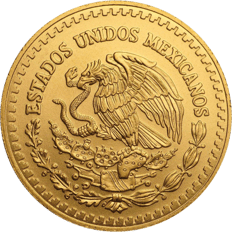
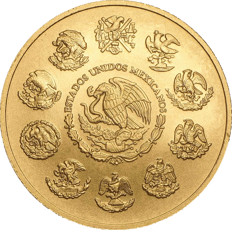
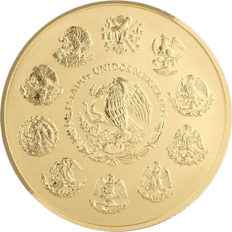
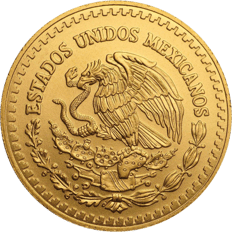
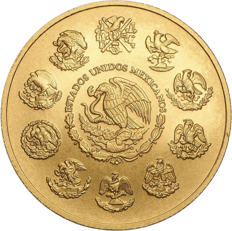
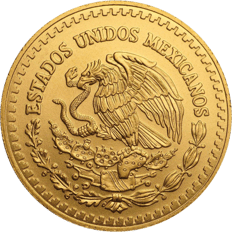
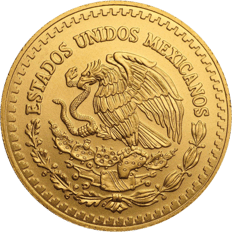
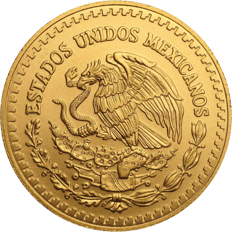
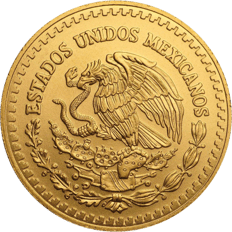
The reverse depicts the national coat of arms of Mexico: an eagle perched on a cactus, battling a serpent. This image is rooted in an Aztec legend about the founding of Tenochtitlan, today's Mexico City. The coat of arms is surrounded by the inscription ESTADOS UNIDOS MEXICANOS. Since the year 2000, coins of one ounce and above have also featured ten historical versions of the coat of arms arranged in a circle; smaller denominations omit these for reasons of space. The edge was originally smooth but has been reeded since 1990, a feature the American Eagle and other classics handle in a similar way.
The Gold Libertad is issued in a wide range of five denominations, from the compact smallest issue to the full ounce. This variety makes it attractive both for newcomers with a small budget and for experienced investors:
The 1-ounce coin of the early years still had a diameter of 36 mm and a thickness of 3.5 mm; since 1996 it has measured a flatter 40 mm. Smaller denominations are particularly suitable for building up holdings via a savings plan or as a divisible reserve. Anyone who prefers larger quantities of fine gold will find a cost-effective alternative with a lower premium in gold bars. For comparing various world coins, it is also worth taking a look at the Vienna Philharmonic from Austria.
Good to know: fineness over time
Libertad gold coins from 1981 to 1990 are made from a 900 gold alloy with a silver content. Only from 1991 onwards was the fineness raised to 999/1,000. When buying older years of issue, it is therefore worth taking a careful look at the year of minting and the fineness indication.
What sets the Gold Libertad apart from many other bullion coins is its remarkably low mintages. The 1-ounce variant of the first generation alone was struck around 596,000 times between 1981 and 1990. After that, annual mintage figures fell drastically, from a good 110,000 in 1991 to at times well under 5,000 pieces per year.
Certain years of issue are extremely rare: only around 1,000 pieces of the 1-ounce coin were struck in 1994, just 500 in 2003, a mere 300 in 2008, and around 900 in 2017. This makes the Libertad one of the rarest gold bullion coins in the world and gives it an unusually high collector potential for a bullion coin. This combination of gold value and rarity makes it an exciting addition, both for classic gold bullion coins and for the field of collector's coins.
The Gold Libertad is issued in several versions that differ in appearance and target audience:
Early Proof years such as 1983 and 1989 are particularly sought after, as the mint experimented with tiny mintage figures at the time. Such rarities are usually only available via the secondary market and clearly belong in the collector's segment, much like strictly limited issues among the limited editions. Collectors also value complete sets in an elegant wooden case that combine several denominations of a single year. A platinum version, on the other hand, was discontinued due to insufficient demand.
As with any high-quality gold coin, it is advisable to check the weight, diameter, fineness indication and reeded edge carefully when buying. Since the Libertad is struck to clearly defined dimensions, any deviations can be readily detected with precision scales and a calliper. When purchasing through an established dealer such as Kettner Edelmetalle, every coin undergoes an ISO-compliant authenticity verification, providing additional security.
Gold coins are sensitive to fingerprints and mechanical contact: with Proof issues in particular, even a scratch can reduce collector value. Suitable coin capsules, which protect the surface from environmental influences, are ideal for safe storage. For larger holdings, coin cases are a good option, keeping several coins neatly organised and protected from impact. Anyone wishing to secure their precious metal for the long term should ideally combine home storage with protection in a safe or bank safe deposit box.
A key advantage of gold coins such as the Libertad is their tax status. Investment gold is exempt from VAT in Germany and throughout the EU, provided it meets the criteria for investment gold; the Gold Libertad counts as a recognised investment gold coin in this respect.
Tax notice
In Germany, investment gold is exempt from VAT under § 25c UStG. If physical gold is held for longer than one year, any subsequent capital gain is tax-free under current law. This notice does not replace tax advice; a tax advisor should be consulted for your individual situation.
This clearly distinguishes gold from silver coins, which are usually subject to the margin scheme. For investors who wish to use gold as a building block for long-term wealth preservation and as an inflation hedge, this tax treatment is a weighty argument. Incidentally, anyone who appreciates the Mexican variant will also find the corresponding coin as the Libertad in silver.
Since 1991, the Gold Libertad has been struck with a fineness of 999/1,000. Older years from 1981 to 1990 are made from a 900 gold alloy with a silver content. When buying historical pieces, it is therefore worth checking the year of minting.
The Libertad deliberately carries no stamped face value. As with the Krugerrand, its monetary value is derived from the current gold price, taking fine weight and fineness into account. In Mexico, however, it is still recognised as legal tender.
The Gold Libertad is issued in five denominations: 1 oz, 1/2 oz, 1/4 oz, 1/10 oz and 1/20 oz. The 1-ounce coin is the most sought-after investment format, while smaller sizes are suitable for gradually building wealth.
Neither coin carries a face value. However, the Krugerrand consists of a 22-carat gold alloy with copper, while the modern Libertad is pure 999 fine gold. The Libertad is also struck in significantly lower mintages, which gives it additional collector potential.
Yes. As a recognised investment gold coin, the Gold Libertad is exempt from VAT in Germany under § 25c UStG. For questions regarding your personal tax situation, it is advisable to consult a tax advisor.
The 1-ounce years 1994 (around 1,000 pieces), 2003 (500 pieces), 2008 (300 pieces) and 2017 (900 pieces) are particularly rare. Early Proof issues from 1983 and 1989 are also considered major rarities and are usually only available via the secondary market.
 Libertad
Stay informed with product launches, financial news and exclusive offers. Sign up for our free newsletter today.
By entering your email address and clicking the "Submit" button, you give the following consent: "I agree to be informed by email about new products, financial news and exclusive offers, and therefore consent to the processing of my email address for the purpose of sending the newsletter. I can revoke this consent at any time without giving reasons, with effect for the future. The lawfulness of processing carried out prior to revocation remains unaffected."