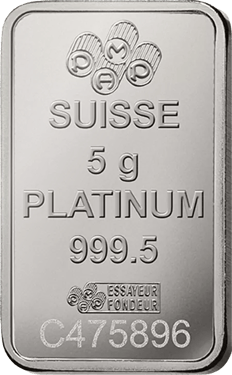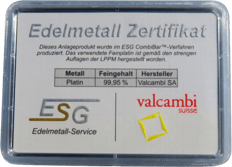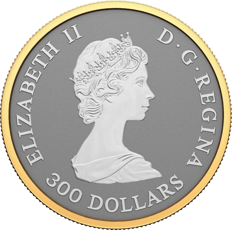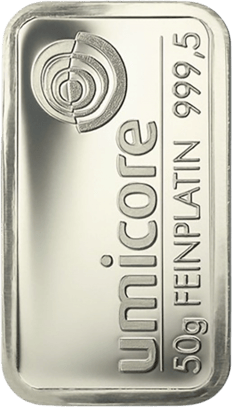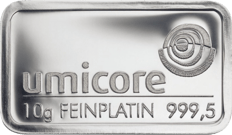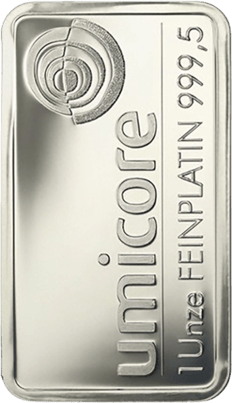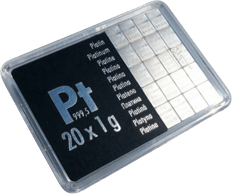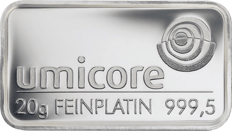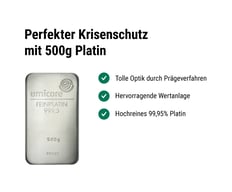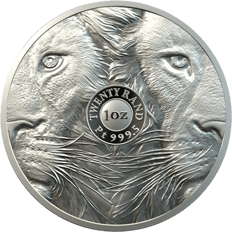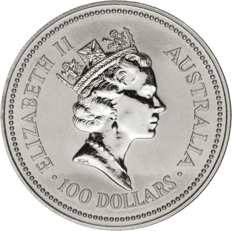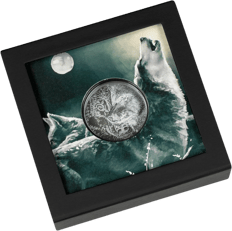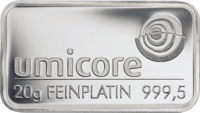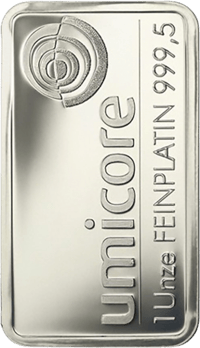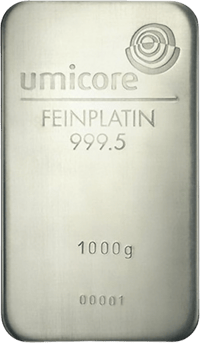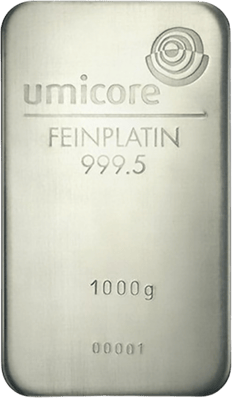
1kg Platinum Bar Umicore, Heraeus, Degussa, PAMP, UBS
£53,110.85
excl. UK import VAT and shipping
Available in 2–3 business days
 +49 7930-2699

 More than 300,000
 Over 30 years
 Secure shipping
 Google: 4.9/5
The significance of platinum coins and platinum bars is growing. For investors, platinum can be a suitable addition as a complement for diversification of their own portfolio.


Platinum and palladium are two of the six platinum-group metals. All six have “similar physical and chemical properties and tend to occur together in nature”, writes the U.S. Geological Survey.
Atomic number, symbol and name. The metal of this page is highlighted.
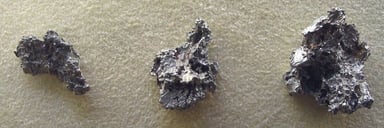
They come together in magma. When it becomes saturated with sulphur, a sulphide melt separates out, and the platinum-group metals preferentially concentrate in it. Deposits of this kind provide almost everything that is mined.
The upper crust contains, on average, half a milligram of platinum per tonne. Ores mined for platinum-group metals contain 5 to 15 grams of all six combined per tonne. Our own calculation: around 10,000 to 30,000 times as much.
Platinum ends up mainly in minerals of its own. In most rocks they are tiny: from less than a thousandth to a few tenths of a millimetre.
“Most geologists can spend a lifetime working on rocks enriched in PGEs and never see a platinum-group mineral in a hand specimen.”
U.S. Geological Survey, 2017
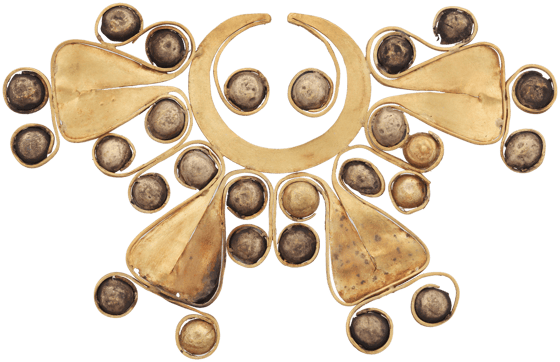
On the coast along what is now the border between Colombia and Ecuador, the La‑Tolita‑Tumaco culture knew platinum some centuries before Christ. Its goldsmiths combined it with gold: they sintered both into alloys, coated gold with platinum and plated objects with foil made of both metals. The sophistication of their metalworking was “in some cases, unique in the world”, writes David A. Scott.
Many centuries later, in 1786, Pierre François Chabaneau succeeded in producing malleable platinum in Madrid, aided by Fausto de Elhuyar. A royal decree of 1787 kept the process secret. The laboratory in Calle Hortaleza was called “Casa de la Platina”. There and in a second laboratory, 435 to 560 kilograms of platinum were produced.
The steps after the study in Mineralogical Magazine, 2020.
“the ingots, all too often cracked and sometimes even crumbled away under the hammer, all for no apparent reason”
Chaston, 1980, quoted in Mineralogical Magazine, 2020
A study from 2020 sees the cause here: the platinum still contained the other platinum-group metals.
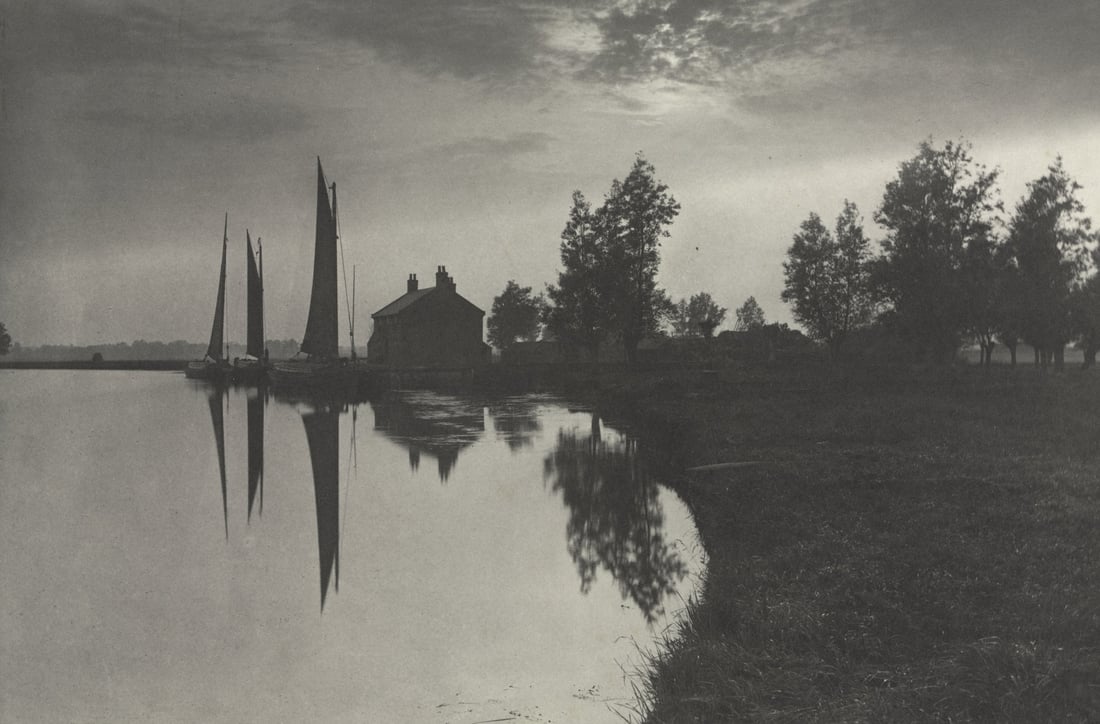
William Willis invented platinum printing in 1873. The image first forms from light-sensitive iron salts. During development, these are dissolved out and replaced by platinum, as the Victoria and Albert Museum describes it. In the end, the image consists of platinum.
The prints were prized for their wealth of subtle tonal gradations, mostly silvery greys, and for their permanence. Today, platinum printing is enjoying a return in fine-art photography.
In 1886, Peter Henry Emerson shows cargo sailing boats near Cantley in Norfolk, waiting for the turn of the tide. The print is Plate XXIV of the book “Life and Landscape on the Norfolk Broads”.
In June 1924, A. F. Lombaard panned gravel from a dry river bed on the farm Maandagshoek in South Africa. He found “a few specks of heavy white metal” and immediately suspected platinum. His concentrate was sent to Hans Merensky on 7 June; on 12 August, Merensky joined him in the field.
The most important discovery followed in the first half of September: the rock layer now known as the Merensky Reef. The reports of 1925 do not say who took the first sample, and no one recorded the exact day.
A reef like this is usually a rock layer centimetres to metres thick, extending over tens to hundreds of kilometres. The Merensky Reef can be traced throughout the eastern and western parts of the Bushveld Complex.
The complex is around 2.05 billion years old and underlies an area of around 69,000 km². According to the U.S. Geological Survey (as of 2017), 7,200 tonnes of platinum-group metals have been mined there since the 1920s.
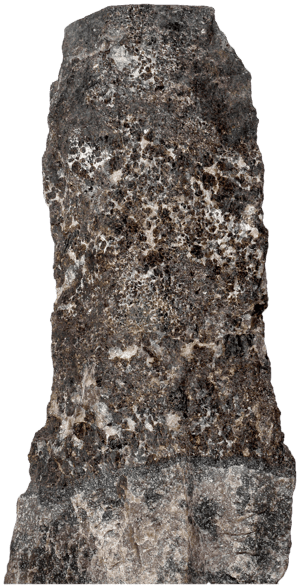
Diagram, not to scale: the band is drawn much thicker than it would be in proportion.
Six stages lie between the ore and the metal. At the refinery, the other metals are separated out first, then the six platinum-group metals from one another, until each is more than 99.99 per cent pure. They are supplied as bars, granules or a fine powder called “sponge”.
After the U.S. Geological Survey, 2017.
For wholesale trade in London and Zurich, the London Platinum and Palladium Market specifies what a bar must be like: 1 to 6 kilograms in weight, at least 999.5/1,000 fine, with edges that are not sharp.
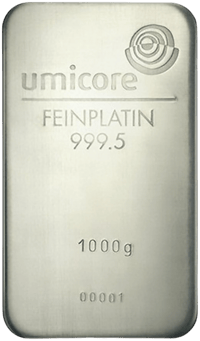
Diagram of the larger surface after the Good Delivery Rules, without real marks. Alongside it, a kilo bar from the shop.
In the ore, platinum usually occurs alongside palladium and the other four platinum-group metals; only the refinery separates them. The palladium page tells how the palladium coin of 2017 came into being.
Stay informed with product launches, financial news and exclusive offers. Sign up for our free newsletter today.
By entering your email address and clicking the "Submit" button, you give the following consent: "I agree to be informed by email about new products, financial news and exclusive offers, and therefore consent to the processing of my email address for the purpose of sending the newsletter. I can revoke this consent at any time without giving reasons, with effect for the future. The lawfulness of processing carried out prior to revocation remains unaffected."