Only 5 left to order
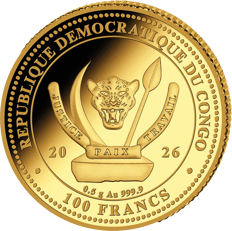
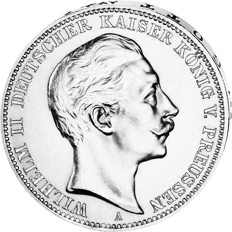
1/4 oz Gold Kaiser Wilhelm I 155 Years of the Gold Standard 2026 (Mintage: 99 | Proof)
£1,659.88£2,076.93
VAT-free and excl. shipping
Ships from 18/12/2026

 More than 300,000
 Over 30 years
 Secure shipping
 Google: 4.9/5

The actions of a few decide the lives of many! The history of humanity has been decisively shaped by a few outstanding minds. Wars, inventions and cultural achievements are largely attributed to a handful of individuals – for better or for worse. Important personalities have always been depicted on coins and remain a classic among designs.


What survives of six people is what was printed, filed for a patent, photographed or given as a lecture. Each of the five chapters shows one of these documents and at the end tells of the coin that belongs to it.
William Shakespeare, 1623
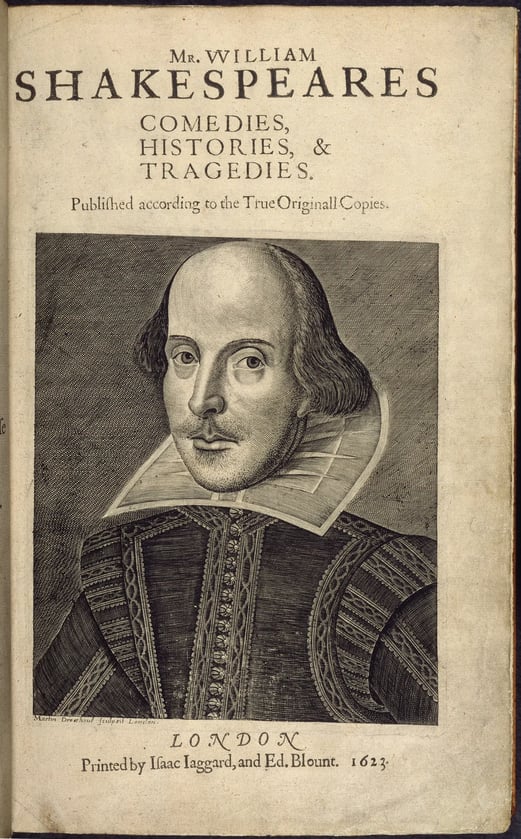
In 1623, seven years after Shakespeare’s death, the First Folio appeared in London, a book in the large folio format with 36 of his plays. It was compiled by his colleagues John Heminge and Henry Condell, actors and part owners of the acting company King’s Men. Of the 36 plays, 18 had never been printed before. His manuscripts of these plays have not survived.
Probably about 750 copies were printed; 235 are known today.
According to the Folger Shakespeare Library, accessed in October 2026.
* Troilus and Cressida stands in the book between Henry VIII and Coriolanus. According to the Folger Shakespeare Library, the play is missing from the book’s table of contents. Titles in modern spelling.
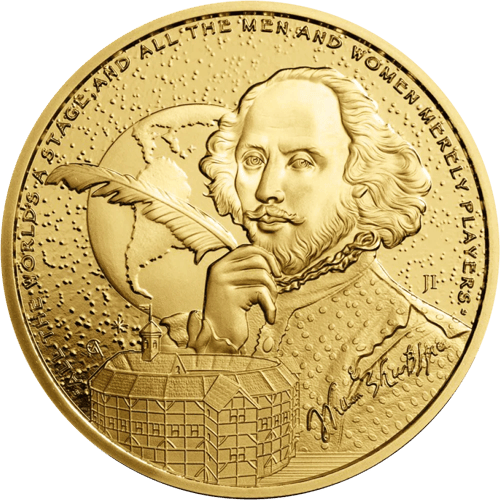
All the world’s a stage,And all the men and women merely players.
As You Like It, act 2, scene 7, spoken by the character Jaques
The lines run as an inscription around Shakespeare’s portrait on the coin. Their play had never been printed before the book; without the book they might no longer exist.
Thomas Edison, 1877 and 1878
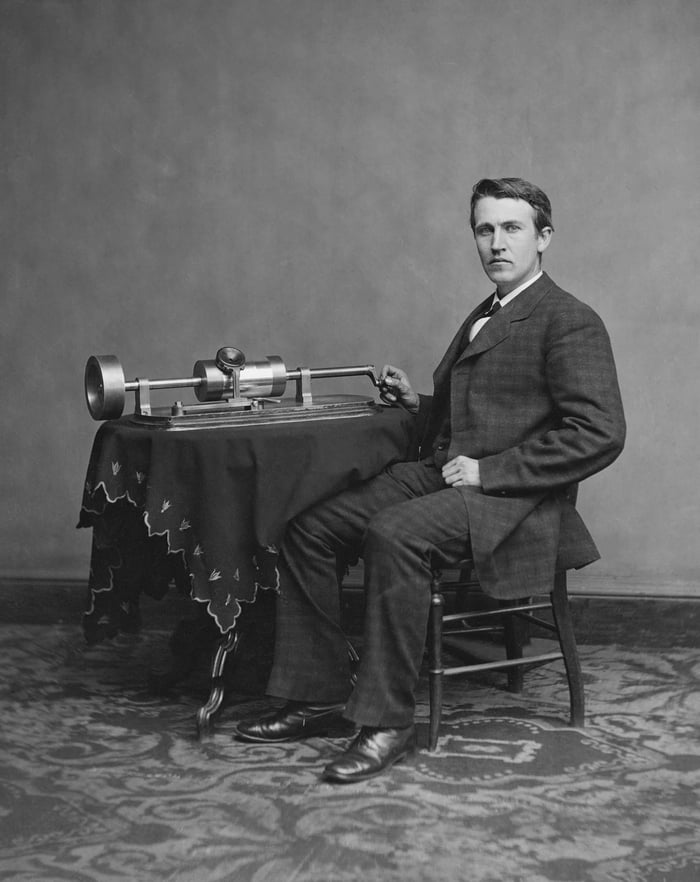
In Menlo Park, Thomas Edison made his first sound recordings in 1877. His phonograph presses the sound as a groove into a sheet of tinfoil wrapped around a cylinder, and plays it back. On 24 December 1877 Edison applied for a patent on the machine, that is, for official protection of his invention; patent No. 200,521 was granted on 19 February 1878.
Sketch, demonstration and announcement according to the Engineering and Technology History Wiki and the Thomas Edison National Historical Park; application and grant according to the head of the patent specification.
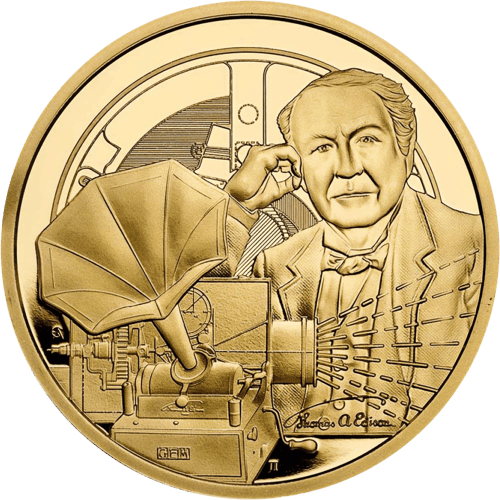
On the coin, Edison holds his hand to his ear; beside him stands a phonograph with a large horn, and behind it gears can be seen.
Orville and Wilbur Wright, 1903
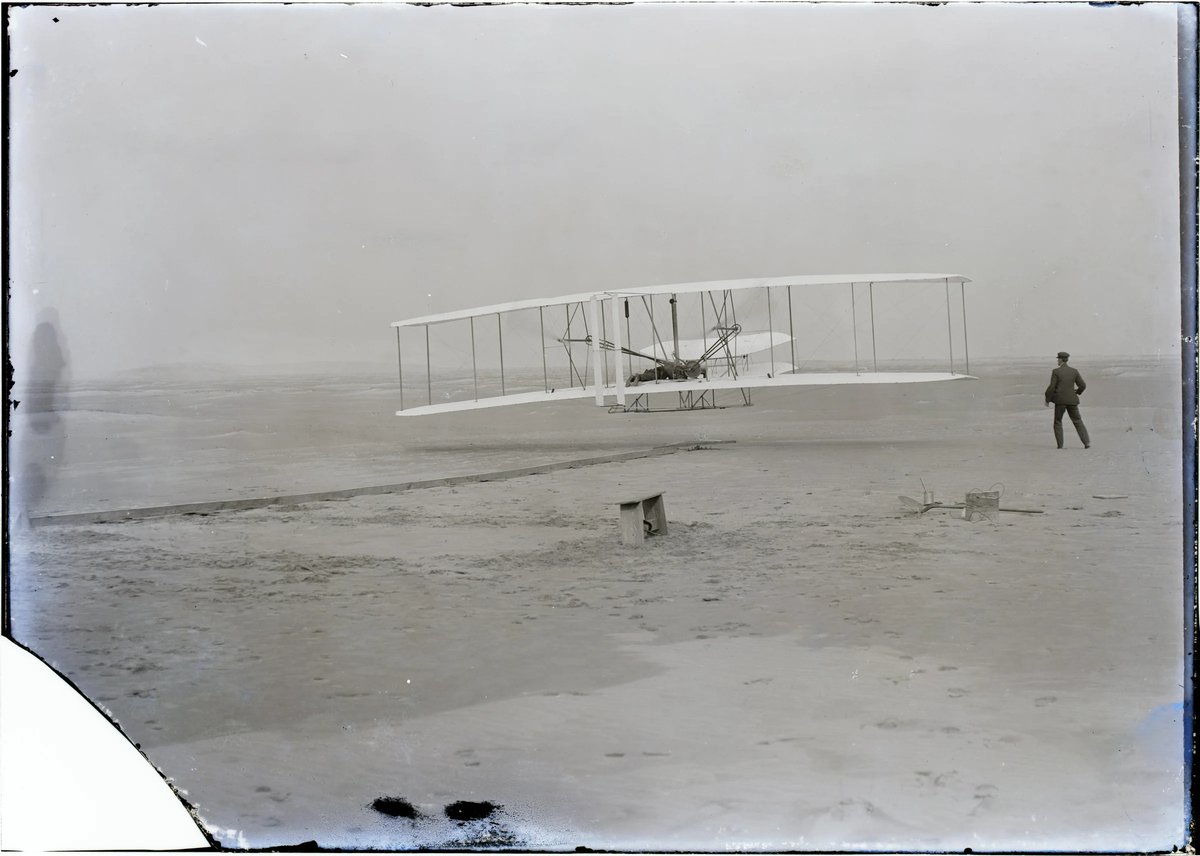
On 17 December 1903, a powered flying machine took off near Kitty Hawk. Orville Wright lay at the controls: for 12 seconds, over 36 metres. According to the Library of Congress, it was the first sustained flight, fully controlled by the pilot, of a machine heavier than air. What was new was the brothers’ control: they twisted the ends of the wings in opposite directions, so that the two ends received different amounts of lift.
Wilbur Wright piloted the fourth flight. The brothers’ telegram to their father begins with “Success four flights Thursday morning” and gives 57 seconds for the longest flight; according to the National Air and Space Museum, it was 59.
Our own calculation: distance divided by the wingspan. The distances (36 m and 255.6 m), the flight times and the wingspan according to the National Air and Space Museum.
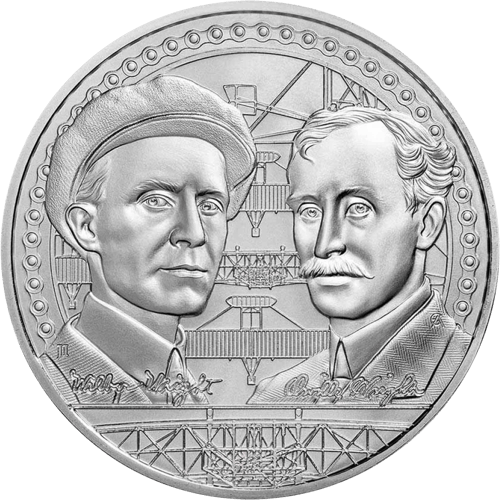
The coin shows Orville and Wilbur Wright as two portraits with their signatures, and between them a biplane seen from the front.
Albert Einstein, 1905
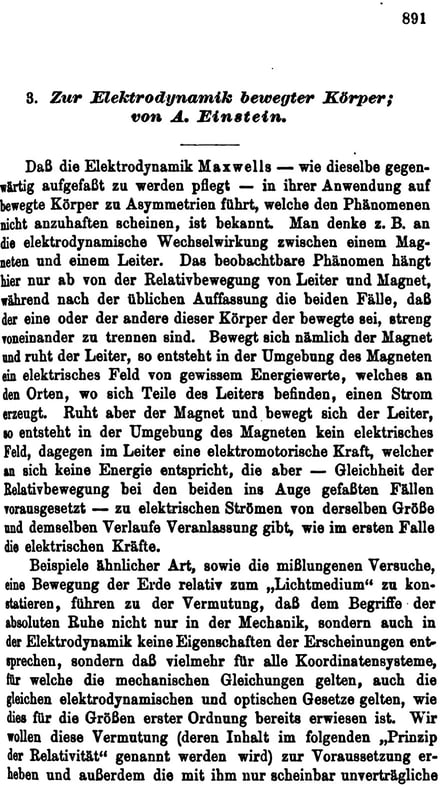
In 1905 the journal Annalen der Physik published two related papers by Albert Einstein, both dated in Bern. The first, “Zur Elektrodynamik bewegter Körper” (On the Electrodynamics of Moving Bodies), fills 31 pages. The second, “Ist die Trägheit eines Körpers von seinem Energieinhalt abhängig?” (Does the Inertia of a Body Depend on Its Energy Content?), is only three pages long.
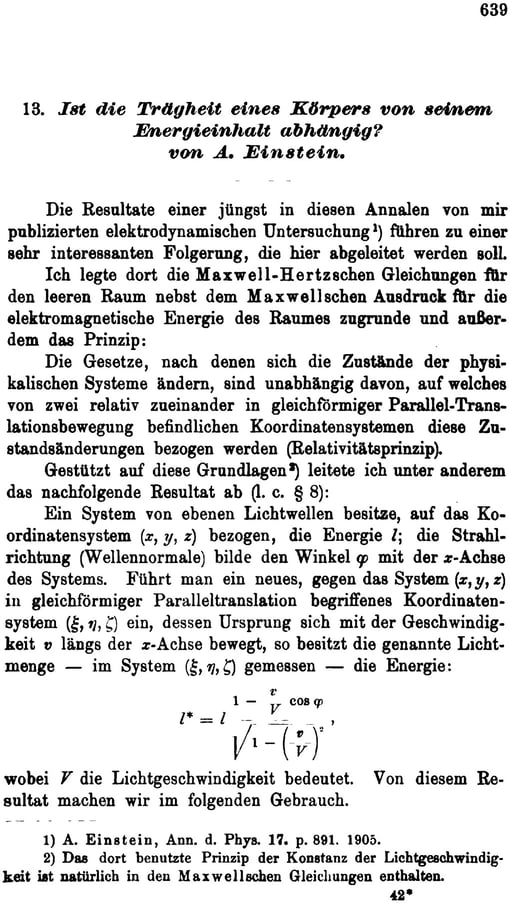
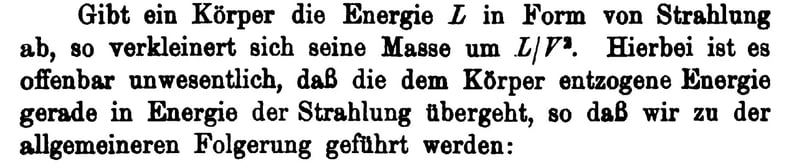
The sentence on mass and energy, in German:… so verkleinert sich seine Masse um L/V²
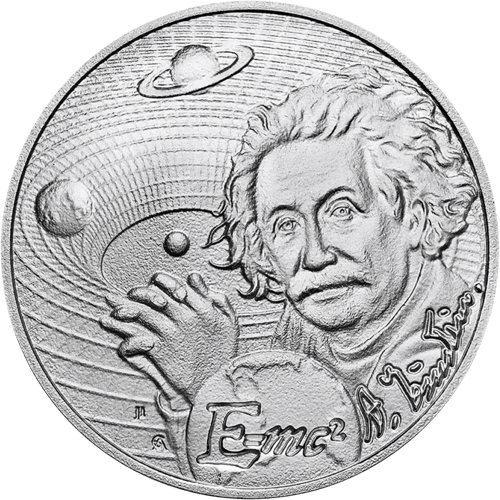
At the lower edge of the coin is E=mc²: today’s short form of the sentence on p. 641, in which Einstein still writes L and V.
At the end of the paper, Einstein names a substance on which the theory could be tested:
Es ist nicht ausgeschlossen, daß bei Körpern, deren Energieinhalt in hohem Maße veränderlich ist (z. B. bei den Radiumsalzen), eine Prüfung der Theorie gelingen wird.
It is not ruled out that with bodies whose energy content is variable to a high degree (e.g. with the salts of radium) a test of the theory will succeed.
A. Einstein, Annalen der Physik (4) 18, 1905, p. 641
Marie Curie, 1903 and 1911
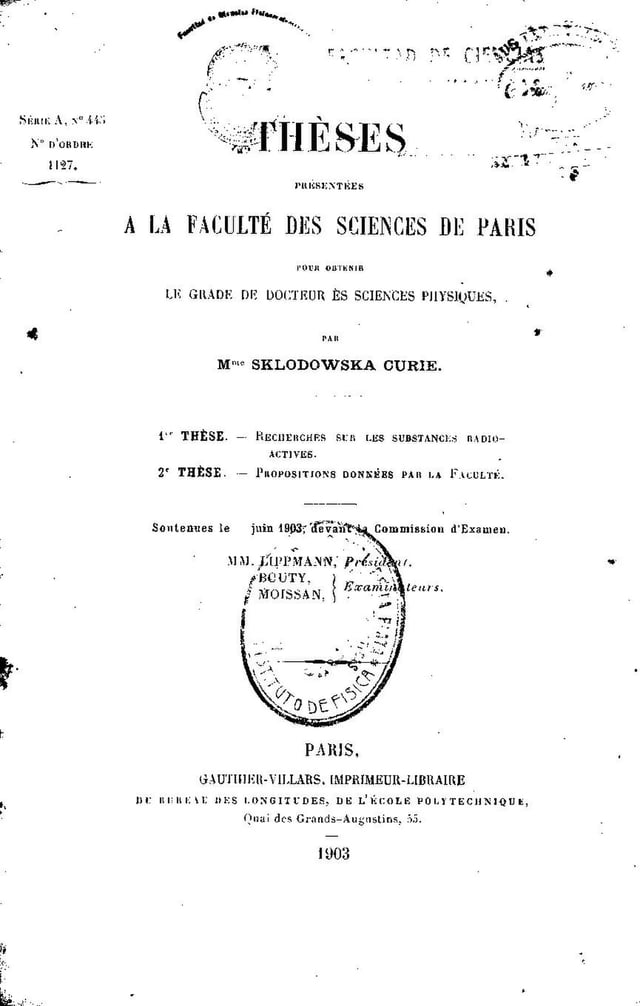
Together with Pierre Curie, Marie Curie discovered radium; in 1903 she presented her doctoral thesis on it. In her Nobel lecture on 11 December 1911 in Stockholm she gave the amounts: residues from processing uranium ore from St. Joachimsthal contain a few decigrams of radium per tonne, that is, a few tenths of a gram. She separated it in several thousand crystallisations; in this process a salt is dissolved and forms crystals again, a little purer each time. As the purity grew, so did the value she determined for the atomic weight, the measure of how heavy an atom is.
as the purity grows
Values and amounts according to the Nobel lecture of 11 December 1911; the bars start at zero, the tenths of a gram are converted from decigrams.
In 1910, together with André Debierne, she obtained radium as a metal.
On the coin, Marie Curie holds a small vial in her raised hand; beside it stands an atomic model with Ra, the symbol for radium.
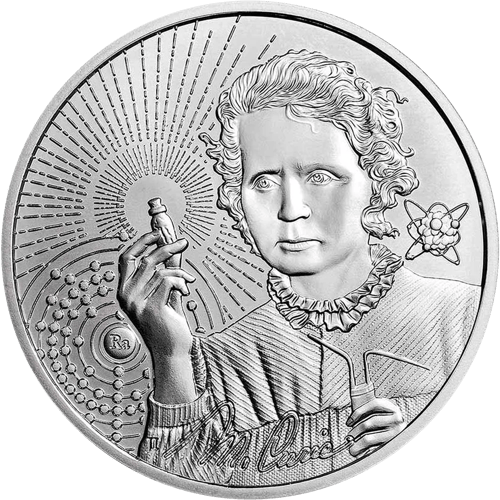
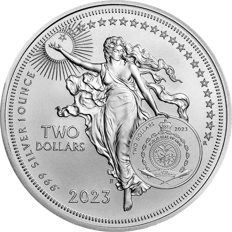
The coins of the five chapters belong to a series from Niue called “Inspiring Icons”. The picture side of each coin shows the person with tools or works and a signature, both brothers on the Wright coin; on the back, all of them carry the seal of Niue.
 Famous Figures
Stay informed with product launches, financial news and exclusive offers. Sign up for our free newsletter today.
By entering your email address and clicking the "Submit" button, you give the following consent: "I agree to be informed by email about new products, financial news and exclusive offers, and therefore consent to the processing of my email address for the purpose of sending the newsletter. I can revoke this consent at any time without giving reasons, with effect for the future. The lawfulness of processing carried out prior to revocation remains unaffected."