Only 1 left to order
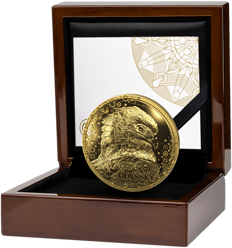
1 oz Silver Odyssey of the Sky Bateleur Eagle 2025 (Mintage: 5,000 | Proof)
£209.14£293.15
excl. UK import VAT and shipping
Available in 2–3 business days

 More than 300,000
 Over 30 years
 Secure shipping
 Google: 4.9/5
Birds are revered across all cultures. Even the ancient Greeks adorned their coins with the majestic eagle, which was interpreted as an omen of Zeus. To this day, numerous collector's coins as well as bullion coins are minted as themed coins featuring bird designs, without having lost any of their appeal.


Every feather is built from the same material, feather keratin, a protein; the variety of feathers across around 10,000 bird species comes from fine differences in their structure. Colour reaches the feather in four ways, and beyond colour, a feather dampens noise and a casque gives off heat. Each chapter shows one of these in a bird that also appears on a coin.
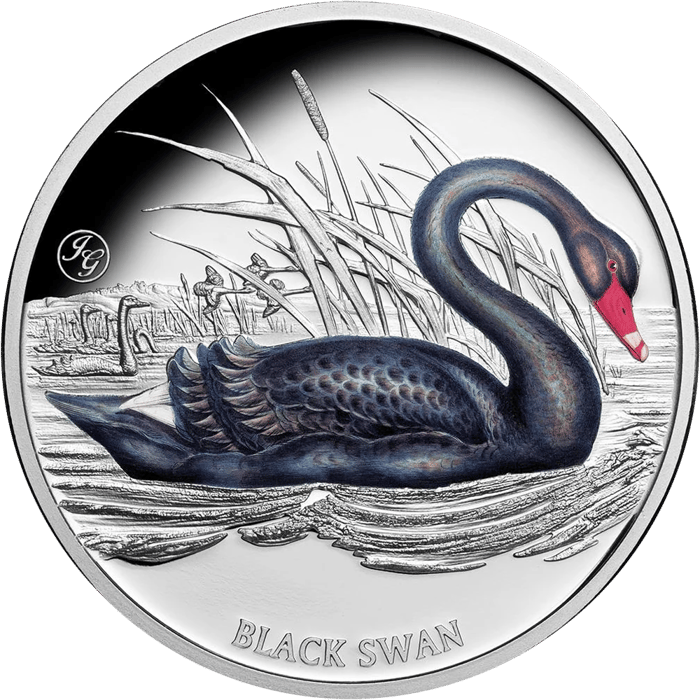
Black swan
In the adult black swan the body is almost entirely black. Only the broad white wing tips stand out, and they are visible in flight. The bill is a deep orange-red, paler at the tip, with a narrow white band. Young birds are greyer and have black wing tips; chicks are covered in grey down. For the black, a general rule applies: black, dark brown and grey come from eumelanin, a form of the pigment melanin, which sits in tiny granules called melanosomes. Birds are among the animals with the most varied colouring from melanin, especially in the plumage.
zagen veele Swaanen
Roughly: saw many swans
The passage names no colour. W. B. Alexander quotes it in 1915 and adds that in 1915 black swans were among the most conspicuous birds to be seen on the river.
white wing tips, visible in flight
bill orange-red, paler tip, narrow white band
plumage almost entirely black
Young birdblack wing tips, greyer plumage
Chickgrey down
Diagram, not to scale
On the picture side a black swan in colour is swimming: dark plumage, a red bill with a paler tip, a little white under the folded wing, reeds behind it.
Anna’s hummingbird and kingfisher
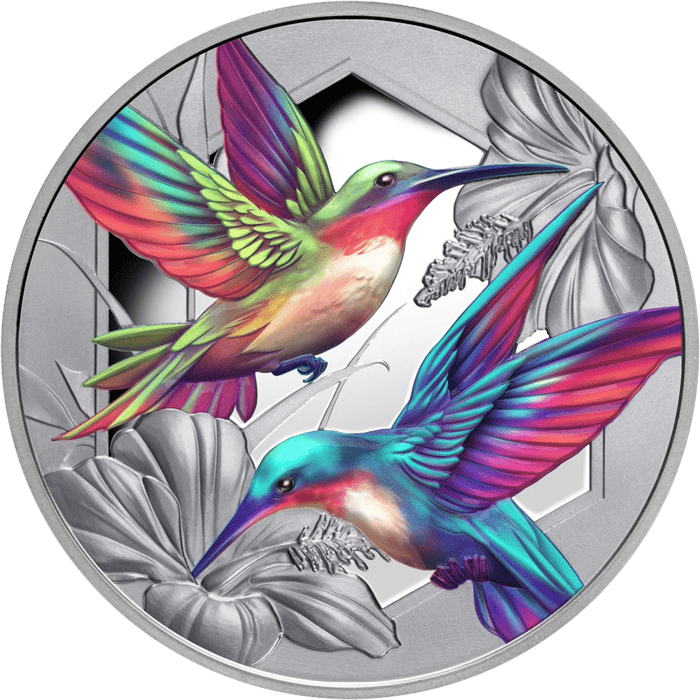
In the male Anna’s hummingbird the throat glows reddish pink. This colour comes from the structure of the feather and is called structural colour. In the barbules, the finest branches of the feather, melanosomes lie in layers, separated by keratin, the material of the feather, and reflect the light almost like a mirror. The colour changes with the angle at which the light falls. Where it shines most strongly apparently depends on the tilt of the barbules; measurements on hummingbirds of the genus Coeligena, together with a model calculation, point to this. So the same pigment that blackens plumage gives shimmering colours in thin layers.
The common kingfisher Alcedo atthis shows both ways in one bird. Its colours sit in the barbs, the branches on the shaft of the feather: the orange of the breast in small pigment granules, the turquoise of the back and the blue of the tail in sponge-like structures.
The organization of the reflectors as a Venetian blind presumably functions to create a high spectral contrast of the male’s plumage during courtship.
The barbules stay fixed; the angle changes.
at the right angle: reddish pink
from another angle: without the glow
barbule with layers of melanosomes and keratin
Diagram, not a measurement
On the picture side two hummingbirds in colour fly among blossoms.
The coin shows the colours; their cause lies in the structure of the real feather.
Flamingo and red finches
Carotenoids are yellow to red pigments that birds cannot make themselves; they have to eat them. In wild house finches during the moult, the change of plumage, a study compared the food they ate with the colour of the growing feathers: males whose food held more carotenoids got brighter plumage. This is an observation, not a feeding experiment. In the body, yellow can become red; in the red siskin, the canary and the zebra finch, one particular gene is considered a strong candidate for this, but that has not been proven. Greater flamingos also spread tinted secretion from their preen gland, a gland at the base of the tail, onto their feathers. Feathers without this care became less red in the sun, but not in the dark.
individuals need to regularly apply makeup to be more colorful.
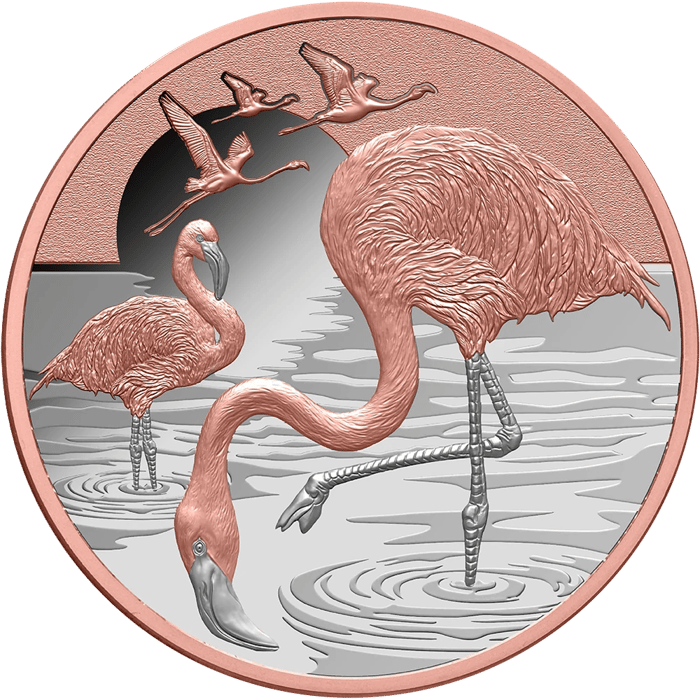
Chicks of the American flamingo are not pink. They hatch with white down and turn pink only after several years and moults.
Diagram
On the picture side flamingos stand in pink: one with its head in the water, a smaller one behind it, three in flight.
Parrots
Parrots go their own way. The red feathers of 44 parrot species from all three families held the same five psittacofulvins, the parrots’ own pigments. They were missing from the blood while the feathers grew. This indicates that parrots make them themselves at the growing feather instead of eating them.
In parrots, the predominant green color results from the combination of 2 different primary colors: yellow and blue.
Yellow is the parrots’ own pigment; blue presumably comes from the structure of the feather.
Rose-ringed parakeet, yellow formThe melanin granules are missing from the sponge-like layer of the barbs. The blue drops out; yellow remains.
Budgerigar, blue, bred in captivityA single swap of one building block in an enzyme erases the yellow; the same swap also turns lovebirds blue.
Diagram
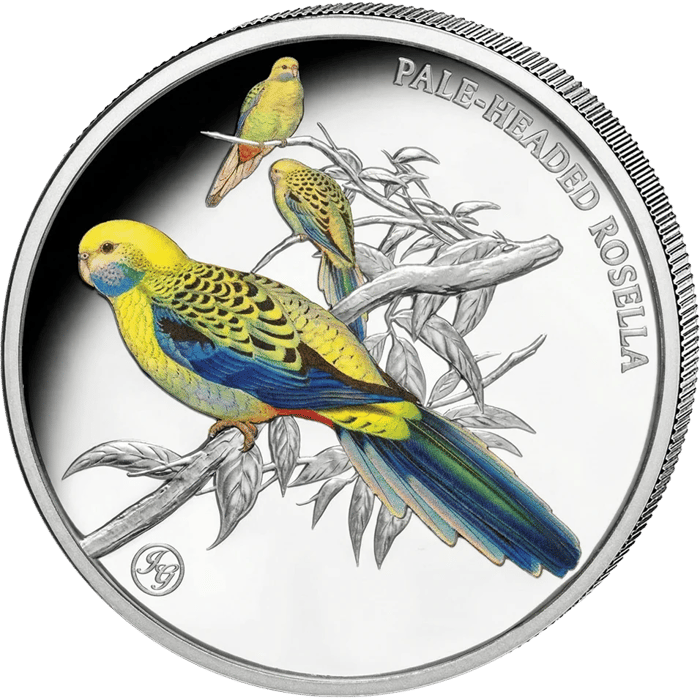
On the picture side a pale-headed rosella in colour sits on a twig: head and breast yellow, wings and tail blue, with two smaller parakeets behind it.
The coin shows the colours, not their cause.
Barn owl
The flight feathers of owls carry a velvet on their upper side: a mat of long, fine threads that rise from the barbules. In birds it arose independently at least four times. In one experiment, 96 pairs of feathers from 17 bird species were rubbed against each other. The noise covered many pitches at once, much like sandpaper or Velcro. In species with velvet the rubbing was 20.9 decibels quieter than in species without; the decibel is the measure of loudness. The results support the idea that the velvet mainly dampens the rubbing of feather against feather. What the quiet flight is for remains open; the findings so far slightly favour the idea that the owl drowns itself out less with its own flight noise.
rather than regarding owls as silent, perhaps it is bird flight that is loud.
Diagram, not a measurement
20.9 dB
quieter: species with velvet compared with species without
With hairspray, which stiffens the velvet, feathers with velvet became 7.4 dB louder, feathers without velvet only 1.7 dB.
The facial ruff, the ring of feathers around the face, helps barn owls Tyto alba locate sounds sideways and in height. In a hearing test with sounds filtered as if the ruff had been removed, they no longer distinguished front from back.
In the American barn owl the left ear opening in the skin sits higher than the right, even before hatching; the skull remains symmetrical.
Diagram, not to scale; left and right as seen from the bird
Southern cassowary and emu
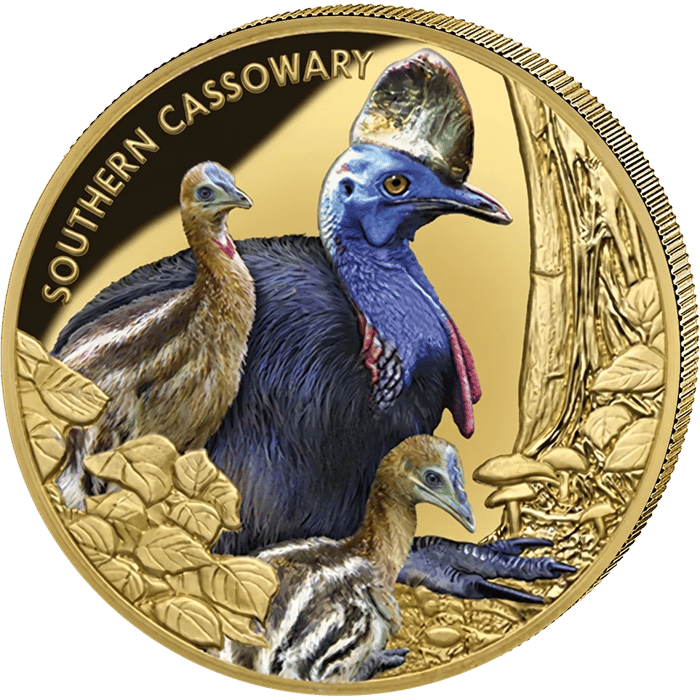
The southern cassowary carries a large, greyish structure on its head: the casque. The bare skin of the head and the front of the neck is blue, the nape red, and red wattles hang from the neck. What the casque is for is regarded as an open question. What has been measured is how it gives off heat: cassowaries are large birds with dark plumage, dark like the black swan, and in the tropical climate they have to get rid of heat. One study recorded living cassowaries with a thermal imaging camera over a wide range of air temperatures.
the casque acts as a thermal radiator, offloading heat at high temperatures and restricting heat loss at low temperatures.
casque
blue skin
wattles
nape
in cool airholds heat back
in moderate warmthwarms first at the rear
in heatgives off heat
cooler warmer
Diagram, not to scale, no temperatures
On the picture side a southern cassowary in colour stands with its casque, blue neck and red wattles; with it a brownish young bird and a striped chick.
In the southern cassowary the male takes on incubation and rearing; in the emu the male incubates alone, without drinking, eating or leaving the nest, and the young stay with him for four months. The chicks are striped: in the southern cassowary yellow and black, in the emu cream with dark brown stripes.
One material and four ways of colour: melanin, the structure of the feather, carotenoids from the food and the parrots’ own pigment. Beyond these, a feather that dampens noise and a casque that gives off heat.
similar colour phenotypes can arise through different regulatory, metabolic or structural routes.
 Birds
Stay informed with product launches, financial news and exclusive offers. Sign up for our free newsletter today.
By entering your email address and clicking the "Submit" button, you give the following consent: "I agree to be informed by email about new products, financial news and exclusive offers, and therefore consent to the processing of my email address for the purpose of sending the newsletter. I can revoke this consent at any time without giving reasons, with effect for the future. The lawfulness of processing carried out prior to revocation remains unaffected."