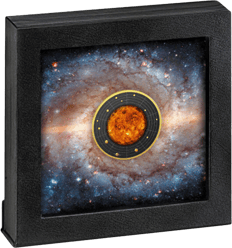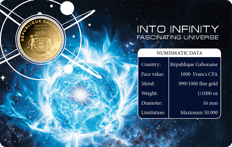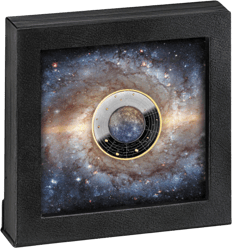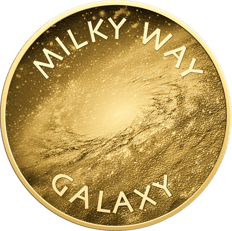
Gold Milky Way Coin
£29.08
VAT-free and excl. shipping
Available in 2–3 business days

 More than 300,000
 Over 30 years
 Secure shipping
 Google: 4.9/5


On 20 July 1969 at 20:17:39 UTC, the lunar module of Apollo 11 touched down in the Sea of Tranquility. It stayed for 21 hours and 36 minutes. The timeline shows the whole journey, hour by hour.
Launch
16 July 1969, 13:32:00 UTCMission time 0 h
Apollo 11 lifts off. This starts the mission time, which the timeline shows in hours.
Landing
20 July 1969, 20:17:39 UTCMission time 102 h 45 min 40 s
The lunar module touches down in the Sea of Tranquility, about four miles, or just over 6 km, beyond the calculated point and almost a minute and a half earlier than planned.
First step
21 July 1969, 02:56:15 UTCMission time 109 h 24 min 15 s
Neil Armstrong steps onto the Moon, and Buzz Aldrin follows about 20 minutes later. By Houston time it is still 20 July.
Liftoff
21 July 1969, 17:54:00 UTCMission time 124 h 22 min 1 s
The lunar module lifts off from the Moon, 21 hours and 36 minutes after landing.
Splashdown
24 July 1969, 16:50:35 UTCMission time 195 h 18 min 35 s
The capsule splashes down. The whole mission lasted 8 days, 3 hours, 18 minutes and 35 seconds.
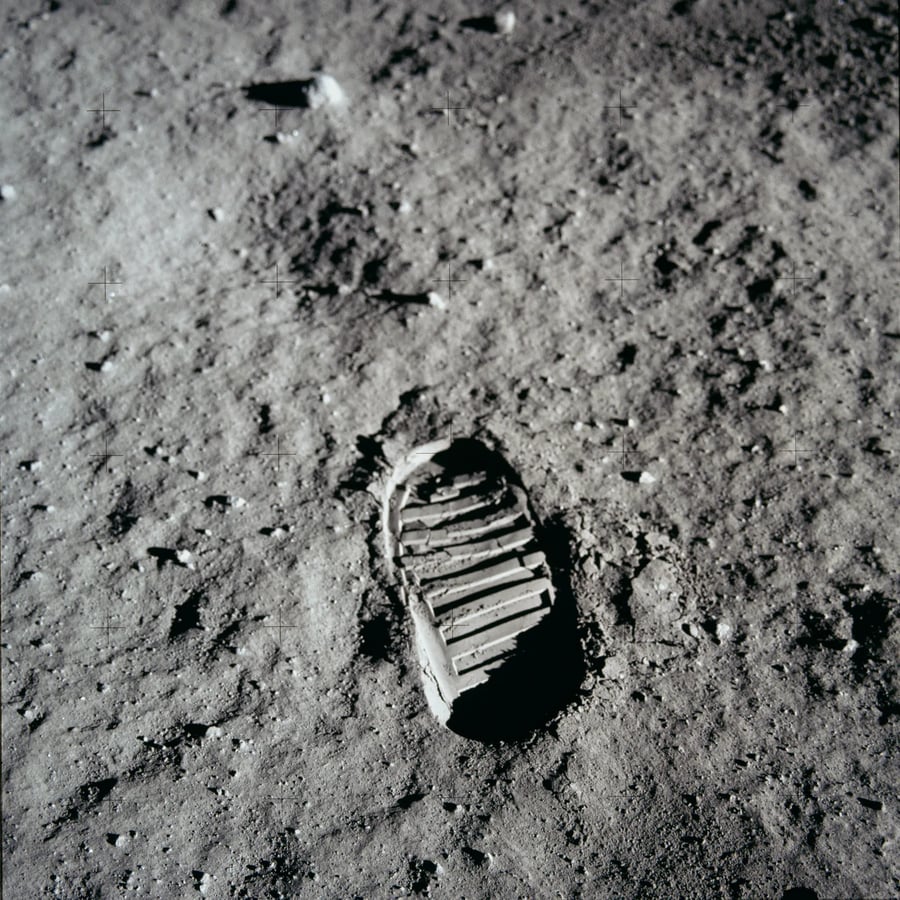
Many captions give 20 July for the first step, the date in American local time. In UTC it was already the 21st. An estimated 650 million people watched this step on television.
The two were outside for just over two and a half hours: the hatch opened on 21 July at 02:39:33 UTC and closed again at 05:11:13 UTC.
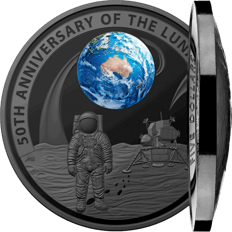
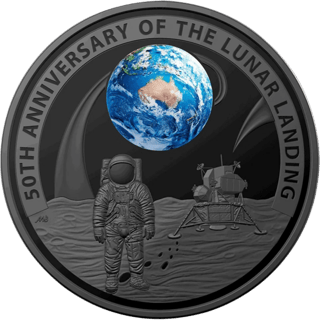
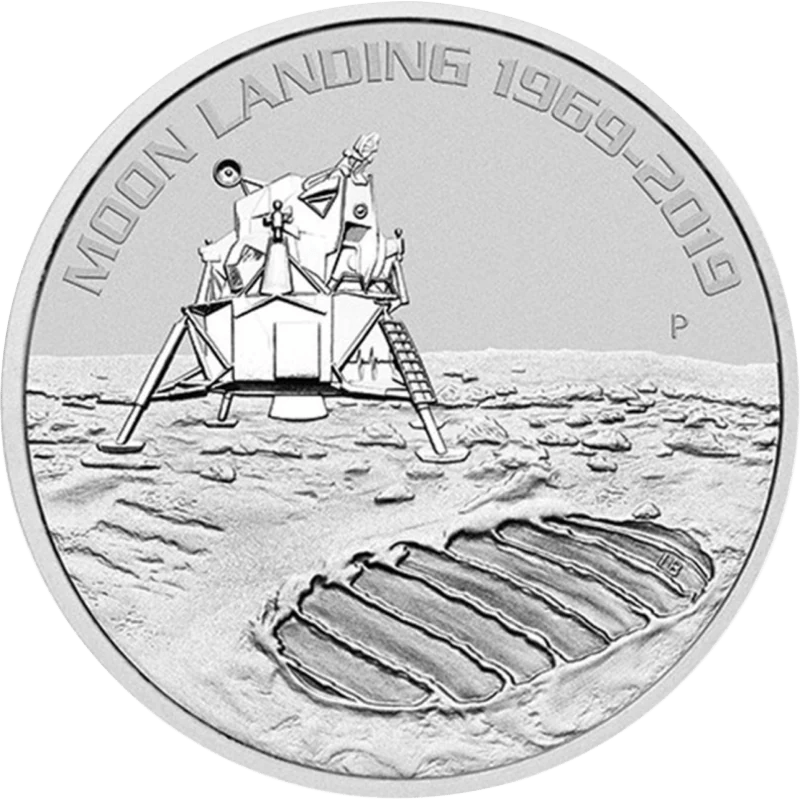
The Perth Mint’s coin for the 50th anniversary shows the lunar module behind a large boot print, with the inscription “MOON LANDING 1969‑2019”.
 Boot print, silverBoot printMoon landing at 50, Perth MintSilver, Perth Mint
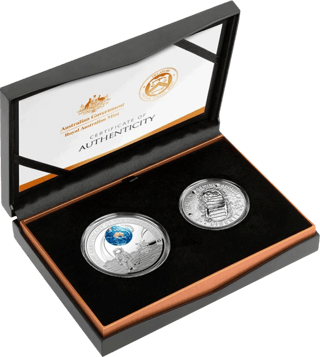 Two coins in a caseTwo coinsMoon landing at 50, setSet
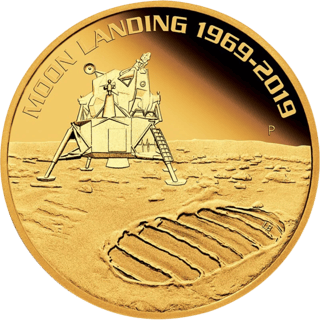 Boot print, goldBoot printMoon landing at 50, Perth MintGold, Perth Mint
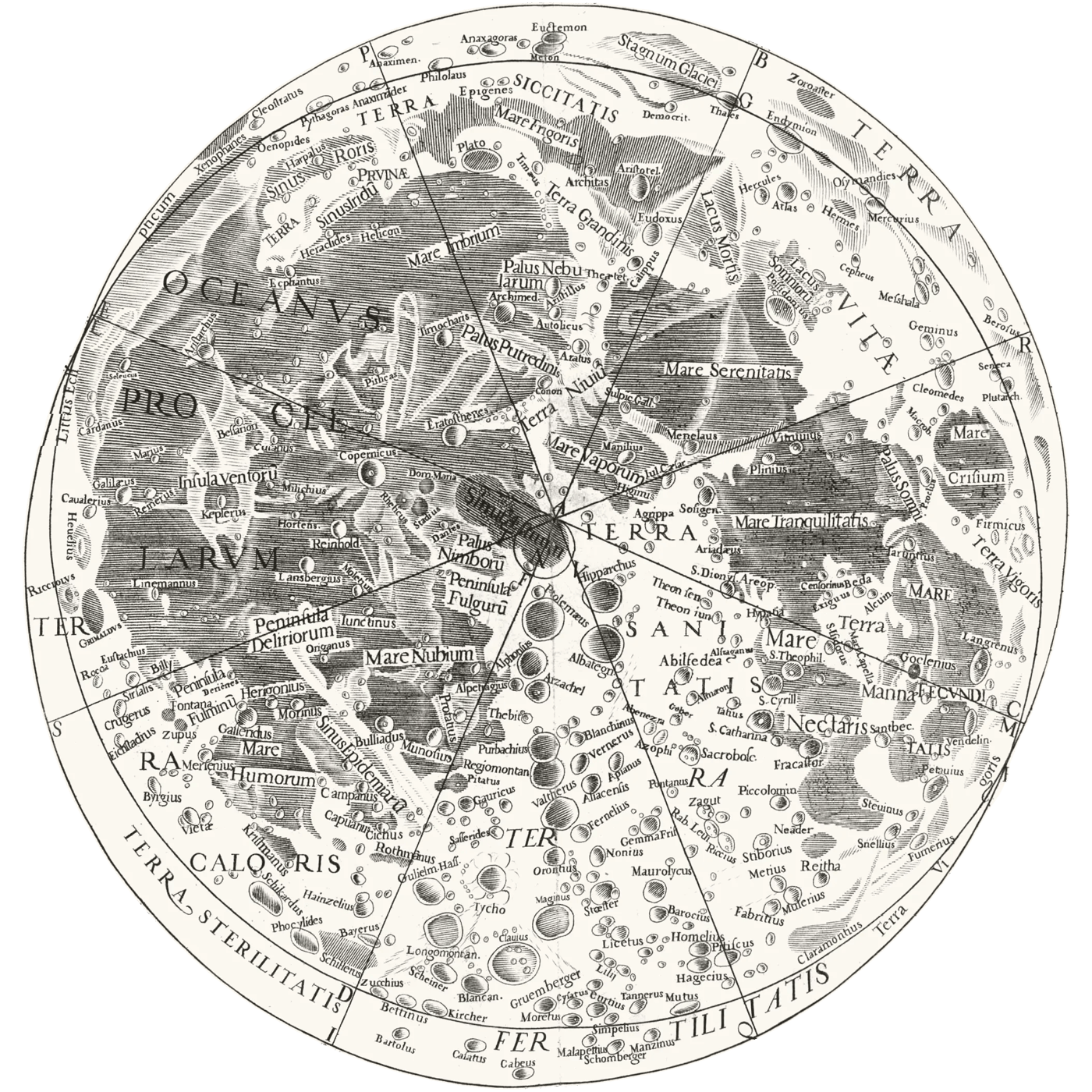
The lunar map in the “Almagestum novum”, Bologna 1651, laid the foundation for the system of lunar names that is still in use today.
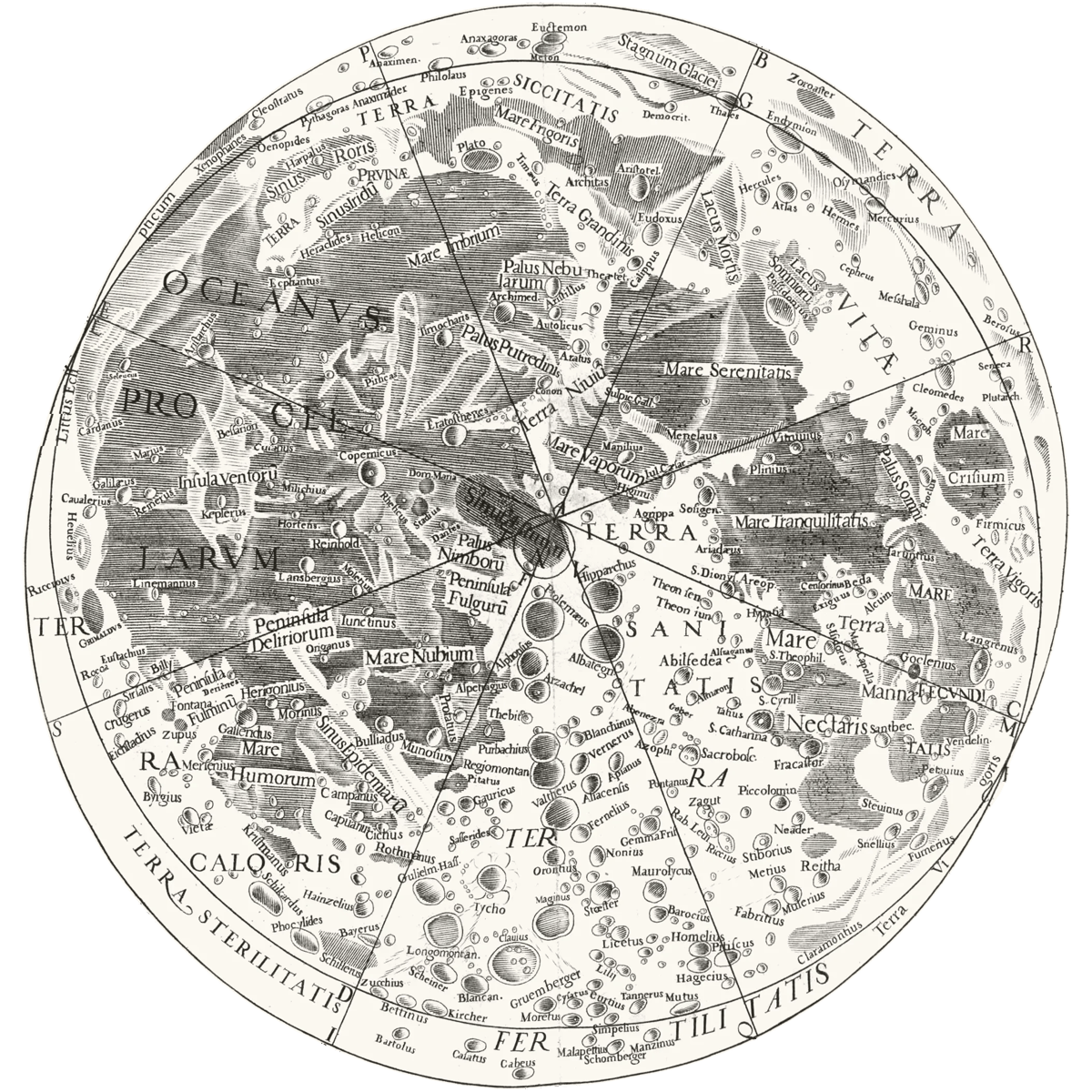
Grimaldi drew the map, Riccioli devised the names. This is where the Sea of Tranquility got its name, Mare Tranquillitatis, along with craters such as Plato, Ptolemaeus and Tycho.
From 1651 to the landing, 318 years passed. Apollo 11 touched down in this sea, at 0°41′15″ north and 23°26′ east.
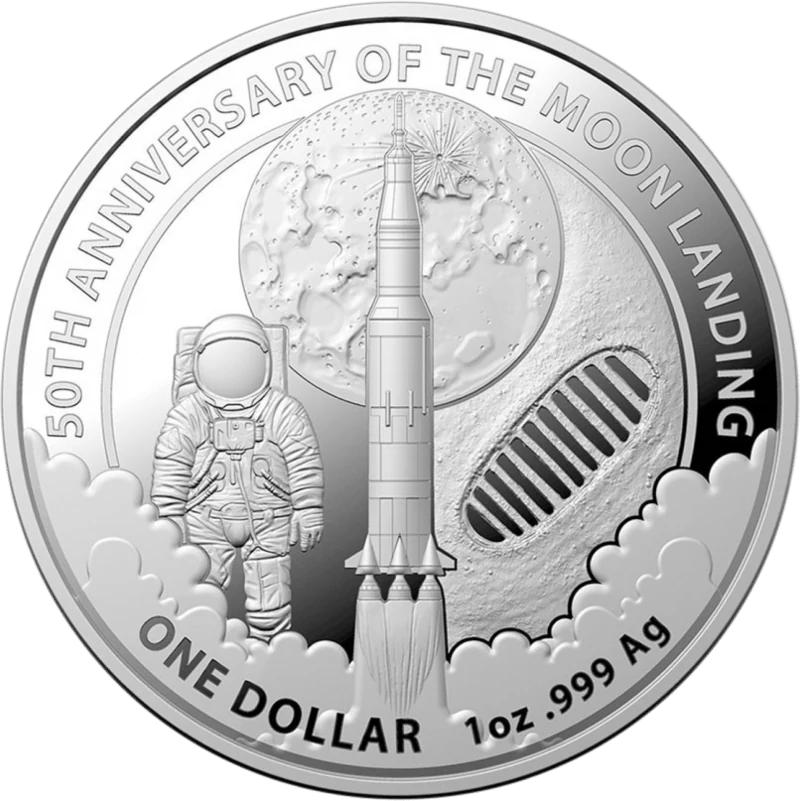
The coin for this chapter shows an astronaut and a rocket, with the Moon behind them in cratered relief.
Light travels almost 300,000 km every second. From the Sun to Earth it takes 8 minutes and 19 seconds on average, to Neptune 4 hours and 11 minutes.
Timeline from 0 to 6 hours. Sunlight reaches Mercury after 3 min 13 s, Venus after 6 min 1 s, Earth after 8 min 19 s, Mars after 12 min 41 s, Jupiter after 43 min 17 s, Saturn after 1 h 19 min 37 s, Uranus after 2 h 39 min 23 s and Neptune after 4 h 11 min. On 14 February 1990, Voyager 1 was about 5 h 36 min away in light travel time.
The first 15 minutesThe first 15 minutes
 Sun
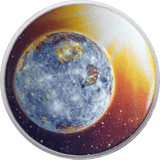 Mercury3 min 13 s
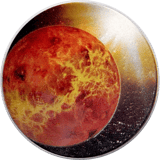 Venus6 min 1 s
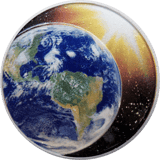 Earth8 min 19 s
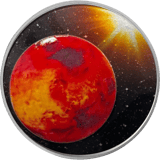 Mars12 min 41 s
The first 6 hours
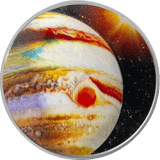 Jupiter43 min 17 s
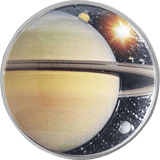 Saturn1 h 19 min 37 s
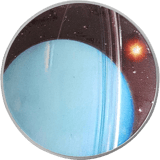 Uranus2 h 39 min 23 s
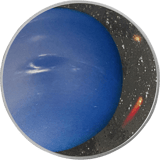 Neptune4 h 11 min
Voyager 1, 14 February 1990: about 5 h 36 min
Calculated for the planets’ mean distance from the Sun.
Because Earth’s orbit is not an exact circle, light takes between 8 min 11 s and 8 min 27 s over the course of the year.
Light from the Moon takes just under 1.3 seconds to reach Earth.
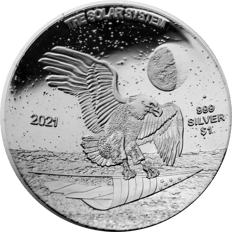
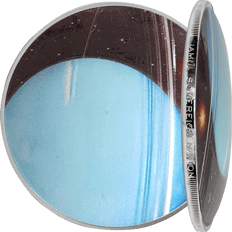
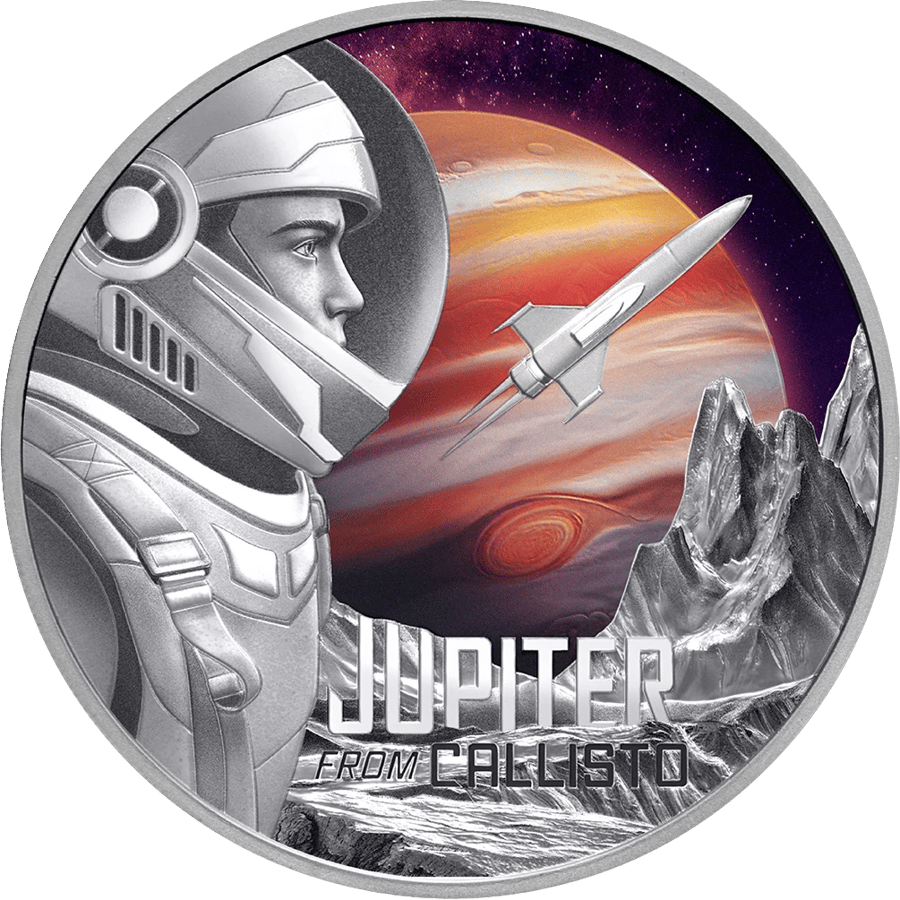
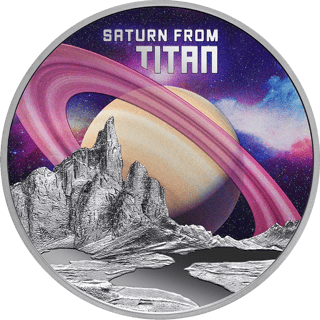
The rounds of the series “THE SOLAR SYSTEM” each show one body as a coloured disc against a dark background: the Sun in full, Jupiter with the Great Red Spot, Saturn with its ring.
How large would a planet appear in the sky of its moon? Calculated from the moons’ orbits and compared with the full Moon, which we see from Earth as 0.52 degrees wide.
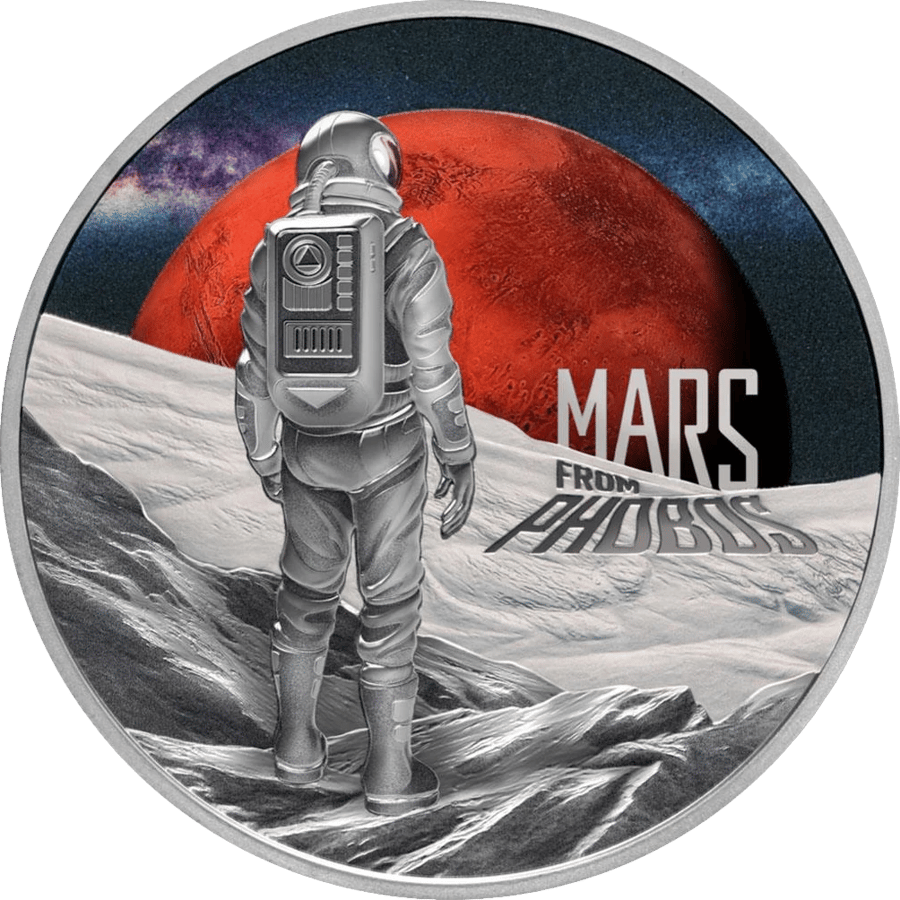
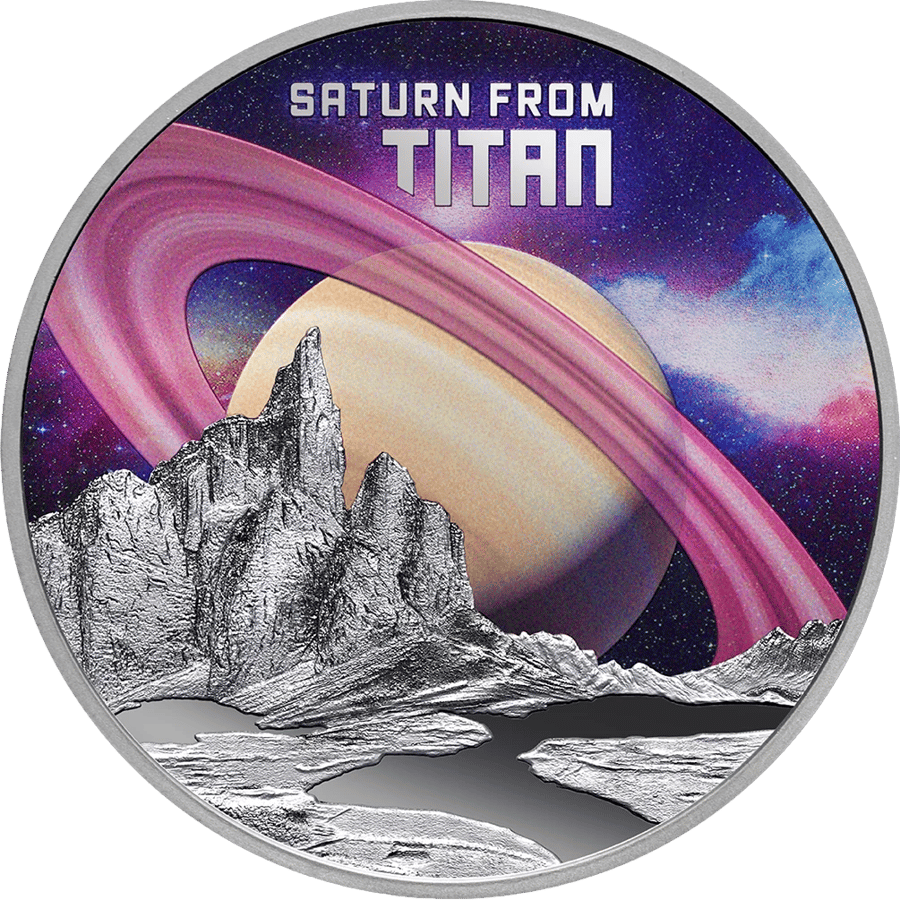
Seen from Phobos, Mars would fill a large part of the sky: 42.5 of the 180 degrees from horizon to horizon. Saturn and Jupiter would appear much smaller in the skies of their moons, yet still wider than eight full Moons side by side.
The coins in the series show the view itself.
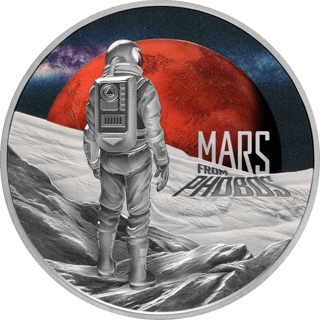 Mars from Phobos, silverMars from PhobosAstronaut against red Marsagainst red Mars
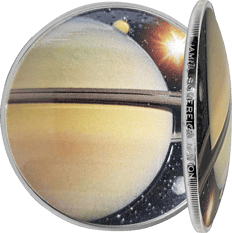
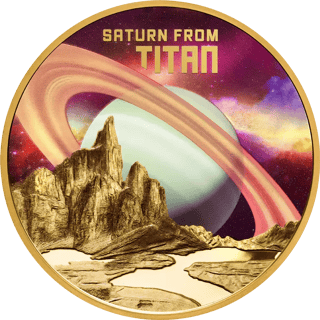 Saturn from Titan, goldSaturn from TitanRinged planet over pinnaclesGold, over pinnacles
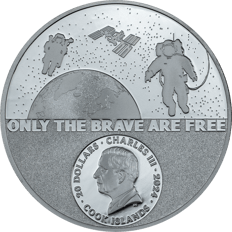
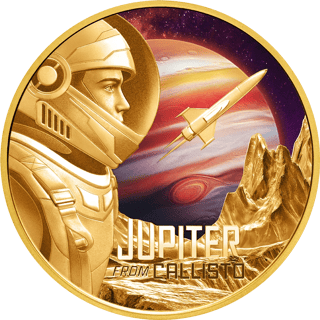 Jupiter from Callisto, goldJupiter from CallistoAstronaut and rocket against JupiterGold, against Jupiter
Three photos of Earth, each taken from farther away than the one before.
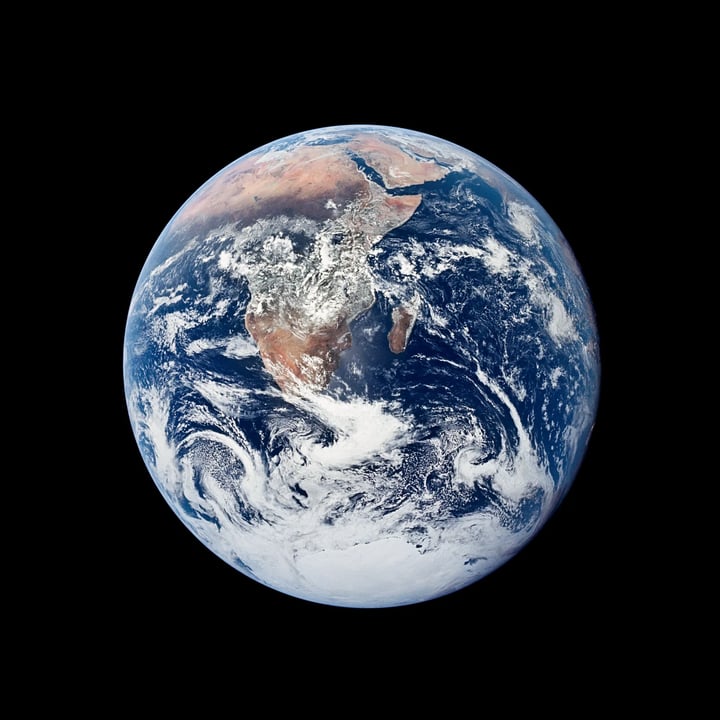
Distance: on the way to the Moon
Apollo 17, 7 December 1972
Earth fills about two thirds of the image width.
Almost cloud‑free Africa, Saudi Arabia at the top, Antarctica with the South Pole at the bottom. The last Apollo mission to the Moon.
Image: NASA
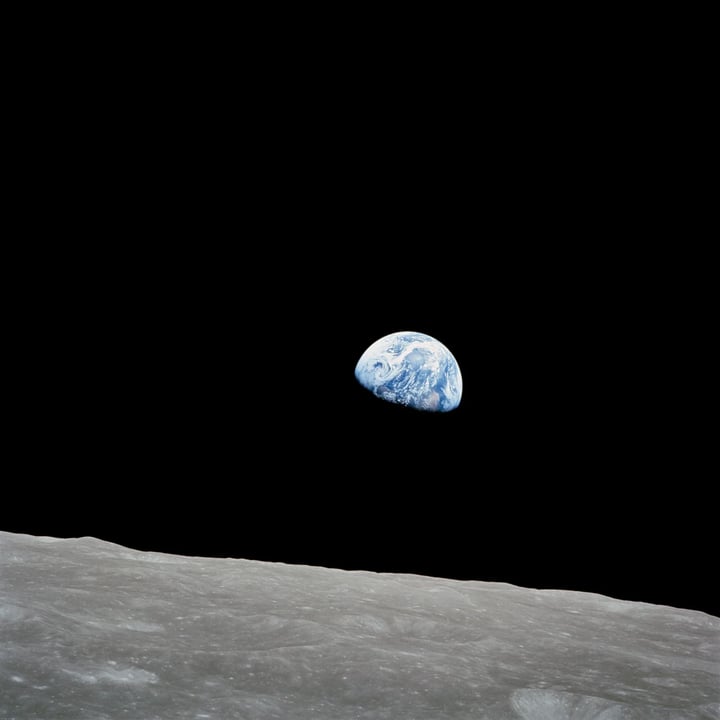
Distance: about 386,000 km
Apollo 8, 24 December 1968
Earth takes up about one seventh of the image width.
Earth stands about five degrees above the lunar horizon. The line between day and night runs across Africa.
Image: NASA
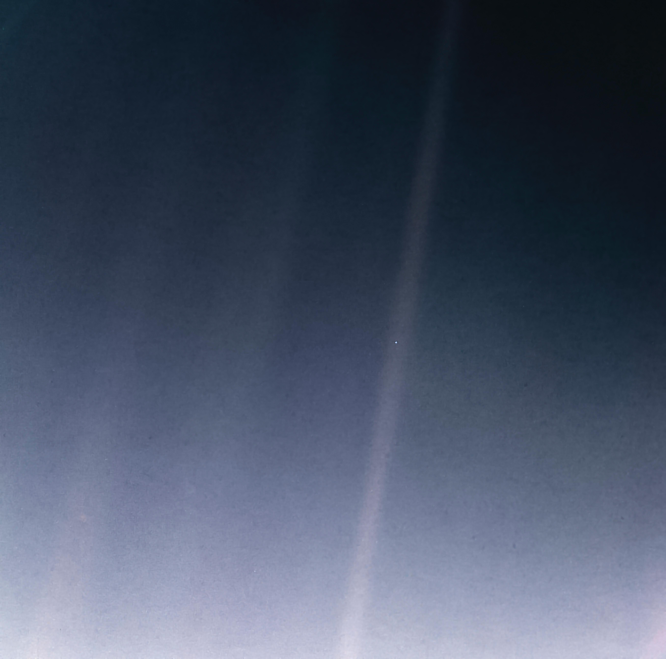
Distance: about 6 billion km
Voyager 1, 14 February 1990
Earth is smaller than a single pixel. The ring shows where it lies.
34 minutes later the probe switched off its cameras for good. The name “Pale Blue Dot” comes from a book by Carl Sagan, 1994.
Image: NASA/JPL‑Caltech
How large Earth appears in a picture does not show the distance on its own: Earthrise was taken with a telephoto lens.
The coins that go with them show their own pictures of Earth.
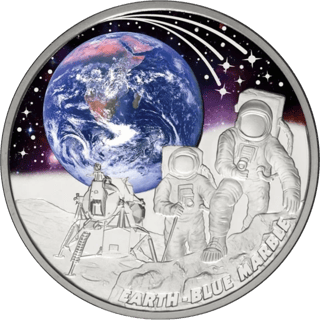 Blue Marble 2022, silverBlue Marble 2022Earth above the MoonEarth above the Moon
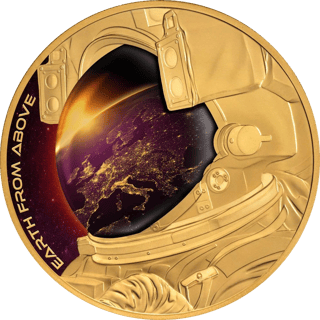 Earth From Above 2022, goldEarth From Above 2022Earth at night in the visorEarth in the visor
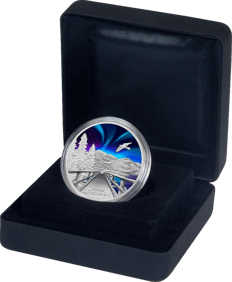
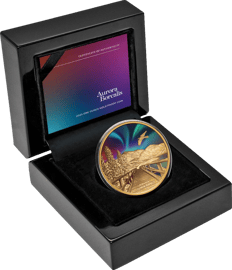
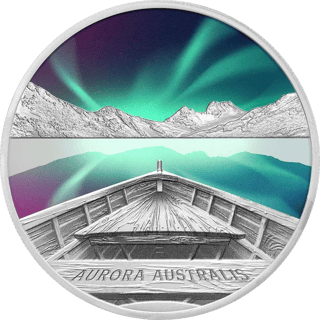
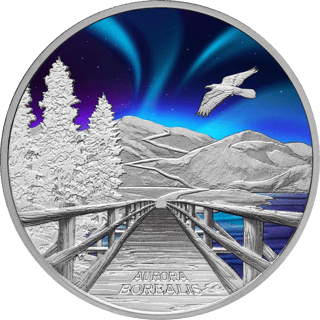
Aurora glows far above the clouds, from below 100 km to above 200 km in altitude. Its colour depends on the altitude and on the gas that glows.
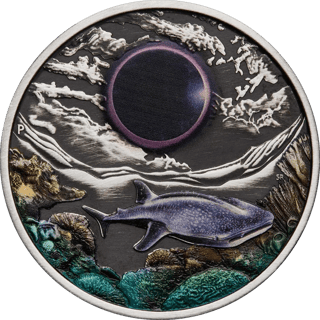
Calculated without the Moon’s limb profile: the times may shift by about 1 to 3 seconds.
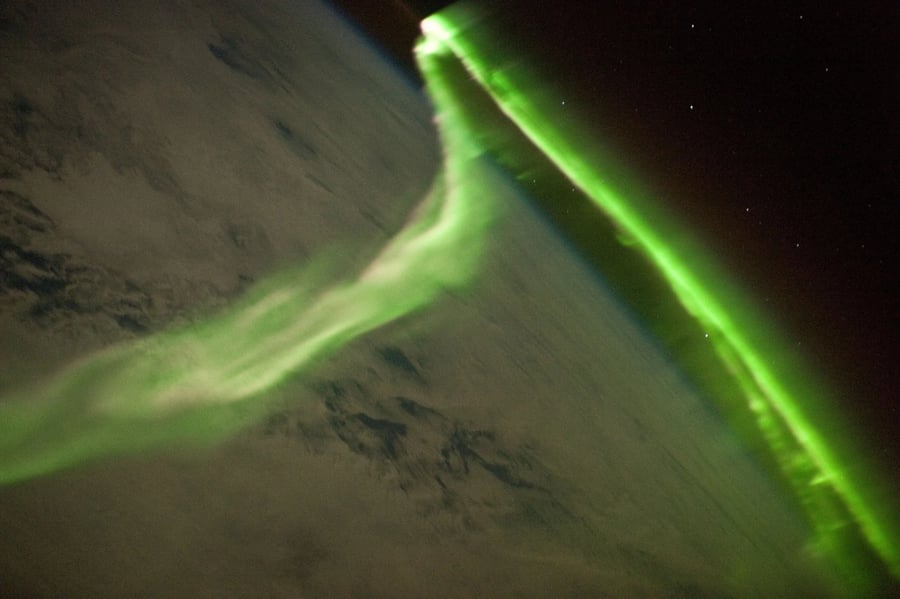
Auroras are not unique to Earth: they have also been seen on Saturn and Jupiter.
The date of this eclipse appears on the rim of the Ningaloo coin.

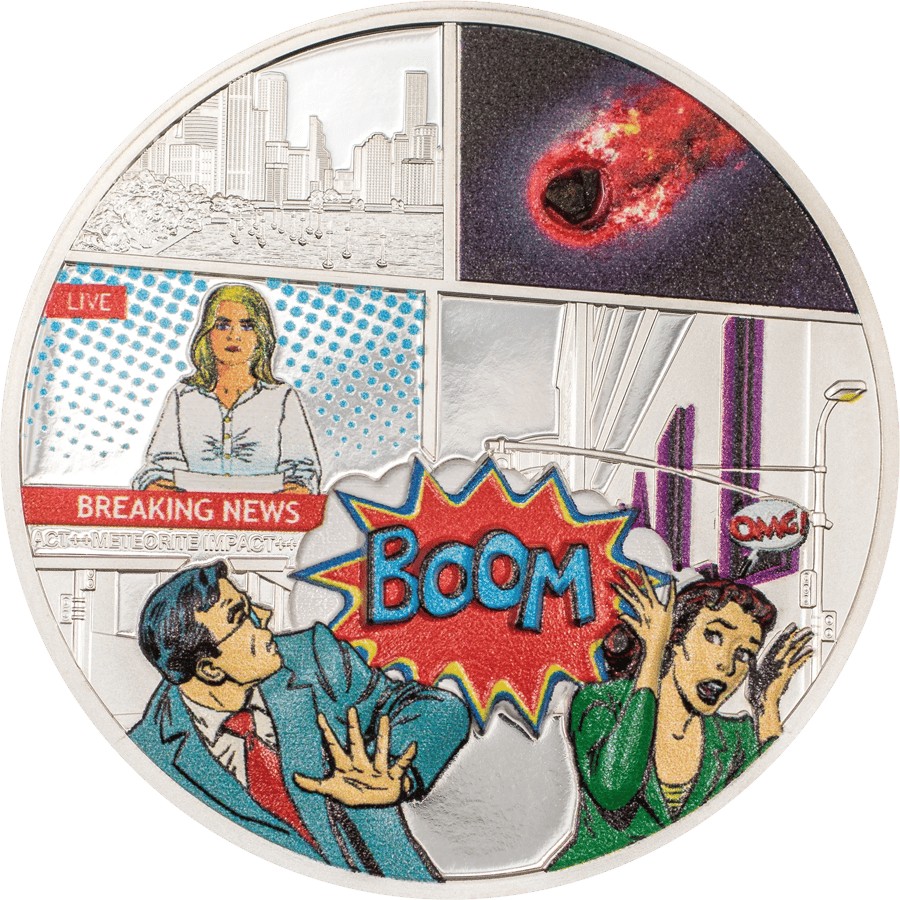
Twice, a mineral was found in nature for the first time in this stony meteorite: in 1969 and in 2014.
Ringwoodite is named after A. E. Ringwood; its violet grains were described in “Nature” in 1969.
In 2014 came bridgmanite, according to “Science” the most abundant solid phase in Earth. From the accompanying minerals, the researchers infer peak shock values of about 24 gigapascals and 2,300 kelvin. This ended a search lasting half a century.
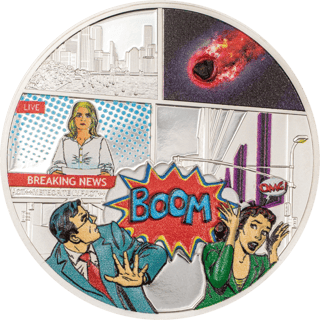
The Tenham Meteorite coin tells of an impact as a comic page, with “BREAKING NEWS” and “BOOM”.
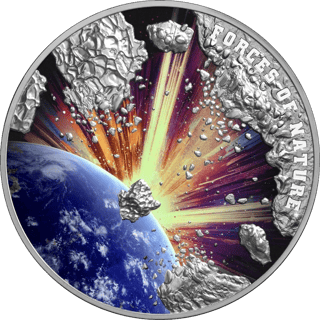 Forces of Nature 2023Forces of Nature 2023a shattering boulder above EarthBoulder above Earth
Ever since humans first gazed up at the night sky, outer space has exerted an unbroken fascination, and mints around the world have immortalised precisely this enthusiasm on gold and silver coins. Space coins depict planets, galaxies, space missions and cosmic symbols, combining a classic precious metal with a design that stands for research, progress and pioneering spirit. This text sheds light on the most important design themes, the best-known series, minting qualities and mintages, as well as the question of what makes these collecting fields so appealing.
As infinite as the cosmos is, so too is the variety of designs that serve as inspiration for a space coin. From the Milky Way and the entire solar system to individual planets such as Saturn or Mars, the themes extend far beyond the precious metal itself. What makes these coins so special is the tension between a timeless store of value and a design that embodies human curiosity. The cosmos is instantly recognisable, emotionally charged and universally understandable in its visual language.
Most of these issues are released in strictly limited mintages and with elaborate minting techniques, such as colour applications, niobium inlays or high relief. This means space designs appeal to two groups of buyers at once: collectors seeking thematic completeness, and buyers who value precious metal with added aesthetic appeal. Anyone generally interested in design-driven coinage will find numerous related collecting fields in the collector's coins section as well as in the other themed worlds.
The range extends from scientifically accurate depictions to imaginative interpretations of distant worlds. Frequently found motifs include:
This variety of designs makes the theme a rewarding entry point into the world of silver coins and gold coins, especially as a gift for people with a passion for astronomy and space travel.
No event in space travel has shaped numismatics as much as the first manned moon landing in 1969. Numerous issuing countries captured this moment in precious metal, which is why that year remains a natural anchor point for thematic collections to this day. Typical depictions show astronauts, the lunar module or the Earth rising over the lunar horizon, images that have become deeply etched in the collective memory.
Round-number anniversaries also keep the theme alive: numerous commemorative issues appeared worldwide for the 50th anniversary of the moon landing in 2019. Other coins honour earlier milestones, such as the first human in space or the deployment of Mars rovers. Such pieces serve not only as highlights of a collection but also as small time documents of an era of discovery. Anyone looking for space-travel designs with historical relevance will also find them in the Technology and History categories.
The cosmos cannot be manufactured: it can only be explored, admired and honoured in precious metal.
Many space designs do not appear as standalone pieces but are embedded in ongoing series. This creates a clear collecting logic and makes years of issue, designs and minting variants directly comparable. Cosmic designs are minted by mints around the globe, from the Perth Mint in Australia and the Münze Österreich to smaller issuing countries such as the Cook Islands. Europe, too, has a tradition in this theme: France, Germany and other countries have issued commemorative coins for space-travel milestones, including historic moon-landing coins denominated in francs from several African states.
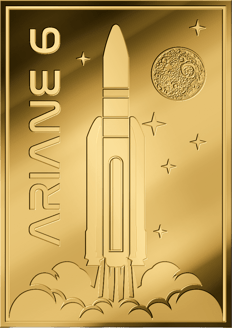
A current example is the German collector's coin series on space travel: several partially coloured 5-euro issues running until 2028 honour milestones and visions of space exploration, with the series opening with a design centred on the European Ariane launch vehicle. These colour-printed coins offer a low-threshold entry into collecting and combine well with high-quality technology designs.
Where the moon becomes the organising principle for a collection, the Lunar series come into play. They systematically depict the Chinese lunar calendar and are among the most popular collecting fields in modern numismatics. Even though the zodiac design takes centre stage, the reference to the lunar calendar forms a direct bridge to the theme of the cosmos. Related issues can be found among the Lunar silver coins as well as the Lunar gold coins, complemented thematically by the Zodiac Signs category.
Not every issue refers to a specific mission. Some coins deliberately draw on astronomical symbolism, with the sun and moon as emblems of balance, the equinoxes or the eternal cycles of the calendar. Such designs feel more timeless, as they work independently of anniversaries, and form a bridge to the Symbolism category.
Whether a gold coin or a silver coin with a space design is the better choice cannot be answered in general terms: it depends on budget, collecting focus and intended use.
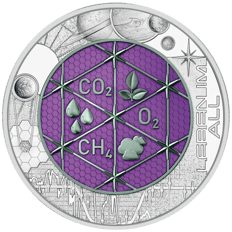
Gold is more expensive to purchase but, due to its scarcer deposits, is considered the more price-stable store of value and tends to be subject to fewer fluctuations. Those who opt for smaller denominations remain flexible and can more easily sell individual pieces again. Silver is considerably cheaper to get started with but fluctuates more in price; in return, it offers a particularly impressive stage for cosmic designs when combined with coloured or high-relief finishes. Unusual material combinations such as silver-niobium with shimmering, colour-shifting tones are also used for space-themed issues.
Tax note
In Germany, investment gold is exempt from VAT under §25c UStG. Silver coins have been subject to the standard tax rate since 2022, although many imported collector's coins are taxed under the margin scheme. Anyone weighing material value against collector's value should keep this difference in mind. This is general information and does not replace tax advice.
For pure long-term value preservation, classic gold bars or silver bars are also suitable. With space coins, however, the material value is joined by an intangible, potential collector's value, an aspect that does not apply to plain bars.
With thematic coins, pure precious metal content rarely determines desirability; rather, it is the interplay of design, quality and scarcity. Three factors are of particular importance here:
A complete series is generally more sought after among collectors and more stable in value than a single piece. Those who specifically target strictly limited editions combine the appeal of the design with scarcity. Further information on the performance of precious metals can be found on the Value Appreciation topic page; however, no specific return guarantees can be derived from it.
Especially with elaborately designed space coins, condition is a key value driver. Coloured surfaces and polished mirror fields are sensitive to touch, moisture and dust. Proper storage therefore protects not only the material itself but also the intangible value.
Anyone maintaining a growing collection will find further aids, from coin pouches to collector's accessories, throughout the Accessories section.
Hardly any theme captivates generations as reliably as the universe. A space coin made of gold or silver combines lasting material value with a design that leaves both children and adults in awe, a gift that does not disappear into a cupboard but tells stories. Whether for a milestone birthday, a birth, or under the Christmas tree: cosmic designs strike a chord. Further inspiration can be found in the Gift Ideas and Christmas categories.
Space coins are gold, silver or copper coins whose design is dedicated to the cosmos, such as planets, galaxies, the moon landing or astronomical symbolism. They are mostly collector's and bullion coins issued in limited mintages, designed around a theme and often coloured or struck in Proof quality.
Space coins combine the material value of precious metal with an additional collector's value. With low mintages and sought-after designs, the collector's premium can grow over the years. However, value appreciation is never guaranteed and depends heavily on the design, mintage and condition. Those relying solely on material value are usually better off with classic bars or bullion coins.
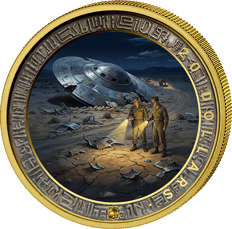
Among the most sought-after designs are the 1969 moon landing, the solar system, individual planets such as Saturn and Mars, the Milky Way, and astronomical depictions of the sun and moon. Space-travel milestones and tongue-in-cheek alien designs are also very popular.
Silver coins offer an affordable entry point and a wide choice of designs but fluctuate more strongly in price. Gold coins are more expensive, are considered more price-stable, and are well suited to long-term value preservation. For many collectors, a mix of both metals makes sense. Which option is right depends on budget and collecting goals.
Many cosmic designs are issued in strictly limited mintages of just a few hundred to a few thousand pieces. Since collectors around the world wait for certain editions, these are often available only for a short time. A low mintage combined with a popular design can further increase demand.
Coin capsules are recommended, as they enclose the piece airtight and protect it from skin contact. Coloured and polished surfaces are sensitive to touch, moisture and dust. Coin cases are a good option for entire series; higher-value pieces are best kept in a safe or bank safe-deposit box.
 Space
Stay informed with product launches, financial news and exclusive offers. Sign up for our free newsletter today.
By entering your email address and clicking the "Submit" button, you give the following consent: "I agree to be informed by email about new products, financial news and exclusive offers, and therefore consent to the processing of my email address for the purpose of sending the newsletter. I can revoke this consent at any time without giving reasons, with effect for the future. The lawfulness of processing carried out prior to revocation remains unaffected."