


Sold out

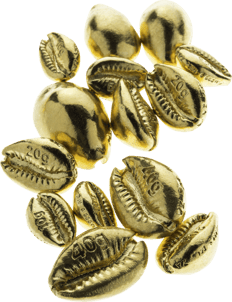
40g Gold Cowrie Shell Bar
£5,385.00
VAT-free and excl. shipping
currently not available
 +49 7930-2699

 More than 300,000
 Over 30 years
 Secure shipping
 Google: 4.9/5
Buyers of 40g gold bars can look forward to 0% VAT and a fineness of 999.9/1000 Gold. The bars are priced at a similar level to comparably weighted coins, but feature a serial number and even a certificate of authenticity. Since the bars are shipped securely in a blister pack, the likelihood of consistently high quality is also very high.
The 40 g gold bar is one of the more unusual denominations in the investment gold segment: small enough to sit comfortably in the hand, yet heavy enough to embody a noticeable value in fine gold. Anyone taking this bar out of its blister pack for the first time quickly senses why gold has fascinated people for thousands of years: its density, its warm lustre, the quiet weight resting in the palm. This guide examines its origin and production, the fineness of 999.9/1,000, the tax particularities, questions of storage, and a comparison with neighbouring formats and gold coins.
Gold bars, alongside bullion coins, are among the most popular ways to hold physical precious metal. The 40-gram bar occupies a special position here: it falls exactly within the range where a bar contains substantial value without tying up a large amount of capital in a single piece. For many investors, it is precisely this middle ground that appeals, larger than a pure entry-level format, yet considerably more manageable than a 100 g gold bar or even a 1 kg gold bar.
As investment gold, the 40 g bar is priced at a similar level to gold coins of comparable weight, but offers one key difference: it typically carries an individual serial number and is supplied with a certificate of authenticity. The bar's value tracks the daily gold price, which is set on the international market per troy ounce. Anyone who views physical gold as a building block for inflation hedging or long-term retirement provision will find the 40-gram format a conveniently divisible, portionable unit.
Gold bars are produced in two fundamentally different ways, and both can be found in the 40-gram range. Minted bars are stamped out of a rolled gold strip and, under high pressure, given a design along with weight and fineness markings. The result is a particularly smooth, even surface with sharp edges. Cast bars, by contrast, are created by pouring molten gold into a mould; they appear more rustic and carry the charm of hand-crafted work.
Reputable mints usually supply the bars sealed in a blister pack, often combined with a printed serial number and a certificate based on the so-called Certicard principle. Ideally, this protective packaging should remain intact, as it is an important factor in any later resale. Well-known manufacturers worldwide include Heraeus, C. Hafner and Argor-Heraeus, names that stand for consistent quality and international tradability.
Alongside the classic rectangular bar, special shapes also exist in the 40-gram range. One example is the gold bar designed in the shape of a cowrie shell, a tribute to one of humanity's oldest forms of payment, as cowrie shells served as a medium of exchange and substitute for money in many cultures for centuries. Thanks to its shape, each of these pieces is a small one-of-a-kind item, combining the material value of fine gold with a historical and symbolic appeal that makes it a popular gift.

The 40 g gold bar is usually made of fine gold with a purity of 999.9/1,000, often referred to as four nines or "Four Nines". This means that out of 1,000 parts by weight, 999.9 parts are pure gold. This purity is the standard for modern investment gold and also forms the basis for its tax treatment. Every reputable bar carries several markings that together form the basis of authenticity verification:
For bars in a sealed blister pack, authenticity can additionally be checked via the integrity of the packaging as well as by matching the serial number with the certificate. At Kettner Edelmetalle, every product undergoes an ISO-compliant authenticity verification before leaving the logistics centre. Anyone wishing to keep the bars permanently protected can additionally make use of suitable accessories.
Gold bars are available in a wide range of weights, from delicate minibars to massive kilobars. The choice of denomination depends on budget, intended use, and the desired degree of divisibility. Smaller units offer more flexibility when it comes to later resale but carry a higher premium per gram; larger units are cheaper per gram but tie up more capital in a single piece.
The 40-gram bar fits in as a convenient mid-size format among the common sizes. Anyone wishing to broaden their selection will find numerous neighbouring options:
A complete overview of all sizes is provided by the parent category Gold bars. For anyone wishing to regularly shift smaller amounts into gold, savings plan products can also be an interesting addition.
A key advantage of physical gold is its tax status in Germany. Investment gold is exempt from VAT under § 25c UStG, provided it meets the statutory criteria, which include, among other things, a fineness of at least 995/1,000 for bars. The 40 g gold bar, with its purity of 999.9/1,000, easily meets this requirement. This means no VAT is charged on the gold value when purchasing, making gold significantly more attractive than many other tangible assets.
Tax note
Investment gold is exempt from VAT in Germany under § 25c UStG. In addition, a one-year speculation period applies to the private sale of physical gold: after a minimum holding period of twelve months, any capital gain is exempt from income tax. This information is general in nature and does not replace individual tax advice.
Unlike silver, which can be subject to the margin scheme or the full tax rate, gold thus enjoys a tax-privileged position. This treatment applies equally to other gold products with a corresponding fineness, whether in bar or coin form.
Physical gold needs to be stored securely. Essentially, three options are available for the 40 g gold bar, and they can also be combined. Home storage in your own safe offers access at any time but requires a burglar-resistant safe and, where applicable, an adjustment to your home contents insurance. The bank safe deposit box offers a high level of security away from home but comes with ongoing costs and limited access. As a third option, professional storage solutions exist with specialised providers.
Regardless of the chosen location, the original blister packaging with serial number and certificate should remain as intact as possible, as it documents authenticity and facilitates resale. For the orderly storage of several bars and coins, coin cassettes or a coin case are suitable; smaller units can additionally be protected in coin capsules. Kettner Edelmetalle ships all orders 100% insured from a fully automated high-security logistics centre.

With comparable gold weight, investors are often faced with the question of whether to opt for a bar or a coin. Both forms have their merits, and the decision depends on personal priorities.
Classic bullion coins such as the Krugerrand, the Maple Leaf or the Vienna Philharmonic enjoy high tradability worldwide. The bar, in turn, scores with its pure focus on the precious metal. Many investors therefore combine both worlds and add to their holdings from the wide range of gold bullion coins.
The price of a 40 g gold bar is made up of the daily gold value plus a small premium for minting, packaging, and trading. Since the gold price is quoted on the market per troy ounce and fluctuates constantly, it is worth checking the current daily price before every purchase or sale. Anyone who becomes familiar with the basics of the gold market can choose the timing of purchases and sales more deliberately.
When it comes to later buy-back, a tried-and-tested rule of thumb applies: the dealer from whom the bar was originally purchased often offers fair terms. The buy-back price is always based on the current gold price per ounce. An intact certificate and undamaged packaging have a positive effect here, as they simplify the authenticity verification. Founded in 2011 as a German family business, Kettner Edelmetalle is today one of the largest online precious metals dealers in German-speaking countries.
No. Investment gold is exempt from VAT under § 25c UStG, provided it meets the statutory criteria. A 40 g gold bar with a fineness of 999.9/1,000 falls under this rule, so no VAT is charged on the gold value when purchasing.
Minted bars are stamped out of a gold strip and given a design along with fineness markings under pressure: they have a smooth, precise surface. Cast bars are created by pouring liquid gold into a mould, giving them a more rustic appearance. The material value is identical for the same weight.
The sealed blister packaging protects the bar from scratches and documents its authenticity via the printed serial number together with the accompanying certificate. Intact packaging makes later resale easier and can have a positive effect on the buy-back price.
That depends on the intended use. A single 40 g bar is usually cheaper per gram than several small bars of the same total weight. Several smaller units such as 10 g or 20 g, on the other hand, offer more flexibility if only a partial amount is to be sold later.
The price is derived from the current daily gold price, which is quoted on the market per troy ounce. A small premium is added for minting, packaging, and trading. Since the price fluctuates constantly, it is advisable to check the current daily price before buying or selling.
Possible options include home storage in a burglar-resistant safe, a bank safe deposit box, or professional storage. In all cases, the original packaging with the certificate should remain intact. Coin cassettes or a coin case are suitable for orderly storage.
 40 g Gold Bars
Stay informed with product launches, financial news and exclusive offers. Sign up for our free newsletter today.
By entering your email address and clicking the "Submit" button, you give the following consent: "I agree to be informed by email about new products, financial news and exclusive offers, and therefore consent to the processing of my email address for the purpose of sending the newsletter. I can revoke this consent at any time without giving reasons, with effect for the future. The lawfulness of processing carried out prior to revocation remains unaffected."