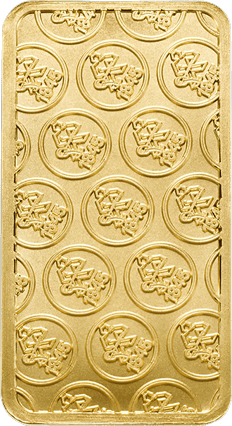
25 x 1g Gold Bar Heimerle und Meule UnityBar
£2,849.43£2,891.16
VAT-free and excl. shipping
Ships from 25/11/2026
 +49 7930-2699

 More than 300,000
 Over 30 years
 Secure shipping
 Google: 4.9/5
If you want to buy gold, choose between gold bars and gold coins, e.g. from Krugerrand, Maple Leaf to Swiss Vreneli. Both categories are available in denominations from 1g up to 1kg gold bars.


Gold hardly reacts with oxygen. That is why it neither tarnishes nor rusts in the air. Experts call it the noblest of all metals.
The yellow colour of gold is an effect of the theory of relativity. Without it, gold would only begin to absorb light strongly in the invisible ultraviolet.
Liquid gold solidifies at 1,064.18 degrees Celsius. This is a fixed point of the International Temperature Scale. Measurement institutes calibrate their radiation thermometers against it. Gold has been part of the scale since 1927.
Gold is the most malleable of all metals. Today, goldbeaters turn one ounce of fine gold into around 18 square metres of gold leaf. Such a leaf is about a ten‑thousandth of a millimetre thick.
In the early 17th century, the goldbeaters of Paris managed nearly 10 square metres from one ounce, and in the early 18th century nearly 14.
One ounce of fine gold makes a cube with edges of 11.7 millimetres. It is drawn enlarged here: at the scale of the squares, it would be too small to see.
Each of the two coins contains 31.1 grams of fine gold.
 KrugerrandKrugerrandSouth Africa916.67/1,000
Gold is heavy: one cubic centimetre weighs 19.3 grams. By mid‑2026, around 222,600 tonnes of gold had been mined worldwide. Cast into one cube, all of it together would have edges of 22.6 metres.
A thousand times as much gold makes a cube with edges only ten times as long.
All four cubes are drawn to the same scale. In our shop, gold starts with a coin of 1/1,000 ounce, which contains 0.031 grams of fine gold.
Each step has its own scale. The small cube next to it is the step before. Up to 1,000 tonnes, each step holds a thousand times as much gold as the one before, but its edges are only ten times as long.
The world’s mines produced 3,672 tonnes of gold in 2025. As a result, the cube of all the gold ever mined grows by around 12 centimetres along each edge.
Cubes at the same scale. “Large investors, off‑exchange” means gold belonging to institutional and very wealthy investors, bought directly rather than through an exchange. “Other” is mainly gold in technology and industry. Source: World Gold Council, as at 18 August 2026.
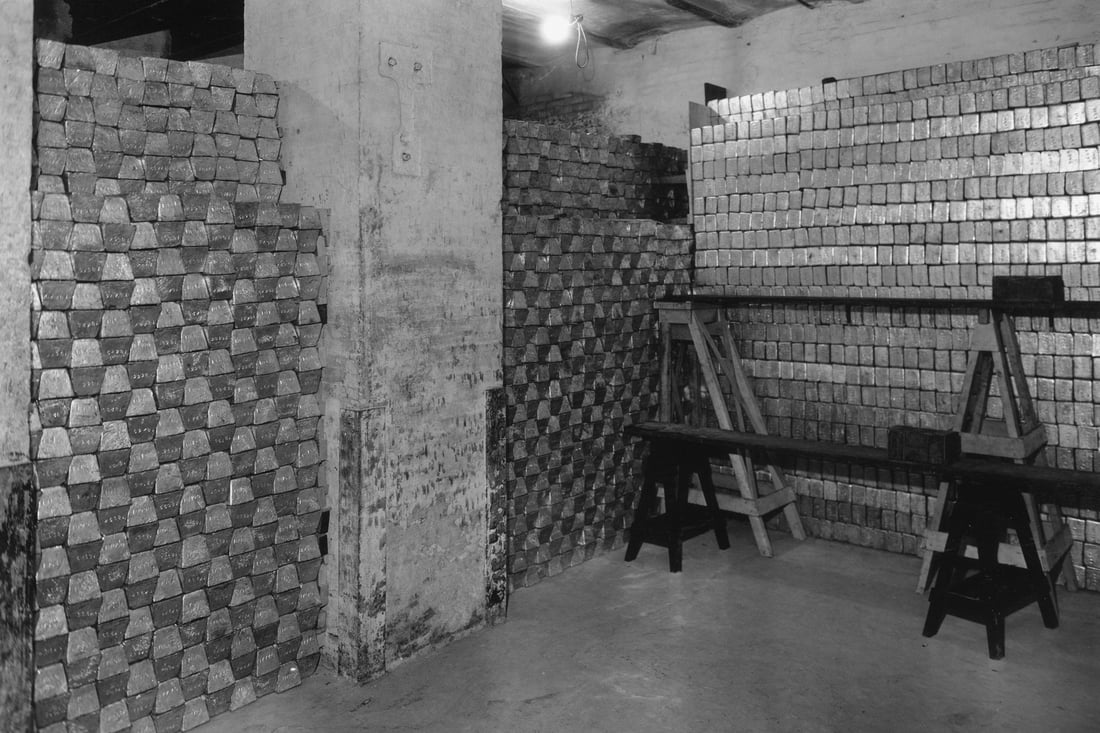
That is how much gold the Deutsche Bundesbank held at the end of 2025. Of this, 1,710 tonnes are stored in Frankfurt am Main, 1,236 tonnes at the Federal Reserve Bank of New York and 404 tonnes at the Bank of England in London.
From 2013 to 2017, the Bundesbank moved 674 tonnes from New York and Paris to Frankfurt, three years earlier than planned.
Tungsten is almost as dense as gold. That is why weighing alone is not enough.
The Bundesbank calls remelting the “ultimate” authenticity check. But this destroys the bar. It regularly checks all the other bars in its holdings without destroying them.
In 2025, the Bundesbank sold 1,260 kilograms of gold to the German federal government for minting gold coins.
View Goldeuro coinsThis rule has applied since 1 January 2000 and now covers all member states of the European Union. It goes back to Directive 98/80/EC. Today it is set out in Articles 344 to 356 of the VAT Directive 2006/112/EC and in § 25c of the German VAT Act (UStG).
Gold “does not only serve as an input for production but is also acquired for investment purposes”.
Reasoning given in Directive 98/80/EC
It must meet all four conditions.
Every year before 1 December, the European Commission publishes a list of the gold coins that count as investment gold in the following year. The list also includes coins from countries that no longer exist under that name, such as Yugoslavia, Rhodesia and Zaire. A coin that is not on the list can still be investment gold.
KrugerrandSouth Africa1 ounceHardly any material has accompanied humankind for as long as gold: it does not rust, it does not fade, and an ounce from the year 1900 is today exactly the same ounce it was back then. It is precisely this permanence that makes the precious metal the classic choice for wealth preservation, from the 1-gram bar to the bullion coin traded worldwide. The following sections look at the differences between gold bars and gold coins, denominations, fineness and premium, the VAT exemption for investment gold, authenticity verification, storage, and the question of how the gold price actually comes about.
The Latin name aurum still survives today in the stock ticker XAU. Pharaohs were buried with it, gold prospectors crossed continents for it, and central banks still stack it in their vaults today. The reason is both banal and powerful at once: gold cannot be printed. All the gold ever mined in the world would, by calculation, fit into a cube with edges of around 22 metres, and only a few per cent is added each year. Paper money, by contrast, is fiat money: its quantity is a political decision.
Anyone holding a troy ounce for the first time immediately notices its unfamiliar weight: 31.1035 grams packed into the surface area of a two-euro coin. Gold is around 19 times heavier than water. This weight is also the first, very tangible clue to authenticity.
Physical gold pays no interest and distributes no dividend: it does not work, it preserves. In return, it carries no issuer risk: a bar in the safe retains its value even if a bank, a fund or a certificate issuer defaults. This is why the metal is traditionally sought after as a safe haven in turbulent market phases and is often seen as a building block for protection against loss of purchasing power. Unlike silver, whose price depends heavily on industrial demand, the gold price is driven mainly by investment, jewellery and central bank demand.
For investment purposes, two product categories have become established, because both carry a comparatively low premium over the material value: bars and minted bullion coins. Which form suits you best depends less on the gold price than on the purpose: building wealth in large units or tradeable small denominations.

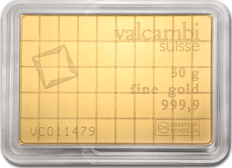
Gold bars track the gold price most directly. Their value derives solely from fine weight and fineness, with casting or minting costs, packaging, logistics and trading margin added on top. The larger the unit, the lower this surcharge is as a percentage: a kilo bar is proportionally far cheaper than a thousand one-gram bars. A distinction is made between cast bars with a rough, individual surface and minted bars, which usually come in a sealed blister pack with a certificate and serial number. A practical special form is the CombiBar, which can be broken into small units without any tools. Refineries such as Heraeus, Umicore, C.Hafner or Valcambi supply LBMA-certified goods that are recognised internationally.
Gold coins are more complex to produce and therefore carry a somewhat higher premium. In return, they offer advantages that no price list can capture: they are legal tender in their country of issue, recognised worldwide, available in small denominations and therefore more flexible to sell. Complex designs, edge reeding and fine minting details also make counterfeiting harder. And some issues develop a collector's value over the years that goes beyond the pure gold content.
Denomination is one of the most underestimated decisions when buying gold. It determines how much premium is paid, and how easily a holding can later be sold off in portions. Rule of thumb: large units for building wealth, small units for flexibility.
| Unit | Fine weight | Typical use |
|---|---|---|
| 1 g to 5 g | 1–5 g | Entry-level, gifts, very small trading units |
| 1/10 oz | 3.11 g | smallest common bullion coin |
| 1/4 oz | 7.78 g | middle ground between price and divisibility |
| 1/2 oz | 15.55 g | larger fractional denomination |
| 1 oz | 31.10 g | worldwide standard for bullion coins |
| 100 g | 100 g | popular bar size for building a holding |
| 1 kg | 1,000 g | lowest premium per gram |
A 1-gram gold bar costs, as a percentage, many times what applies to a kilo bar, but in return it can be sold individually at any time. Many investors therefore deliberately mix the two: a solid base of 100-gram bars or ounce coins, supplemented with small units in case only part of the holding needs to be liquidated. Anyone wanting to build up a position step by step will find in savings plan products a way to purchase smaller amounts regularly and smooth the average purchase price over time.
Purity is stated in thousandths. 999.9 means: 999.9 of every 1,000 parts by weight are pure gold, equivalent to 99.99 per cent. Before the metric system was introduced, the carat was the customary measure, with pure gold corresponding to 24 carats. Both systems still exist side by side today: the carat figure for precious metal must not be confused with the carat used for gemstones, which is a unit of weight.
What matters is the distinction between fine weight and total weight: a 1-ounce coin made of 916.7 gold contains a full 31.1 grams of fine gold, but weighs around 33.93 grams in total, because copper is added as a hardening agent. This admixture also explains the slightly reddish tint of some bullion coins: colour alone says nothing about purity. A 1-ounce bar in 999.9 and a 22-carat ounce coin contain exactly the same amount of fine gold.
A handful of series dominate the global trade in investment gold. They come from state mints, are issued in high mintages and are recognised at every trading venue, which makes them particularly easy to sell on.
Besides the perennial favourites, there are series that thrive on an annual change of design. The China Panda has appeared with a new design every year since 1982 and has been issued in metric weights since 2016. The Perth Mint's Lunar Series III is dedicated to the zodiac signs of the Chinese calendar; individual designs such as the Dragon or the Tiger regularly develop a noticeable collector's premium. The Gold Euro takes up national themes, such as World Heritage sites or native forests. And historical pieces such as the Swiss Vreneli in 900 gold or coins of the German Empire combine material value with historical significance.
The worldwide reference price is the spot price, quoted in US dollars per troy ounce. The London Bullion Market Association (LBMA) sets a reference rate twice a day, which serves as the basis for over-the-counter trading. For buyers in the eurozone, the exchange rate also plays a role: a weaker euro makes gold more expensive, even if the dollar price stays unchanged. The current gold price can be tracked on a daily basis, including conversion into grams, kilograms and all common denominations.
The final price of a product is always above the spot price. The difference is called the premium and covers minting, packaging, insurance, transport and trading margin. It is proportionally higher for small units than for large ones, and is generally lower for bars than for coins. The second important figure is the spread: the gap between the buying and selling price. A narrow spread and a liquid buy-back market are often more decisive for later resale than saving a few euros on the purchase.
Gold-to-silver ratio as a point of reference
This figure shows how many ounces of silver match the value of one ounce of gold. It has historically fluctuated considerably and serves market observers as a reference point for the relative valuation of the two metals. Anyone wanting to cover both sides will find a suitable complement in silver bars and silver coins, though different tax rules apply there.
In Germany, investment gold is treated for tax purposes like a currency and is exempt from VAT under § 25c UStG. This clearly sets gold apart from silver, platinum and palladium, where VAT or the margin scheme applies. Not everything that glitters counts as investment gold, however: the legislator sets out clear criteria.
Classic gold bullion coins consistently meet these conditions. Heavily limited collector editions in Proof quality, on the other hand, can exceed the 80 per cent threshold, in which case they are subject to VAT.
Mind the speculation period
Profits from the sale of physical gold are tax-free after a holding period of more than one year (§ 23 EStG). Within this period, the profit counts as a private disposal transaction and is taxed at the individual's personal income tax rate above the applicable tax-free allowance. No flat-rate withholding tax, as applied to securities, is due. This information does not replace tax advice.
For cash purchases, Germany has had an identification requirement for amounts of 2,000 euros or more since 2020. Purchase receipts should always be archived permanently: they later serve as proof of the time of acquisition and the holding period, and therefore of tax exemption on sale.
Investment gold is standardised, and that is precisely what makes checking it comparatively straightforward. Every common coin has precisely defined values for diameter, thickness and weight. If any of these deviates, something is wrong.

At Kettner Edelmetalle, every item undergoes an ISO-compliant authenticity verification before it leaves our fully automated high-security logistics centre. For storage afterwards, the rule is: keep the original packaging closed wherever possible, since the blister pack, case and certificate all contribute to preserving value. Fingerprints are particularly hard to remove again from Proof coins: coin capsules and coin cassettes protect against this.
Three options compete for storage: your own safe with an adequate resistance rating and solid anchoring, a bank safe deposit box with separate insurance, and custody with a specialised provider. Gold has a practical advantage here: the same value in silver takes up around sixty times the volume. A six-figure sum in bars fits into a drawer; for a start, a can safe or a small furniture safe is often enough. What remains important is a clean inventory list together with receipts.
The reasons for buying gold vary considerably, and the sensible product choice changes with the purpose. Three motives dominate.
The most common motive is security. Gold moves independently of bank balance sheets and issuers, and is therefore often used as a complement to long-term retirement provision. Those taking this route usually choose market-standard products with a low premium: large bars and well-known ounce coins. Ready-made gold investor packages bundle such positions together.
The second motive is divisibility. A kilo bar is difficult to break down into portions, whereas coins in fractional ounces are very easy to divide. This is exactly what crisis protection packages aim for, deliberately relying on many small units instead of a few large ones.
And finally, there is simply the pleasure of the object itself: a coin struck in Proof quality, a complete annual set, a mintage of just a few hundred pieces. With collector's coins, mintage, condition and demand also help determine the price, with the gold value forming only the lower limit. Small units from half a gram upwards have also established themselves as a gift that, unlike many other presents, retains a lasting material value.
Gold was never a quick bet. It is the metal of the long haul, and that is exactly where its calm lies.
You can order your gold directly here in the shop or by phone from our customer advisors on 07930-2699, Monday to Friday from 8 am to 8 pm. If you would like to invest a larger amount, our customer advisors will be happy to put together an individual offer for you and discuss your selection, payment and delivery with you. You can also put together your personal offer online for this.
Every shipment is insured for its full value. We pack your order at our own logistics centre in Germany and ship it in neutral boxes that give no indication of precious metals. For orders with a value from 20,000 €, we recommend delivery by valuables courier. If your order is sent as a parcel, you will receive the tracking number by e-mail. You can pay by bank transfer or directly online, for example with PayPal or credit card. The checkout will show you which payment methods are available for your order. You can read more about this under shipping and payment.
We are happy to buy back gold coins and gold bars that you purchased from us. After logging in to our buy-back portal, you select the items directly from your orders; you do not need an invoice for this. Gold from another purchase can be offered to us there together with the purchase invoice. Whether we make an offer for it depends on the item, the quantity and our current demand.
You will usually receive a written offer within 24 hours. If you accept it, you will receive an insured DHL shipping label for sending it from Germany, free of charge for offer amounts from 500 €. Please send in coins and bars complete, that is, with capsule, case, blister card or certificate, if they were supplied with these. Otherwise, we may only be able to pay out the metal value. Our experts check authenticity, completeness and condition, after which we transfer the amount to your account. For bullion coins and bars, the gold price on the day your gold reaches us applies; for collector's coins, market demand applies. Due to customs regulations, a buy-back from Switzerland and Liechtenstein is currently not possible.
Both are investment gold; the difference lies in the purpose. Bars reflect the material value with the lowest premium and are suited to larger amounts. Coins cost a little more but are recognised worldwide, easier to divide and harder to counterfeit. A mix of both covers both requirements.
The difference between the spot price and the final price is called the premium. It covers minting costs, packaging, insured transport, storage and trading margin. For small denominations, it is considerably higher as a percentage than for an ounce or a 100-gram bar.
Not on investment gold. Bars with a fineness from 995/1,000 and coins with a fineness from 900/1,000, minted after 1800 and that are or were legal tender, are exempt from VAT under § 25c UStG. Limited collector editions whose price exceeds the material value by more than 80 per cent do not fall under this exemption. For silver, the exemption generally does not apply.
After a holding period of more than one year, capital gains on physical gold are tax-free under § 23 EStG. Within this speculation period, they count as a private disposal transaction. Purchase receipts should be kept permanently, as they prove the time of acquisition. This information reflects the general framework and does not replace individual advice: how periods, tax-free allowances and your personal tax rate apply in a specific case is best clarified with a tax advisor.
Internationally known bullion coins with high mintages have proven reliable, such as the Maple Leaf, the Vienna Philharmonic or the Krugerrand. With a small budget, 1/10-ounce coins and 1-gram bars offer a low-threshold entry point, albeit with a correspondingly higher premium.
Weight, diameter and thickness are precisely defined for every bullion coin and can be checked with a fine scale and calliper. The magnet and sound tests provide additional help. Professional dealers also use ultrasound, conductivity and X-ray fluorescence measurement, methods that also reveal tungsten cores beneath a thin gold coating.
The figure describes the fineness in thousandths: 999.9 out of 1,000 parts are pure gold, which corresponds to 24 carats. Bullion coins made of 916.7 gold contain the same amount of fine gold, but weigh more in total because of their copper content. The colour of a piece alone says nothing about its purity.
Market-standard bars with a certificate and well-known bullion coins are among the most liquid tangible assets of all and are bought back worldwide. What matters is undamaged packaging, an existing certificate and a product that the market recognises. For exotic issues or damaged blister packs, the buy-back spread is wider.
Stay informed with product launches, financial news and exclusive offers. Sign up for our free newsletter today.
By entering your email address and clicking the "Submit" button, you give the following consent: "I agree to be informed by email about new products, financial news and exclusive offers, and therefore consent to the processing of my email address for the purpose of sending the newsletter. I can revoke this consent at any time without giving reasons, with effect for the future. The lawfulness of processing carried out prior to revocation remains unaffected."