Only 6 left to order
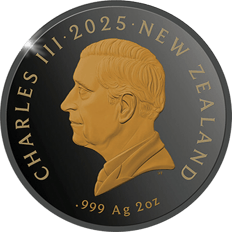
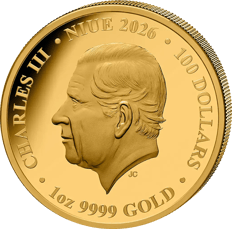
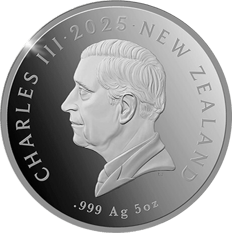
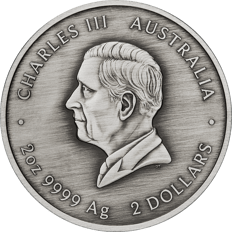
1 oz Silver Hummingbird 2026 (Mintage: 500 | Prism | Proof)
£142.86
excl. UK import VAT and shipping
Available in 2–3 business days

 More than 310,000
 Over 30 years
 Secure shipping
 Google: 4.9/5


Exotic birds are among the most popular designs on modern collector and bullion coins. From the striking silhouette of the kookaburra to the flightless kiwi and on to colourful parrots, flamingos and kingfishers, the spectrum of minted birdlife is wide-ranging. This guide highlights the most important series, the available denominations in gold and silver, the particularities of mintages and finishes, as well as the tax and practical aspects relevant to building a collection of exotic bird coins.
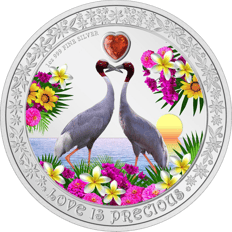
Birds are among the most expressive designs minted worldwide. Their fine feather structures, dynamic poses and sometimes vivid colours make them a rewarding subject for high-quality minting techniques. The Exotic category specifically covers species native outside Central Europe, such as the Australian kookaburra, the New Zealand kiwi, tropical cranes or the vividly coloured dwarf kingfisher. Unlike the native birds, the focus here is on species from Australia, Oceania, Africa and Asia.
The range is split into two major groups: classic bullion coins with high mintages and low premiums, and limited collector's coins in elaborate minting quality. Anyone wanting an overview of the entire subject area will also find, in the parent category Birds, the related sections on birds of prey and further bird designs.
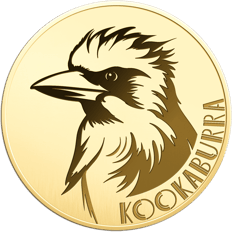
A key appeal lies in the variety. Each mint reinterprets its national bird species anew, giving rise over the years to extensive year-by-year series. The Perth Mint in Australia has minted the Kookaburra series since 1990, while New Zealand issues showcase the kiwi as a national emblem. Collectors also value the often very low mintages of the enhanced editions, which can turn individual years into sought-after pieces.
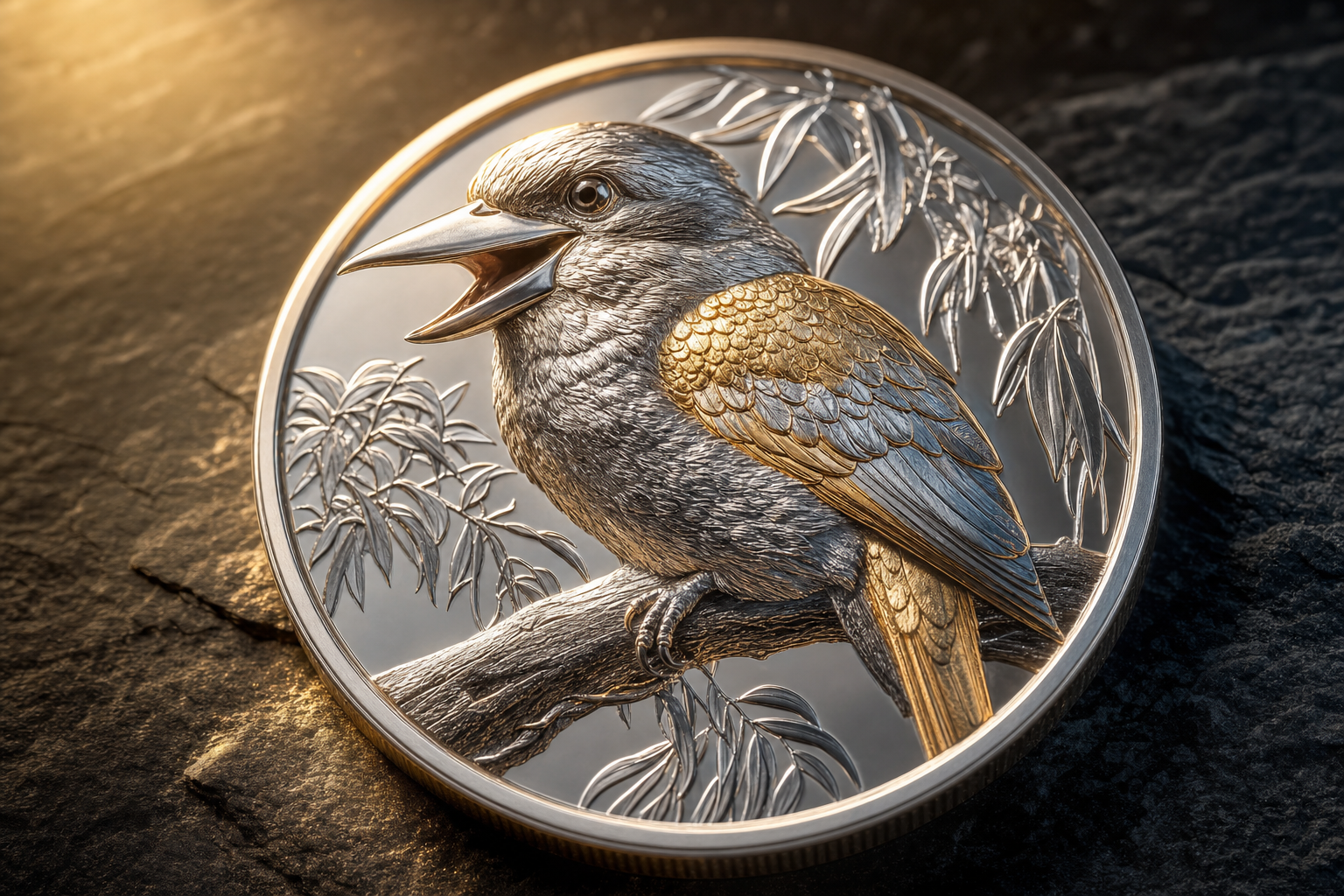
The range spans from affordable entry-level pieces to rarities weighing several ounces. Some series have been established for decades, while others are modern reissues with colourful designs or partial gilding.
Many of these coins are issued in both silver and gold. The Kookaburra issues, for example, are found in the extensive silver Kookaburra range as well as in a gold version, similar to the Kiwi in silver. Those specifically seeking more precious metals will also find what they need in the general sections of gold coins and silver coins.
Exotic bird coins cover a wide range of weights. The choice of denomination depends largely on whether the collector's aspect or the pure metal value is the priority.
The 1 oz (31.1 grams) is by far the most common format and forms the backbone of most series. Heavier issues of 2 oz or 5 oz allow for elaborate high-relief minting with particularly pronounced depth. Smaller formats and coloured issues round out the range. Anyone collecting silver coins should also consider suitable storage, for example via coin capsules, which protect the delicate relief from scratches.
In gold, the range extends from the convenient 1/4 oz through mini issues of 0.5 grams to impressive 5-ounce coins. Small gold denominations are suitable as an entry point or gift, while the larger formats often appear in mintages of under a hundred pieces. It is also worth looking at the classic bullion formats in the gold bars section if metal value is the priority.
For orientation between the formats, a comparison of the most common issues is helpful:
| Denomination | Fine weight | Typical use |
|---|---|---|
| 0.5 g gold | 0.5 grams | Entry point, gift, mini issue |
| 1/4 oz gold | 7.78 grams | Collector's issue in Proof quality |
| 1 oz silver | 31.1 grams | Standard format for many series |
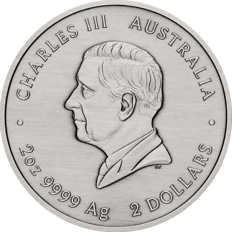
| 2 oz silver | 62.2 grams | High relief, partially gilded |
| 5 oz silver | 155.5 grams | Impressive collector's minting |
Much of the collector appeal of exotic bird coins lies in their finishing. Mints use numerous techniques to make the designs appear particularly vivid.
These techniques appear across the series. Coloured issues, for example, are collected in the coloured silver coins section, and partially gilded coins in the corresponding partially gilded silver coins section. The various grades of preservation influence collector value far more strongly than with pure bullion coins.
A bird design lives by its detail: only the minting technique turns fineness into a work of art you hold in your hand.
Exotic bird coins come from some of the most renowned mints in the world. The origin shapes not only the design but also the technical signature.
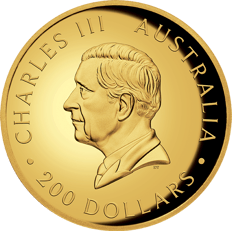
Australia is a centre of bird coinage. The Perth Mint is responsible for the Kookaburra series and numerous special issues, while further Australian designs can be found in the Australian gold coins section. These coins are issued with a face value from their country of issue and are therefore considered legal tender.
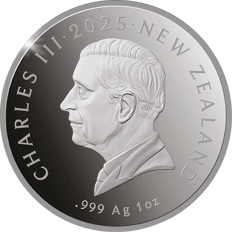
New Zealand issues are devoted mainly to the kiwi, often commissioned by issuing countries such as Niue. Further exotic designs appear under the flag of countries such as Gabon or Ascension Island. An overview of the manufacturers involved can be found in the Perth Mint Australia section as well as at New Zealand Mint.
Exotic bird coins appeal to two groups of buyers. For one, the metal matters most; for the other, it is the rarity and design.
Both approaches can be combined. A well-thought-out portfolio can combine a base of liquid investment products with a few selected collector's items. Anyone wishing to delve deeper into the collecting aspect will find further suggestions in the collector's coins category.
Tax note
In Germany, investment gold is exempt from VAT pursuant to §25c UStG. Silver coins, on the other hand, are subject to margin scheme taxation or the standard tax rate, which explains the price difference between gold and silver issues of the same design. This is general information and does not replace tax advice.
As with all precious metal products, proper handling plays a central role in preserving value. For enhanced collector's coins, the condition is particularly sensitive.
Official coins bear a face value, a year of issue and often a mintage certificate. Weight and diameter can be checked with a precision scale and a calliper. At Kettner Edelmetalle, every item undergoes an ISO-compliant authenticity verification before leaving via insured shipping.
Proof and coloured surfaces are sensitive to touch and environmental influences. Capsules, cases and cassettes protect against scratches, fingerprints and oxidation. For larger collections, coin cassettes or coin boxes are suitable, while individual pieces are well kept in coin pouches. Silver coins should be stored dry and airtight to prevent tarnishing.
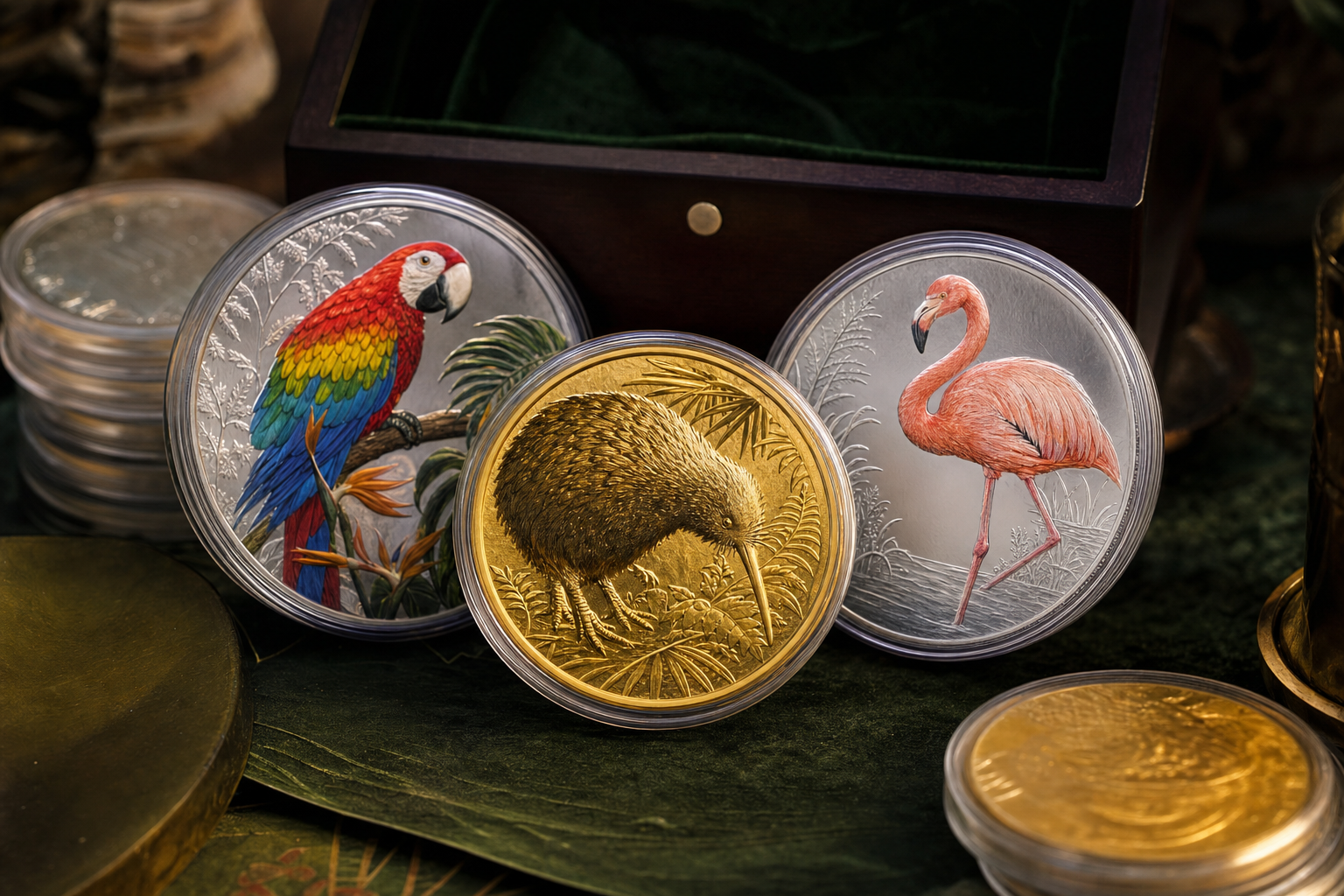
Among the most sought-after designs are the Australian kookaburra and the New Zealand kiwi. Both appear in long-running year-by-year series and are minted both as bullion issues and as enhanced collector's issues. In addition, parrots, flamingos, cranes and kingfishers are very popular as coloured individual issues.
Both are possible. Issues with high mintages and low premiums are suitable for investment-oriented purchases, while limited, enhanced coins place the collecting aspect in the foreground. With small mintages, value also derives from rarity and condition, not just metal content.
In Germany, investment gold is exempt from VAT pursuant to §25c UStG. Silver coins, on the other hand, are subject to margin scheme taxation or the standard tax rate. This is why the price difference between a gold and a silver issue of the same bird design is affected not only by metal value but also, in addition, by tax. For specific cases, tax advice is recommended.
Proof refers to the highest collector quality, with a mirrored background. High relief stands for a particularly raised, three-dimensional minting. Antique finish is an artificially aged surface. Partial gilding and colouring highlight individual design elements in colour. These features influence collector value more strongly than with pure bullion coins.
Enhanced surfaces should never be touched with bare fingers. Coin capsules, cases, cassettes or boxes protect against scratches and environmental influences. Silver coins should be stored dry and as airtight as possible to prevent tarnishing. For value preservation, the original packaging together with the certificate is important.
A large proportion come from Australia and New Zealand, minted by the Perth Mint, the Royal Australian Mint and the New Zealand Mint. Besides Australia and New Zealand, issuing countries also include Niue, Gabon and Ascension Island. Each mint brings its own technical signature to the coins.
Stay informed with product launches, financial news and exclusive offers. Sign up for our free newsletter today.
By entering your email address and clicking the "Submit" button, you give the following consent: "I agree to be informed by email about new products, financial news and exclusive offers, and therefore consent to the processing of my email address for the purpose of sending the newsletter. I can revoke this consent at any time without giving reasons, with effect for the future. The lawfulness of processing carried out prior to revocation remains unaffected."